10 yen 1938
About This Note
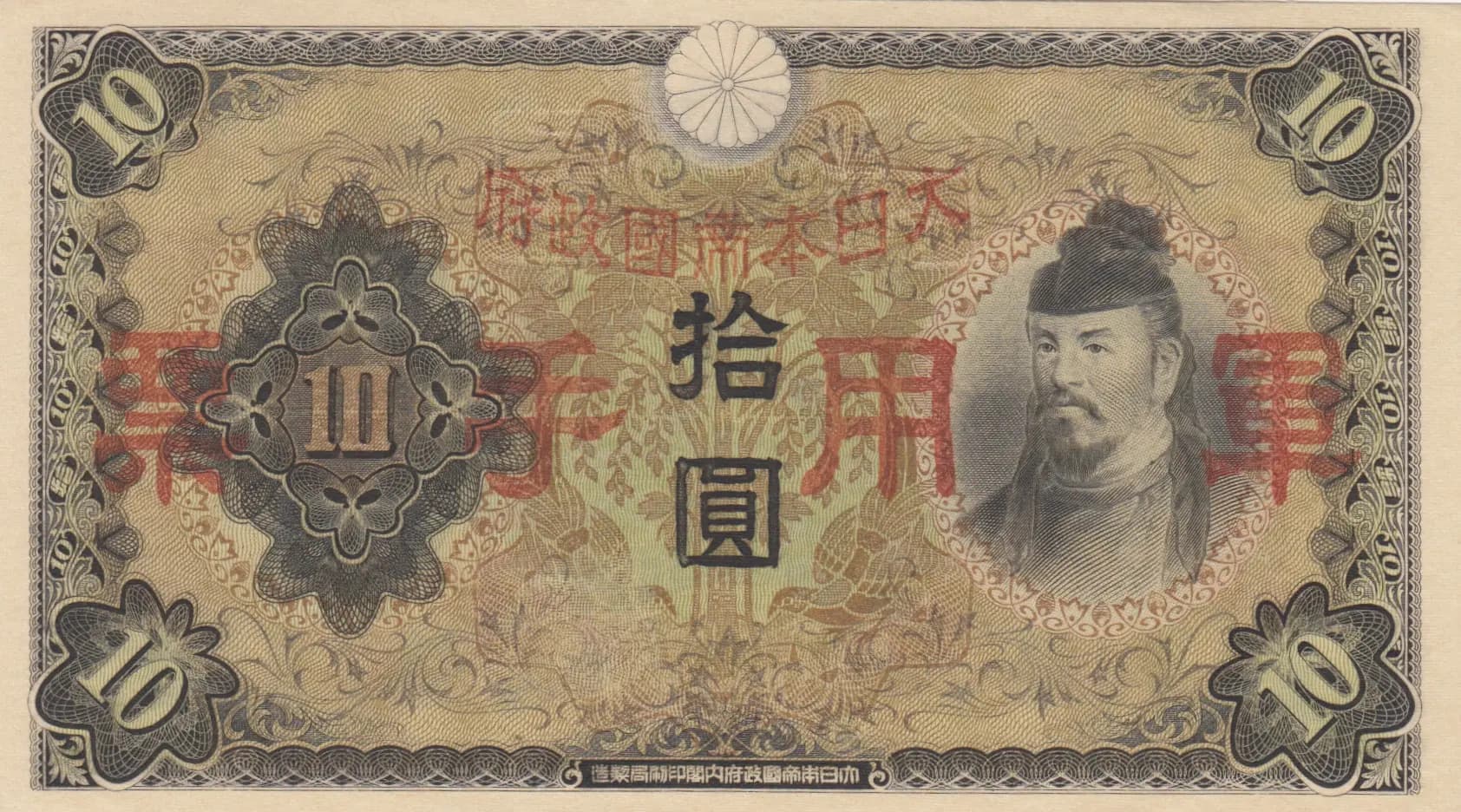
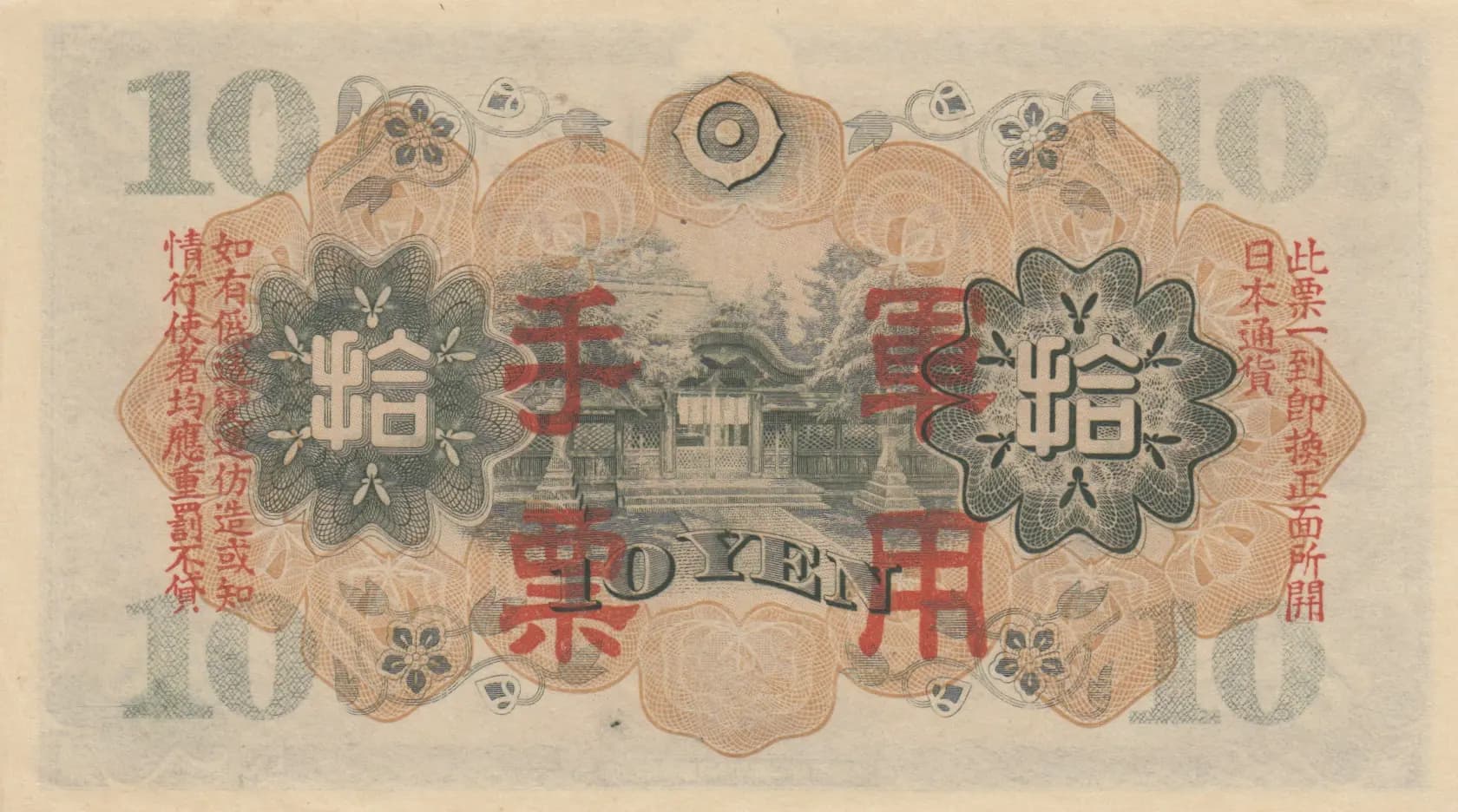
This 10 Yen banknote from 1938 represents Japanese Military currency issued for use in occupied China during the Second Sino-Japanese War. The note exhibits typical UNC characteristics with cream/beige background and ornate decorative borders in black and red, featuring a portrait of a bearded man in traditional Asian dress on the obverse and a central architectural landmark on the reverse. Despite catalog notation of UNC grade, the visual analysis reveals age-related foxing and discoloration consistent with 1938 paper stock, though the note remains structurally sound and all inscriptions remain clearly legible.
Common. Japanese Military yen notes from 1938, particularly the 10 Yen denomination (P-M27a), were issued in substantial quantities for circulation in occupied China and other territories. While these notes are historically significant artifacts of WWII-era occupation currency, they were not produced in limited quantities and surviving examples remain relatively abundant in numismatic markets. The UNC grade designation suggests excellent preservation, which increases collector interest, but the underlying note type itself is not scarce.
This Military yen note was issued by the Japanese Imperial Government during its occupation and military operations in China (1937-1945), specifically during the Second Sino-Japanese War period. The presence of bilingual inscriptions in both Japanese and Chinese reflects the occupation context, with Chinese text stating 'This note is in circulation' and penalty provisions for counterfeiting, emphasizing the forced adoption of Japanese currency in occupied territories. The ceremonial portrait and temple/architectural imagery on the reverse symbolize imperial authority and cultural dominance during this period of Japanese military expansion.
The obverse features an ornate frame with elaborate floral and geometric cartouches in all four corners, centering on a portrait of a bearded man wearing traditional formal Asian dress, positioned on the right side of the composition. Above the portrait is a distinctive white sunburst design, while a large ornamental emblem with floral patterns and Roman numeral III occupies the center-left, symbolizing imperial authority. The reverse depicts a significant Asian temple or governmental building with traditional architectural features in the center, flanked by opposing decorative floral and geometric cartouches on both sides. The denomination '10' appears in pale text at the upper corners. The symmetrical layout, fine line work borders, and multi-element decorative scheme are characteristic of early 20th-century East Asian currency design, emphasizing prestige and authority.
FRONT SIDE: '拾圓' (Juu En / Ten Yen); '大日本帝國政府' (Dai Nippon Teikoku Seifu / Government of the Empire of Japan); '紙幣' (Shihei / Banknote); '此票通用' (Ci piao tong yong / This note is in circulation); '日本帝國政府內閣印刷局白山所開' (Japanese Imperial Government Cabinet Printing Bureau, Hakusan Division - Printed By). BACK SIDE: '10' and '拺圓' (Ten Yen); '10 YEN' (English denomination); '此票通用' (Ci piao tong yong / This note is in circulation); '如著情柱被掛著掛者均罪' (Penalty provisions regarding counterfeiting and fraudulent use).
This note was produced using traditional intaglio/engraving techniques combined with multi-color letterpress printing. The fine decorative line work, sharp portrait definition, and ornamental borders are consistent with engraved plates. Color separation between the cream background, black line work, red overprints, and grey tonal elements indicates sequential printing passes typical of government security printing of this era. The printer was the Imperial Japanese Government Cabinet Printing Bureau, Hakusan Division (白山所), as noted in the inscriptions, which was Japan's primary security printer during the 1930s-1940s period.
Pick catalog P-M27a represents the primary 10 Yen Japanese Military note from 1938. Varieties of this note may exist related to printer marks, serial number prefixes, or subtle overprint variations specific to different occupation zones in China, though the visual analysis does not provide sufficient detail to definitively identify specific serial numbers or printer distinguishing marks. Collectors of this series should note variations between the Cabinet Printing Bureau's different production divisions and periods of issue within 1938-1945.