10 yen 1940
About This Note
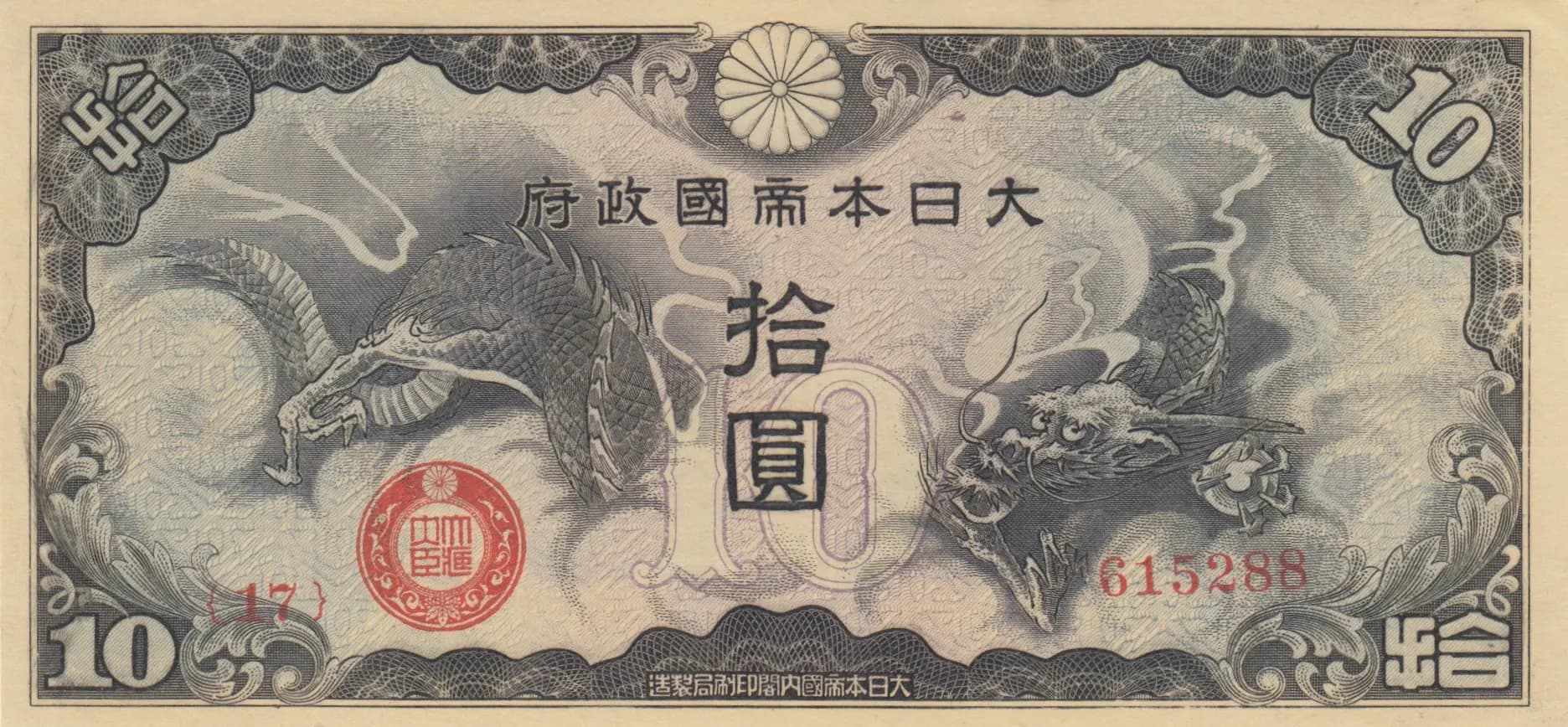
This is a well-preserved 10 yen banknote issued by the Japanese Military Government in 1940 (Pick M19), presenting in uncirculated condition with only minor aging consistent with its 80+ year history. The note features an elegant design centered on two ornate dragons in traditional East Asian style, flanked by imperial chrysanthemum symbols and intricate decorative cloud patterns, with a prominent red circular seal bearing the chrysanthemum emblem on the obverse. The exceptional quality of the engraved details, fine line work, and the complete absence of circulation wear make this a desirable example of Japanese military occupation currency.
Common. The 10 yen military note from 1940 (Pick M19) was produced in substantial quantities for circulation throughout Japanese-occupied territories. While Japanese military occupation currency is collected, this particular denomination and year represent standard, widely-distributed issues rather than limited or short-run printings. The serial number 615288 and the uncirculated condition suggest a note that was preserved but not exceptionally rare from a numismatic standpoint. Military occupation notes of this type, though historically significant, remain relatively affordable and available in the collector market.
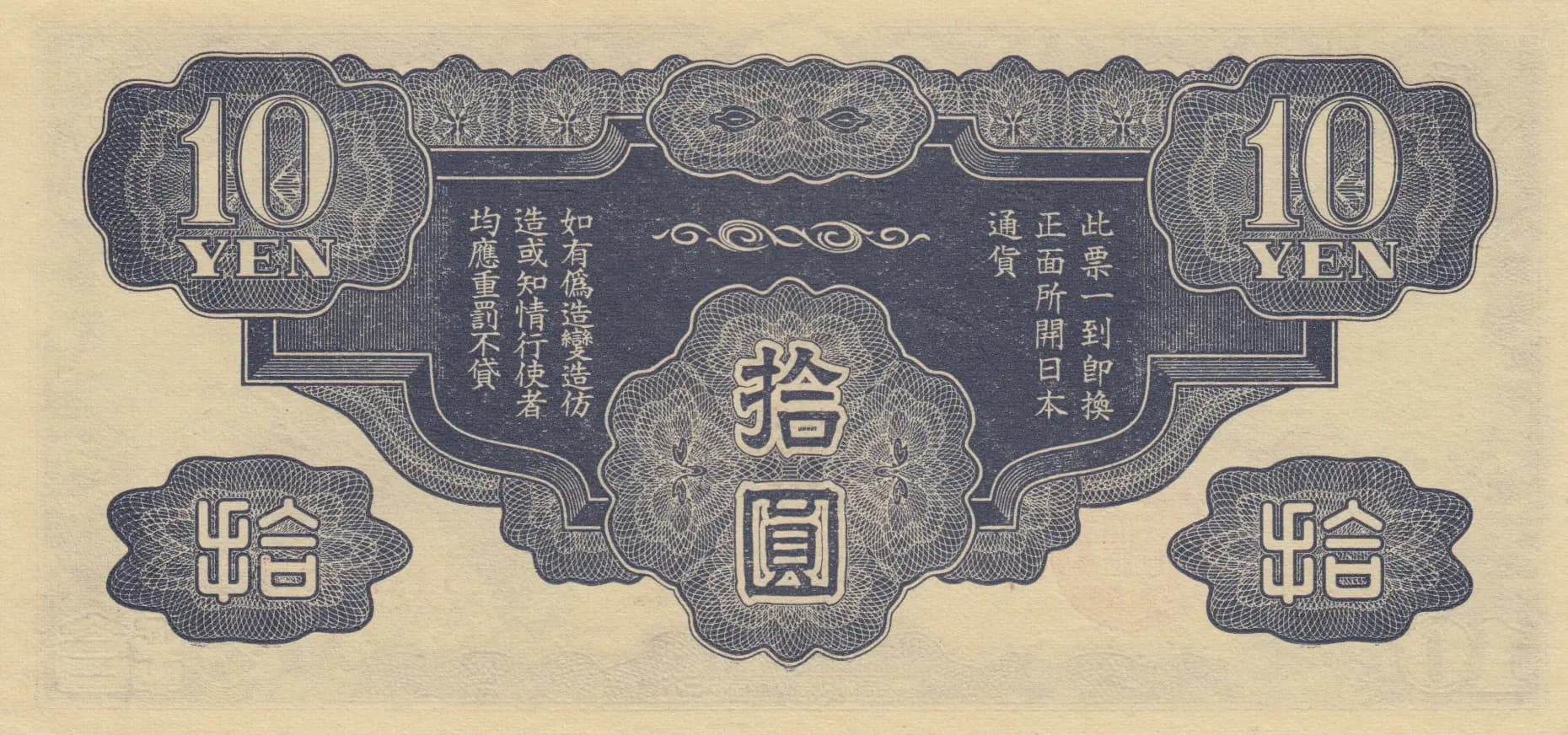
Issued during Japan's aggressive expansion in East Asia, this military yen was circulated in occupied territories and represents a pivotal moment in World War II monetary policy. The imperial chrysanthemum seal and the inscribed text 'Imperial Government of Japan' (大日本帝國政府) reflect the militaristic nationalism of the era, while the use of both Chinese characters and Japanese text indicates its intended use across conquered territories in China and other occupied regions. The legal tender declarations and counterfeiting penalties inscribed on the reverse underscore the government's effort to establish monetary authority in occupied lands.
The obverse features a symmetrical design dominated by two stylized dragons in traditional East Asian artistic rendering, positioned to face each other across the central denomination. Above the dragons sits an ornamental imperial chrysanthemum flower medallion, serving as the emblem of imperial authority. A prominent red circular seal containing the chrysanthemum and Japanese characters appears on the left side, functioning as an authentication mark. The entire design is enclosed within an ornamental border featuring elaborate scrollwork and decorative cloud patterns characteristic of traditional Asian artistic motifs. The denomination appears in both Chinese characters (拾圓) and Arabic numerals (10) positioned in the corners. The reverse maintains a symmetrical composition with large central denomination characters, corner medallions featuring floral designs, and extensive ornamental cloud and geometric patterns throughout. The color scheme on the obverse is predominantly gray, black, and cream with red accents, while the reverse features dark blue/navy against cream backgrounds, creating visual distinction between the two sides.
{"front":{"10":"10 (Arabic numerals)","615288":"Serial number","大日本帝國政府":"Imperial Government of Japan","拾圓":"Ten Yen"},"back":{"10":"10 (Arabic numerals)","YEN":"Yen (English)","拾圓":"Ten Yen (Chinese characters)","此貨通正日本印換到開所一面票":"This note is legal tender and can be exchanged at designated locations in Japan","偽造行使知情若造有為知悉者均應重罰不食":"Counterfeiting or knowingly using counterfeit notes will result in severe penalties"}}
Intaglio engraving (also known as copperplate or steel plate engraving), evidenced by the fine, precise line work visible throughout the design, the intricate background patterns, detailed scrollwork, and the three-dimensional appearance of the printed elements. This was the standard security printing method for Japanese government banknotes of this era. The sharp definition of the dragons, chrysanthemum motifs, and decorative borders, combined with the observable depth in the line work, confirms professional intaglio production. The printer for Japanese military occupation currency during this period was typically the Imperial Japanese Government Printing Bureau (now Japan's National Printing Bureau), though specific attribution for this particular note type would require additional documentation.
This specimen carries serial number 615288 in red on the obverse, consistent with standard production. Pick M19 may have multiple serial number prefixes and color variations across its production run; the red serial number and red seal on this example represent the typical configuration for this issue. No specific overprints or unusual characteristics are visible that would distinguish this as a rare variety. Further cataloging would require comparison with other known examples to identify any block letter or prefix varieties that might exist within the M19 designation.