10 dollars 1919
Market Prices
About This Note
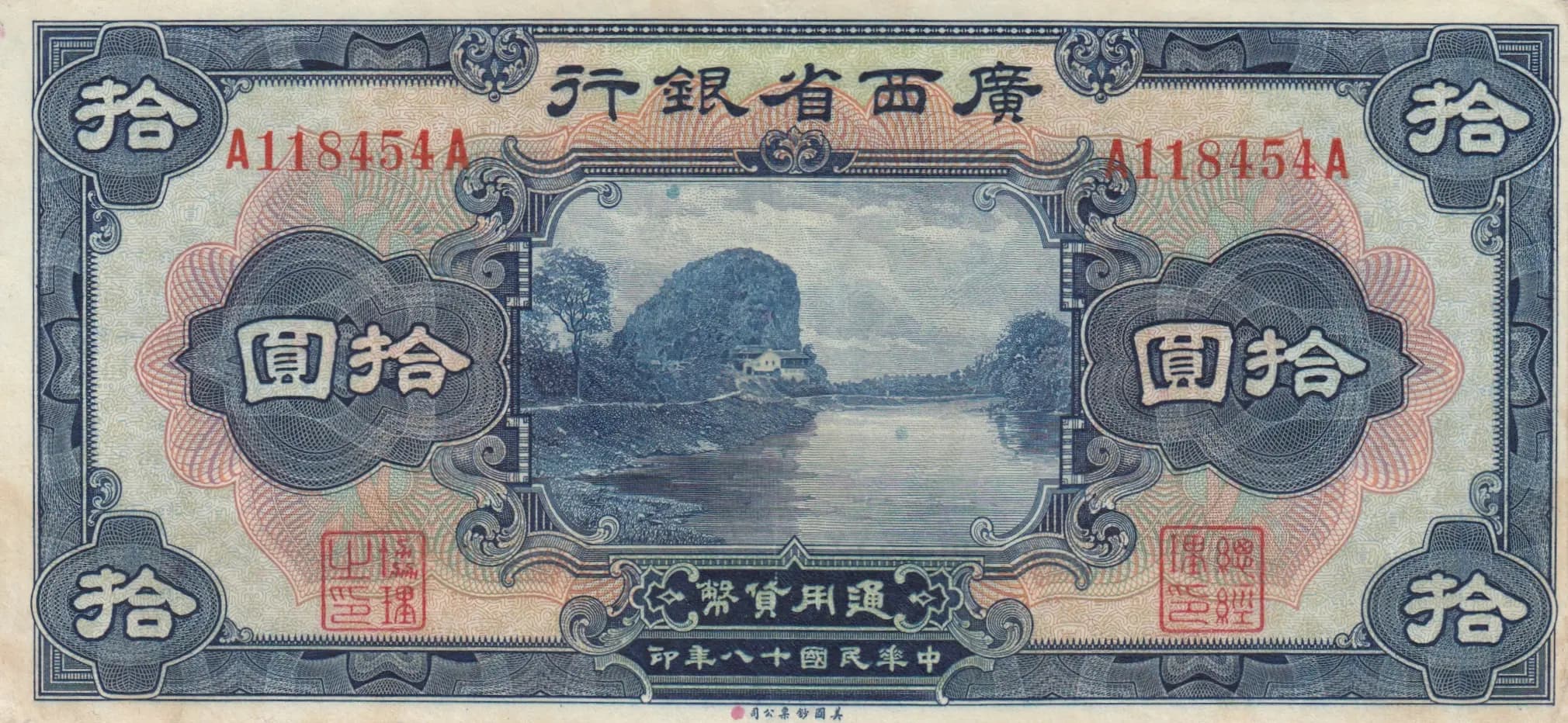
This is a scarce Provincial Bank of Kwangsi 10 Dollar note from 1929, beautifully rendered in the classical Chinese banknote style with ornate blue and red decorative borders framing a serene river landscape vignette. The note exhibits excellent condition with clean surfaces, minimal aging, and no significant wear, placing it solidly in the EF (Extremely Fine) range as graded. The presence of American Bank Note Company printing and bilingual English-Chinese inscriptions make this an important example of early Republican-era Chinese provincial currency, particularly notable for its artistic landscape composition and well-preserved state.
Uncommon. While the eBay price data shows considerable variation ($3.00 to $449.99), the clustering of prices in the $95-$150 range for XF and VF grades, combined with the specific Pick number classification and remainder note designation, indicates this is not a common note in high grades. The EF condition grade and the relatively specialized nature of provincial Chinese currency from this period place this note in the uncommon category rather than common. The wide price range suggests condition-dependent demand, with pristine examples commanding premium prices typical of uncommon collectible banknotes.
The Provincial Bank of Kwangsi operated during the tumultuous warlord and early Republican periods of Chinese history, with this 1929 issue marking the 28th year of the Republic of China (民國二十八年). The river landscape vignette with distant pagoda reflects traditional Chinese aesthetic values and the bank's regional pride, while the American Bank Note Company printing demonstrates the reliance of Chinese provincial banks on foreign expertise and security printing technology during the Republican era. This particular issue type, classified as a remainder note, suggests limited circulation and represents a transitional moment in Chinese provincial banking before the consolidation of currency under the Nationalist government.
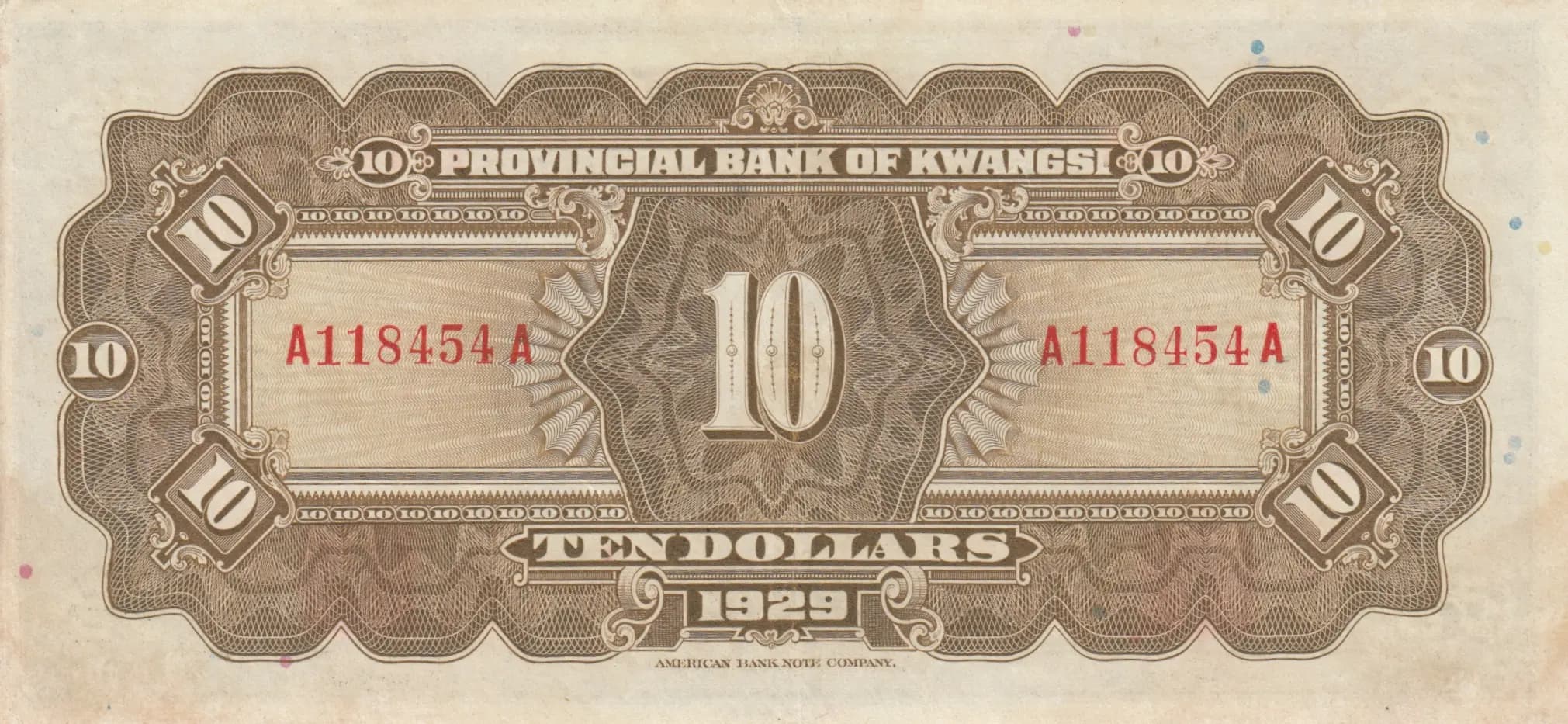
The obverse features an elaborate ornamental border in blue and red/pink tones framing a central landscape vignette depicting a tranquil river scene with mountains in the distance, temples or pagodas visible along the shoreline, and vegetation-lined banks. The composition reflects classical Chinese landscape painting traditions. Ornamental corner medallions containing the Chinese character 拾 (ten) in decorative cartouches appear at all four corners. Cloud scrolls, floral motifs, and baroque-style baroque ornamentation complete the design. The reverse presents a more austere monochromatic brown and tan design dominated by a large central numeral 10, with shield or cartouche frames containing additional denomination markings. Both sides employ fine line engraving throughout, with geometric border patterns and intricate vignette work characteristic of American Bank Note Company security printing standards.
FRONT: Chinese characters 廣東西省銀行 (Provincial Bank of Kwangsi); 圓拾 (Ten dollars/Yuan); 中華民國貳拾八年 (Twenty-eighth year of the Republic of China, corresponding to 1929); 通用兌現連 (For general use and redemption). Serial number: A1I8454A. BACK: English text 'PROVINCIAL BANK OF KWANGSI'; 'TEN DOLLARS'; '10' (denomination); '1929' (year); 'AMERICAN BANK NOTE COMPANY' (printer identification). Serial number repeated: A1I8454A.
Intaglio engraving (line engraving) as the primary printing method, evidenced by the fine detail work, intricate border designs, and high-quality vignette rendering throughout both sides. The note was printed by the American Bank Note Company, a leading international security printer of the era. Multi-color printing was employed on the obverse (blue, red/pink, cream, gray) while the reverse utilized monochromatic brown/tan intaglio. The fine line work, ornamental patterns, and detailed landscape engraving are characteristic of premium security printing designed to prevent counterfeiting.
The visual analysis identifies this note with serial number A1I8454A. The Pick catalog designation P-S2341r indicates this is specifically cataloged in the S-series (provincial/specialized issues). The 'r' suffix in the Pick number may indicate a remainder note variety, consistent with the RealBankNotes.com classification as a 'Remainder Banknote.' The discrepancy between the catalog year of 1919 and the inscribed date of 1929 (and back-printed year) warrants clarification—the banknote itself clearly shows 1929 and Chinese Republican era 28th year dating, suggesting the 1919 catalog reference may relate to the design's adoption date rather than the actual issue date. No overprints or additional security markings are evident in the visual analysis.