10 dollars 1928
Market Prices
11 salesAbout This Note
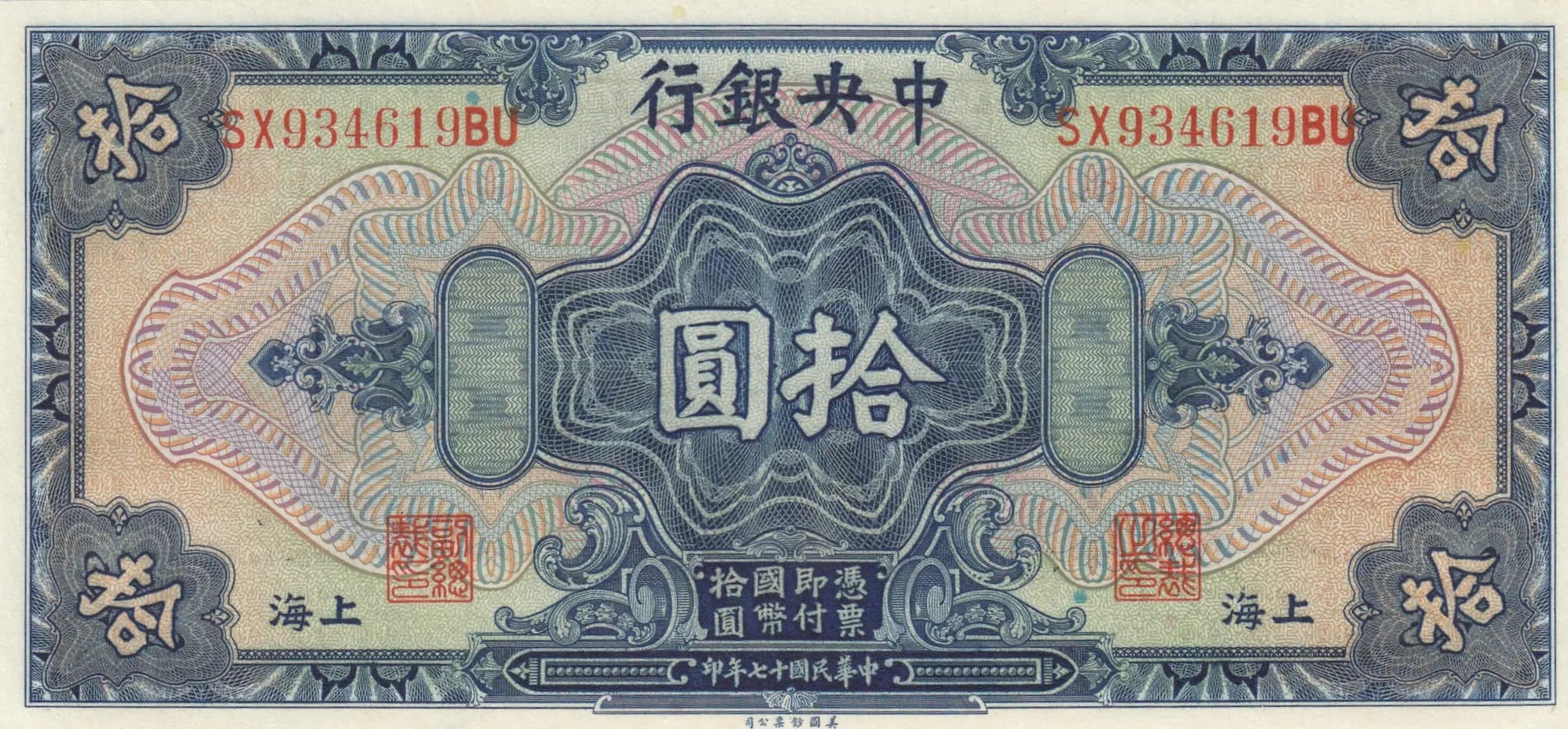
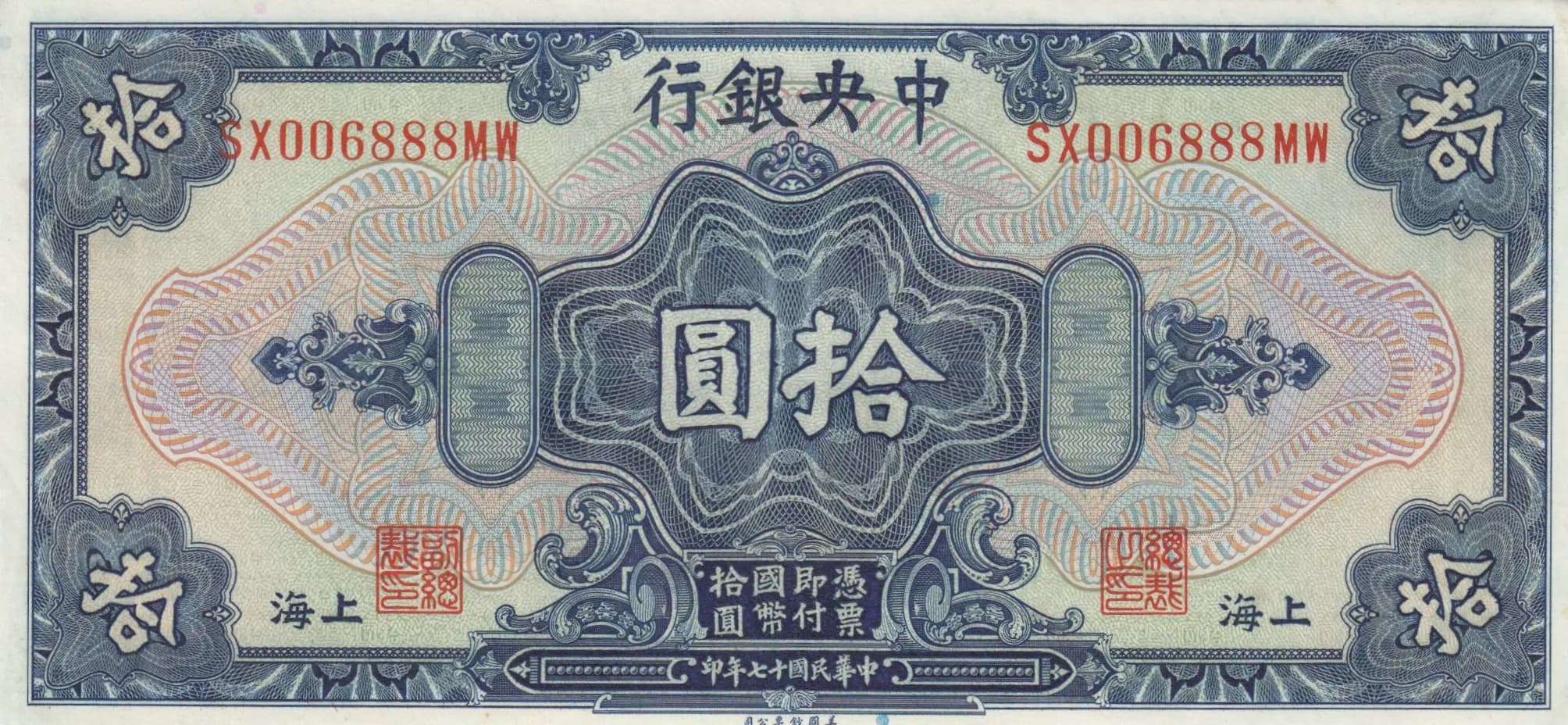
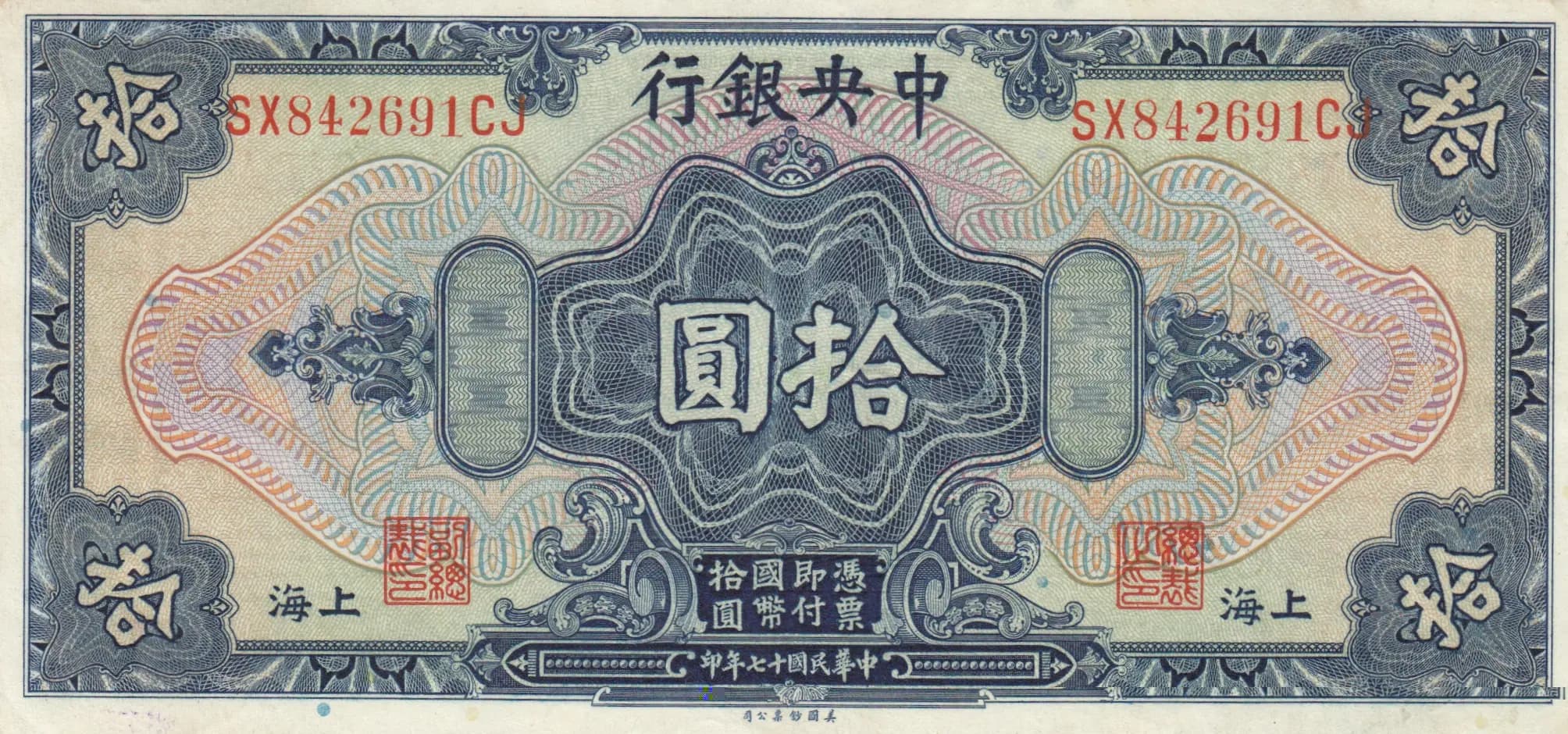
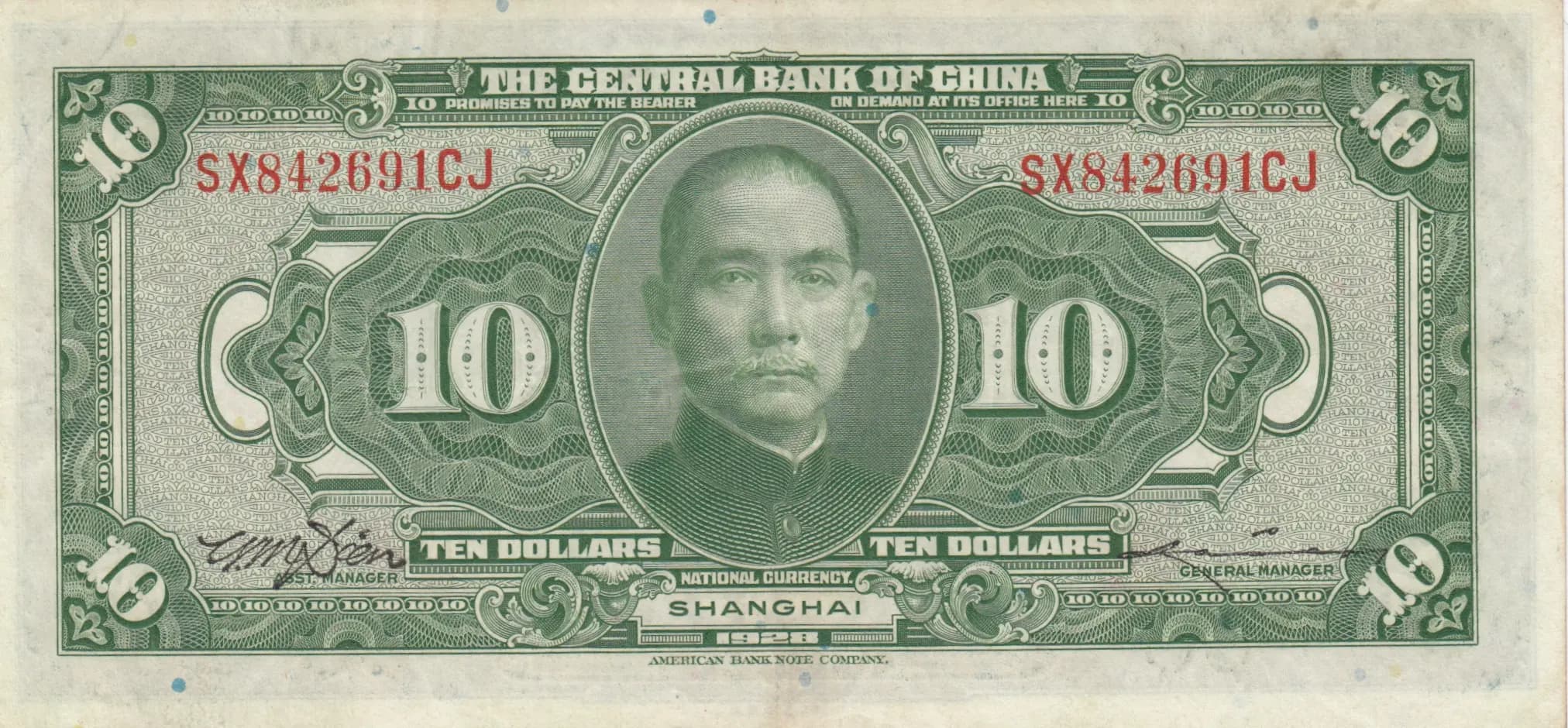
A handsome 1928 Central Bank of China 10 Dollar note in EF condition, printed by the American Bank Note Company in Shanghai. The obverse displays traditional Chinese ornamental design with an elaborate central cartouche in blue and multicolor tones, while the reverse features a formal portrait of a military figure within a green-dominant design. This bilingual note represents an important transitional period in Chinese monetary history, combining Western banking practices with traditional Chinese aesthetics.
Common. The eBay price data provided shows consistent sales in the $1.25 to $9.50 range across various condition grades from 2012 to 2020, with most sales at F-VF grades commanding $2-5. The single UNC example at $9.50 (2013) and $7 (2020) represents the upper end. The 2016 catalog values (VF: $5, UNC: $12.50) align with observed market activity. An EF-graded example would typically sell in the $4-7 range based on historical eBay data. This note was part of a regular issue with substantial circulation, making it a common item in the secondary market.
Issued in 1928 during the Republic of China period (year 20 of the ROC calendar), this note reflects the modernization efforts of the Central Bank of China following the Kuomintang's consolidation of power. The use of the American Bank Note Company as printer, combined with English and Chinese text, demonstrates the international financial relationships and foreign technical expertise that characterized Republican-era China. The Shanghai imprint emphasizes that city's role as the financial and commercial hub of early 20th-century China.
The front presents an ornate traditional Chinese design centered on an elaborate oval cartouche containing Chinese characters, framed by symmetrical floral scrollwork and geometric wave patterns in blue, tan/beige, red, and black. Red rectangular seal stamps appear in the lower corners, emphasizing the official authority of the Central Bank. The reverse showcases a formal portrait of what appears to be a government or military official in high-collared dress, positioned within an ornate oval medallion on a green background. The denomination '10' appears in white in all four corners. The design seamlessly integrates English-language banking text ('PROMISES TO PAY THE BEARER ON DEMAND') with the portrait and Chinese administrative signatures for General Manager and Manager, reflecting the cosmopolitan financial administration of the Shanghai-based Central Bank.
Front Side - Chinese Characters: '行銀央中' (Central Bank of China, vertical right-to-left reading); '圓拾' (Ten yuan); '海上' (Shanghai, appears twice); '中華民國二十年中央印製' (Republic of China Year 20, centrally printed). English/Alphanumeric: 'SX842691CJ' (Serial number, upper left and right corners in red). Back Side - English Text: 'THE CENTRAL BANK OF CHINA'; 'PROMISES TO PAY THE BEARER ON DEMAND AT ITS OFFICE HERE'; 'TEN DOLLARS' (appears twice flanking portrait); 'SHANGHAI'; 'NATIONAL CURRENCY'; 'GENERAL MANAGER' (twice, with signature lines); 'MANAGER' (twice, with signature lines); 'AMERICAN BANK NOTE COMPANY'. Alphanumeric: 'SX842691CJ' (Serial number repeated in red); '10' (denomination in four corners).
Intaglio engraving by the American Bank Note Company, as indicated by the printer's imprint on the reverse. The fine line work, detailed portrait shading, intricate guilloché patterns throughout, and decorative scrollwork characteristic of high-security banknote production are all consistent with ABNC's sophisticated engraving standards of the period. The multicolor printing required careful registration of separate color plates.
The specific variety can be identified as P-197f per the catalog designation. The serial number SX842691CJ observed on this example suggests this is a Shanghai-printed specimen (the 'SH' prefix would indicate Shanghai issue). The presence of black signatures and the specific layout of manager/general manager signature lines are consistent with the P-197f variety designation. Pick catalog notation distinguishes multiple varieties (a through f) of this 1928 10-dollar issue based on printer variations and signature configurations; this example represents the 'f' variety with the specific printing characteristics observed.