10 dollars 1928
Market Prices
60 salesAbout This Note
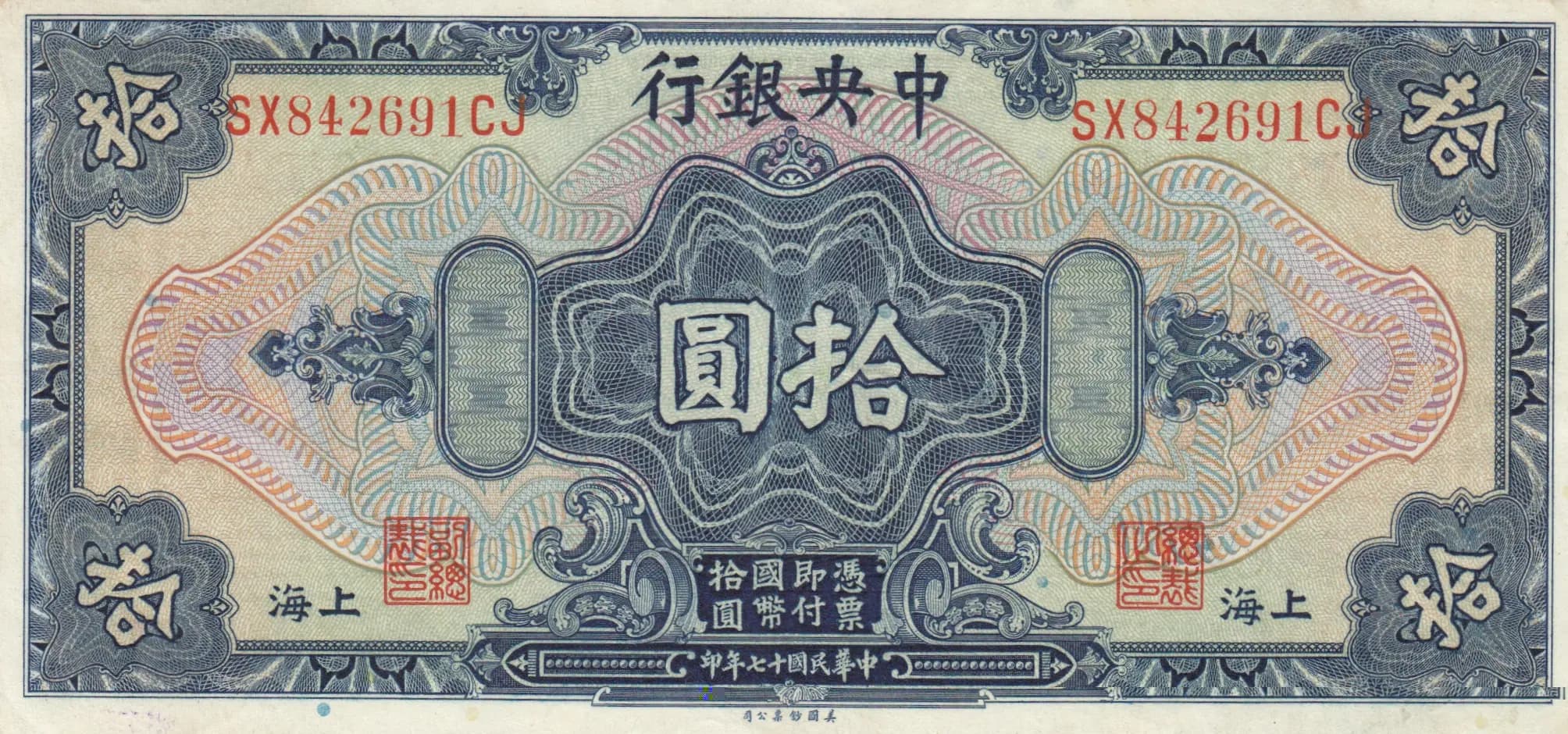
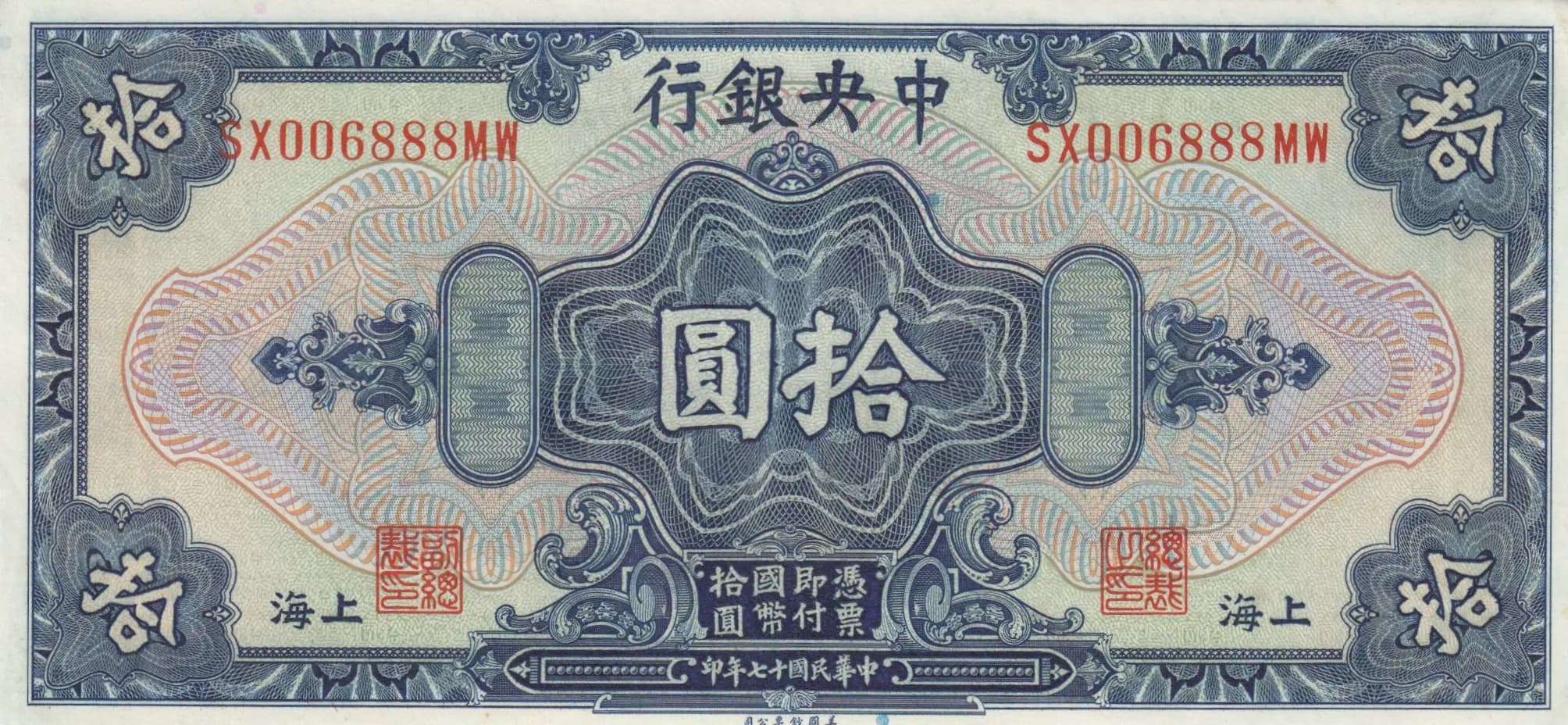
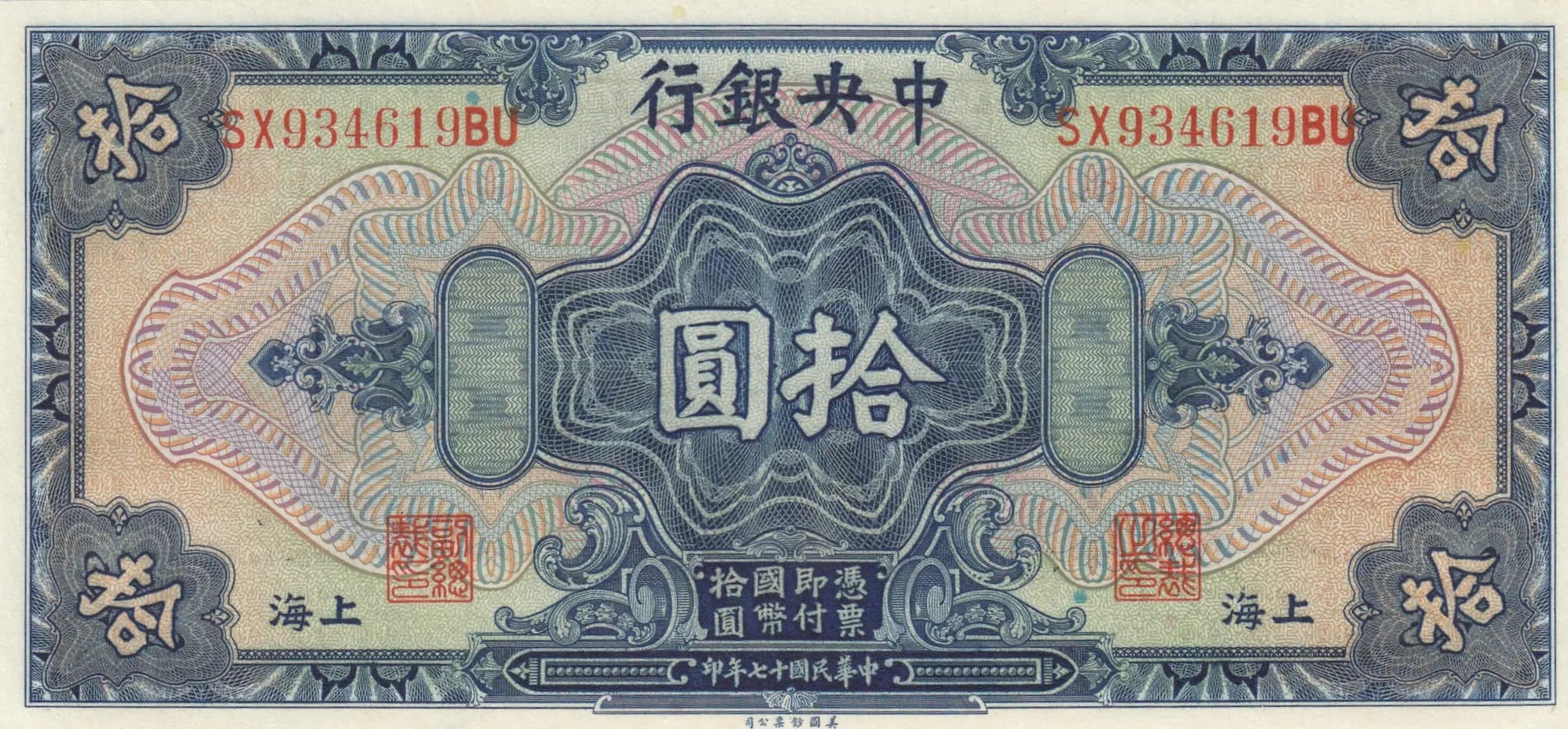
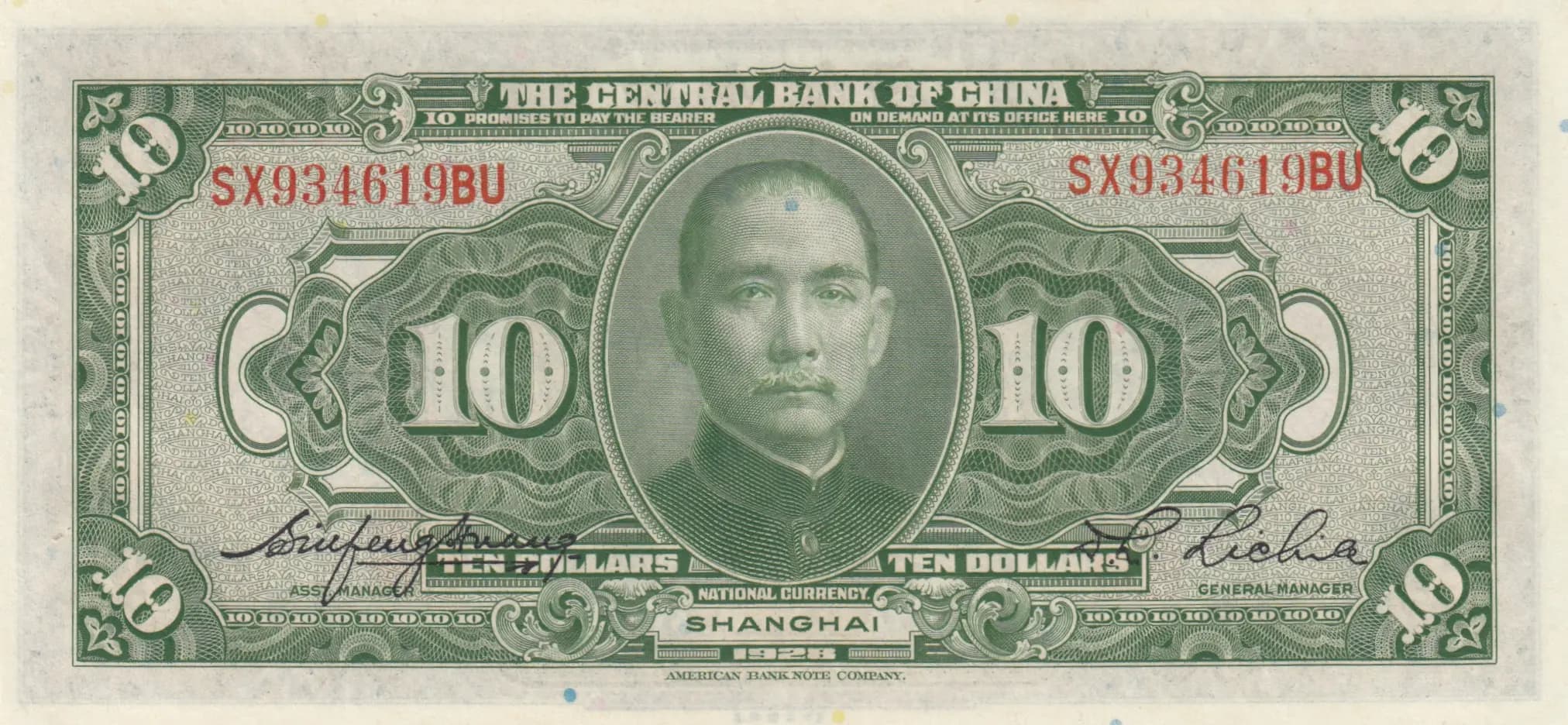
This Central Bank of China 10 Dollar note from 1928 (Pick P-197e) represents a significant piece of early Republican-era Chinese currency, printed by the American Bank Note Company in Shanghai. The note displays exceptional condition with sharp, clear printing throughout, ornate traditional Chinese decorative elements on the obverse, and a dignified portrait on the reverse rendered in fine line engraving. The AU grading reflects minimal wear consistent with careful preservation, making this an attractive example of this denomination for collectors of Chinese numismatic history.
Common. While this is a specialized Chinese banknote from the Republican era, eBay market data shows consistent sales primarily in the $20-35 range for PMG 64-65 grades, with even uncirculated examples regularly appearing on the market for $25-50. The extensive sales history spanning from 2012 to 2023 indicates steady, readily-available supply. The AU condition grade specified falls within the most frequently encountered grades for this note. Print runs for Central Bank of China issues in this period were substantial, and this particular Pick number does not appear in standard references as a scarce or rare variety.
Issued during the early years of the Republic of China (1912-1949), this 1928 note reflects the Central Bank's effort to establish modern, internationally-credible currency featuring bilingual English and Chinese inscriptions. The use of the American Bank Note Company (a prestigious Western security printer) underscores China's desire to adopt international banking standards during a period of relative institutional development, before the subsequent decades of political instability and Japanese invasion disrupted the nation's monetary system.
The obverse features elaborate traditional Chinese ornamental design with imperial-style dragons and phoenix motifs in the corner decorations, reflecting governmental authority and national pride. The reverse displays a formal portrait of a Chinese dignitary in an ornate oval frame, consistent with the style of Sun Yat-sen (founder of the Republic of China), though the vision analysis did not confirm specific identification. The bilingual design demonstrates the note's intended use in international commerce, with English prominently featured for foreign trade purposes. The color scheme of beige/tan with blue, green, and pink accents, combined with intricate scrollwork and geometric patterns throughout, represents the high security standards of American Bank Note Company's 1920s production.
OBVERSE: 中央銀行 (Central Bank), 拾圓 (Ten Yuan), SX934619BU (Serial number), 上海 (Shanghai), 中華民國紀年 (Republic of China year). REVERSE: THE CENTRAL BANK OF CHINA, 10 PROMISES TO PAY THE BEARER ON DEMAND AT ITS OFFICE HERE 10, TEN DOLLARS, NATIONAL CURRENCY, SHANGHAI, AMERICAN BANK NOTE COMPANY, GENERAL MANAGER, ASSISTANT MANAGER, SX934619BU (Serial number in red ink).
Intaglio (line engraving) printing, the standard security method for banknote production. The American Bank Note Company (ABNC) produced this note in Shanghai, utilizing multiple colored inks (blue, green, pink/red) applied through separate passes. The fine detailed engraving visible in portrait rendering, decorative scrollwork, and geometric patterns, combined with the sharp impression quality observed in the images, confirms professional security-grade intaglio production with careful registration of multiple color plates.
This specimen carries serial number SX934619BU printed in red ink on the reverse, consistent with regular issue examples. The 'e' designation in Pick P-197e indicates this is a distinct variety within the 10 Dollar 1928 series, though the specific distinguishing characteristics (signature variants, date variations, or overprints) are not definitively identified from the visual analysis alone. Collectors should note that Pick catalog designations for Chinese notes sometimes reflect printing plate variations or signature differences; the presence of large black signatures mentioned in the catalog data and the SHANGHAI location imprinting are consistent with this variety's cataloging.