10 cents 1925
Market Prices
About This Note
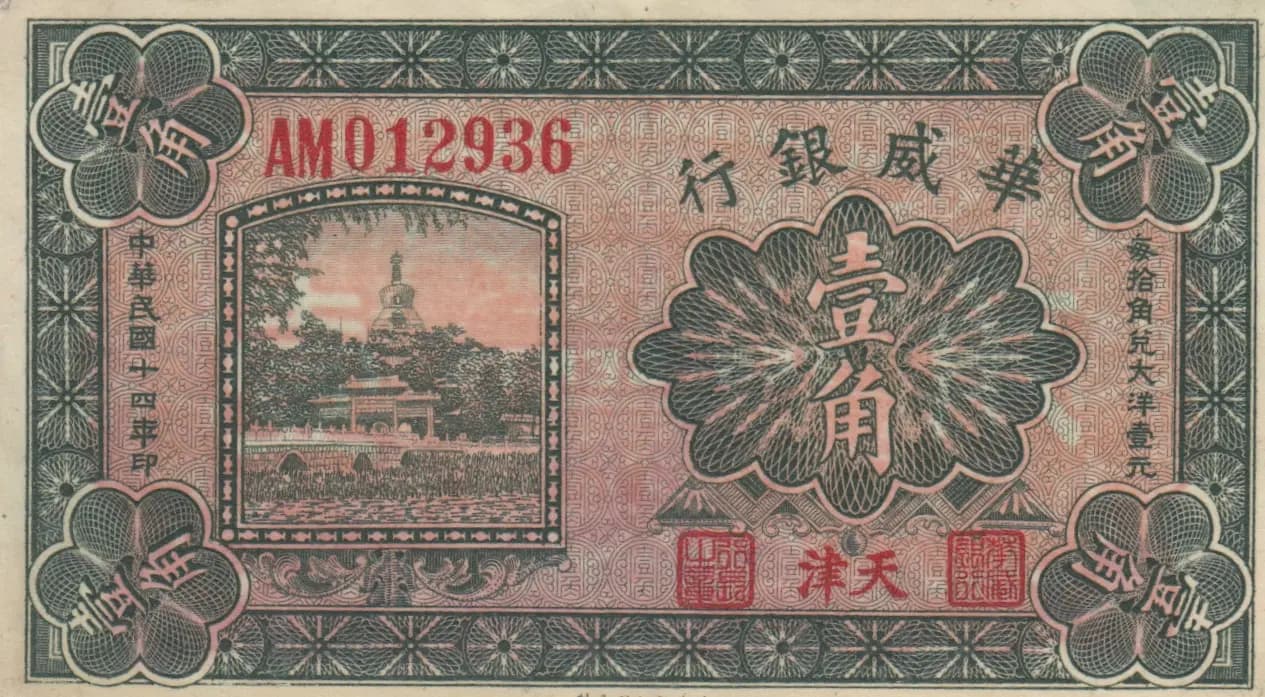
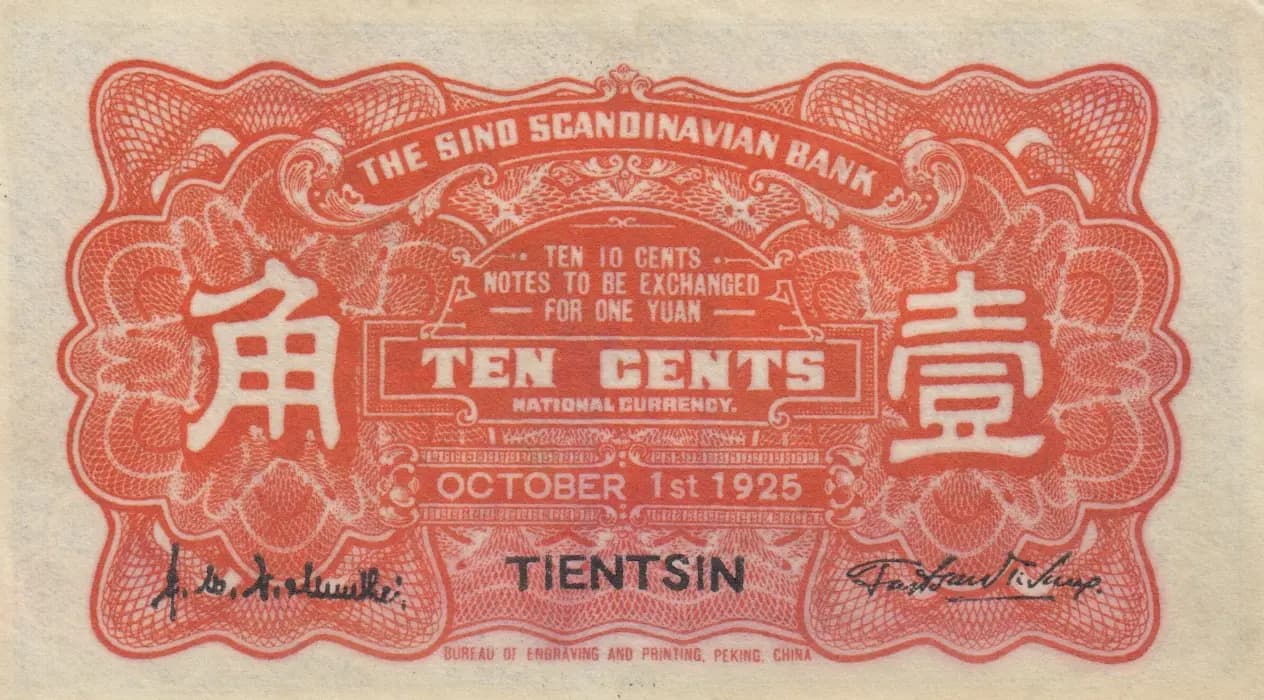
This is a beautiful 1925 Sino-Scandinavian Bank 10 cents note in UNC condition, featuring an elegant salmon-pink front with ornate green decorative borders and a central pagoda vignette surrounded by traditional landscape elements. The reverse displays the issuer information in English and Chinese on a coral-red background with symmetrical ornamental framing. The sharp print quality, vibrant colors, and absence of significant wear indicate excellent preservation for this nearly century-old Chinese regional currency note.
Common. The eBay price tracking data shows numerous sales across multiple condition grades, with UNC examples selling in the $260 range, consistent with accessible early 20th century Chinese regional bank issues. The Sino-Scandinavian Bank operated for several years (1925 onwards), and this denomination was likely produced in reasonable quantities for circulation in Tientsin and surrounding treaty port areas. The presence of multiple examples in various conditions on the secondary market, combined with the moderate UNC pricing, indicates this is a standard collectible rather than a scarce or rare issue.
Issued by the Sino-Scandinavian Bank on October 1, 1925, during the early Republican period of China, this note represents an attempt by foreign-backed banking institutions to participate in China's domestic currency circulation. The pagoda and landscape imagery on the front reflects traditional Chinese aesthetic values, while the dual English-Chinese inscriptions and Tientsin (Tianjin) location stamp the note within the treaty port banking system of the 1920s. The denomination structure (10 cents = 1/10 yuan) reflects the decimal system adopted by the Republic of China.
The obverse features a multi-tiered traditional Chinese pagoda or temple structure as the central vignette, set within a landscape with surrounding vegetation and naturalistic elements, symbolizing Chinese cultural heritage. This is framed by four corner medallions containing ornate four-petaled flower designs with intricate geometric internal patterning. A large central floral emblem with radiating petals dominates the upper right, incorporating Chinese characters within its design. The composition employs repeating geometric key-fret patterns and guilloché work throughout the background in green against the salmon-pink field. The reverse maintains symmetrical design principles with elaborate ornamental border patterns in traditional Chinese style, framing central text areas in both English and Chinese. The dual-language presentation reflects the international commercial context of treaty port banking.
FRONT: Serial number 'AM012936'; Chinese text '民國銀貨券' (Republic of China Silver Certificate); '大清銀行' (Qing Dynasty Bank/Imperial Bank reference). BACK: 'THE SINO SCANDINAVIAN BANK' (English, top center); 'TEN 10 CENTS' and 'TEN CENTS' (denomination in English); 'NOTES TO BE EXCHANGED FOR ONE YUAN' (redemption clause); 'NATIONAL CURRENCY' (status declaration); 'OCTOBER 1st 1925' (issue date); 'TIENTSIN' (issuing location); '青角' (Chinese: qing jiao, referring to the 10 cents denomination); 'BUREAU OF ENGRAVING AND PRINTING, PEKING, CHINA' (printer attribution). Two handwritten signatures present on reverse.
Intaglio engraving (recess printing), evidenced by the complex guilloche patterns, fine line work, and layered detailed engraving visible throughout the note. The sharp, crisp impression of ornamental borders and security patterns, combined with the subtle tonal gradations in the background, are characteristic of high-quality engraving work. Printed by the Bureau of Engraving and Printing, Peking, China, as attributed on the reverse. The multi-color printing required separate passes for the pink/salmon, green, red, black, and cream/white color elements.
Serial number AM012936 is observed on this example. Two handwritten signatures are present on the reverse in the lower left and right areas, which is typical for bank-issued notes of this period where authorized officials would manually sign each note. Specific signature varieties may exist but would require comparison with other documented examples. The October 1st 1925 issue date is fixed for this design type. No overprints or secondary varieties are apparent on this specimen.