10 cents 1924
Market Prices
8 salesAbout This Note
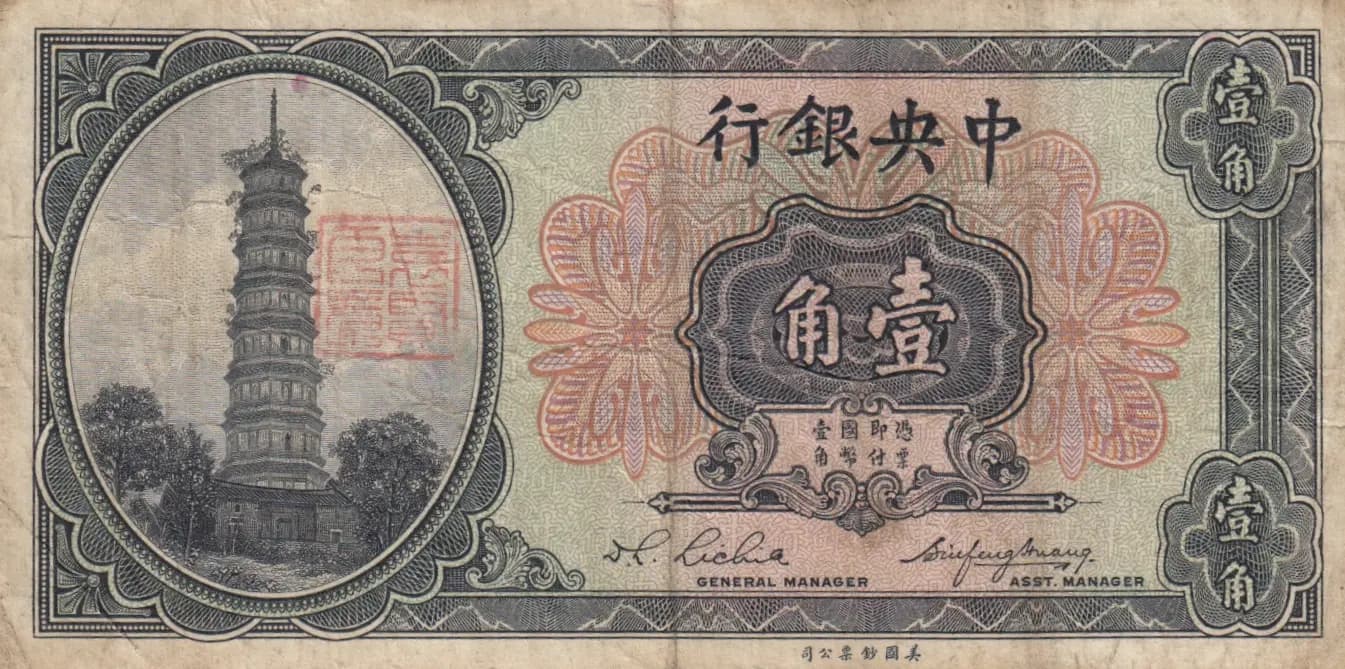
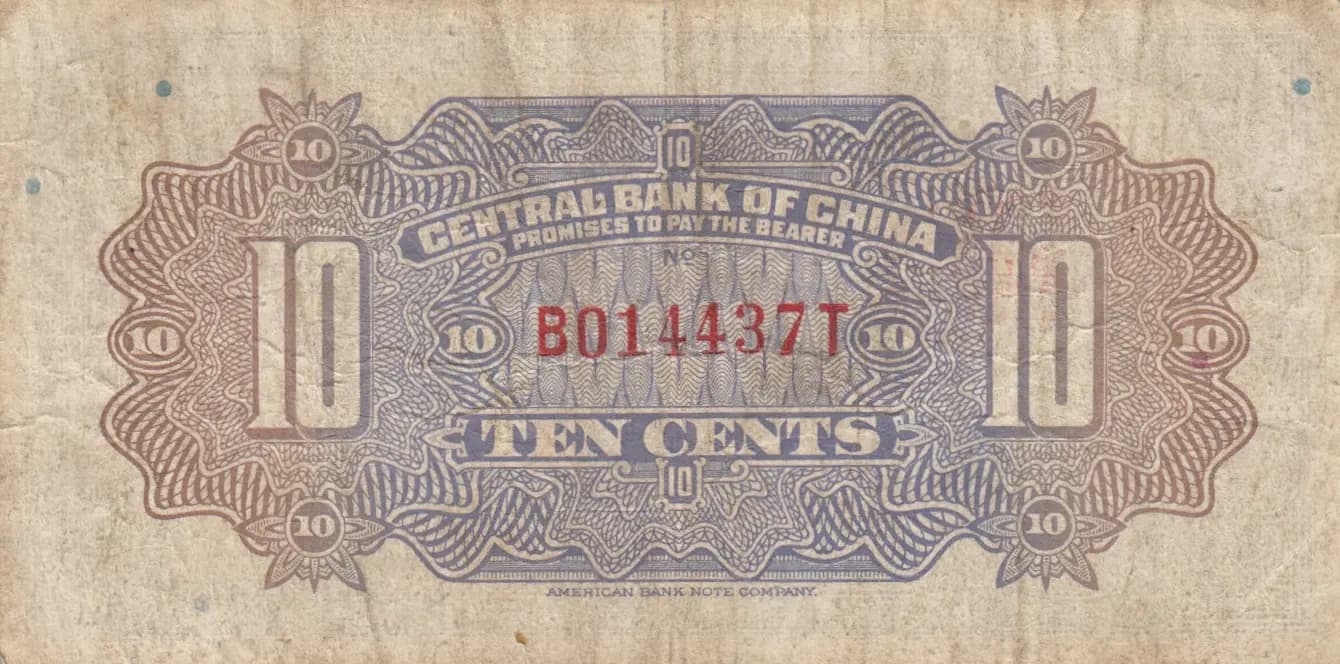
This is a 1924 Central Bank of China 10 cents (1 Chiao) banknote, Pick P-193b, in Fair condition showing substantial circulation wear. The note displays the characteristic design elements of this issue: a multi-tiered pagoda vignette on the obverse and dual eagles with spread wings on the reverse, both rendered in fine engraved detail by the American Bank Note Company. The specimen exhibits heavy creasing, foxing, and age-related discoloration consistent with extended circulation, making it a historically significant example of early Republican-era Chinese currency.
Common. This is a regular issue banknote from 1924 with no indication of limited print run or special scarcity. eBay market data consistently shows examples selling between $2.25 and $71.50 depending on condition, with most circulated examples (VF and lower) selling in the $5-$25 range. The 2016 catalog value for VF is $7.50 and for UNC is $22.50, typical pricing for common Republican-era Chinese banknotes. The existence of multiple documented sales over more than a decade indicates steady supply in the collector market.
Issued during the Republican period of China (1912-1949), this 1924 banknote represents the Central Bank of China's early attempt to establish a modern, nationally-issued currency system. The pagoda imagery on the obverse symbolizes Chinese cultural heritage and architectural achievement, while the reverse's eagles and English-language promise to pay reflect the Western banking practices and international commerce that influenced Chinese financial institutions during this transitional period. The American Bank Note Company's production of this note exemplifies the reliance on foreign security printers for early Chinese banknote production.
The obverse features an ornate decorative border with geometric and floral patterns framing the composition. At left is an oval vignette containing a detailed engraved image of a multi-tiered Chinese pagoda tower with trees at its base, symbolizing the cultural heritage of China. The right side contains a central scalloped cartouche with Chinese characters in black surrounded by red decorative rosette patterns. The reverse displays an elaborate symmetrical design dominated by a large central cartouche flanked by two American eagles with spread wings facing each other, a design element emphasizing international legitimacy. Sunburst symbols marked with the denomination '10' appear in circles at the top and sides. The color scheme on the obverse is predominantly black and red on a light tan background, while the reverse employs brown/tan, blue/purple, red, and cream/beige tones. All elements are executed in fine-line engraved detail.
Front side: 中央银行 (Central Bank), 壹圓 (One Dollar/Yuan), 中華民國 (Republic of China), 寶鈞 (Treasure/Precious), GENERAL MANAGER, ASST. MANAGER. Back side: CENTRAL BANK OF CHINA, PROMISES TO PAY THE BEARER, TEN CENTS, Serial number B0144437T, denomination 10 (multiple locations), AMERICAN BANK NOTE COMPANY.
This banknote was produced using intaglio (engraved) printing by the American Bank Note Company (ABNC), one of the world's premier security printers. The fine-line engraved border work, detailed vignettes with intricate architectural and feather detail, and complex geometric background patterns are all characteristic signatures of intaglio printing technology. The multicolor underprint and layered color application indicate a sophisticated multi-pass printing process typical of ABNC's security printing standards of the 1920s.
This specimen is identified as Pick P-193b, indicating a specific variety within the 1924 10 cents issue. The serial number B0144437T is visible on the reverse. The 'b' designation in the Pick catalog typically indicates a particular signature variety or printing variant; without additional context on what distinguishes P-193a from P-193b specifically, the serial number prefix 'B' may indicate a printing series variation. Collectors should consult detailed Pick catalog notes for specific variety characteristics (such as signature combinations or printer marks) to confirm exact variety classification.