1 yuan 1922
Market Prices
About This Note
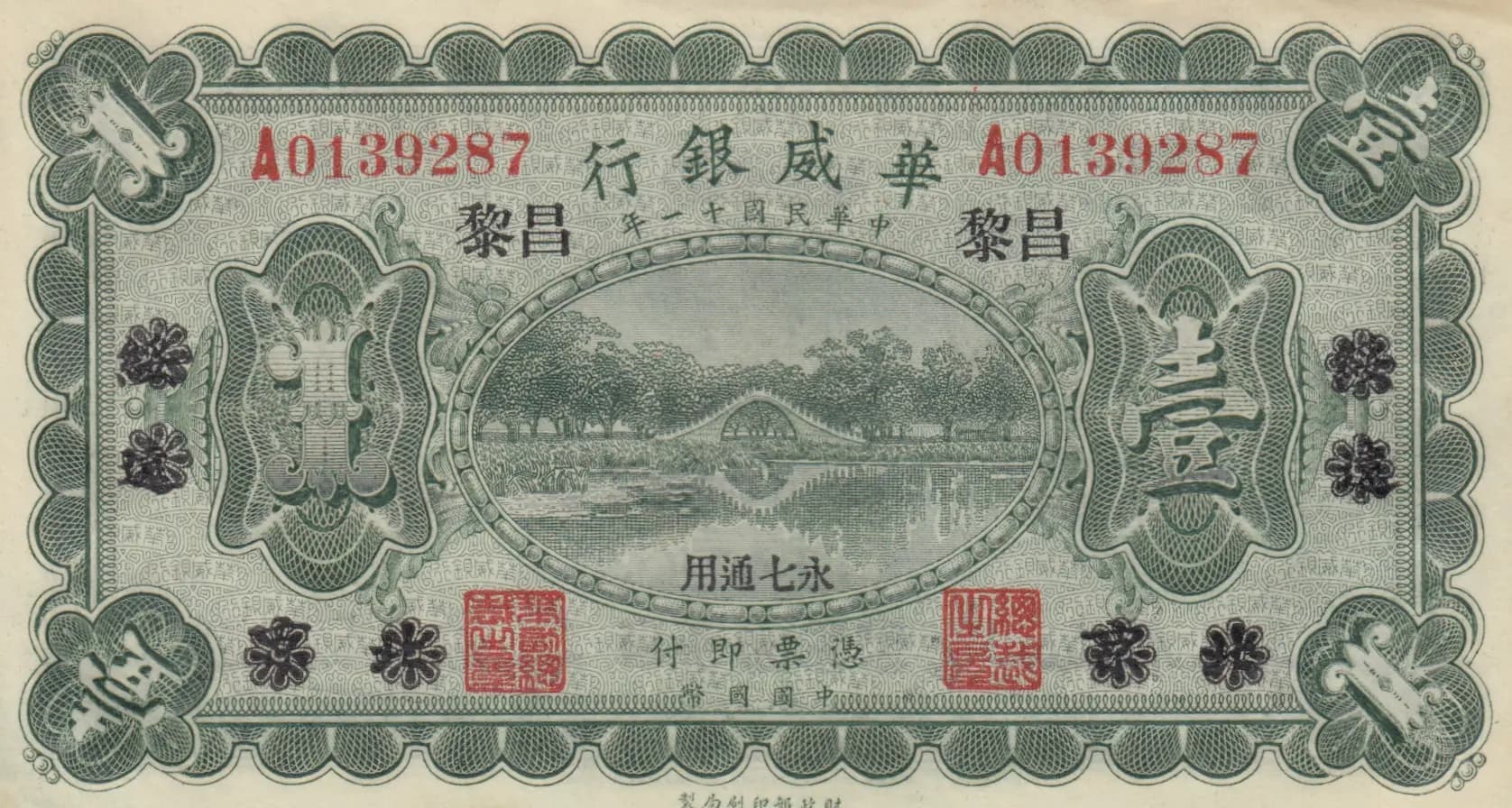
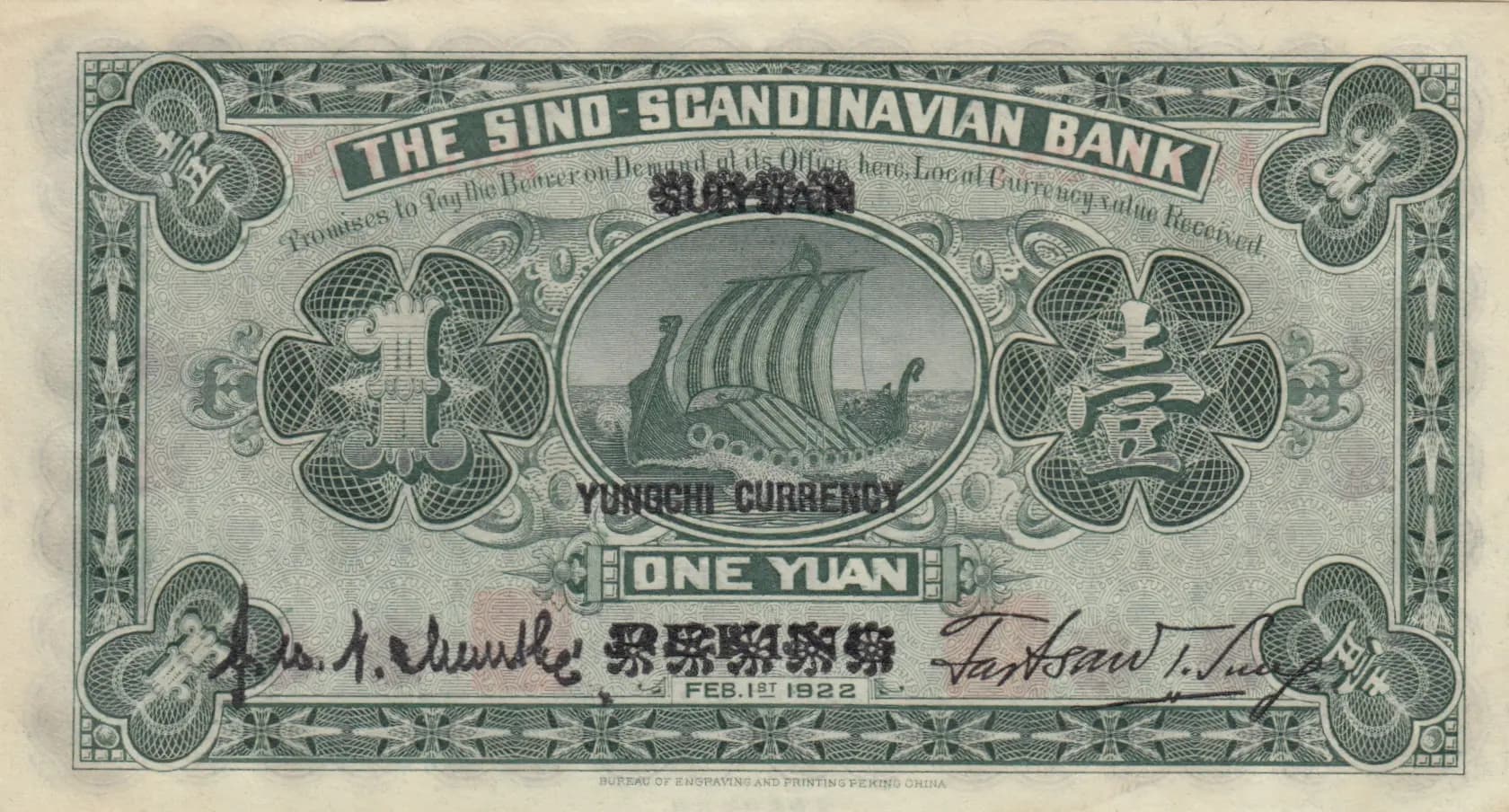
This is an AU-graded 1 Yuan note from the Sino-Scandinavian Bank, issued February 1, 1922, featuring exceptional artistic design with a classical Chinese landscape vignette on the obverse and a striking Viking longship on the reverse. The note displays crisp, well-defined printing in green and black with excellent preservation, showing only minor aging consistent with a century-old banknote, making it an attractive example of this fascinating Sino-foreign banking enterprise.
Uncommon. While the Sino-Scandinavian Bank operated legitimately in Shanghai during the early 1920s, its notes were issued in limited quantities compared to major Chinese banks of the period. The eBay market data shows AU examples trading in the $475 range with scarcer UNC examples reaching $1,500, indicating steady collector demand but limited supply. The AU condition grade specified for this note places it above most surviving examples, which typically appear in VF condition ($250-$475 range). This suggests a modest but not insignificant rarity for the type.
The Sino-Scandinavian Bank represented an ambitious foreign banking venture in Republican China, established to facilitate trade during a period of Western commercial expansion in Asia. The note's dual imagery—traditional Chinese landscape symbolism paired with Nordic Viking ship symbolism—reflects the bank's bicultural mission and the cosmopolitan nature of Shanghai's international financial community in the early 1920s. The prominent English text and reference to the Bureau of Engraving and Printing in Peking demonstrate the involvement of foreign technical expertise in Chinese currency production during this transitional period.
The obverse features an oval-framed landscape vignette depicting a classical Chinese garden or architectural scene with an arched bridge spanning water, surrounded by trees and foliage with buildings visible in the distance—typical imagery symbolizing harmony and prosperity in traditional Chinese aesthetics. The reverse displays a Viking longship (Norse galley) with distinctive sail configuration, serving as the iconic symbol of Scandinavian heritage and the bank's Nordic connection. Both sides employ symmetrical Art Nouveau-influenced border designs with ornate corner rosettes and fine geometric patterns in green/teal and black. The overall composition reflects high-quality bank note engraving with careful attention to decorative detail and security through intricate line work.
FRONT SIDE: Serial number 'A0139287' (appears twice); Chinese inscriptions include references to the Bank of China/Chinese Republic and currency circulation notices. BACK SIDE: English text reads 'THE SINO-SCANDINAVIAN BANK' with the standard bank promise 'Promises to Pay the Bearer on Demand at its Office at Shanghai, Local Currency Value Received.' Denomination is marked as 'ONE YUAN' and currency type as 'YUNGCHI CURRENCY.' Date of issue is 'FEB.1ST 1922.' Printer attribution states 'BUREAU OF ENGRAVING AND PRINTING PEKING CHINA.' Chinese characters '榮昌銀號' appear on reverse (bank name in Chinese). Two signatures are visible in red stamping.
This note was produced using traditional intaglio (engraved steel plate) printing, as evidenced by the crisp, fine-line detail work visible in the ornamental borders, vignette engraving, and background geometric patterns. The multi-color printing technique employed separate plates for the green/teal and black elements, with red used for serial numbers and official stamps. The note was printed by the Bureau of Engraving and Printing in Peking, China, which had acquired modern Western printing technology and expertise during this period.
Serial number A0139287 is noted on this example. The date 'FEB.1ST 1922' indicates this note is from the initial issue period of the bank. No overprints or obvious variants are apparent from the visual analysis. Collectors of this Pick number should note that surviving examples may show variation in signature types (handwritten vs. printed red stamps) and serial number prefixes, though detailed variety cataloging for this obscure foreign bank note may be limited in standard references.