1 yuan 1923
Market Prices
About This Note
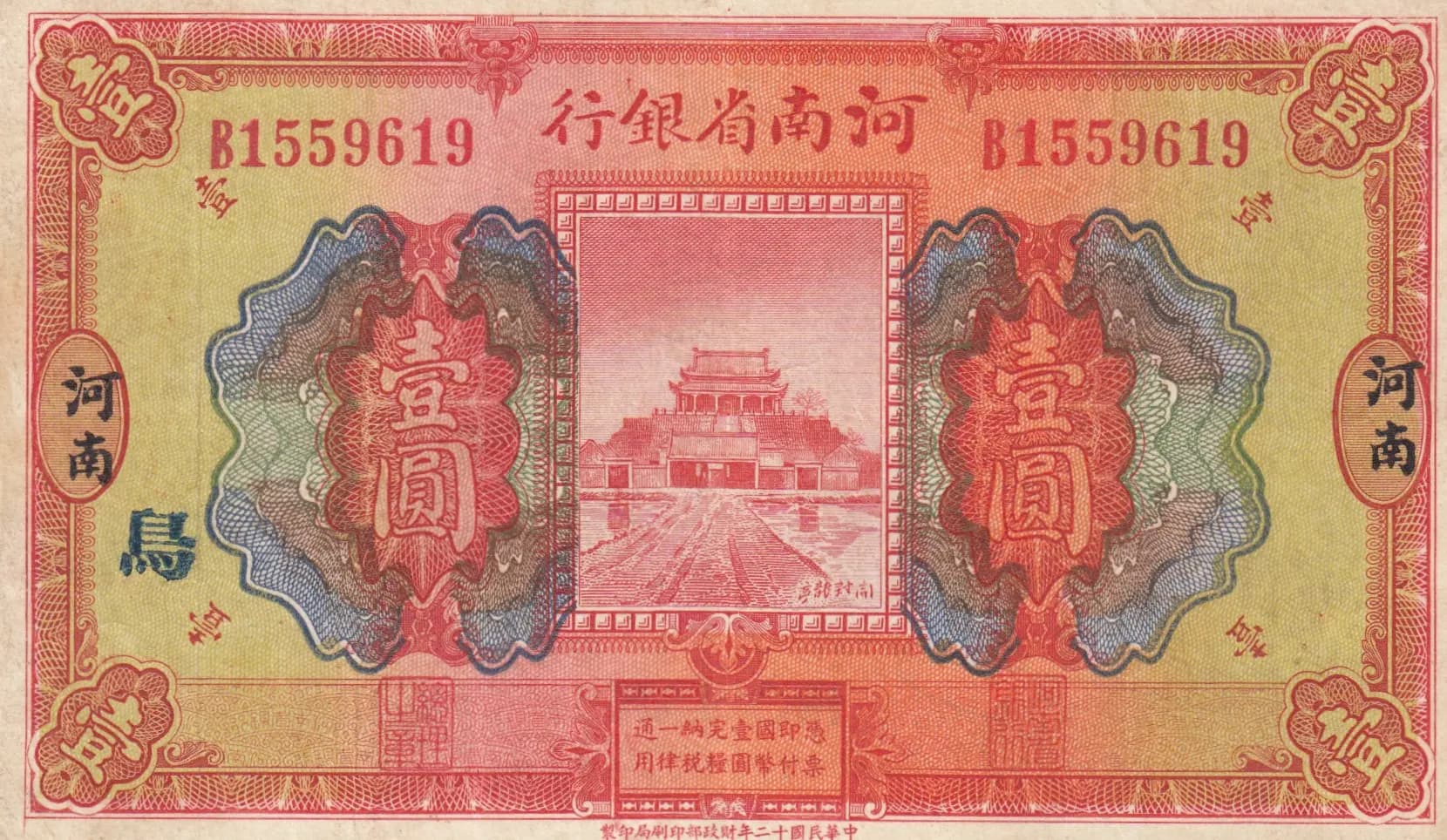
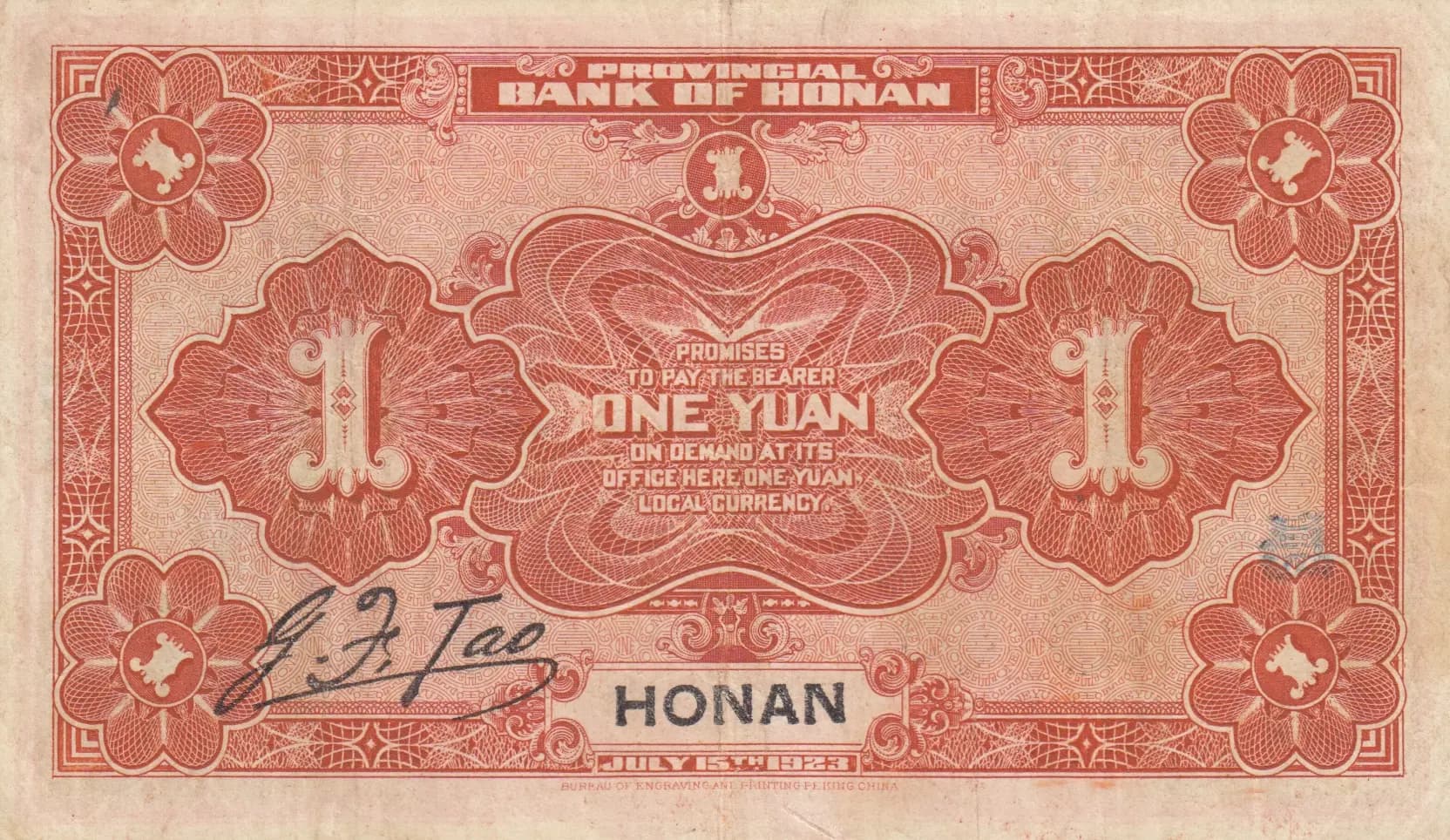
This is a 1923 Provincial Bank of Honan 1 Yuan note in VF condition, representing an important early Republican-era Chinese provincial currency. The note features an impressive central pagoda-style building (likely the Yellow Crane Tower or similar Henan landmark) in red and multicolor print, flanked by ornate decorative cartouches with Chinese characters. The reverse displays a formal English-language promise to pay statement with an eagle emblem, printed by the Bureau of Engraving and Printing in Peking, and shows visible aging with foxing, creasing, and yellowing consistent with a century-old circulated note.
Common. The eBay market data shows VF-grade examples regularly trading in the $32-$115 USD range, with multiple sales across various condition grades ranging from $7.50 to $349.99 USD. The wide range of prices and multiple listings indicate this is a widely available note in the collector market. Provincial Bank of Honan notes were issued in significant quantities during their period of circulation, and this particular denomination and type appear frequently in numismatic commerce. The lack of evidence of extreme rarity (no premium pricing, multiple examples available) confirms common status.
The Provincial Bank of Honan was established during China's early Republican period (post-1912) when provincial banks issued their own currency before centralized monetary control. The July 15, 1923 date places this note during a period of significant provincial autonomy and fiscal decentralization in China. The central architectural imagery (the pagoda-style shrine) likely represents an important Henan cultural or religious landmark, serving both as a security feature and a source of provincial pride and legitimacy for the issuing authority.
This banknote exhibits a highly symmetrical and ornate design typical of early 20th-century Chinese provincial currency. The obverse centers on a multi-tiered pagoda or shrine building shown in perspective with a forecourt or plaza, rendered in fine detail within a decorated rectangular frame. Four corners feature stylized floral or cloud medallions (typical of Chinese classical design), while left and right sides contain matching ornamental cartouches in red and blue-black with Chinese provincial designations. The reverse maintains the symmetrical aesthetic with large corner medallions containing what appear to be lion or mythical creature emblems, and features a central eagle or bird emblem at the top—a common symbol of sovereignty on Republican-era Chinese currency. The decorative borders throughout employ fine geometric patterns characteristic of security printing. The handwritten signature of an official (L.J. Tao) appears on the reverse, adding administrative authenticity.
FRONT: 河南省銀行 (Henan Provincial Bank), 河南 (Henan), 圓 (Yuan - currency denomination), B1559619 (serial number appearing twice in upper corners). BACK: 'PROVINCIAL BANK OF HONAN' (header), 'PROMISES TO PAY THE BEARER' (promise clause), 'ONE YUAN' (denomination in English), 'ON DEMAND AT ITS OFFICE HERE' (redemption clause), 'ONE YUAN LOCAL CURRENCY' (currency designation), 'HONAN' (province name), 'BUREAU OF ENGRAVING AND PRINTING PEKING CHINA' (printer attribution at bottom), 'JULY 15TH 1923' (issue date), 'L.J. Tao' (handwritten signature, lower left).
This note was produced using intaglio (engraved) printing by the Bureau of Engraving and Printing (BEPP) in Peking, as credited on the reverse. The fine line work, layered multicolor printing (red, yellow, cream, blue-black, and green accents), and intricate decorative patterns throughout are consistent with high-security intaglio production. The precision of the border designs, corner medallions, and central architectural rendering indicate professional bank-note quality engraving. The handwritten signature was added post-printing, a common practice for Chinese provincial currency of this era.
This example is identified as Schwan-Boling (S/M) #H62-20c and Pick catalog S1688. The serial number observed is B1559619 (appearing twice in upper corners), suggesting this falls within the standard range of issued notes. The handwritten signature 'L.J. Tao' represents the official authorizing the note at the time of issue. No overprints or unusual serial number prefixes are evident. The July 15th, 1923 date and signature combination may distinguish this from other state-varieties of the same basic design if multiple signatory officials existed during the note's circulation period. Collectors should compare signature variations and serial number prefixes to establish specific sub-varieties.