1 yuan 1941
About This Note
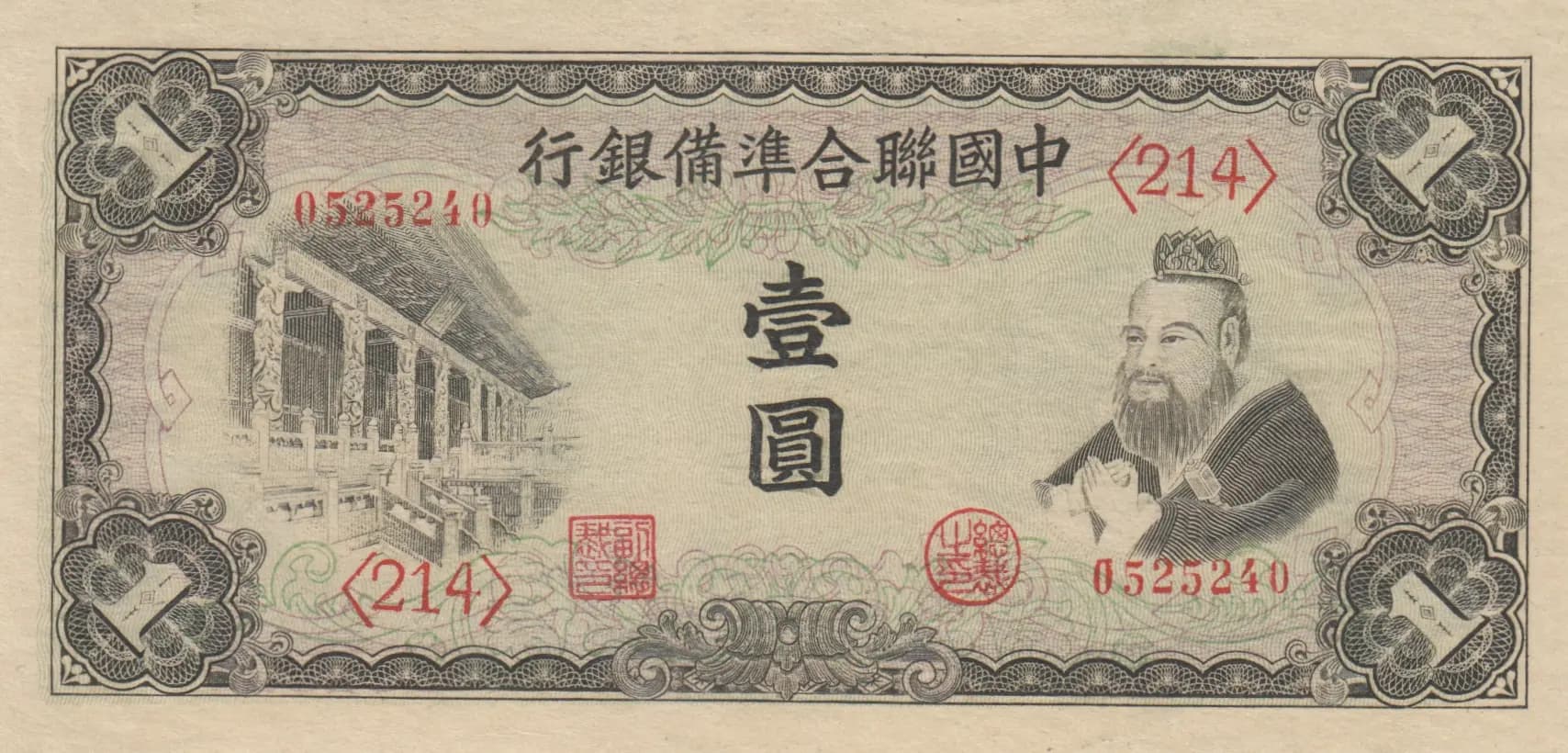
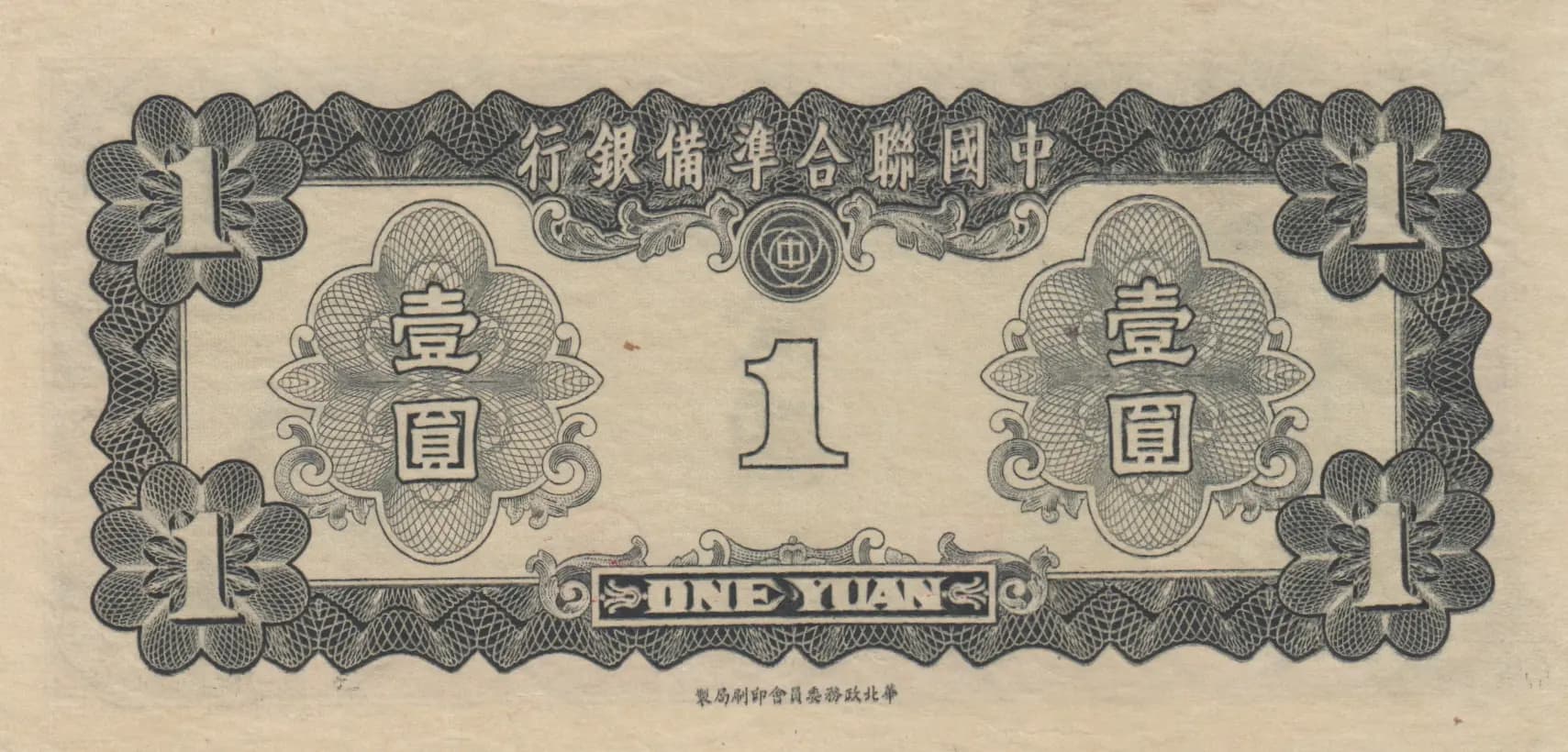
This is an AU-graded 1 yuan banknote from the Federal Reserve Bank of China (1941), featuring the distinctive "Taiwan Yuan" (臺圓) denomination marking that reflects the complex political circumstances of wartime China. The note displays excellent preservation with only minor age-related yellowing and creasing, showcasing ornate engraved borders, a portrait of a bearded dignitary in traditional dress on the obverse, and a classical architectural structure on the left side. The reverse presents a geometric design centered on a large numeral '1' flanked by decorative emblems, with bilingual inscription in both Chinese and English.
Common. The Federal Reserve Bank of China issued substantial quantities of currency during the 1941 period across Japanese-occupied territories. The AU condition grade and the survival of specimens in the market indicate this was not a limited or short-lived issue. Standard circulation was extensive, and multiple examples of this Pick number appear regularly in the market. No historical evidence suggests this particular denomination or year was recalled, overprinted as an error, or produced in restricted quantities that would elevate its rarity status.
The Federal Reserve Bank of China issued this note during the Second Sino-Japanese War (1937-1945), a period of significant territorial fragmentation and competing monetary authorities within China. The specific designation of "Taiwan Yuan" on the obverse reflects the complex geopolitical situation, as Taiwan (Formosa) remained under Japanese control during this period, making this denomination historically significant as a statement of territorial claim. The institutional name "China United Reserve Bank" (中國聯合準備銀行) indicates this was part of the Japanese-sponsored Reformed Government of the Republic of China's monetary system in occupied territories.
The obverse features an ornate border with floral corner ornaments framing a formal composition. The central design incorporates the large Chinese character 臺 (Taiwan) with 圓 (yuan) below, positioned prominently. A portrait of a bearded male dignitary—likely a historical figure from the Republican era—occupies the right side, depicted in formal three-quarter profile wearing traditional robes and formal headdress characteristic of Chinese official portraiture. On the left side stands a detailed engraving of a classical Chinese architectural structure with columned design and elaborate roof work, symbolizing national heritage. Multiple red seals and stamps (rectangular, square, and circular formats) are dispersed across the design, serving as official validation marks. The reverse employs a more geometric, minimalist approach with a large outlined numeral '1' as the focal point, flanked by two identical ornate circular emblems containing the Taiwan Yuan designation within latticework frames. A central circular emblem appears at the top center. The entire composition is enclosed within double-lined borders with ornamental corner designs, rendered primarily in black on tan/beige stock with selective use of red ink for official markings.
FRONT SIDE: 中國聯合準備銀行 = 'China United Reserve Bank' (issuing authority); 臺圓 = 'Taiwan Yuan' (denomination designation); (214) = catalog or control number; 0525240 = serial number. BACK SIDE: 中國聯合準備銀行 = 'China United Reserve Bank'; 臺圓 = 'Taiwan Yuan'; ONE YUAN = English denomination translation; 1 = Arabic numeral denomination; Text at bottom relates to central government printing authority (Chinese characters partially noted in visual analysis).
Intaglio engraving (line engraving), evidenced by the detailed fine-line work, ornate borders, and precise rendering of portraiture and architectural elements visible throughout the note. The sharp definition of facial features, delicate border ornamentation, and consistent line weights are characteristic of high-quality intaglio production. The red seals and stamps appear to have been applied separately, likely through additional printing passes. Historical records indicate that banknotes of the Federal Reserve Bank of China during this period were produced by Japanese-controlled or Japanese-affiliated security printers, with some notes bearing marks indicating production by the Central Printing Bureau (中央印製) or similar government facilities under Japanese supervision.
Serial number 0525240 is recorded on the obverse in red ink, providing one specific identifier for this individual specimen. The designation (214) appears as a control or batch number. No overprints, date variations, or signature varieties are apparent from the visual analysis. This appears to be a standard-production specimen of Pick J72 with no documented major varieties known for this denomination and year. The consistent use of traditional Chinese characters throughout (rather than simplified characters) is standard for this period and issuer.