1 yen 1940
About This Note
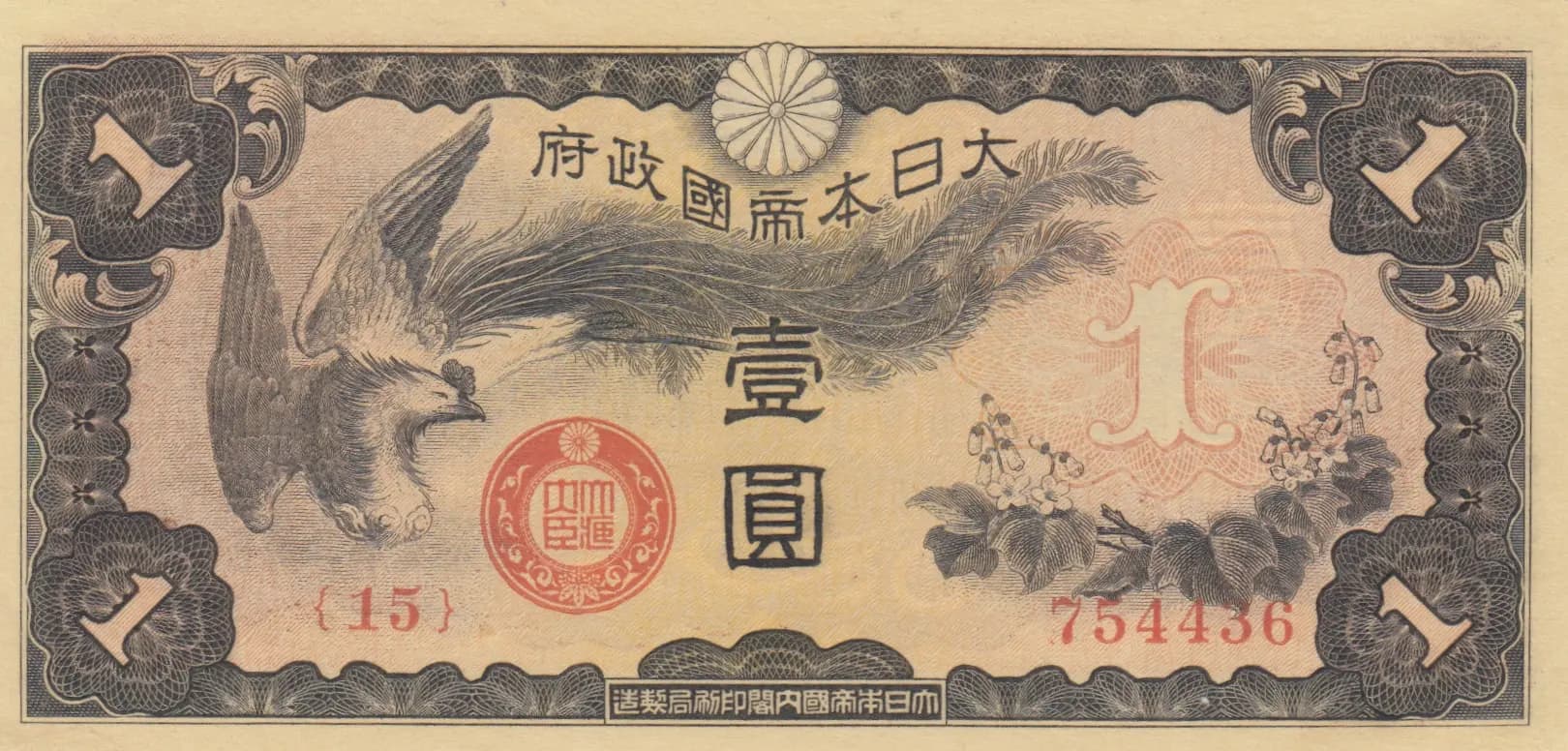
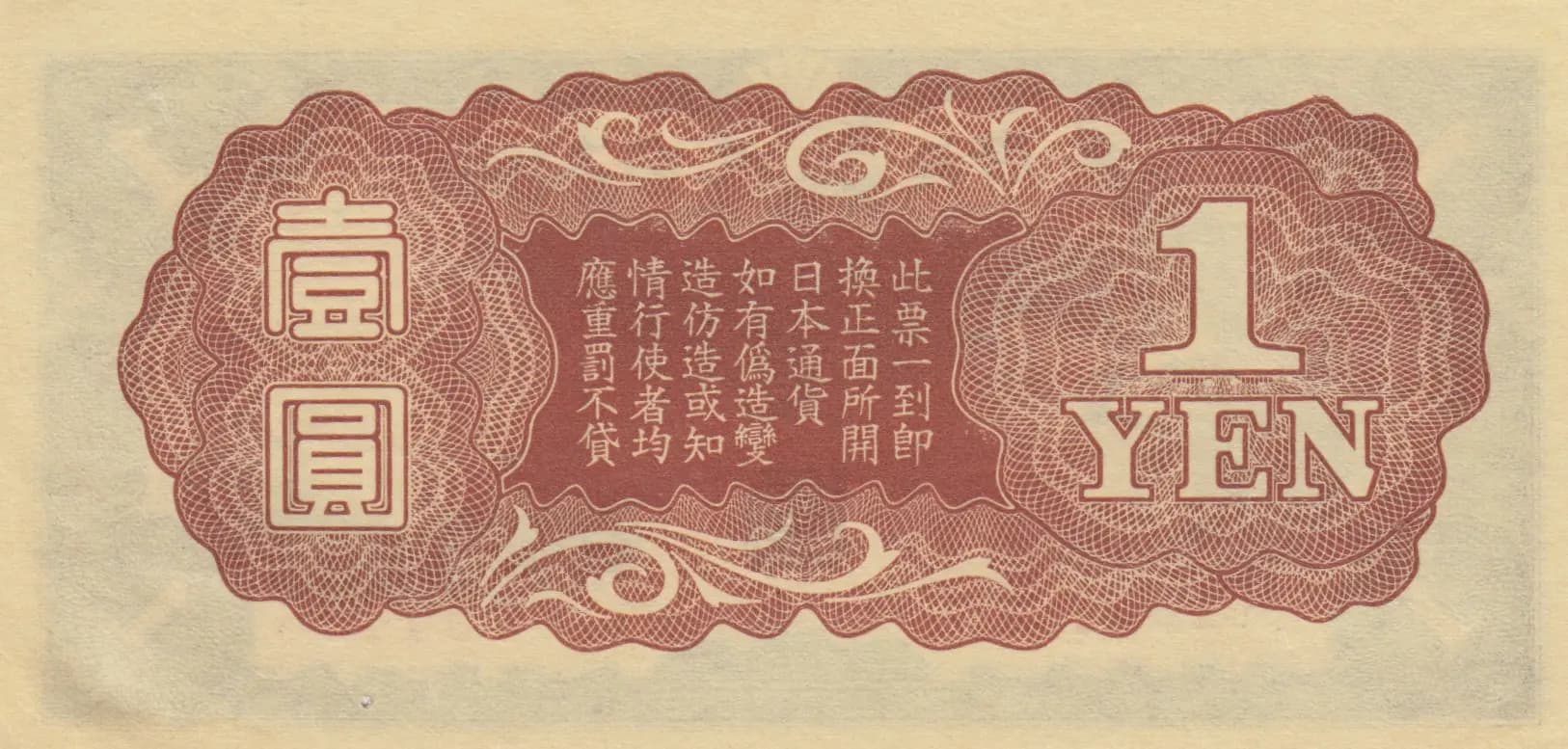
An exceptional example of a 1 Yen Japanese Military occupation currency note from 1940, graded AU and issued by the Greater Japanese Empire Government. The note displays the characteristic ornate design with a dragon motif on the obverse and elaborate red decorative cartouches on the reverse, both rendered in fine line engraving with crisp, clean printing. This piece represents an important artifact of WWII-era Japanese monetary policy in occupied territories, with minimal wear consistent with its AU grade and excellent preservation of the intricate security features.
Common. While Japanese occupation currency from this period is collected, the 1 Yen denomination P-M15 represents a standard denomination from a well-established printing program. The print run for this note appears to have been substantial, and examples regularly appear in the secondary market. The AU condition grade is desirable but does not substantially elevate the rarity assessment, as many examples survive in excellent condition due to the durable printing methods and relatively recent vintage (1940).
This 1 Yen note was issued in 1940 by the Japanese Empire's Ministry of Finance Printing Bureau during the period of Japanese territorial expansion in East Asia. The prominently displayed imperial chrysanthemum emblem and inscriptions in both Japanese and Chinese reflect Japan's administration of occupied Chinese territories. The ornate design incorporating traditional dragon imagery and East Asian landscape elements was deliberately chosen to establish monetary authority and legitimacy in these regions while asserting Japanese imperial dominance.
The obverse features a symmetrical ornamental design centered on a dragon (representing imperial power and divine authority in East Asian tradition) positioned in the upper left quadrant with flowing mane and scaled body rendered in fine detail. A pine or coniferous branch with naturalistic foliage appears on the right side, evoking traditional landscape painting. The central composition incorporates a prominent red circular seal with geometric border patterns, likely representing an official stamp of authority. An imperial chrysanthemum emblem crowns the design at top center. The entire composition is framed by an ornate border of geometric repeating patterns with fine-line security work. The reverse presents a more minimalist approach with decorative scalloped cartouches positioned symmetrically in the upper corners and a central ornamental panel with wavy borders containing the warning text. The color palette shifts to predominantly red/burgundy on the reverse against the cream background, creating visual distinction between sides.
OBVERSE: 大日本帝國政府 (Greater Japanese Empire Government) | 壹圓 (One Yen) | 日本帝國財務省印刷局製造 (Made by Japanese Empire Ministry of Finance Printing Bureau) | Serial number: 754436. REVERSE: 國 (Country) | 圓 (Yen) | YEN (English designation) | Denomination: 1 | Warning text: 此票到期日換如情造此票此票所面一通應造知複有代不賠使者或造假知均 (This note: regarding validity, exchange dates, counterfeiting warnings, and liability disclaimers for the bearer).
Intaglio engraving (line engraving) executed by the Japanese Empire Ministry of Finance Printing Bureau. The fine-line engraving is evident throughout both sides, particularly in the intricate border work, cross-hatch patterns in background areas, and the elaborate security lines and geometric patterns. The crisp, sharp printing and excellent detail preservation visible in the AU-graded example indicates professional security printing standards typical of imperial Japanese currency production.
The note is identifiable as variant P-M15a (standard 1 Yen) based on catalog data. The PMG catalog distinguishes this from P-M15s (Title A variant). The observed serial number 754436 is specific to this individual note and does not indicate a cataloged variety. No overprints, date variations, or signature differences are apparent in the visual analysis that would indicate a separate listed variety. The note appears to be from a standard printing run without distinctive variety characteristics.