1 dollar 1938
About This Note
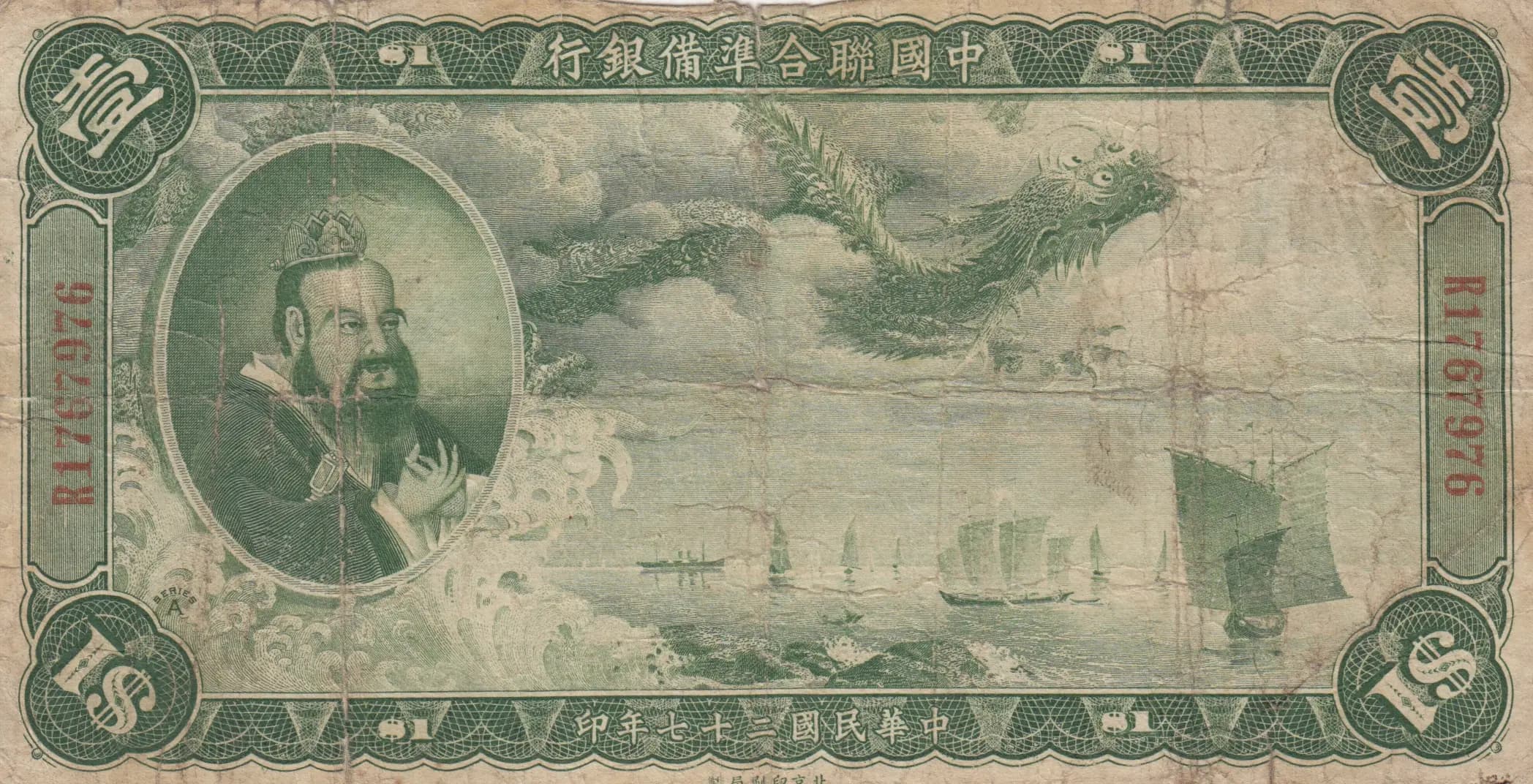
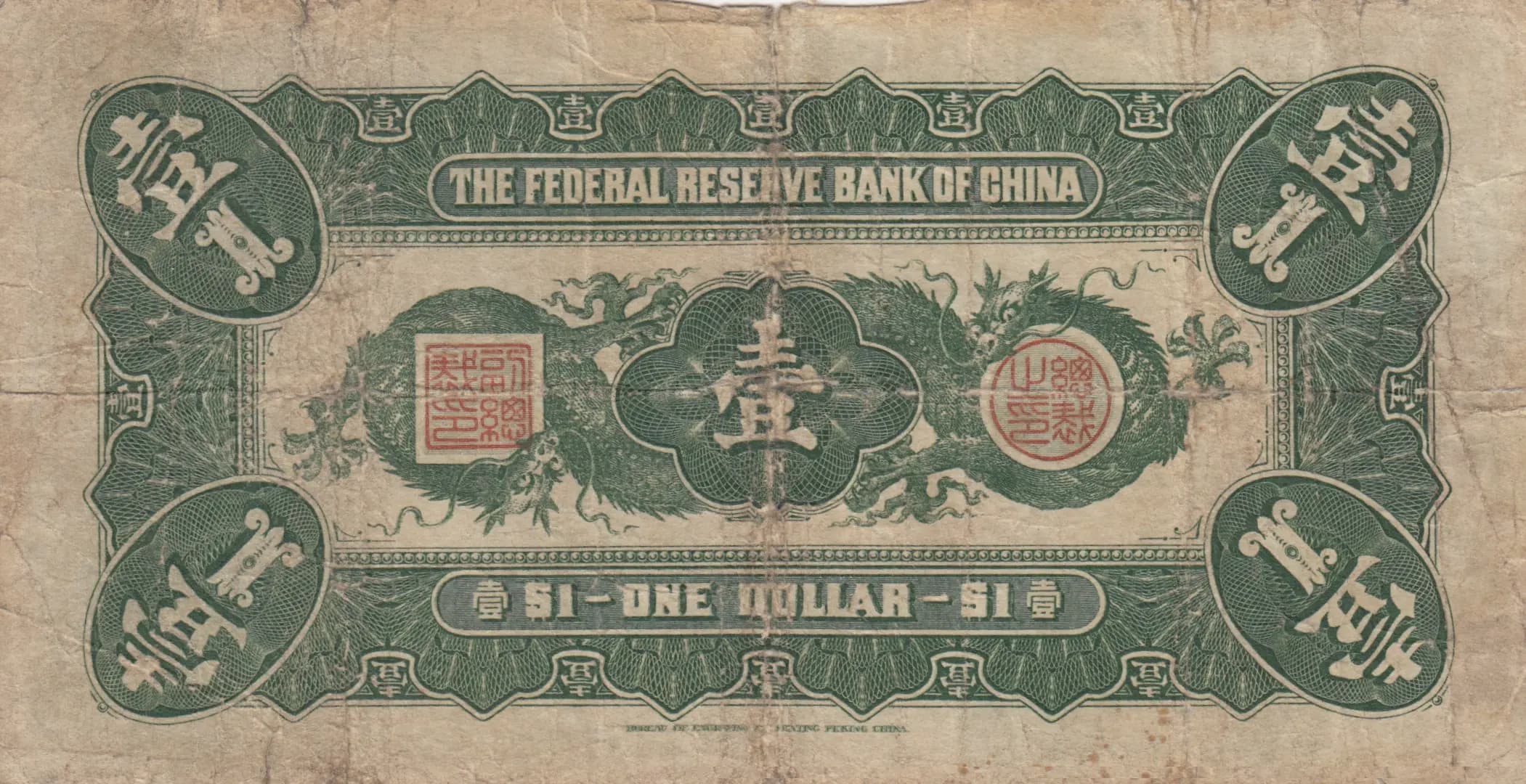
This 1938 Federal Reserve Bank of China 1 Dollar note (Pick J54) presents a fascinating example of pre-war Chinese currency featuring bilingual English-Chinese design elements. The front displays a dignified bearded portrait in military dress alongside a classical harbor landscape with dragon symbolism, while the reverse showcases ornate traditional Chinese decorative motifs with official red seals. In VG condition with significant aging, foxing, and creasing consistent with nearly nine decades of storage and possible circulation, this note remains historically significant as a product of China's tumultuous Republican era.
Common. Federal Reserve Bank of China notes from the 1938 period were issued in substantial quantities to support domestic commerce during the Republic of China era. While the political upheaval of the following decades (Japanese invasion, civil war, Communist takeover) resulted in many notes being destroyed or lost, surviving examples remain relatively available in the international collector market. The VG condition grade—showing significant wear and aging—is typical for notes that circulated or were stored in suboptimal conditions, further indicating these were not rare high-denomination pieces but rather practical currency in regular use.
Issued by the Federal Reserve Bank of China during the Second Sino-Japanese War period, this note reflects the Republic of China's attempt to establish modern financial institutions under increasingly difficult circumstances. The bilingual presentation and Western security printing techniques represent the early 20th-century modernization efforts of the Chinese government, while the prominent dragon motifs and classical design elements maintain connection to traditional Chinese cultural symbolism. The 1938 date places this issue during a critical period when Japanese invasion threatened China's territorial and economic stability.
The front features a left-aligned portrait of a bearded gentleman in formal military dress uniform with decorative medals and insignia, characteristic of Republican-era Chinese leadership portraiture. The right side depicts a stylized coastal landscape with multiple sailing vessels on water, mountainous terrain, and vegetation, dominated by a celestial dragon figure in the upper right—a powerful symbol of imperial authority and national pride in Chinese culture. The verso displays elaborate traditional Chinese design vocabulary including stylized peony or lotus flowers, dragon motifs within decorative clouds, classical scrollwork, and ornamental patterns typical of high-denomination or commemorative issues. Two official red seals—one square (likely official government chop) and one circular—provide authentication marks. Fine crosshatching and intricate engraving throughout serve both decorative and security purposes.
FRONT SIDE: 中華民國聯合儲備銀行 (Federal Reserve Bank of the Chinese Republic); 中華民國 (Republic of China); 貳拾圓 (Twenty Yuan) [NOTE: Visual analysis indicates denomination confusion - reverse clearly states ONE DOLLAR/壹圓, suggesting this may be a Twenty Yuan note or cataloging discrepancy]. BACK SIDE: THE FEDERAL RESERVE BANK OF CHINA (English text); ONE DOLLAR (English denomination); 圓 (Yuan); 壹圓 (One Yuan); FEDERAL RESERVE BANK OF CHINA (repeated English text); 圓 (Yuan - repeated in corner cartouches).
Intaglio engraving combined with letterpress elements, a standard technique for high-security banknote production of the 1930s era. The fine line work, precise crosshatching in backgrounds, and sharp portrait rendering are characteristic of quality foreign security printers who contracted with Chinese authorities during this period. The multi-color printing (green, black, red) was applied through sequential passes typical of the era, with evidence of careful registration visible in the ornate border designs.
The visual analysis reveals a potential variety discrepancy: the front inscription references 貳拾圓 (Twenty Yuan) while the reverse clearly states ONE DOLLAR/壹圓 (One Yuan), and the catalog designation indicates 'P-J54' with denomination listed as 1 dollar. This may represent a documented variety with mixed-denomination text, a cataloging error in the provided metadata, or a note combining elements from different printings. Serial number designation visible (九〇〇〇〇〇〇〇) should be cross-referenced with known serial ranges for this Pick number to establish specific print batch. Red seal variations (square vs. circular formats and their specific characters) may also indicate different issuing authorities or time periods within the 1938 issue.