1 000 000 gold yuan 1949
Market Prices
4 salesAbout This Note
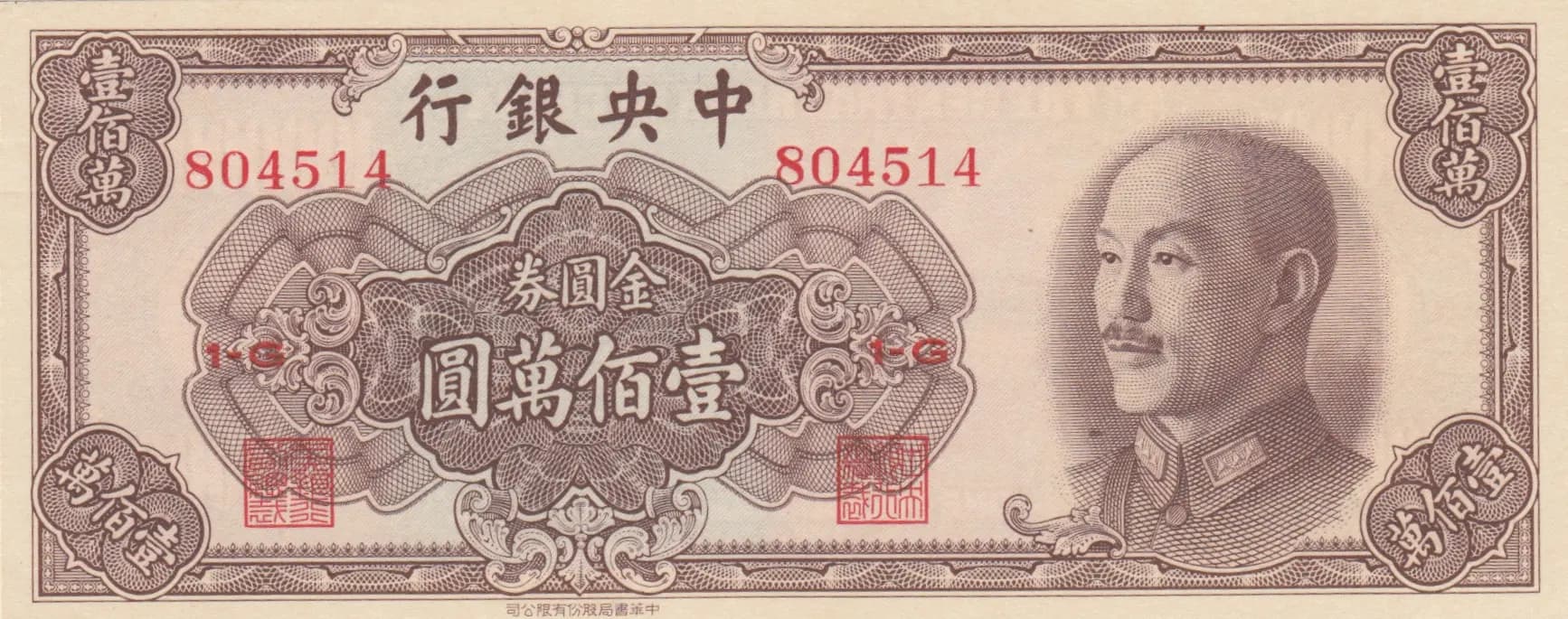
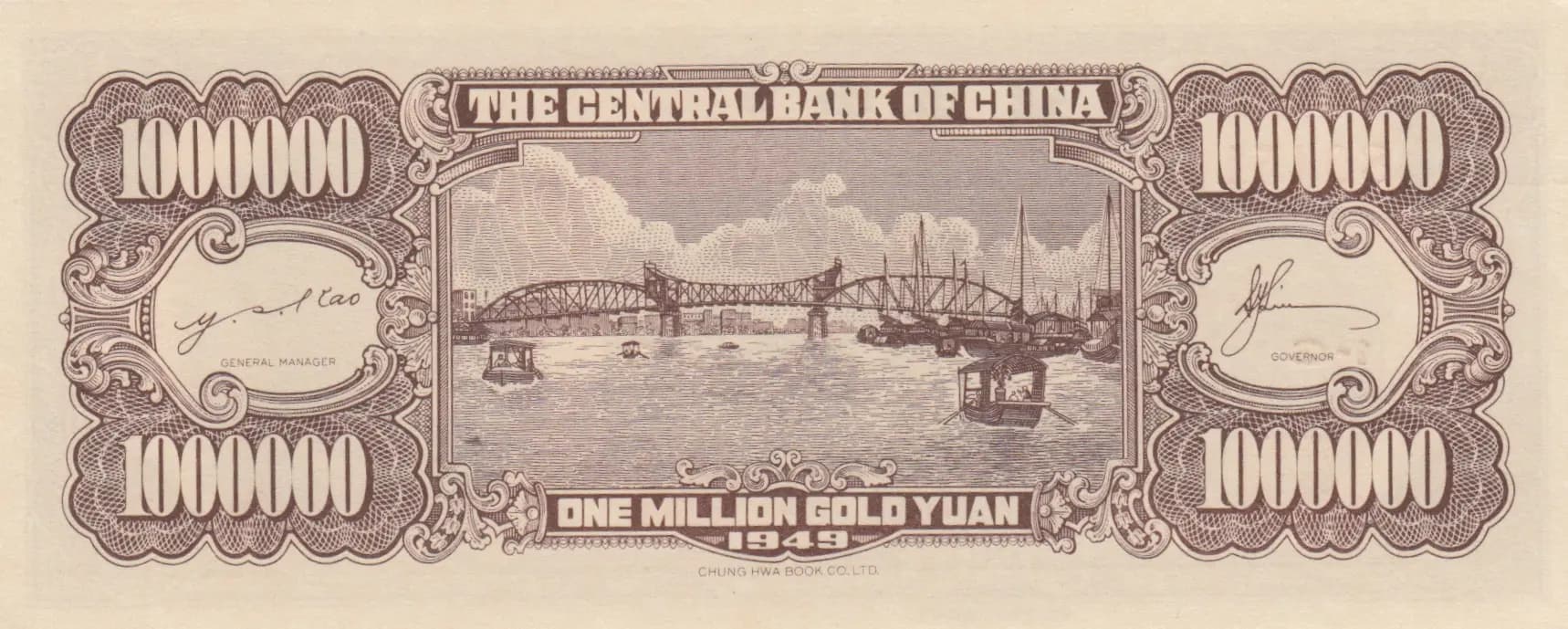
This is an exceptional example of the Central Bank of China's 1 Million Gold Yuan note from 1949, presented in uncirculated condition with crisp printing and pristine paper quality. The note features an elegant design blending traditional Chinese artistic elements with Western banking aesthetics, including a military portrait on the obverse and an impressive harbor/bridge scene on the reverse that reflects China's industrial aspirations during this tumultuous period. This denomination represents one of the final issues before the complete currency collapse during the Chinese Civil War, making it a historically significant artifact of the Republic of China's monetary system.
Common. While this is the highest denomination of the 1949 gold yuan issue, the eBay price history provided shows uncirculated examples selling in the $300-$1000 range (2012-2020), with catalog values around $150 for UNC as of 2016. These price points and the regular appearance of examples on the secondary market indicate this is not a scarce note. The 1949 gold yuan was issued in substantial quantities before the currency's collapse, and many examples survived in collections. The UNC grade is more desirable than circulated examples but does not command extreme premiums.
Issued in 1949, this gold yuan note was part of the Central Bank of China's final attempt to stabilize the hyperinflated currency during the Chinese Civil War. The harbor and bridge depicted on the reverse symbolize China's modernization and industrial development aspirations, while the military portrait on the obverse likely represents a significant political or military figure of the Nationalist government. The denomination of one million units reflects the severe devaluation that had occurred—by 1949, the gold yuan had become virtually worthless, and this issue was soon replaced following the Communist victory and establishment of the People's Republic of China.
The obverse features an ornate frame with traditional Chinese decorative roundels and scrollwork borders in brown and sepia tones. The central oval cartouche contains the denomination in Chinese characters. A portrait in profile facing left depicts a military figure in uniform, likely representing a prominent Nationalist government official or commander. The reverse presents an elaborate harbor scene centered within a rectangular decorative frame, depicting a major port with prominent bridge infrastructure (possibly representing a contemporary Chinese harbor such as Shanghai or another treaty port), multiple vessels including steamships, and industrial port facilities with loading equipment. This imagery emphasizes maritime commerce and industrial modernity. Ornate corner cartouches frame large denomination numerals '1000000' at each corner. The design employs fine line-work engraving throughout with traditional imperial-style emblems.
FRONT SIDE: Chinese characters '中央銀行' (Central Bank) and '壹佰萬圓' (One Million Yuan) and '金圓' (Gold Yuan); serial numbers '804514' appear in red at top. BACK SIDE: English text 'THE CENTRAL BANK OF CHINA' at top; 'ONE MILLION GOLD YUAN' below central vignette; year '1949'; denomination '1000000' appears four times in corner cartouches; signature block labels 'GENERAL MANAGER' and 'GOVERNOR'; printer attribution 'CHUNG HWA BOOK CO. LTD'.
This note was produced using intaglio engraving, evidenced by the intricate line-work, complex decorative borders, fine parallel line shading patterns, and sharp detail reproduction visible throughout both sides. The printer is identified as Chung Hwa Book Company Limited. The color printing employed separate applications of brown/sepia ink for the main design and red ink for serial numbers, demonstrating precise color separation typical of high-security banknote production of the era.
The observed specimen shows serial number 804514 in red on the obverse. While signature varieties are known to exist on this issue (reflecting different Central Bank officials serving as Governor and General Manager), the visual analysis does not provide sufficient detail to definitively identify the specific signatory variety. Collectors should note that different signature combinations exist for this Pick number. The red serial number printing is consistent with standard production for this issue. No overprints or modifications are evident on this example.