1 peso 1943
Market Prices
5 salesAbout This Note
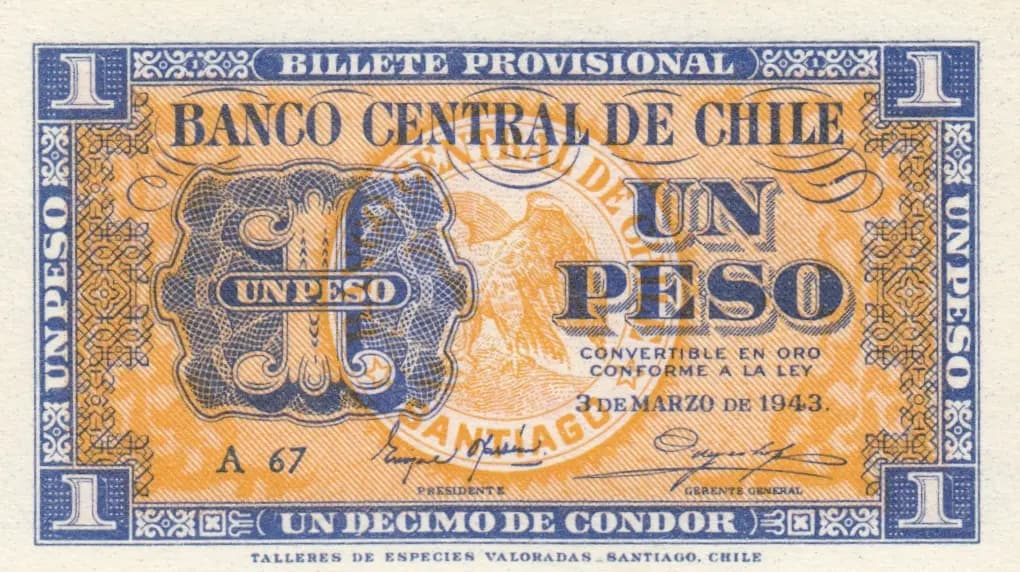
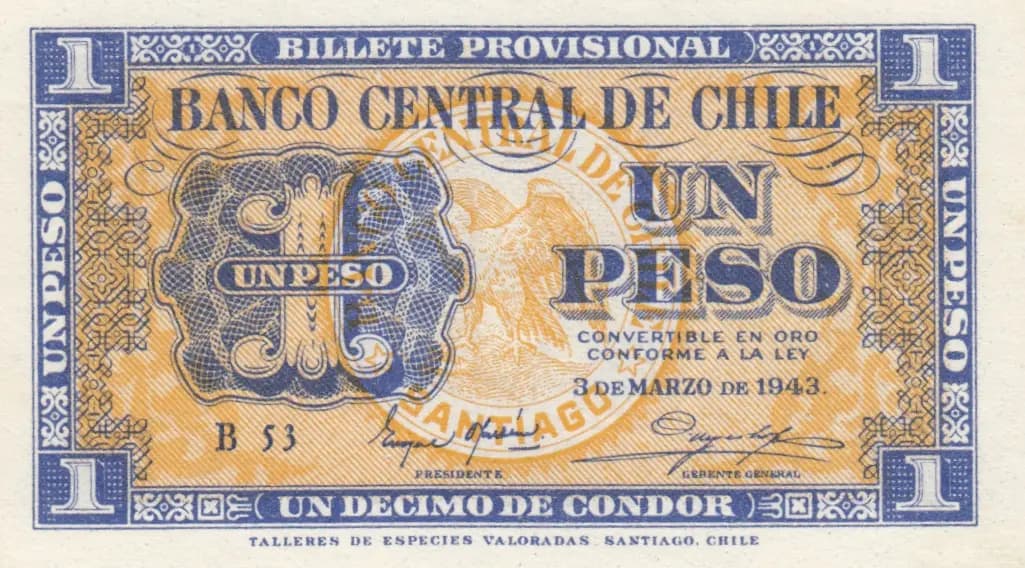
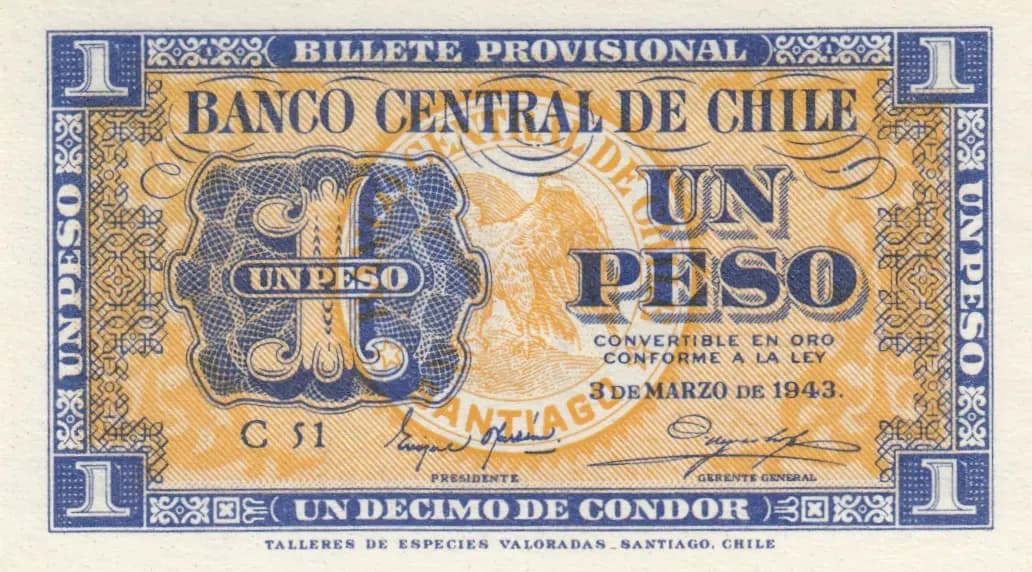
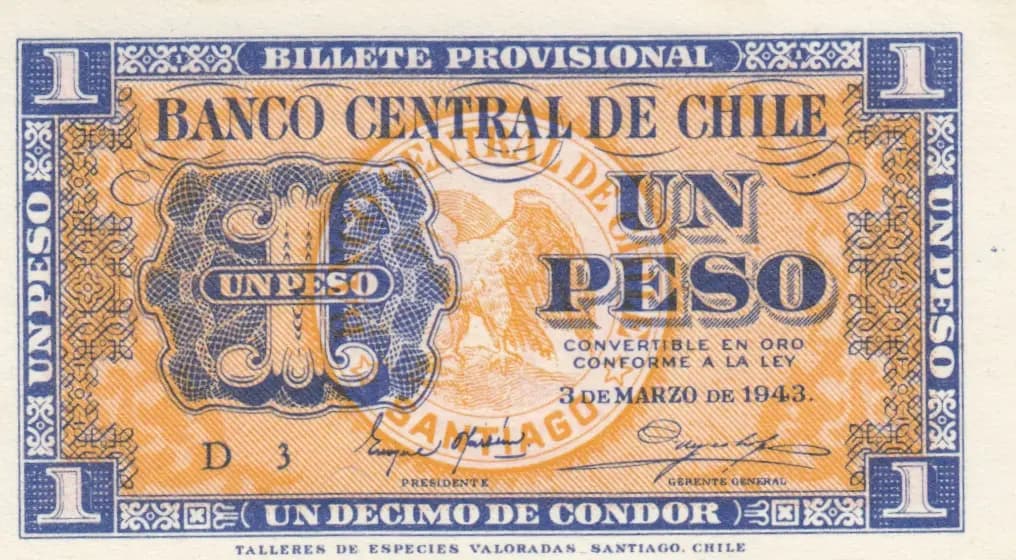
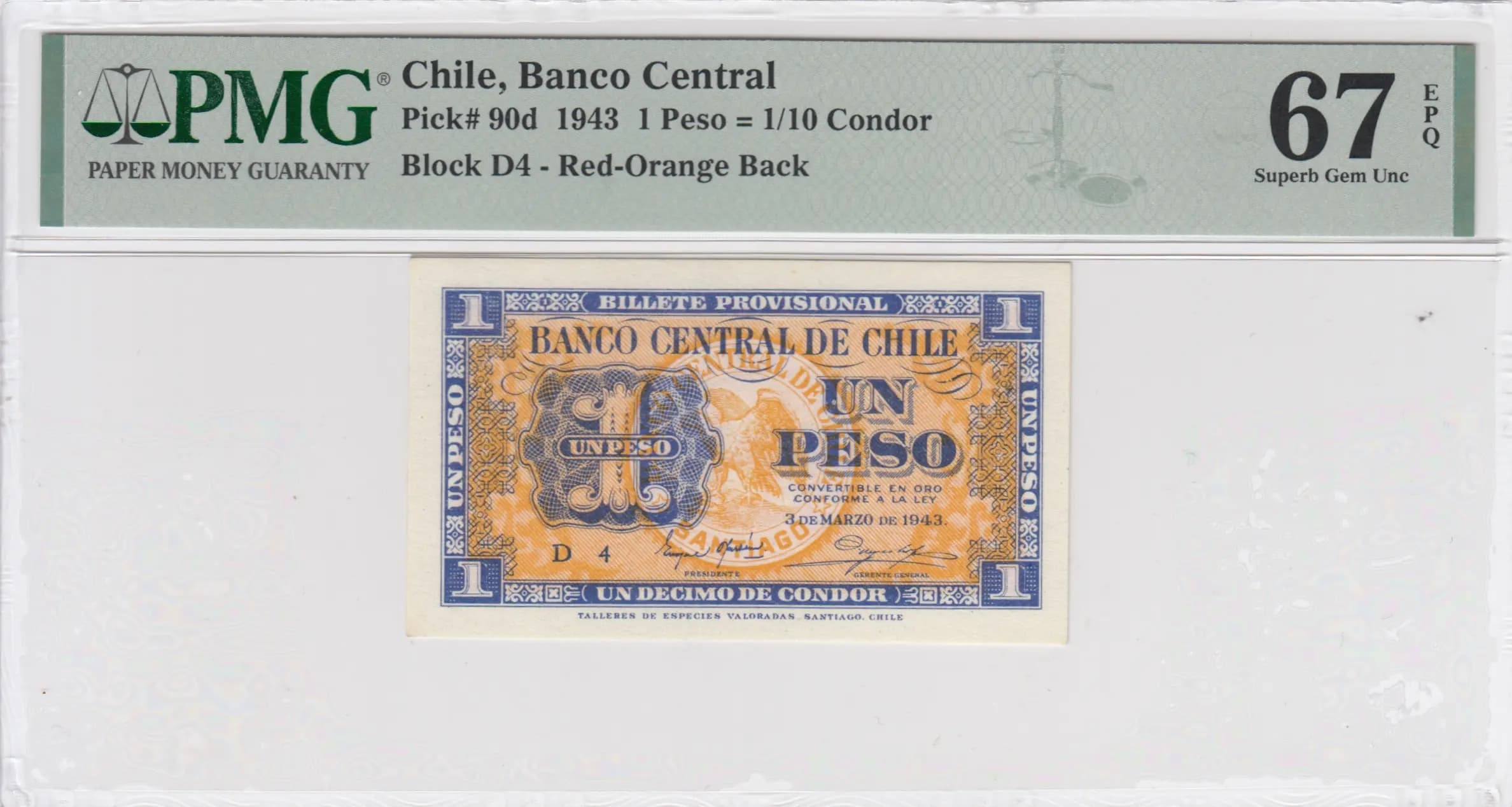
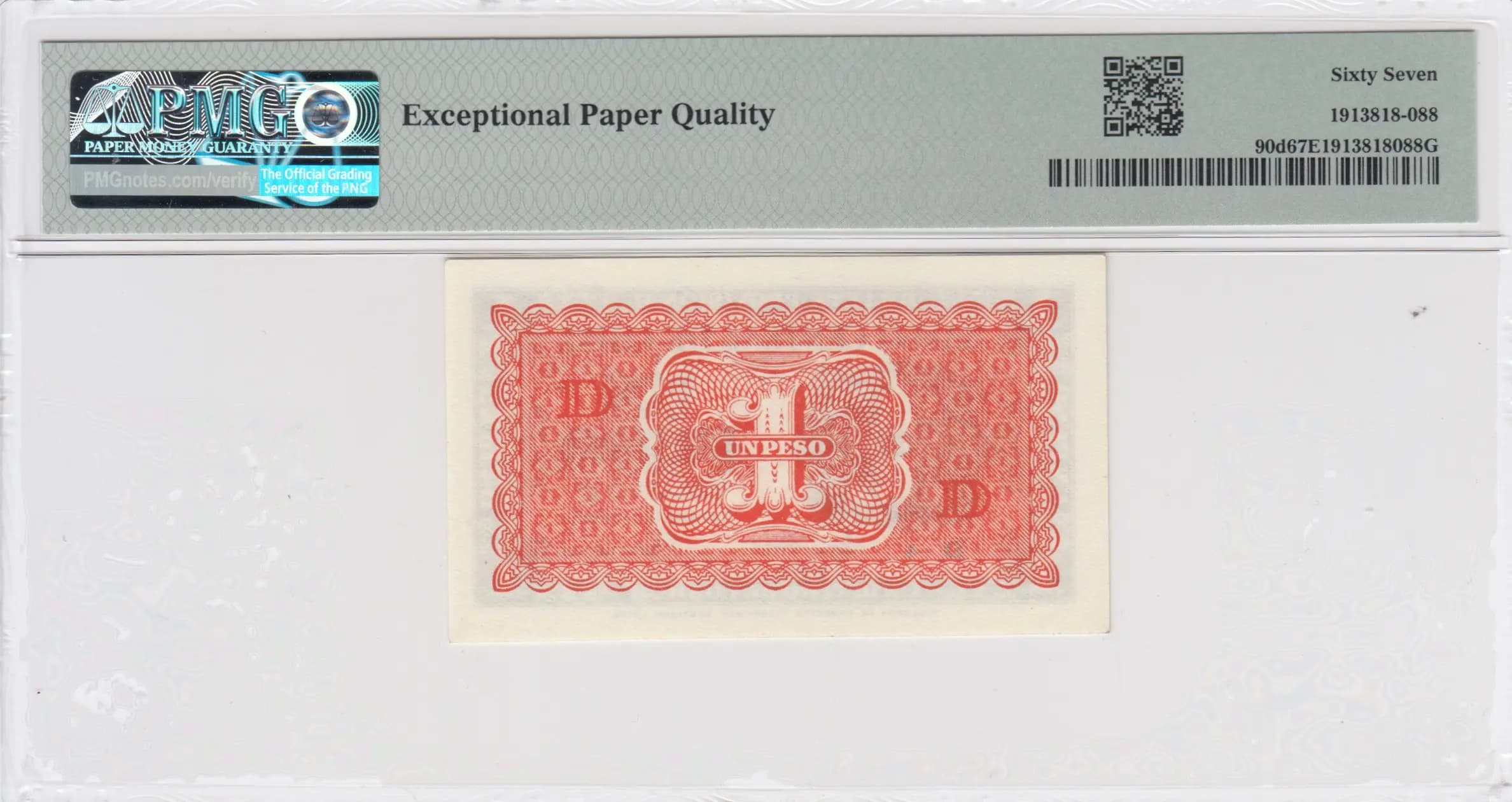
This Chilean 1 Peso from 1943 is a stunning example of early Central Bank of Chile provisional currency, graded PMG 67 EPQ (Superb Gem Uncirculated). The note features striking blue and orange coloring on the obverse with an ornate heraldic coat of arms design, while the reverse displays an intricate all-over red fine-line engraved pattern. In this exceptional near-mint state with vibrant colors and sharp printing, it represents a desirable mid-20th century Latin American banknote.
Common. eBay sales data shows regular market activity with multiple examples selling in recent years ranging from $7.50 to $20.50 depending on condition grade. Catalog valuations place even uncirculated examples at approximately $5 as of 2016. The regular issue designation and apparent adequate production run indicate this is a commonly encountered Chilean note among collectors. While the PMG 67 EPQ grade is high quality, the underlying note itself is not scarce.
Issued on March 3, 1943, during the middle of World War II, this provisional banknote marks an important period in Chilean monetary history when the Central Bank of Chile was establishing its authority over currency production. The note's declaration as 'Convertible into gold in accordance with the law' and its denomination as '1/10 Condor' reflects Chile's historical gold standard monetary system. The printer attribution to Talleres de Especies Valoradas in Santiago demonstrates Chile's domestic capacity for high-quality banknote production during wartime.
The obverse features the coat of arms or heraldic emblem of Chile rendered in dark blue against an orange background, positioned centrally within an ornate geometric border frame. The denomination '1' appears in all four corners with decorative ornamental flourishes. The reverse displays a sophisticated all-over security pattern composed of intricate fine-line engraving in red, with a scalloped cartouche containing the denomination text at center. The denomination equivalency as '1/10 Condor' is prominently noted, reflecting the historical relationship between the peso and the condor gold standard unit. The 'BILLETE PROVISIONAL' designation indicates this was issued as temporary currency pending regular series circulation.
FRONT: 'BILLETE PROVISIONAL' (Provisional Banknote) — 'BANCO CENTRAL DE CHILE' (Central Bank of Chile) — 'UN PESO' (One Peso) — 'CONVERTIBLE EN ORO CONFORME A LA LEY' (Convertible into gold in accordance with the law) — '3 DE MARZO DE 1943' (March 3rd, 1943) — 'UN DECIMO DE CONDOR' (One tenth of a Condor) — 'D 4' (Block designation D4) — 'TALLERES DE ESPECIES VALORADAS SANTIAGO, CHILE' (Valuable Species Workshops, Santiago, Chile). BACK: 'UN PESO' (One Peso) — 'D' (Block designation).
Intaglio (line engraving), characteristic of high-security banknote production. The fine-line work observed throughout both sides, particularly the intricate geometric patterns on the reverse and the detailed border work on the obverse, are consistent with steel plate engraving. Multicolor printing achieved through sequential passes of blue and orange on the obverse and red on the reverse. Produced by Talleres de Especies Valoradas, Santiago de Chile, a specialized banknote printer.
Pick 90d designation indicates this is variety 'd' of the 1 Peso 1943 issue. The block letter 'D4' visible on the obverse and 'D' on the reverse represents the printing block designation. This particular example exhibits no visible overprints, date variations, or signature varieties that would distinguish it as a notable sub-variety. The consistent D-block designation across both sides is standard for this issue.