1 peso 1943
Market Prices
5 salesAbout This Note
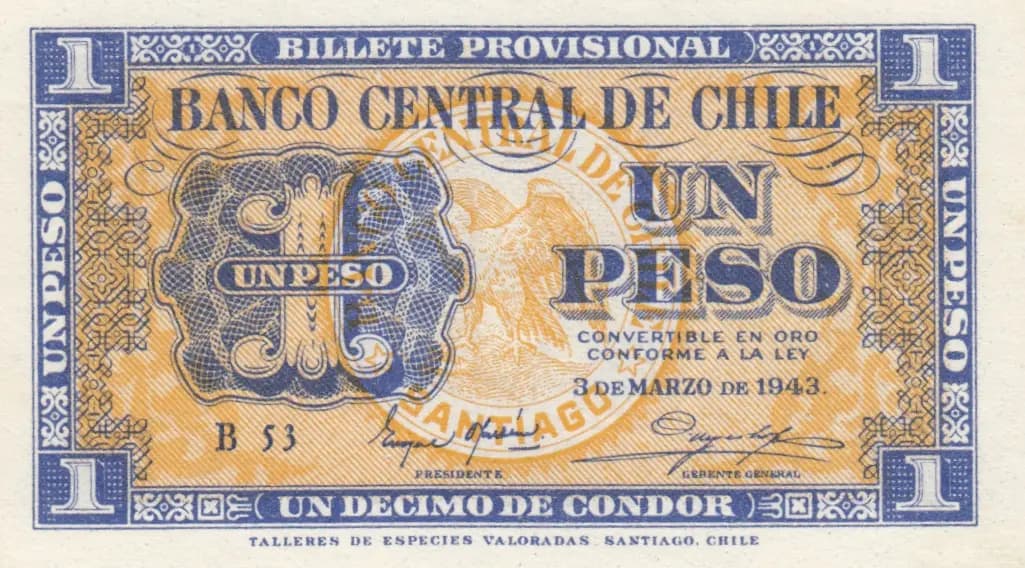
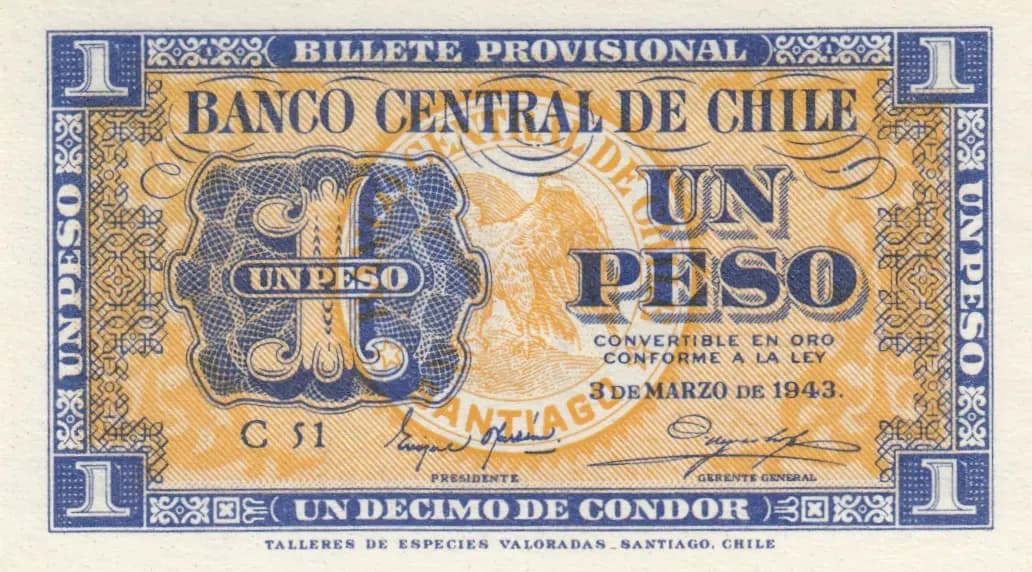
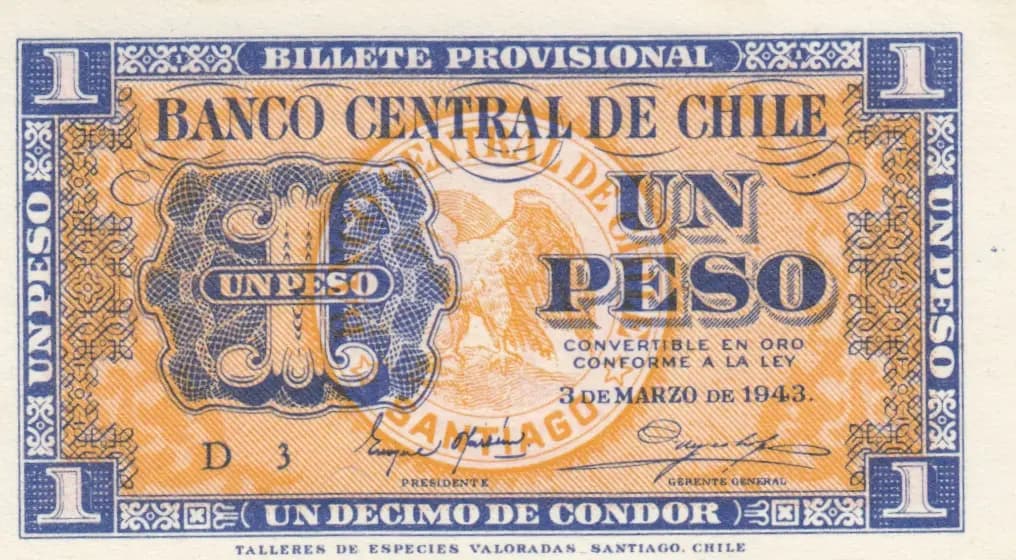
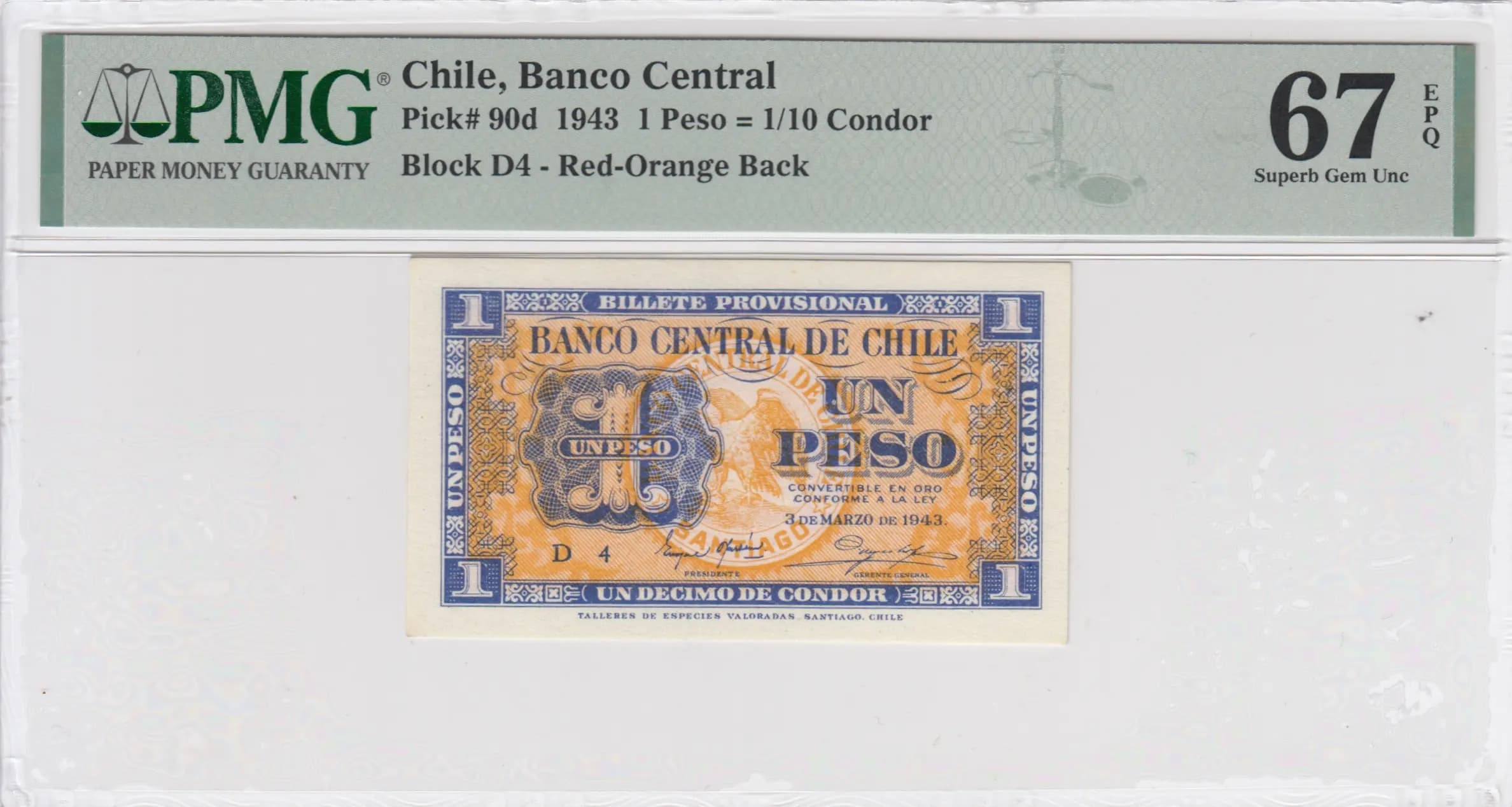
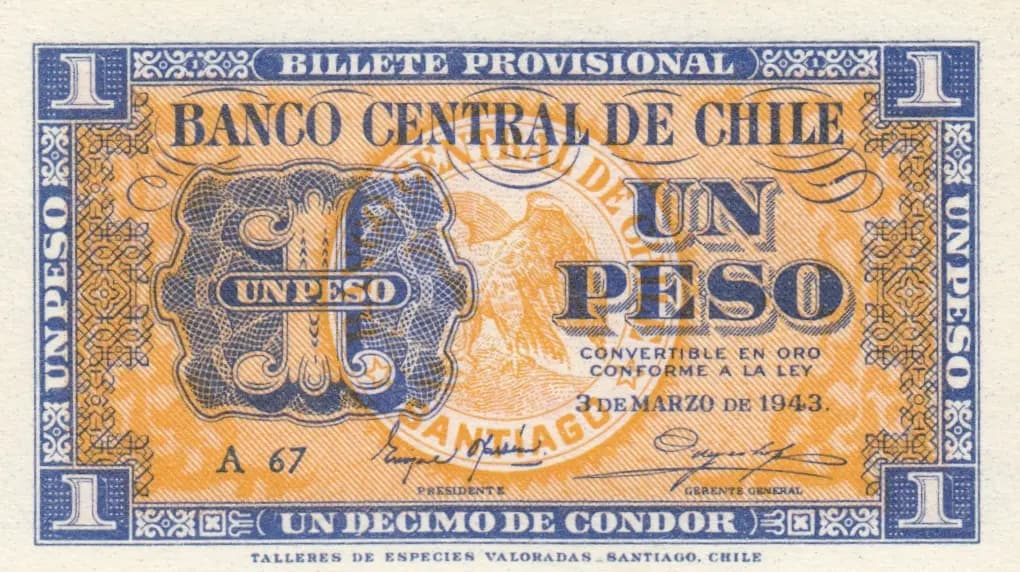
This is a Chilean provisional banknote from 1943, denominated at 1 peso (equivalent to 1/10 Condor), issued by the Banco Central de Chile. The note exhibits uncirculated condition with pristine presentation, featuring ornate blue and orange/gold decorative designs, an eagle or condor figure in flight, and intricate geometric border patterns that reflect the fine line work characteristic of mid-20th century security printing. The 'Billete Provisional' designation and the gold-convertibility clause reflect Chile's monetary transitional period during World War II.
Common. This is a regular issue from the Banco Central de Chile with no indicators of a limited print run or short-lived issuing authority. eBay market data shows UNC examples selling for $20.50 (2018) and AUNC examples trading in the $10.50–$15.50 range across multiple years, consistent with common banknotes. Catalogue values from 2016 list UNC at only $5, further confirming this is a standard, widely-available issue. Despite its age and provisional designation, no evidence suggests scarcity in the collector market.
This provisional banknote was issued on March 3, 1943, during a transitional period in Chilean monetary policy when the country was shifting its currency system and redefining the relationship between the peso and the gold-backed condor. The note's explicit inscription 'Convertible en Oro Conforme a la Ley' (Convertible in gold according to law) reflects the gold standard framework still governing Chilean currency at that time, despite wartime pressures on global monetary systems. The condor, a symbol of national pride and featured prominently on the obverse, represents Chile's historical currency unit and national identity during a period of economic stabilization.
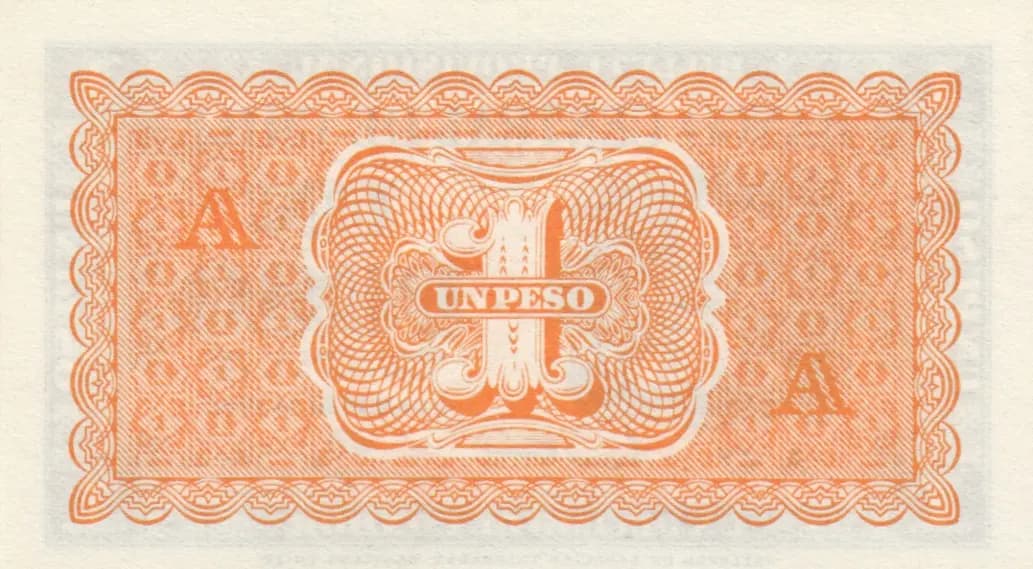
The obverse features a formal, ornate design centered on a decorative shield or cartouche containing the denomination 'UN PESO,' framed by an intricate geometric border in blue and orange/gold tones on a cream background. A condor (the national symbol of Chile and reference to the currency unit) is depicted in flight in the upper right portion, emphasizing the note's connection to the gold-backed condor currency. The reverse presents a simpler but equally detailed composition, with a large central decorative shield containing ornamental patterns including a cross or plus symbol, surrounded by an ornate rectangular border frame with geometric designs in orange/tan on a light background. The overall aesthetic reflects formal governmental and banking symbolism of the 1940s era.
FRONT: 'BILLETE PROVISIONAL' (Provisional Banknote); 'BANCO CENTRAL DE CHILE' (Central Bank of Chile); 'UN PESO' (One Peso); 'CONVERTIBLE EN ORO CONFORME A LA LEY' (Convertible in gold according to law); '3 DE MARZO DE 1943' (March 3, 1943); 'A 67' (Series designation); 'SANTIAGO' (Santiago); 'PRESIDENTE' (President); 'GERENTE GENERAL' (General Manager); 'UN DECIMO DE CONDOR' (One Tenth of a Condor); 'TALLERES DE ESPECIES VALORADAS SANTIAGO, CHILE' (Valued Species Workshops Santiago, Chile). BACK: 'UN PESO' (One Peso).
Intaglio engraving (line engraving), as evidenced by the fine line work, complex crosshatching, and intricate geometric patterns visible throughout both sides. The detailed security features, including the ornate borders and decorative shields with fine detail work, are characteristic of intaglio printing used for security documents. The printer, Talleres de Especies Valoradas of Santiago, Chile, was the official security printer for the Banco Central de Chile during this period and employed traditional intaglio techniques for banknote production.
Series A-A is noted in the catalog references (A 67 visible in the visual analysis), indicating this is from the first series of this provisional issue. Pick catalog P-90a designation suggests variant 'a' status; inquiries into other variants (P-90b, P-90c, etc.) would require cross-reference with complete Pick catalog data. The specific series and sequence number should be verified against the Banco Central de Chile's records for complete variety classification.