1 peso 1943
Market Prices
5 salesAbout This Note
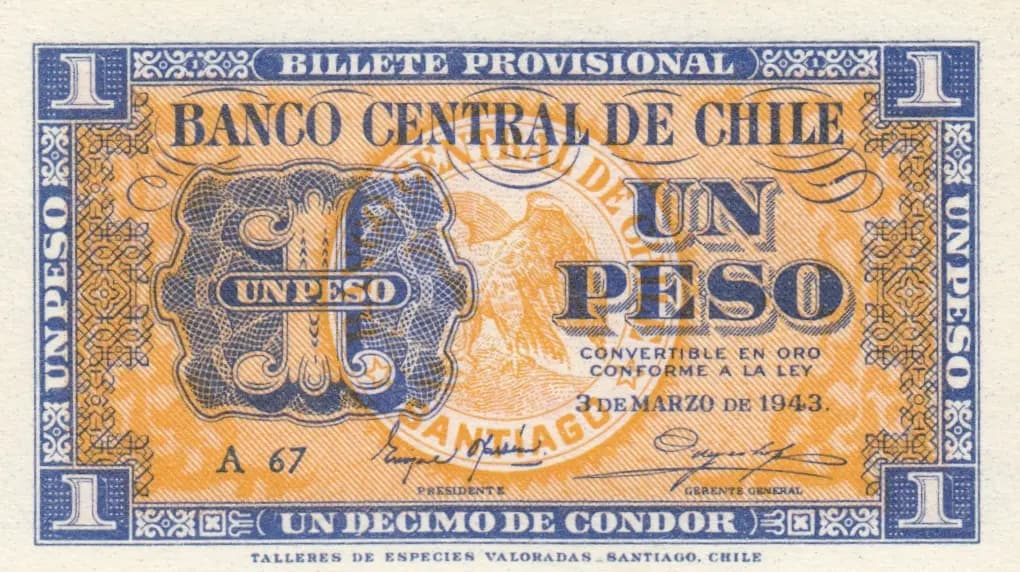
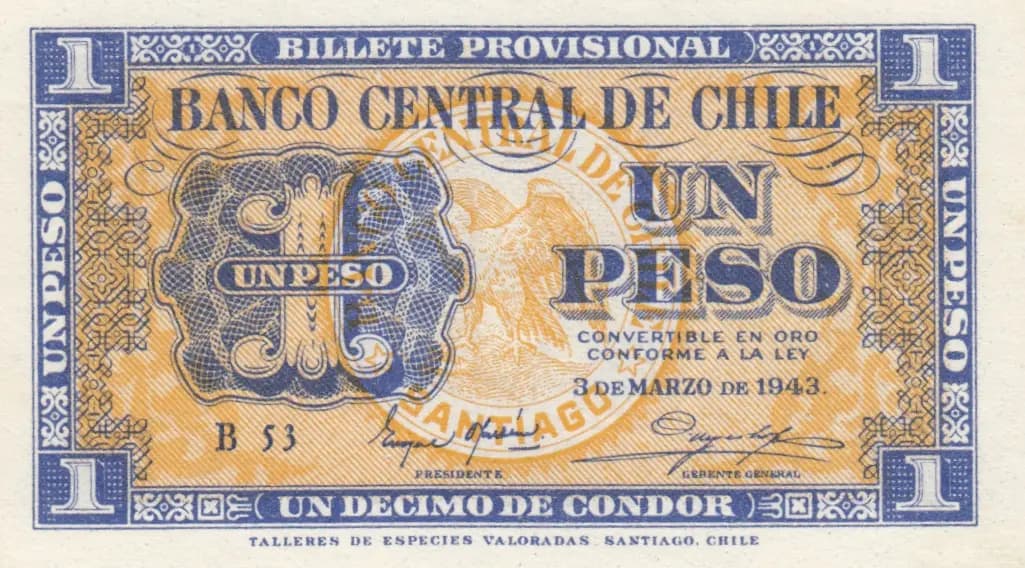
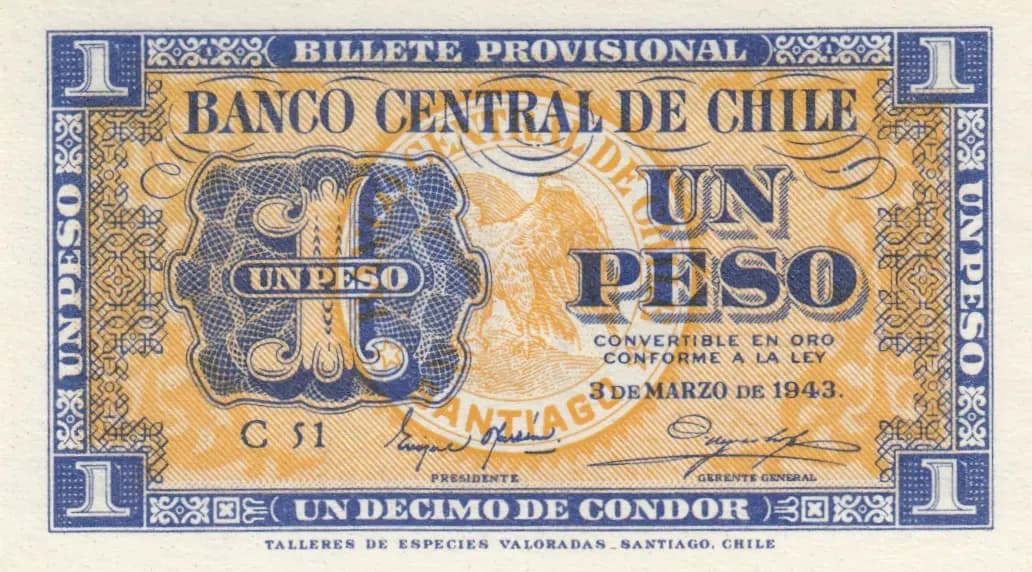
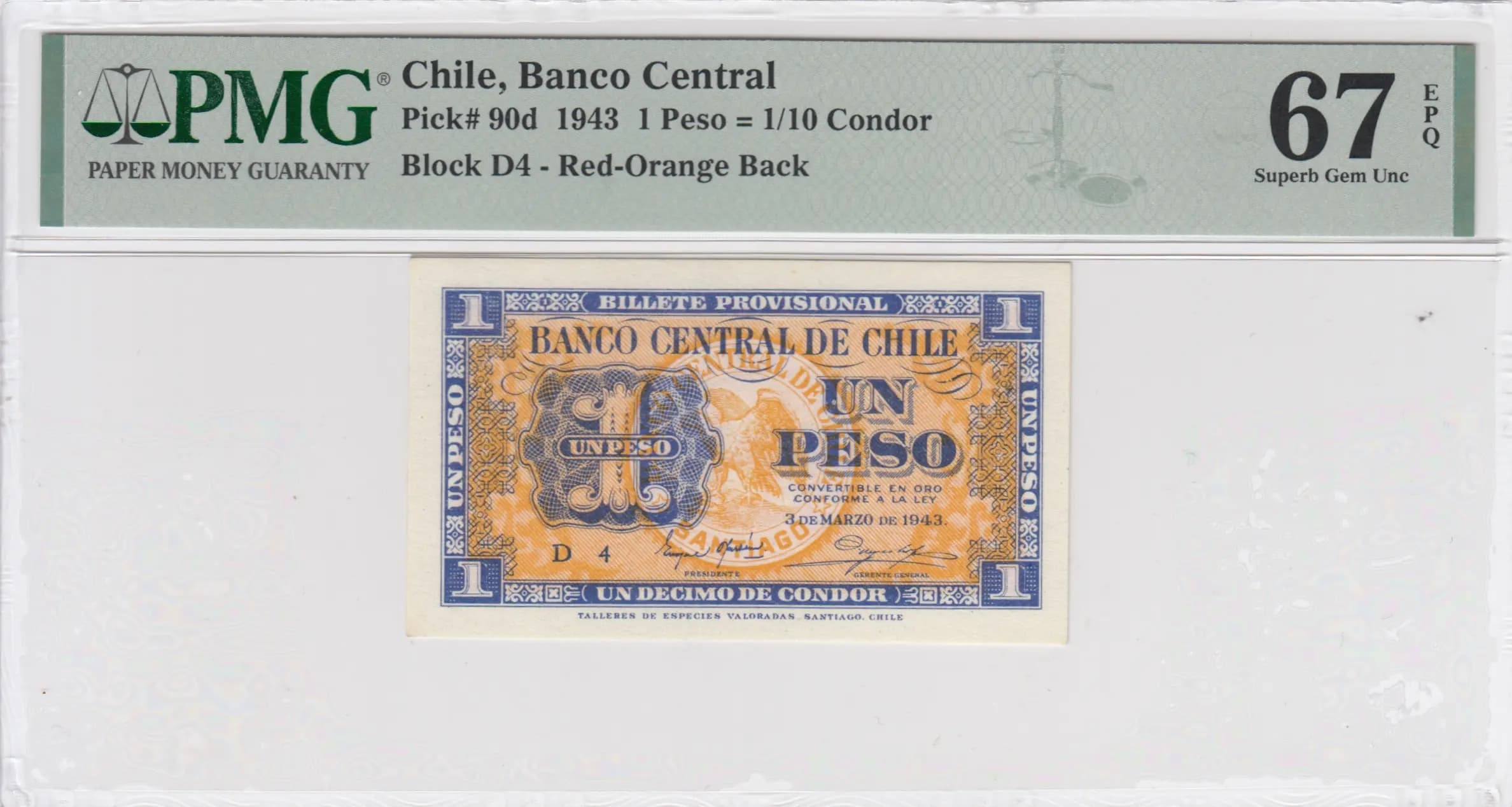
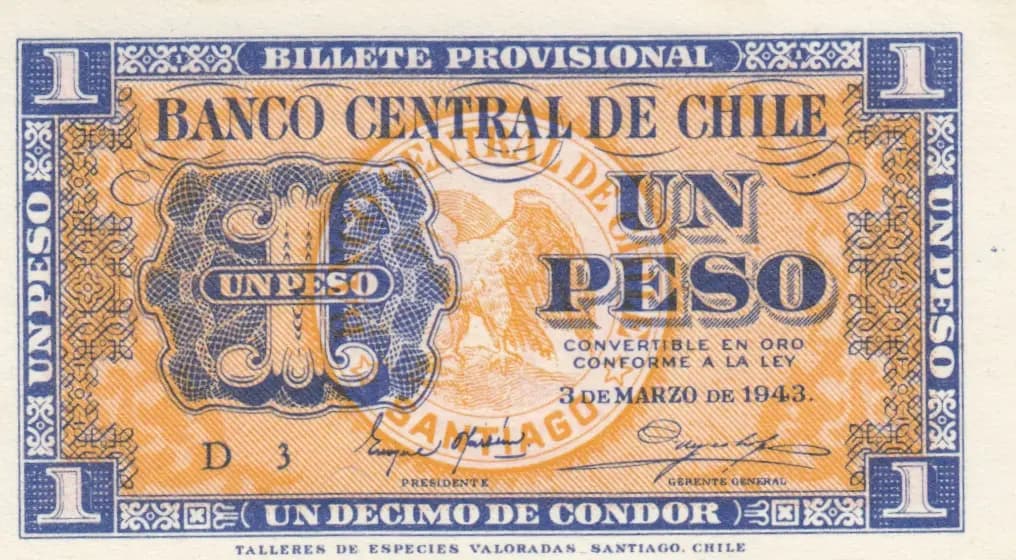
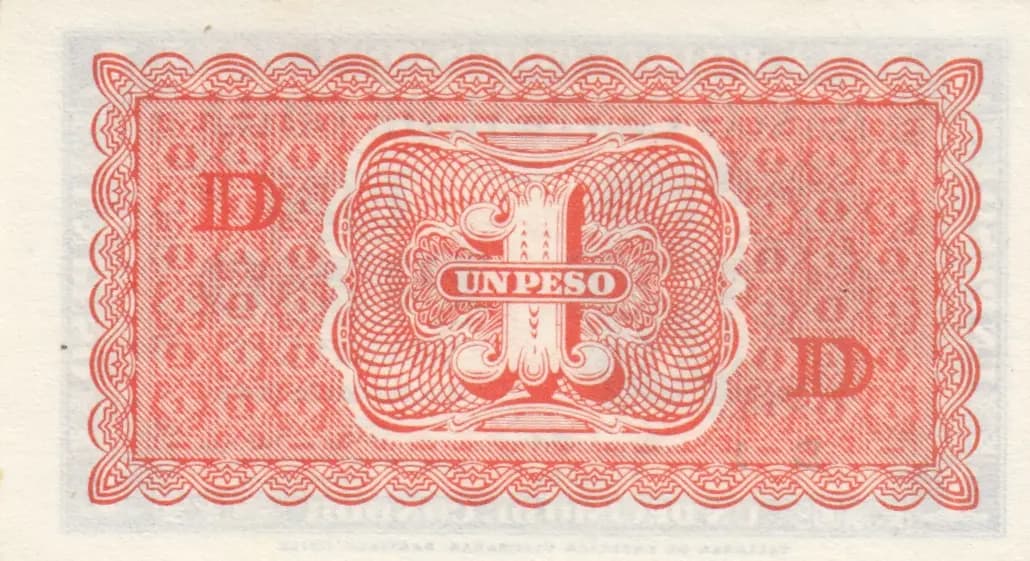
A Chilean 1 Peso provisional banknote from 1943, issued by the Banco Central de Chile and printed by Talleres de Especies Valoradas in Santiago. The note features an attractive blue and orange color scheme on the obverse with an ornate oval medallion containing the denomination, and a red-pink reverse with complementary classical engraving. In UNC condition, this historical specimen represents the provisional currency system of wartime Chile, with the note displaying sharp printing detail and minimal wear consistent with uncirculated status.
Common. Market evidence from eBay sales data shows UNC specimens selling in the $13-20 range (2016-2017), with multiple sales recorded across various condition grades (F through UNC). The 2016 catalog value for UNC was $5, with substantial trading activity indicated by 8-13 bids per sale. This provisional 1943 issue was part of a regular issue by the Banco Central de Chile with no evidence of limited print runs or recalls. The accessibility of specimens across multiple condition grades and consistent market activity confirm this as a common issue for collectors.
This provisional banknote was issued on March 3, 1943, during World War II, as Chile maintained strict currency controls and convertibility standards. The note's inscription 'Convertible en oro conforme a la ley' (Convertible into gold in accordance with the law) reflects Chile's commitment to the gold standard during this period. The 'Un décimo de Condor' (one-tenth of a Condor) designation references Chile's earlier currency unit, demonstrating the transitional monetary system between the old Condor standard and the modern Peso framework.
The obverse features a classical design centered on an ornate oval medallion containing 'UN PESO' in elegant script, flanked by decorative flourishes. Above this medallion is an Andean condor in orange, a prominent national symbol of Chile. The note employs a blue primary color with orange/tan accents and white/cream backgrounds, bordered by intricate geometric and ornamental patterns. The reverse maintains classical aesthetics with a predominantly red-pink palette and a complementary oval medallion design with fine line engraving work. Both sides feature geometric corner ornaments typical of early 20th-century banknote design. The denomination is clearly marked in multiple locations, with the series marking 'D' visible on both sides.
OBVERSE: 'Billete Provisional' (Provisional Banknote) | 'Banco Central de Chile' (Central Bank of Chile) | 'Un Peso' (One Peso) | 'Convertible en oro conforme a la ley' (Convertible into gold in accordance with the law) | '3 de Marzo de 1943' (March 3, 1943) | 'Presidente' (President) | 'Gerente General' (General Manager) | 'Un décimo de Condor' (One tenth of a Condor) | 'Talleres de Especies Valoradas Santiago, Chile' (Valued Currency Workshops Santiago, Chile) | 'D 3' (Series marking). REVERSE: 'Un Peso' (One Peso) | 'D' (Series marking).
Intaglio engraving (line engraving), characteristic of security printing of this era. The detailed ornamental borders, fine line work within the medallions, and intricate geometric patterns all indicate traditional intaglio production methods. This was executed by Talleres de Especies Valoradas (Valued Currency Workshops) in Santiago, Chile, a specialized security printing facility established for producing governmental currency and valued documents. The multi-color printing (blue/orange on obverse, red/pink on reverse) was achieved through multiple plate passes typical of premium banknote production.
This specimen bears the series marking 'D-D' (obverse/reverse) as noted in the catalog reference. The D-3 notation on the obverse front indicates a specific printing variant. The date of issue is fixed at 3 de Marzo de 1943 (March 3, 1943). No signature variants, significant overprints, or error varieties are evident from the visual analysis. This appears to be a standard issue from the D series.