1 peso 1942
Market Prices
8 salesAbout This Note
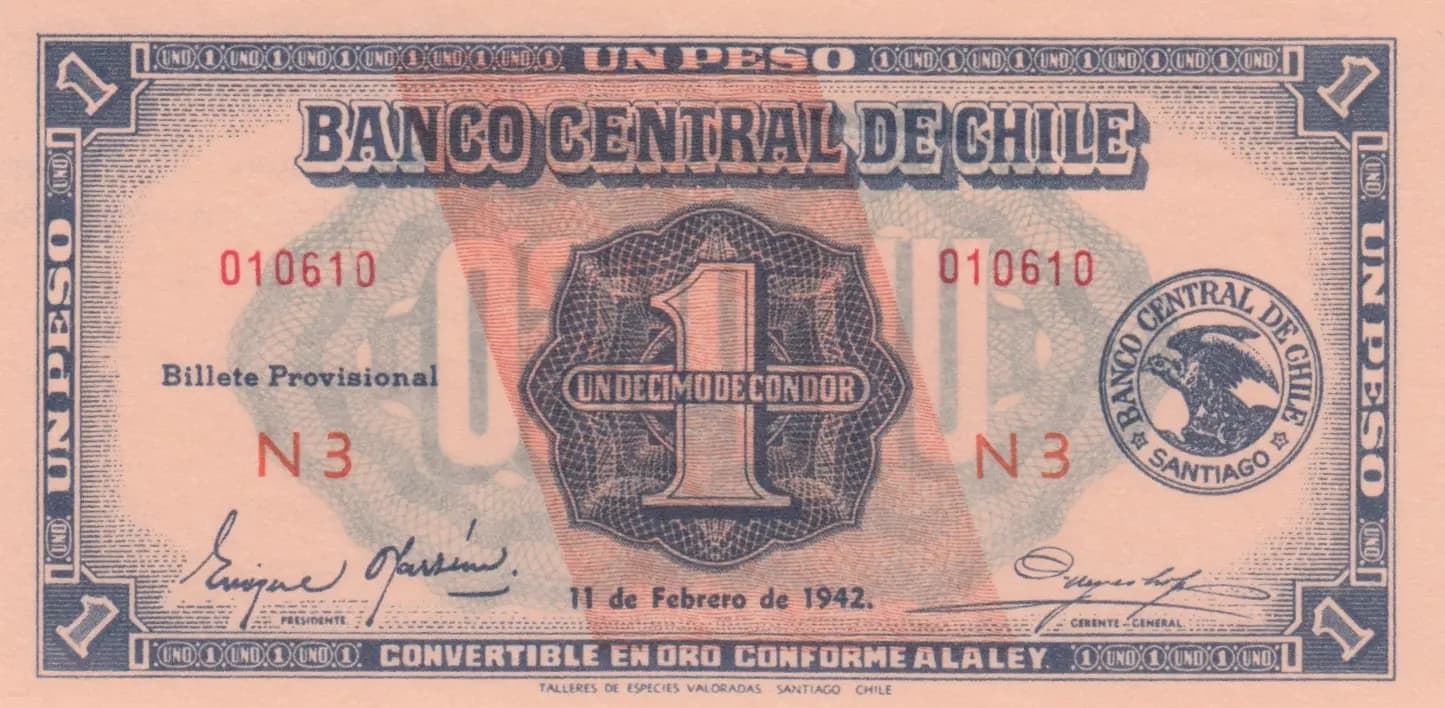
This is a Chilean 1 Peso note from 1942 (Pick P-89), issued by the Banco Central de Chile on February 11, 1942. The note presents in uncirculated condition with sharp, clear printing throughout, featuring a striking salmon/peach background with blue-gray decorative elements and an ornamental shield-shaped frame containing the numeral 1. The design includes the Banco Central de Chile seal with an eagle emblem, fine guilloche patterns, and red serial numbers, representing a well-preserved example of this provisional currency issue.
Common. This note, while historically interesting, remains common in the numismatic market. The eBay price data provided shows consistent sales activity across multiple condition grades, with UNC examples selling in the $18–$83 range in recent transactions. The 2016 catalogue value of $10 for UNC condition and the frequency of sales at modest prices indicate this was a substantial print run with good availability in the collector market. No evidence of rarity exists from the PMG population report or market data.
This note was issued during 1942, in the midst of World War II, when Chile maintained official neutrality while managing significant economic pressures. The inscription 'CONVERTIBLE EN ORO CONFORME A LA LEY' (Convertible into gold according to law) reflects the gold standard framework still nominally in place during this period. The designation '1/10 Condor' references Chile's earlier Condor gold coin standard, demonstrating the continuity of Chile's monetary heritage despite the transition to paper currency as the primary circulating medium.
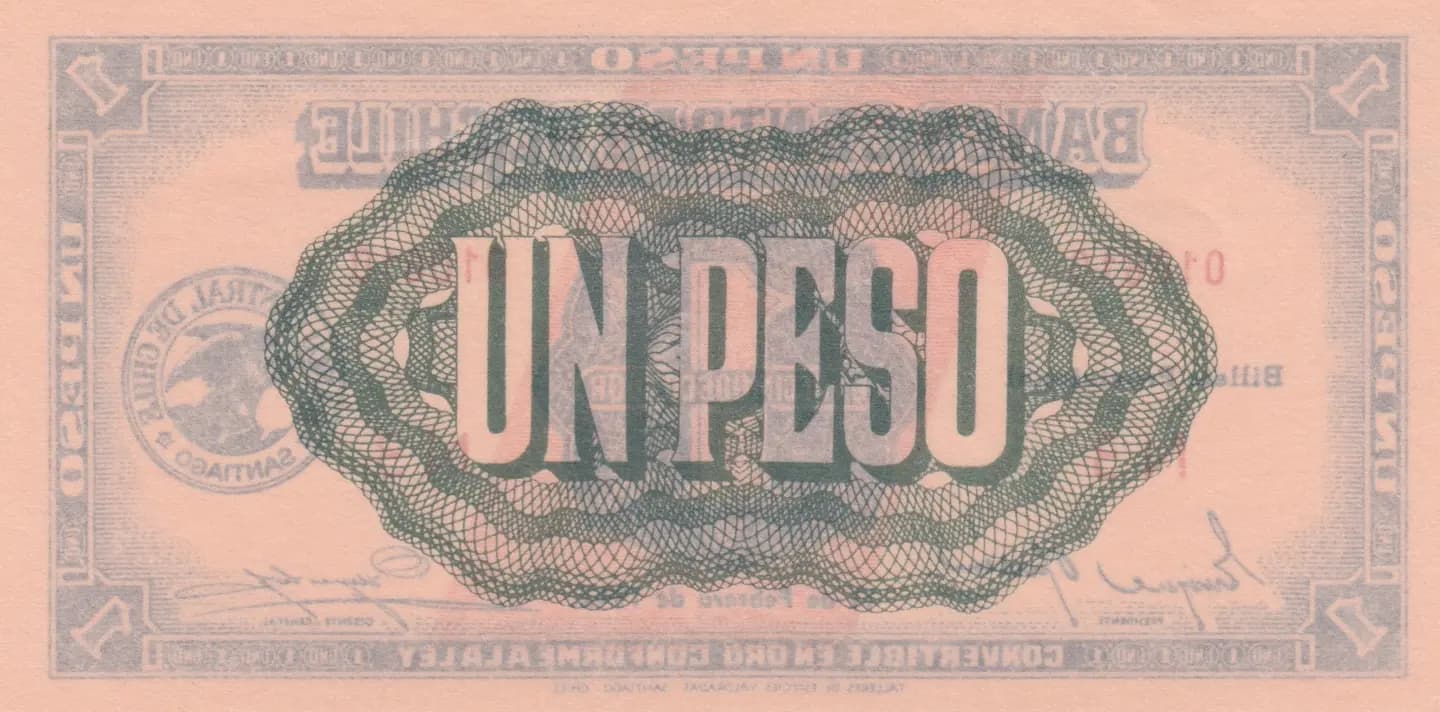
The obverse features a classical design centered on a large ornamental shield-shaped frame containing the numeral '1' in elaborate style. The note displays a salmon/peach colored background with blue-gray decorative border elements and corner ornaments marked 'UNO'. The Banco Central de Chile seal appears on the right side, featuring an eagle emblem. Text identifying the issuer and issue date are prominently displayed at the top, with the gold convertibility guarantee and printer attribution in the lower section. The reverse presents a symmetric design with a large central wreath or shield-shaped ornamental frame containing 'UN PESO', surrounded by decorative corner elements and bank emblems in faint form. The color scheme on the reverse shifts to green-gray and light blue tones on the salmon/peach base. Both sides employ fine engraved line work and guilloche patterns as security features typical of the era.
FRONT SIDE: 'UN PESO' (One Peso); 'BANCO CENTRAL DE CHILE' (Central Bank of Chile); 'Billete Provisional' (Provisional Banknote); 'UNDECIMODECONDOR' (Eleventh of Condor / One-tenth Condor); '11 de Febrero de 1942' (February 11, 1942); 'CONVERTIBLE EN ORO CONFORME A LA LEY' (Convertible into gold according to law); 'TÁLLERES DE ESPECIES VALORADAS SANTIAGO CHILE' (Valued Specimens Workshops Santiago Chile); 'PRESIDENTE' (President); 'GERENTE-GENERAL' (General Manager); Serial number 'N 3' and '010610'. BACK SIDE: 'UN PESO' (One Peso).
Intaglio engraving (recess printing), as evidenced by the sharp, crisp line work, fine guilloche patterns, and the dimensional quality visible in the ornamental frames and decorative borders. The note was printed by Talleres de Especies Valoradas (Valued Specimens Workshops) in Santiago, Chile, which was the primary security printer for Chilean currency at this time. Multiple colors were applied in successive passes—salmon/peach base with blue-gray, dark blue, and red overprints—a technique standard for high-security banknote production of the 1940s era.
Series B-E variants are documented (referenced in the realbanknotes.com catalog). The observed specimen shows Series designation visible in the note. The specific serial number format '010610' with prefix 'N 3' may indicate a particular printing batch. This Pick number (P-89) is noted in the external reference as having a similar earlier predecessor (P-88), suggesting this represents a later state of the design during the provisional banknote period of Chilean currency. No major overprints or extraordinary varieties are evident in the examined specimen.