20 pesos 1888 uncut sheet 3 pcs
Market Prices
About This Note
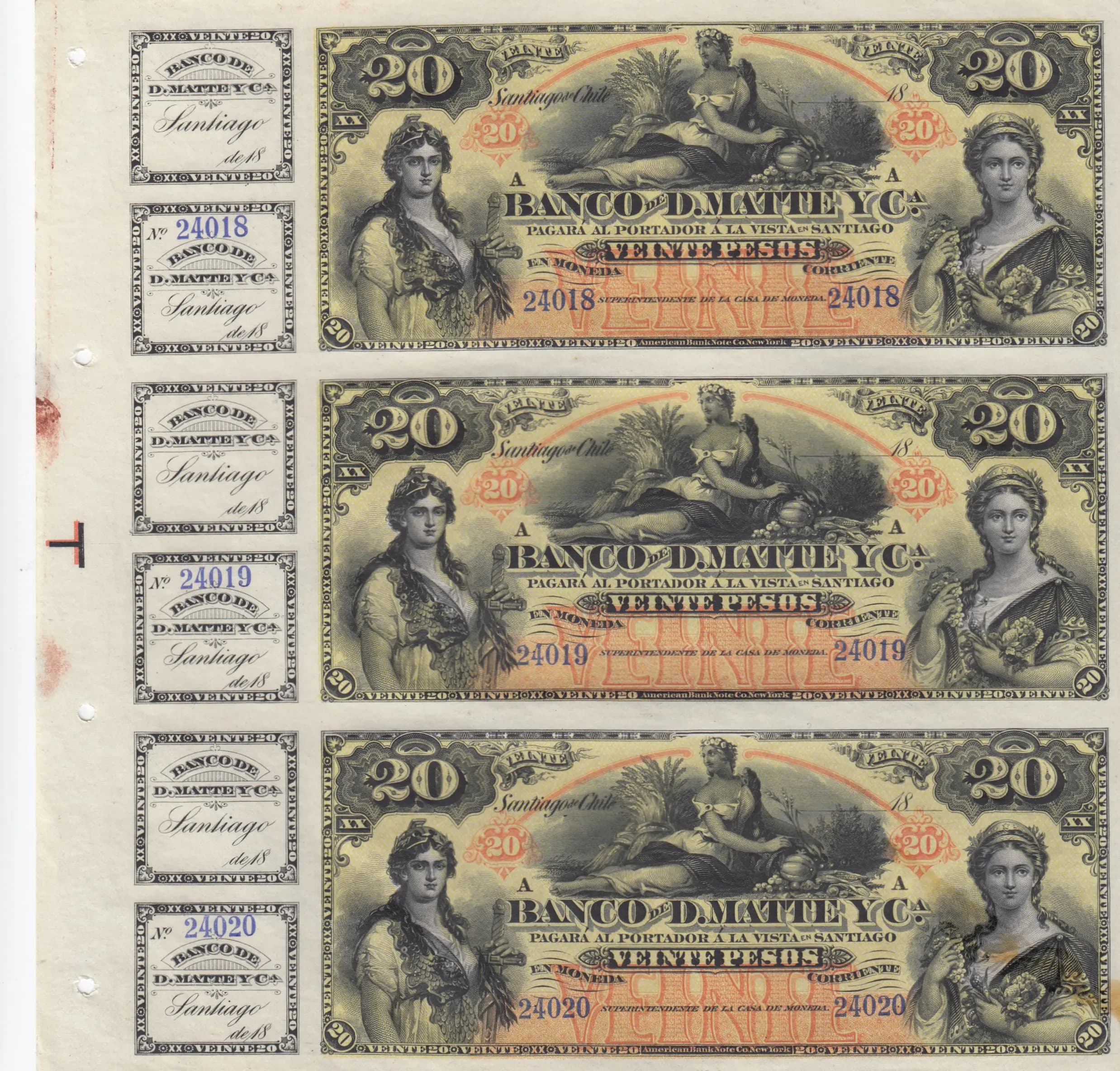
This is an uncut sheet of three 20 pesos banknotes from Banco de D. Matte y Cía, dated 1888 and printed by the American Bank Note Company. The sheet is graded AU and features sequential serial numbers (24018, 24019, 24020) with allegorical female figures representing classical virtues. The specimen is notable as a printer's proof uncut sheet with archival provenance, showing excellent preservation with only minor foxing and storage creasing consistent with 19th-century currency archives.
Uncommon. While individual specimens of this 1888 Banco de D. Matte note exist, uncut sheets of three pieces in AU condition represent a specialized collector category. eBay pricing data shows significant variation ($6.50 to $750 USD) depending on condition and grading, but AU specimens consistently trade in the $550 range, indicating strong but limited collector demand. The printer's proof status and uncut sheet format add material scarcity beyond standard circulation notes. Not rare enough to command premium pricing of truly rare Chilean banknotes, but uncommon within the collector market.
The Banco de D. Matte y Cía was a prominent private bank operating in Santiago, Chile during the late 19th century, a period of economic development following the War of the Pacific. The allegorical female figures depicted—including representations of Strength and commerce-related virtues with produce and grapes—reflect the bank's role in financing Chile's agricultural and resource-based economy. The use of the American Bank Note Company as printer demonstrates the international standards and security printing practices adopted by Chile's banking institutions during this modernization period.
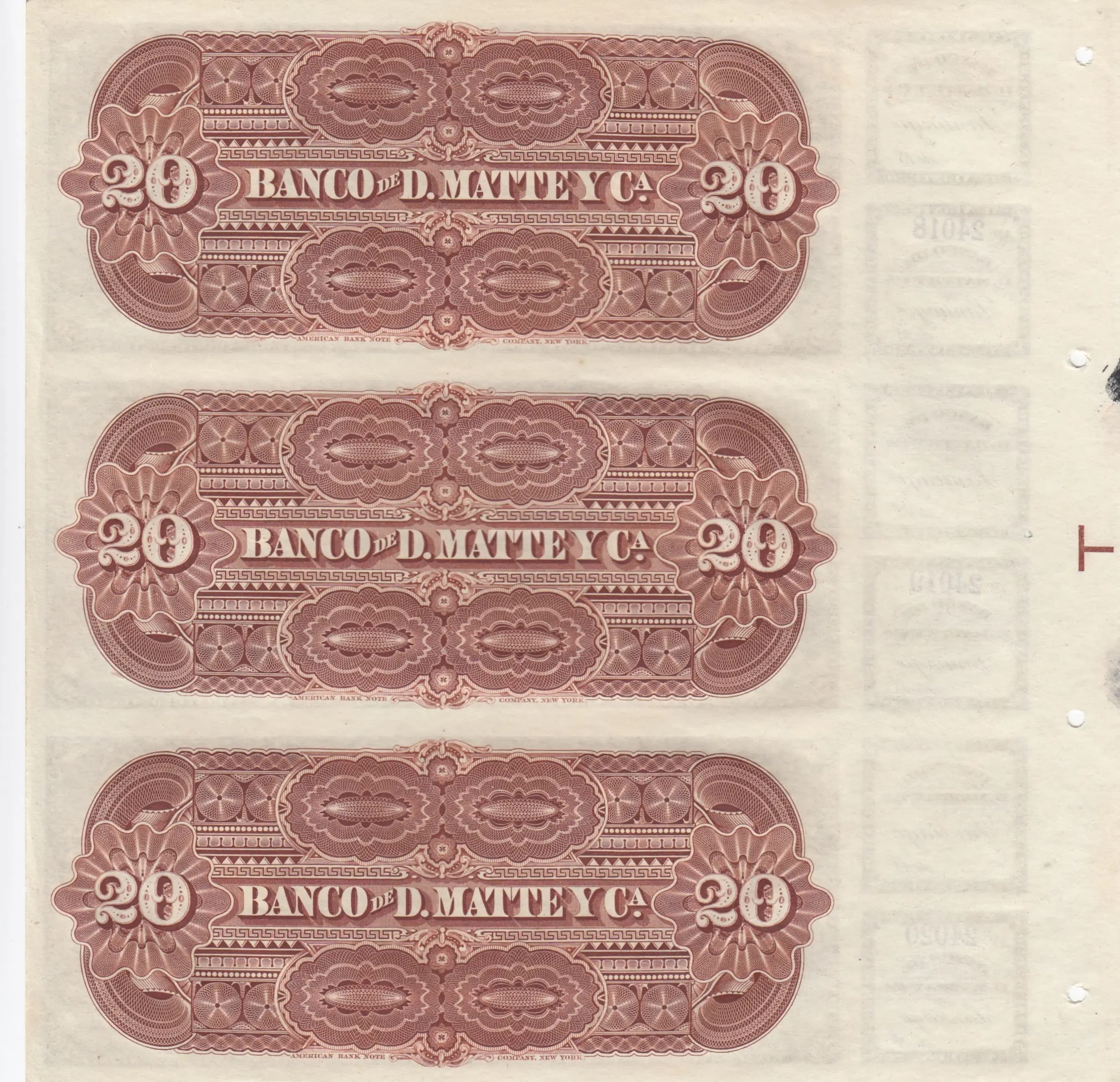
The obverse features a classical allegorical composition with three female figures: a robed 'Strength' figure at left wearing classical draped garments and headdress, a central reclining female figure at top center representing commerce or prosperity, and a crowned female allegorical figure at right associated with grapes and agricultural abundance. The design incorporates fine ornamental borders with scrollwork and classical motifs throughout. The reverse presents a symmetrical geometric and floral ornamental pattern in reddish-brown, featuring Greek key borders, corner rosettes, and central medallions—characteristic of late 19th-century security printing aesthetics. The denomination appears prominently in corners on both sides, with the bank's name centrally positioned.
FRONT SIDE: 'BANCO DE D. MATTE Y CA' (Bank of D. Matte and Co.) | 'Santiago de la' (Santiago of the [region]) | '20' and 'VEINTE PESOS' (Twenty Pesos) | 'EN MONEDA CORRIENTE' (In Current Currency) | 'PAGARÁ AL PORTADOR A LA VISTA' (Will Pay to Bearer on Demand) | Serial numbers '24018', '24019', '24020' | 'American Bank Note Co., New York' | 'Santiago del 18' (Santiago of 18 [administrative division reference]). BACK SIDE: 'BANCO DE D. MATTE Y CA' (Bank of D. Matte and Co.) | '20' (denomination) | 'American Bank Note Co., New York'
Steel engraving combined with multi-color lithography. The American Bank Note Company employed fine line engraving for the portrait vignettes and detailed cross-hatching in background areas, with security features including complex ornamental borders and fine linework designed to resist counterfeiting. The color scheme—black on cream/yellow-orange underprint on obverse and reddish-brown on reverse—was produced through precision lithographic processes combined with engraved elements, a standard technique for high-security banknote production of this era.
This is classified as Pick P-S279, specifically an uncut sheet variant (indicated by the 's' designation in PMG cataloging). The three sequential serial numbers (24018, 24019, 24020) confirm this as an original uncut sheet from production. PMG recognizes three variants for this base Pick number (P-S279p, P-S279r, P-S279s), with the 'r' and 's' variants noted as ABNC printer varieties. The specimen grade and archival storage holes along the left margin confirm this as a printer's proof or bank archive specimen rather than a circulated note. The color scheme and design elements match the reference catalog description of 'Black on yellow and orange underprint' obverse with 'red-brown' reverse.