5 pesos 1927
Market Prices
4 salesAbout This Note
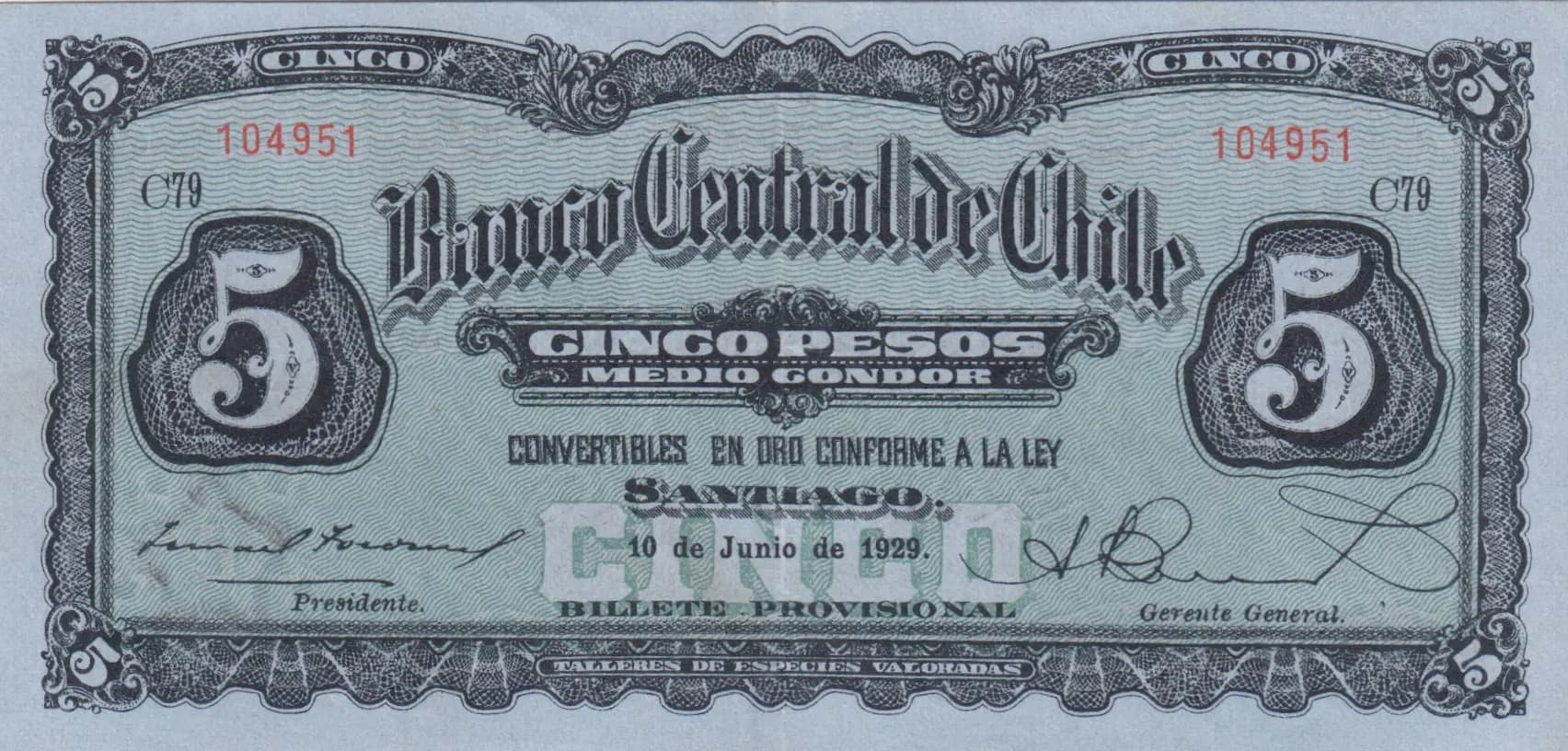
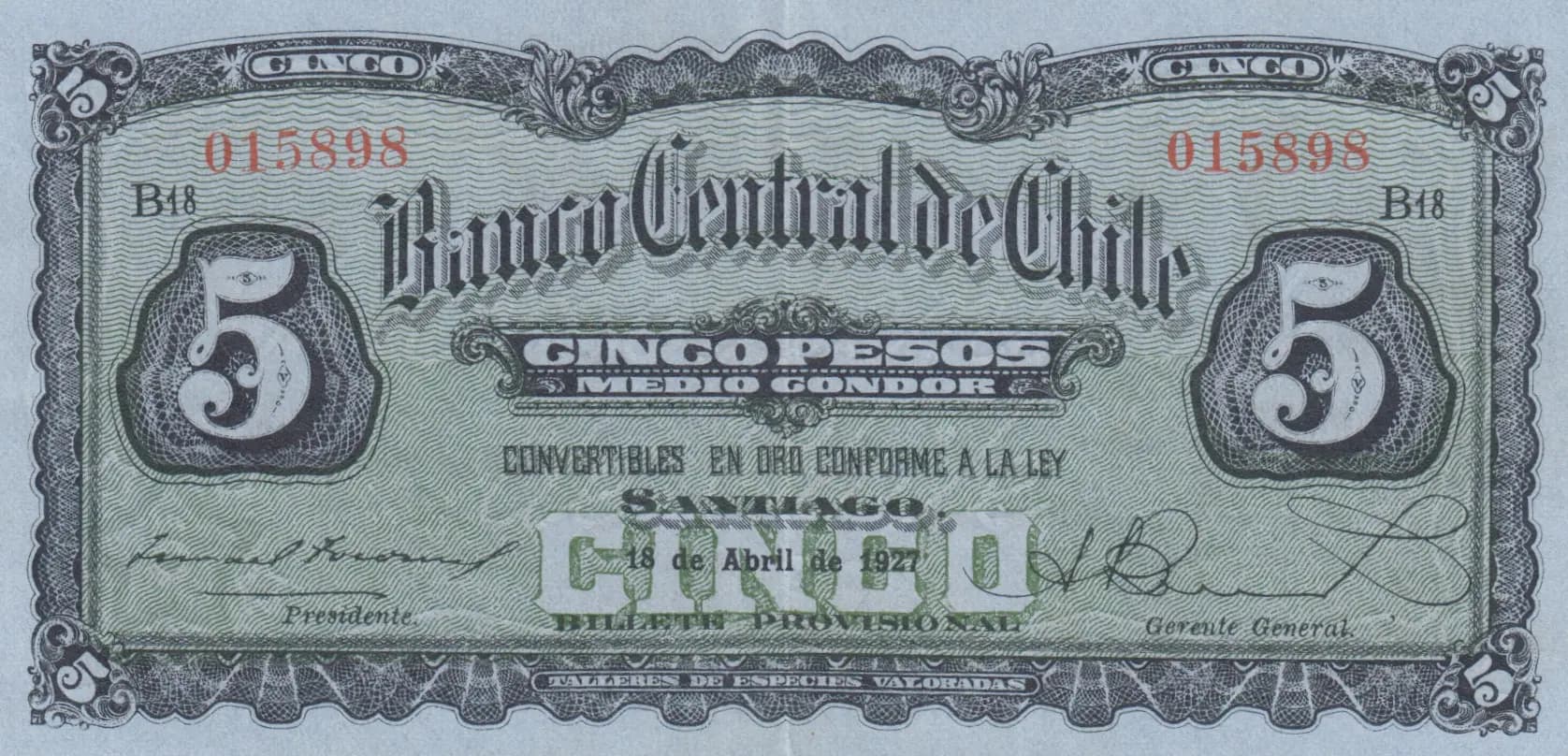
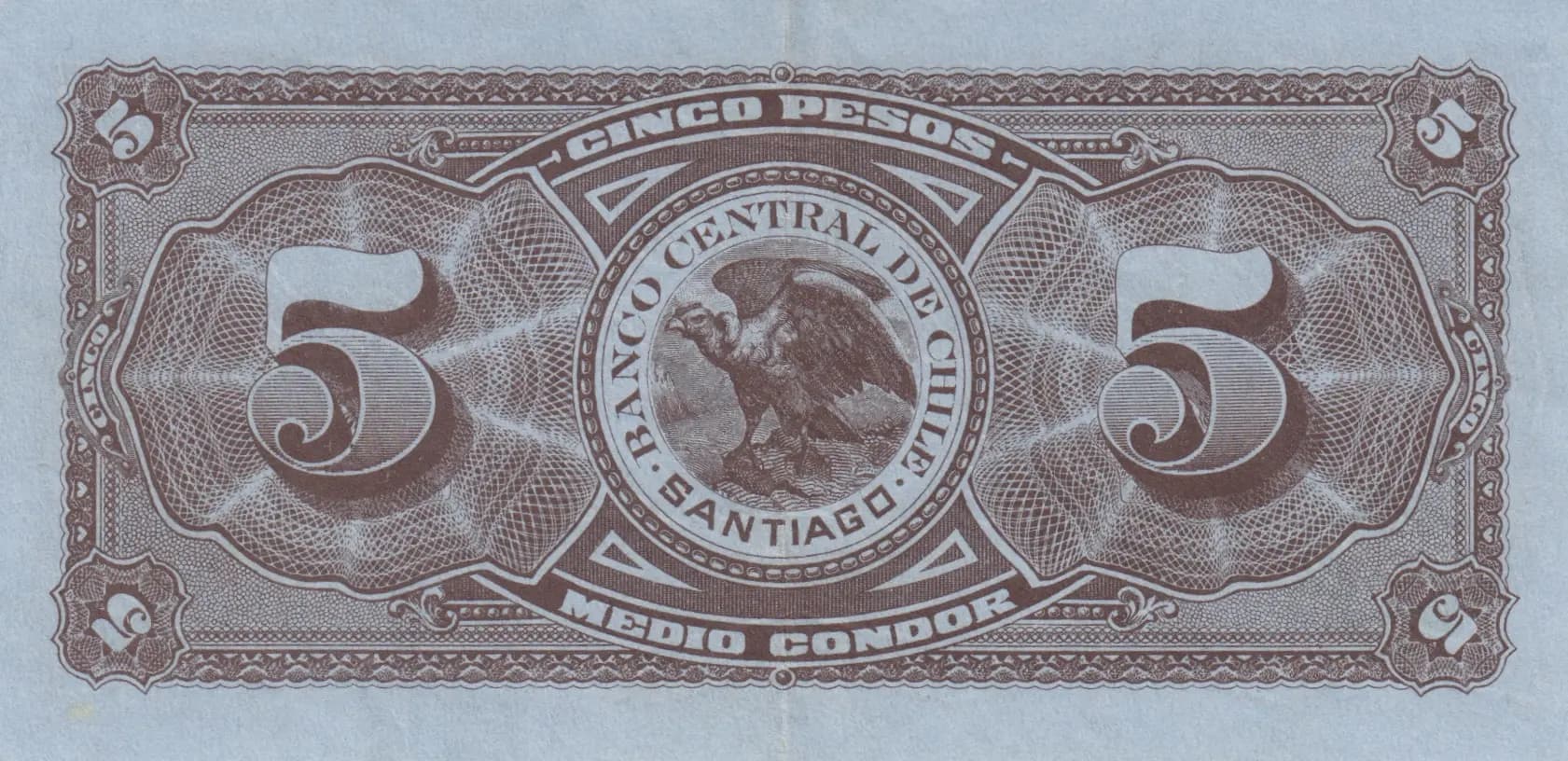
This is a 1927 Chilean 5 Pesos banknote issued by the Banco Central de Chile, featuring the characteristic 'Medio Condor' (Half Condor) monetary unit designation. The note displays an ornate front design in light blue with red serial numbers and gothic lettering, and a more minimalist back featuring a central eagle emblem within a circular seal. In VF condition, the note shows expected circulation wear including visible creases and age-related discoloration, making it a desirable example of early Central Bank of Chile currency from the gold-standard era.
Common. eBay market data shows VF examples selling in the $30-35 range (one VF sale at $33 in 2025), while catalog values from 2016 list VF at $25. The note was part of a regular issue spanning 1927-1930 with documented series varieties (B-E), indicating a substantial print run. The circulation evidence visible on this example and the availability of multiple comparable sales establish this as a readily obtainable note for collectors of early Chilean Central Bank currency.
This banknote was issued on April 16, 1927, during a period when Chilean currency was explicitly pegged to gold, as evidenced by the inscription 'CONVERTIBLES EN ORO CONFORME A LA LEY' (Convertible to gold according to law). The use of the condor reference reflects Chile's adoption of the condor as a monetary unit in the early 20th century. The Banco Central de Chile, established in 1925, was still in its infancy when this note was printed, representing an important step in modernizing the nation's monetary system under centralized banking control.
The obverse features an elegant Art Nouveau-influenced design centered on the institutional authority of the Banco Central de Chile, with the bank name prominently displayed in gothic blackletter script. Ornamental corner flourishes and a scalloped edge design at the bottom provide decorative framing. The note employs red serial numbers in the format seen (0158898 with series B10), indicating this is from the Series B-E production run documented in catalog references. The reverse depicts a central eagle emblem—representing the condor of Chilean heraldry—enclosed within a circular seal or roundel, which serves as the primary security and design element. The eagle symbol is historically significant to Chilean national identity and monetary tradition. The light blue front with gray/black printing and the brown reverse with white space create a visually distinct two-sided design typical of the era.
Front side: 'CINCO PESOS' (Five Pesos), 'Banco Central de Chile' (Central Bank of Chile), 'CONVERTIBLES EN ORO CONFORME A LA LEY' (Convertible to gold according to law), '16 de Abril de 1927' (April 16, 1927), 'SANTIAGO' (Santiago), Serial number '0158898' (appears twice), 'B10' (Series designation), 'Presidente' (President), 'Gerente General' (General Manager), 'VALORES DE ESPECIES VALORADAS' (Security printing works). Back side: 'CINCO PESOS' (Five Pesos), 'BANCO CENTRAL DE CHILE' (Central Bank of Chile), 'SANTIAGO' (Santiago), 'MEDIO CONDOR' (Half Condor), denomination numeral '5'.
This note was produced by Talleres de Especies Valoradas (Security Printing Works) in Santiago de Chile using intaglio/engraving techniques, as evidenced by the fine line work visible in the circular seal and the careful detail in ornamental elements observed in the visual analysis. The use of colored underprints (green noted in catalog reference) combined with overprinting in black and red inks demonstrates the multi-pass printing methodology standard for high-security banknote production in the 1920s. The intricate decorative borders and security design elements are characteristic of intaglio work from this period.
This note is identified as Series B10 based on the series designation visible in the visual analysis. The catalog references note the existence of signature varieties and large/small serial number varieties across the 1927-1930 production period, with series designations B through E documented. The serial number format '0158898' with the B10 designation places this within the documented variety framework for this Pick number. Additional known varieties include different printer signatures for the 'Presidente' and 'Gerente General' positions, though specific signature identification would require comparison with reference materials.