50 escudos 1958 specimen
Market Prices
About This Note
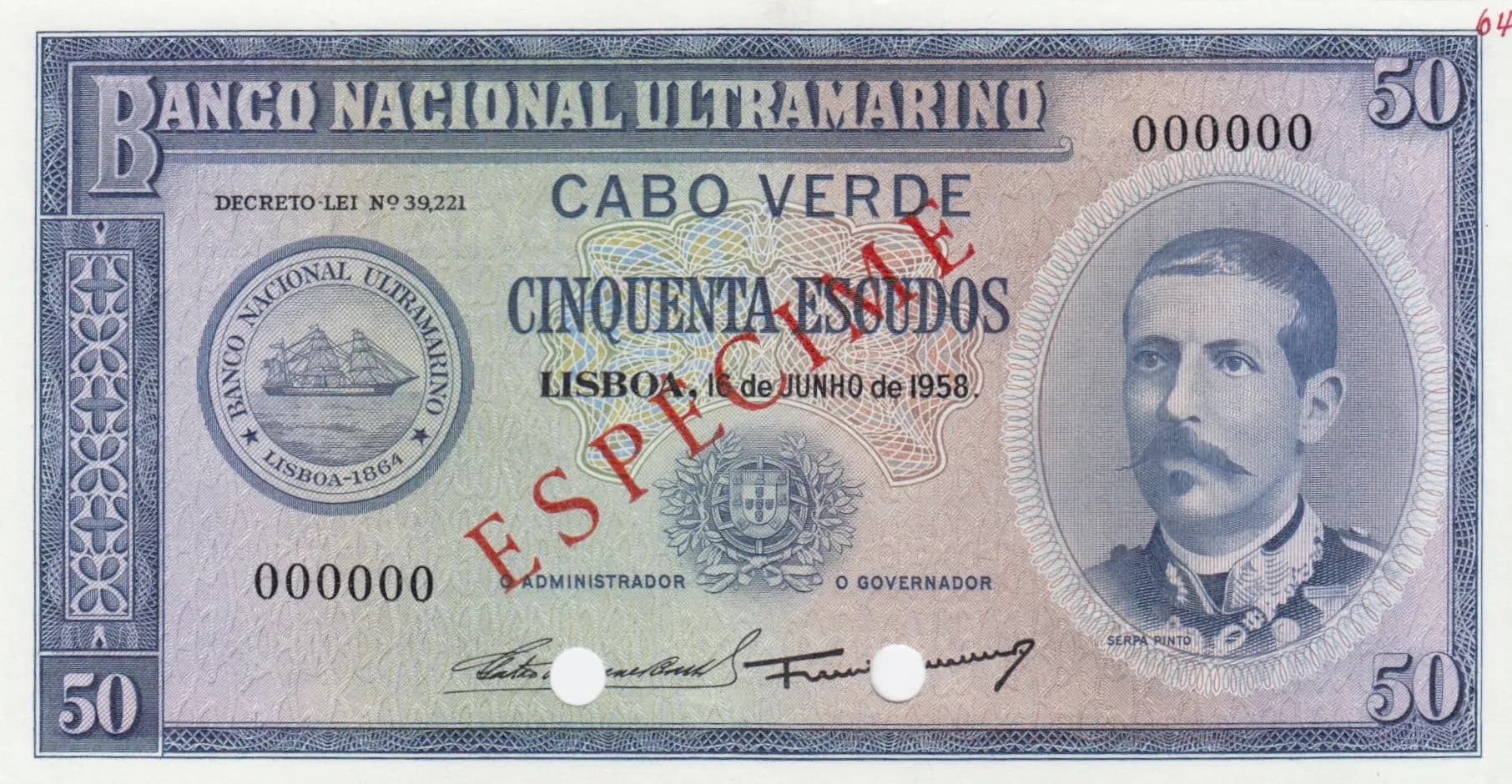
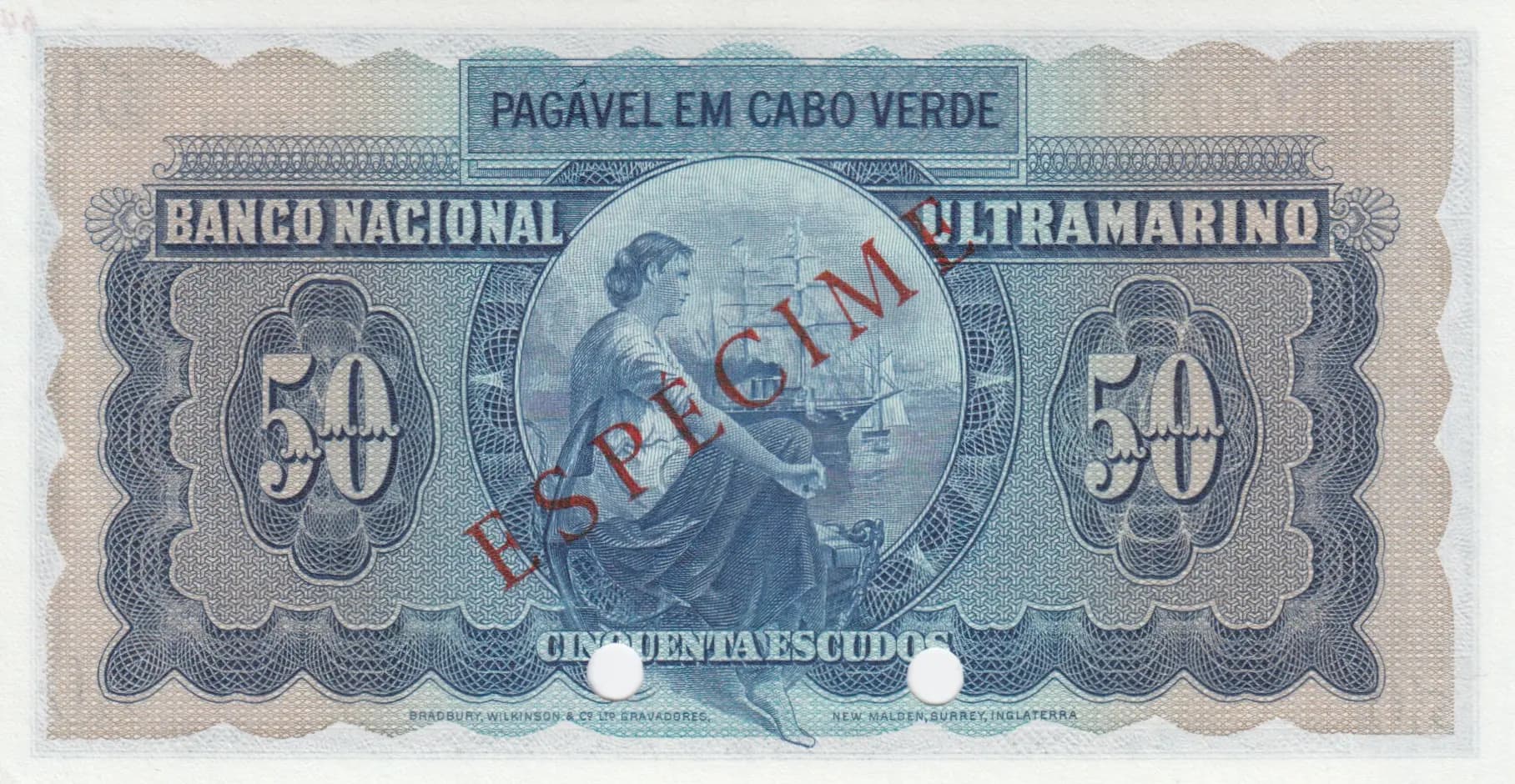
This is a remarkable UNC specimen of the Cape Verde 50 Escudos from 1958, issued by Banco Nacional Ultramarino. The note features a striking portrait of Portuguese explorer Serpa Pinto on the obverse and an allegorical female figure overlooking sailing ships on the reverse, rendered in blue and multicolored underprint with exceptional fine-line engraving. As a specimen note marked with red 'ESPECIMEN' stamp and featuring specimen holes and serial number 000000, this is a presentation piece that represents an important transitional currency for Cape Verde during the late colonial period.
Common. While this is a specimen note (which typically carries some premium over circulation issues), the eBay market data shows multiple UNC examples trading in the $325–$469 range with a 2016 catalog value of only $50. The existence of multiple recent eBay listings at various UNC price points indicates adequate supply in the collector market. Specimen notes from this series do not appear to have been produced in extremely limited quantities, and Cape Verde's currency from this period, though historical, is not particularly scarce. The specimen designation adds collector interest but does not elevate this to rare status.
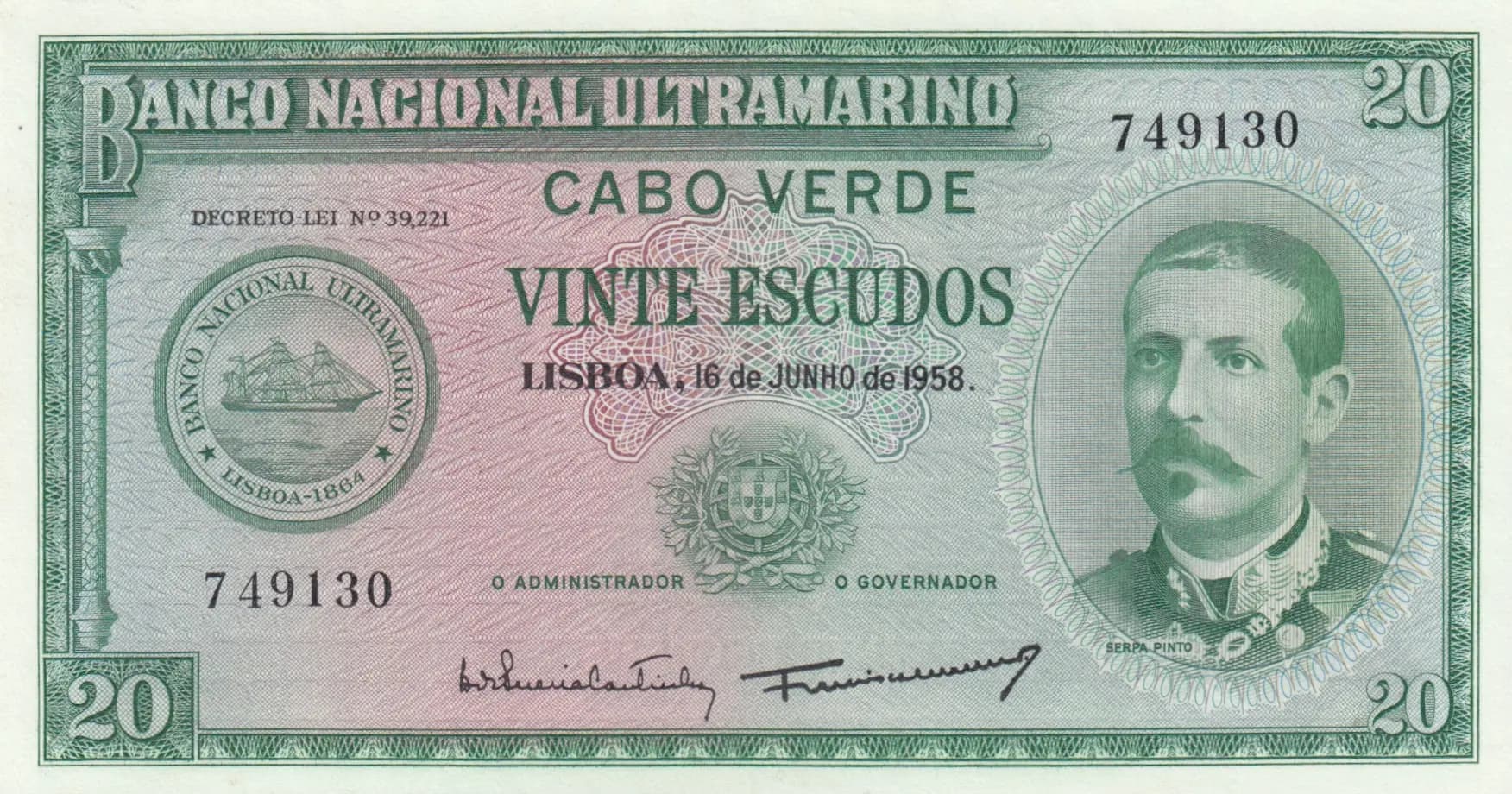
Issued on June 1, 1958, this note reflects Portugal's colonial presence in Cape Verde through the Banco Nacional Ultramarino, which managed currency across Portuguese overseas territories. The portrait of Serpa Pinto—a celebrated Portuguese explorer and colonial administrator—reinforces the imperial narrative of the era, while the allegorical woman and ships symbolize maritime commerce and colonial enterprise. This 1958 issue predates Cape Verde's independence by two decades, making it a tangible artifact of the Portuguese colonial monetary system in Africa.
The obverse presents Serpa Pinto—a bearded Portuguese explorer wearing formal period attire—positioned prominently on the right side. To the left is a circular security seal dated 1864 containing a sailing ship and text ring bearing 'Banco Nacional Ultramarino.' A Portuguese heraldic shield with cross design appears in the center. The reverse features a classical allegorical female figure in flowing robes, seated within a circular frame and gazing toward sailing ships in the background—a symbolic representation of commerce and maritime power. Both sides employ ornamental guilloche borders, fine cross-hatching, and decorative corner panels displaying the denomination 50. The dominant color palette of blue, purple, green, beige, and brown creates visual hierarchy typical of high-security currency design of the 1950s.
FRONT: Banco Nacional Ultramarino (National Overseas Bank) | Decreto·Lei Nº 39,221 (Decree-Law No. 39,221) | Cabo Verde (Cape Verde) | Cinquenta Escudos (Fifty Escudos) | Lisboa 1 de Junho de 1958 (Lisbon June 1, 1958) | Especimen (Specimen) | O Administrador (The Administrator) | O Governador (The Governor) | Serpa Pinto (portrait subject name) | Serial: 000000. BACK: Banco Nacional Ultramarino (National Overseas Bank) | Pagavel em Cabo Verde (Payable in Cape Verde) | Cinquenta Escudos (Fifty Escudos) | Especimen (Specimen) | Bradbury, Wilkinson & Co Ltd Gravadores (Bradbury, Wilkinson & Co Ltd Engravers) | New Malden, Surrey, Inglaterra (New Malden, Surrey, England) | Denomination 50 appears in ornamental corner frames.
This note was produced by Bradbury, Wilkinson & Co Ltd of New Malden, Surrey—one of the world's foremost security printers—using fine-line steel engraving and intaglio printing methods. The extensive use of guilloche patterns, complex cross-hatching, ornamental borders, and detailed circular security seals demonstrates the hallmark technique of BWC, a leader in anti-counterfeiting design. The multicolored underprint visible on the obverse indicates the use of multiple printing passes, characteristic of premium security currency production.
This is cataloged as Pick P-48s (the 's' suffix denoting specimen status). Visual inspection confirms the specimen variety with the red 'ESPECIMEN' overprint, specimen perforation holes near the center vertical axis, and serial number 000000. The PMG population report indicates P-48a and P-48cts as other cataloged variants for this base Pick number, suggesting multiple varieties exist. This particular example represents the specimen variant, which was typically produced in smaller quantities than regular circulation notes but remains collectible and relatively available compared to truly rare specimens from this issuer.