100 escudos 1958 specimen
Market Prices
About This Note
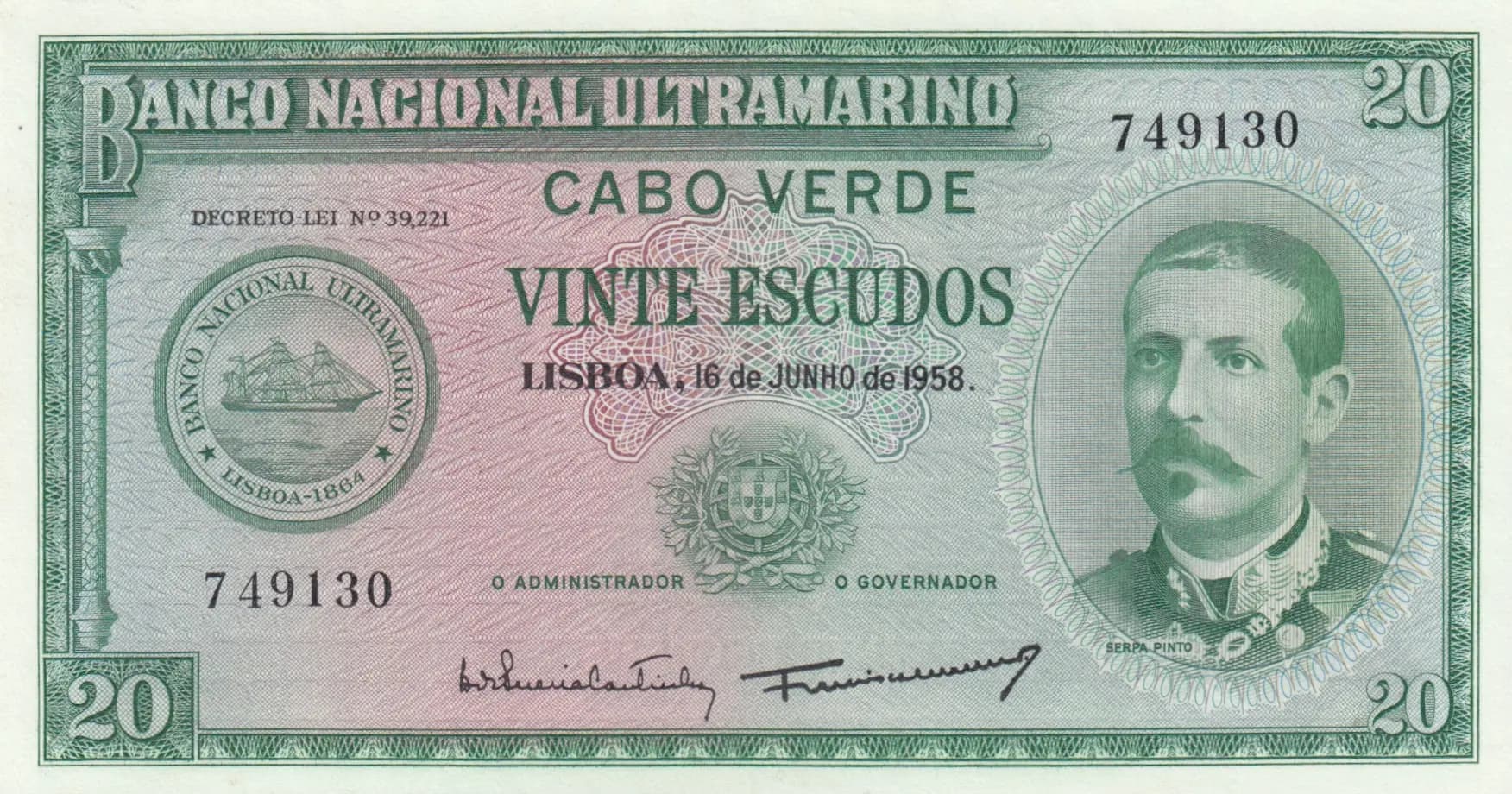
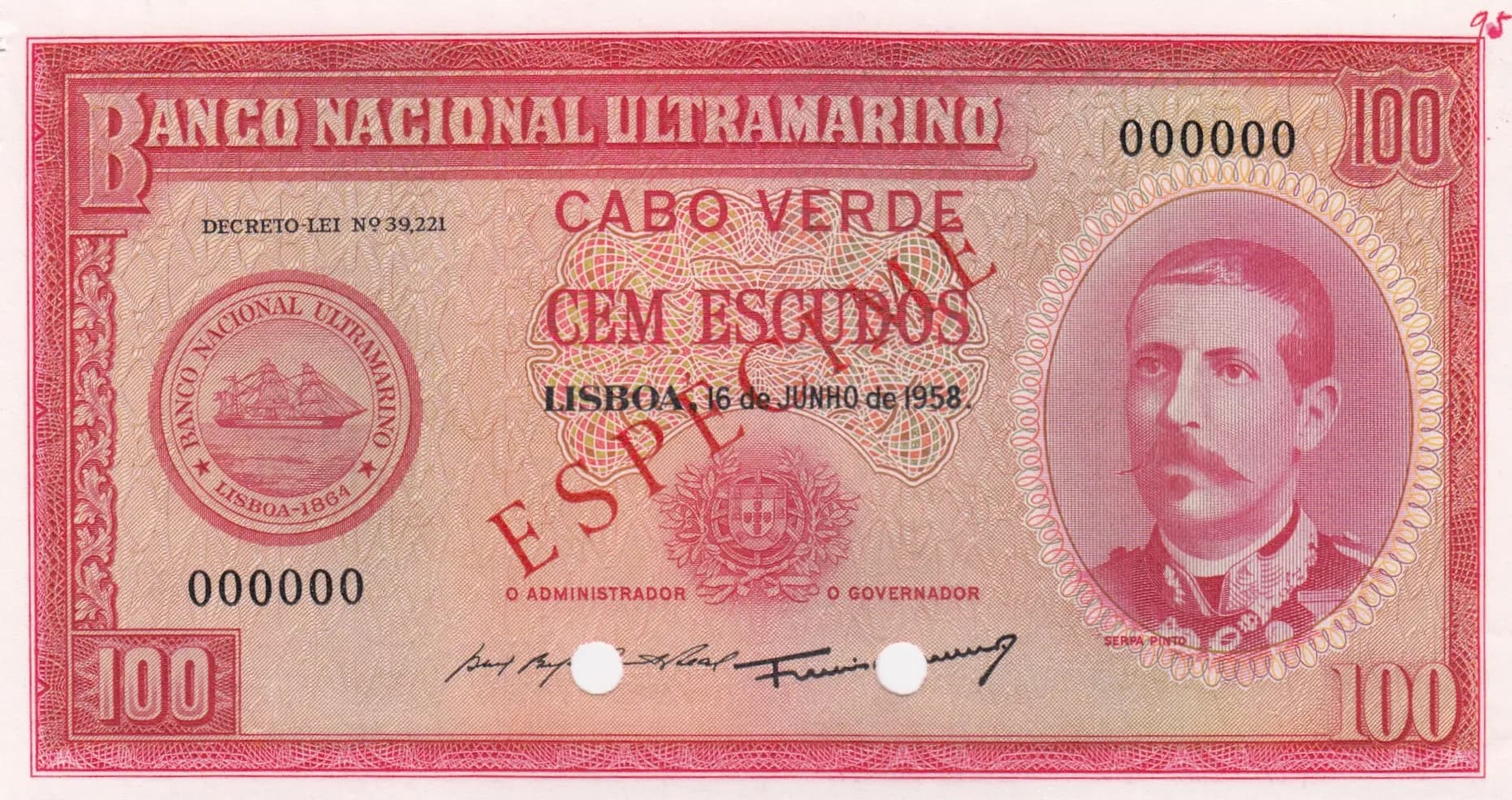
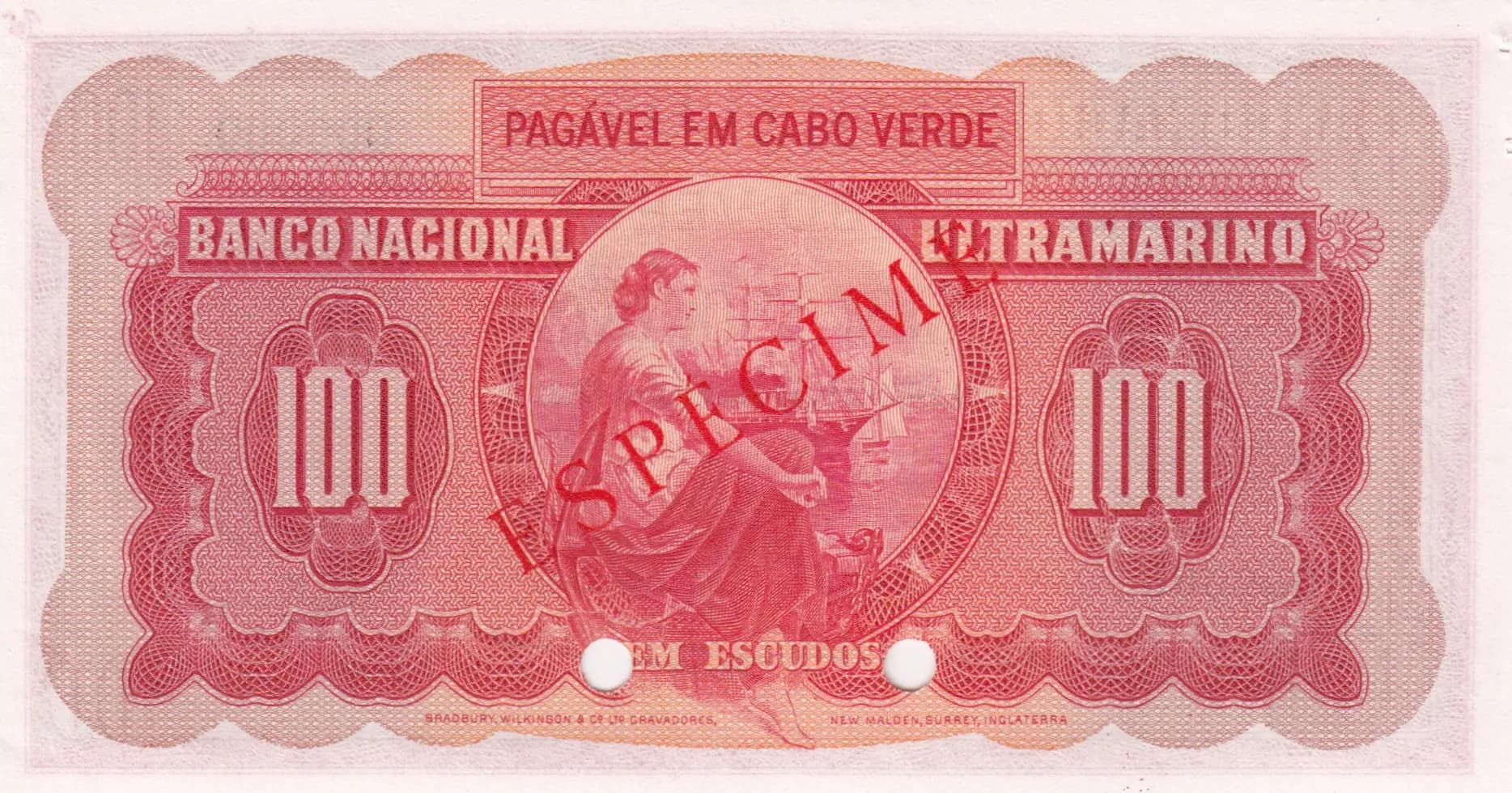
This is a Cape Verde 100 Escudos specimen note from 1958, issued by the Banco Nacional Ultramarino and printed by the prestigious security printer Bradbury Wilkinson & Co. The note displays beautiful classical design work with vibrant pink/magenta coloring, featuring a portrait of explorer Serpa Pinto on the obverse and an allegorical female figure representing virtue or liberty on the reverse. In AU condition with deliberately punched specimen holes and red specimen overprint, this is an attractive example of Portuguese colonial currency showcasing fine line engraving and intricate geometric security patterns typical of mid-20th century Portuguese banknote design.
Uncommon. While specimen notes from major issuing authorities are typically less common than circulation issues, the eBay market data shows AU-grade examples of this note trading in the $218.50 USD range, with UNC specimens reaching $249-$289. These moderate prices suggest the note is not rare but rather uncommon in the collector market. The 1958 Cape Verde 100 Escudos specimen (Pick-49s) was produced in limited quantities by definition of its specimen status, but adequate numbers survive for collectors to acquire. The note's condition and the prestige of its printer (Bradbury Wilkinson) maintain collector interest, but it remains a readily obtainable specimen for focused collectors of Portuguese colonial or Cape Verde currency.
Issued on June 16, 1958, this note represents the final era of Portuguese colonial rule in Cape Verde, when the archipelago was administered as part of the Portuguese overseas territories under the Banco Nacional Ultramarino, Portugal's colonial banking authority. The portrait of Serpa Pinto, a celebrated Portuguese explorer, reflects the colonial-era iconography used by Portugal to emphasize its historical maritime dominance and overseas expansion. The allegorical woman and classical design elements on the reverse were characteristic of Portuguese banknote aesthetics of this period, drawing on European traditions of symbolic representation.
The obverse features a portrait of Serpa Pinto, the Portuguese explorer, depicted as a bearded gentleman in formal attire within an ornate circular frame positioned on the right side of the note. On the left is the circular seal of the Banco Nacional Ultramarino dated 'Lisboa-1864,' featuring a sailing ship symbol representing Portugal's maritime heritage. The center contains an ornate coat of arms with Portuguese heraldic elements. The reverse displays a classical allegorical female figure in the center, likely representing Liberty, Justice, or a similar civic virtue, rendered in the neoclassical style common to Portuguese currency of this era. Both sides are surrounded by elaborate decorative borders with geometric and floral patterns serving as security elements. The color scheme employs pink and magenta as dominant hues with cream and tan accents, creating a distinctive visual identity for this denomination.
FRONT SIDE: 'Banco Nacional Ultramarino' (National Bank of Overseas), 'Cabo Verde' (Cape Verde), 'Cem Escudos' (One Hundred Escudos), 'Decreto Lei Nº 39,221' (Decree Law No. 39,221), 'Lisboa 16 de Junho de 1958' (Lisbon, June 16, 1958), 'O Administrador' (The Administrator), 'O Governador' (The Governor), 'Especimen' (Specimen). BACK SIDE: 'Pagável em Cabo Verde' (Payable in Cape Verde), 'Banco Nacional Ultramarino' (National Bank of Overseas), 'Cem Escudos' (One Hundred Escudos), 'Bradbury, Wilkinson & Co Ltd Gravadores' (Bradbury, Wilkinson & Co Ltd Engravers), 'New Malden, Surrey, Inglaterra' (New Malden, Surrey, England), 'Especimen' (Specimen).
Intaglio engraving, the premium security printing method used by Bradbury Wilkinson & Co Ltd, a world-renowned British security printer based in New Malden, Surrey. The intricate line work, fine geometric patterns, and detailed portraiture visible throughout the note are characteristic of high-quality intaglio production. The deep impression of engraved lines and the sharpness of the design elements—particularly in the allegorical figure and portrait—confirm this traditional yet highly effective anti-counterfeiting technique. The specimen holes were punch-cancelled after printing as part of the specimen issuance process.
This is the P-49s variety (specimen note) as indicated by the punched holes and red 'ESPECIMEN' overprint. According to the PMG population report, three variants exist for this Pick number: P-49a (issued note), P-49cts (possibly a scarcer variant), and P-49s (specimen, as identified here). The serial number shown is '000000,' standard for all specimen notes of this issuing authority. Signature titles visible are 'O-Administrador' and 'O Governador' (or 'Vice-Governador' in some accounts), which should be verified against specific signature combinations if cataloguing multiple examples. The printer identification 'BWC' (Bradbury Wilkinson & Co) confirms this is the standard printing by the London-based security printer.