1/2 dollar 1837
About This Note
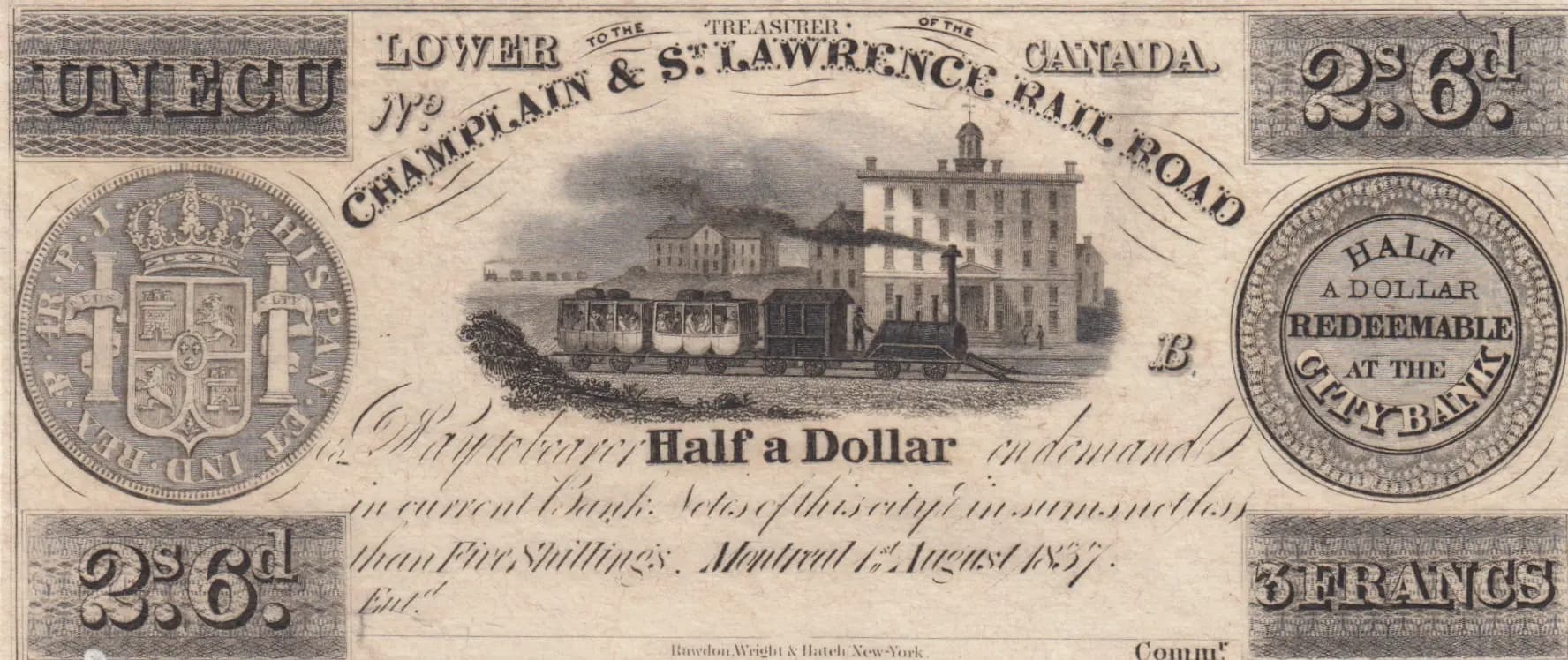
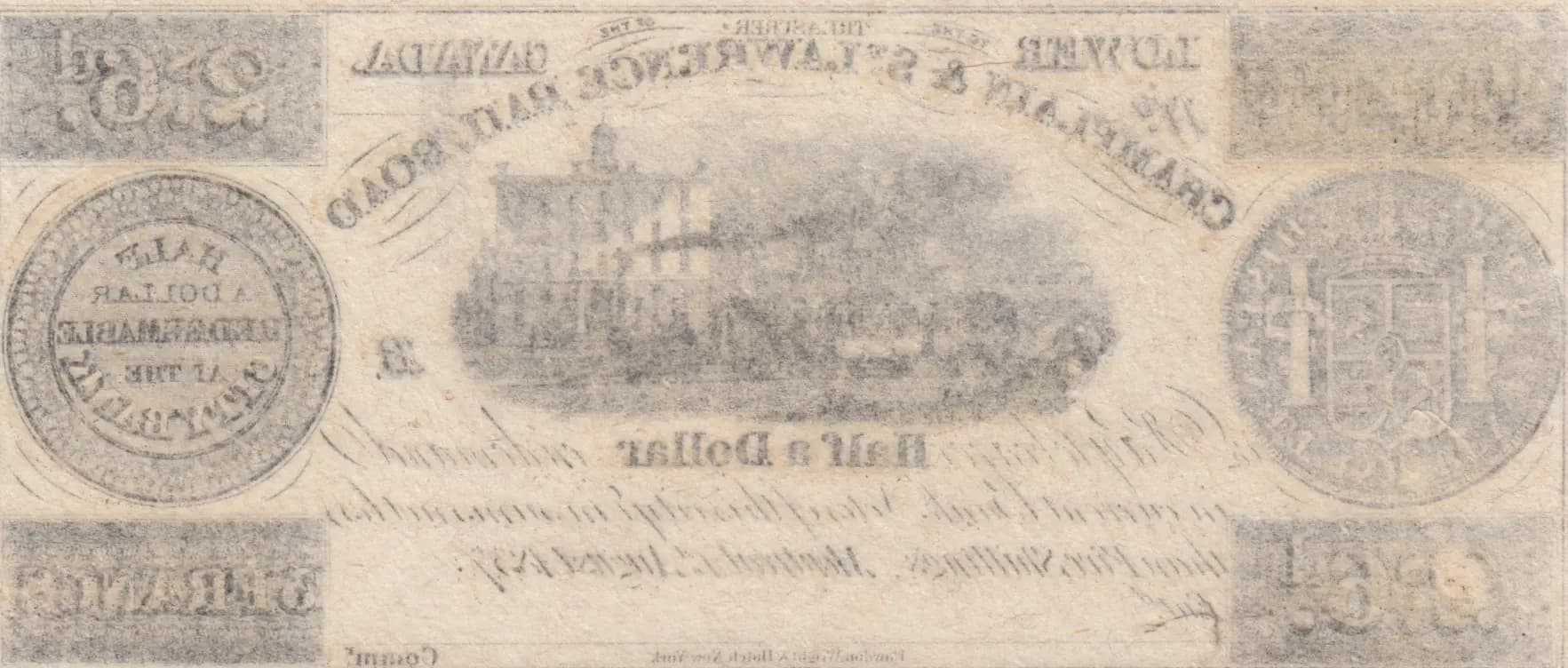
This is a historically significant 1/2 dollar note issued by the Champlain & St. Lawrence Rail Road in 1837, one of Canada's earliest railroad companies. The front features an engraved steam locomotive with passenger cars and a multi-story railway station building, reflecting the industrial optimism of the era. Despite heavy foxing, fading, and age-related deterioration—particularly on the reverse—the note remains legible and represents an important artifact of early Canadian transportation history and corporate scrip currency.
Scarce. The Champlain & St. Lawrence Rail Road operated during a volatile period of early Canadian banking (1836-1837 Banking Crisis), and most corporate scrip from this issuer was redeemed and destroyed or lost to attrition over nearly two centuries. This specific denomination in UNC condition is not commonly encountered. The Pick catalog lists this as unlisted, indicating it falls outside standard cataloging, which further suggests limited surviving specimens. Original print runs for such corporate notes were typically modest, and the conditions of issue (financial instability, railway financial troubles) likely resulted in high destruction rates.
The Champlain & St. Lawrence Rail Road was one of North America's pioneering railways, chartered in 1832 and operational by 1836, connecting the Hudson River to the St. Lawrence River. This 1837 note, dated August 1st from Montreal, was issued during the railroad's early operational period when such companies issued their own currency for wages and local transactions. The depicted steam locomotive and station building symbolize the technological advancement and commercial ambitions that defined the industrial revolution in Canada during this period.
The obverse features an ornate engraved design centered on a steam locomotive hauling passenger cars—a bold declaration of the railroad's modern transportation capabilities. Adjacent is a substantial multi-story railway station building with a distinctive cupola or tower, representing the infrastructure supporting rail operations. A heraldic coat of arms with crown and quartered shield appears on the left, emphasizing corporate authority. A circular redemption seal on the right guarantees redemption at the 'Curb Bank,' a common feature of early railroad scrip. The reverse, now heavily faded, appears to contain a landscape or architectural scene with decorative corner elements and circular authentication marks. Ornamental border patterns frame all sides, typical of 19th-century bank note engraving.
FRONT: 'Lower to the Treasurer of the Champlain & St Lawrence Rail Road' (main text); Denominations marked as '2s.6d' (two shillings and sixpence) and '5 FRANCS' with 'Half a Dollar' designation; Circular seal reads 'Half a Dollar Redeemable at the Curb Bank'; Date and location: 'Montreal 1st August 1837'; Printer credit: 'Hawdon, Wright & Hatch New-York'; Additional text references 'Current Bank Notes of this right on some future shillings'; Country designation: 'CANADA'. BACK: 'Champlain & St Lawrence Rail Road' (partially visible and faded); 'CANADA'; 'Half a Dollar' (inverted); Remaining text largely illegible due to deterioration.
Intaglio engraving (steel plate engraving), as evidenced by the fine line work, detailed cross-hatching, and depth of impression visible in the surviving impression. The printer 'Hawdon, Wright & Hatch' of New York was a respected bank note engraving firm of the era. The security features include engraved ornamental borders, multiple denomination markings, and redemption seals—standard anti-counterfeiting measures for the period.
Dated August 1st, 1837, Montreal. Printer: Hawdon, Wright & Hatch, New York. The note displays dual denomination markings (2s.6d and 5 Francs) reflecting the multi-currency environment of early Canada. No serial numbers are apparent. The 'HALF A DOLLAR REDEEMABLE AT THE CURB BANK' designation on the circular seal may represent a specific redemption variety distinct from other denominations or issuances by this railroad. As a Pick-unlisted note, documented varieties for this specific piece are limited in standard references.