5 dollars 1954 "devil's face"
“O00043”
Market Prices
6 salesAbout This Note
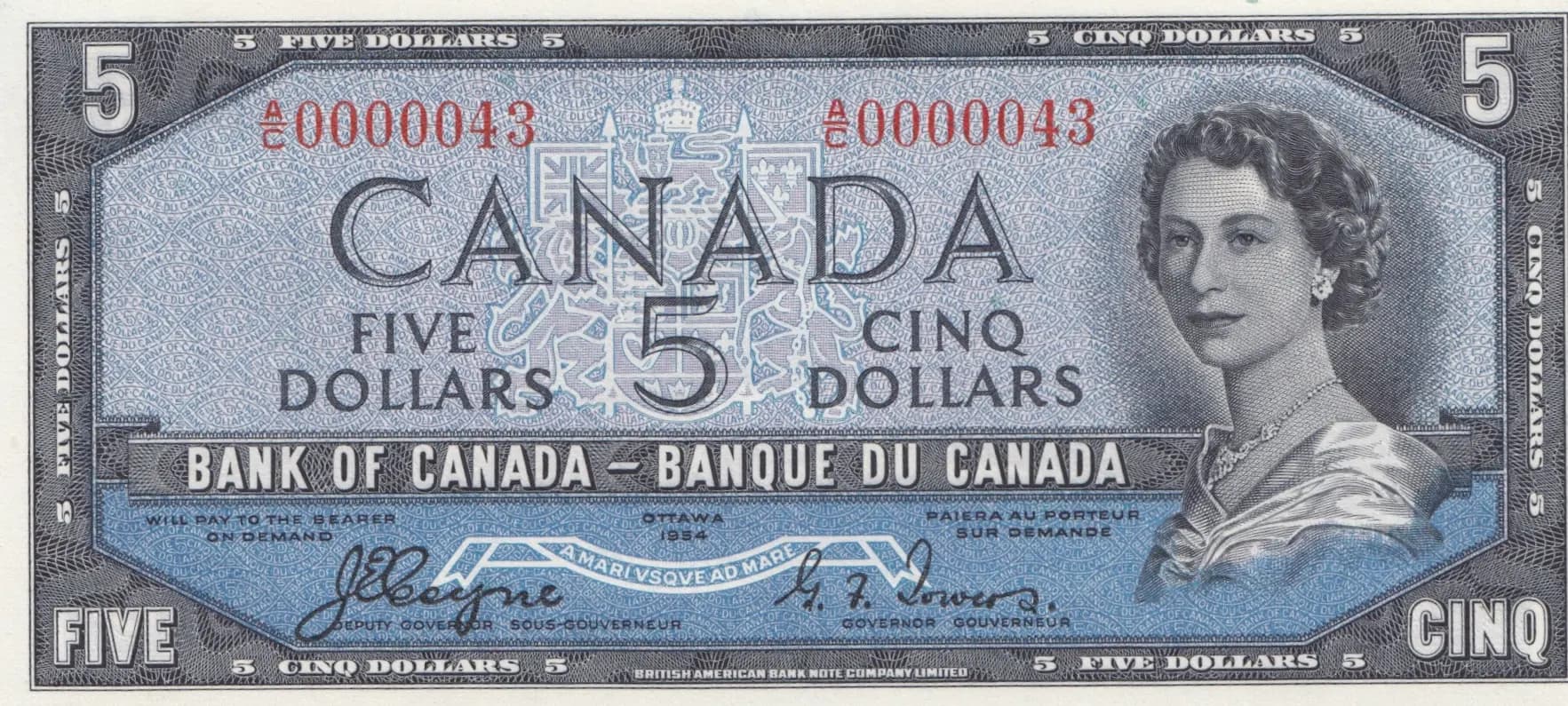
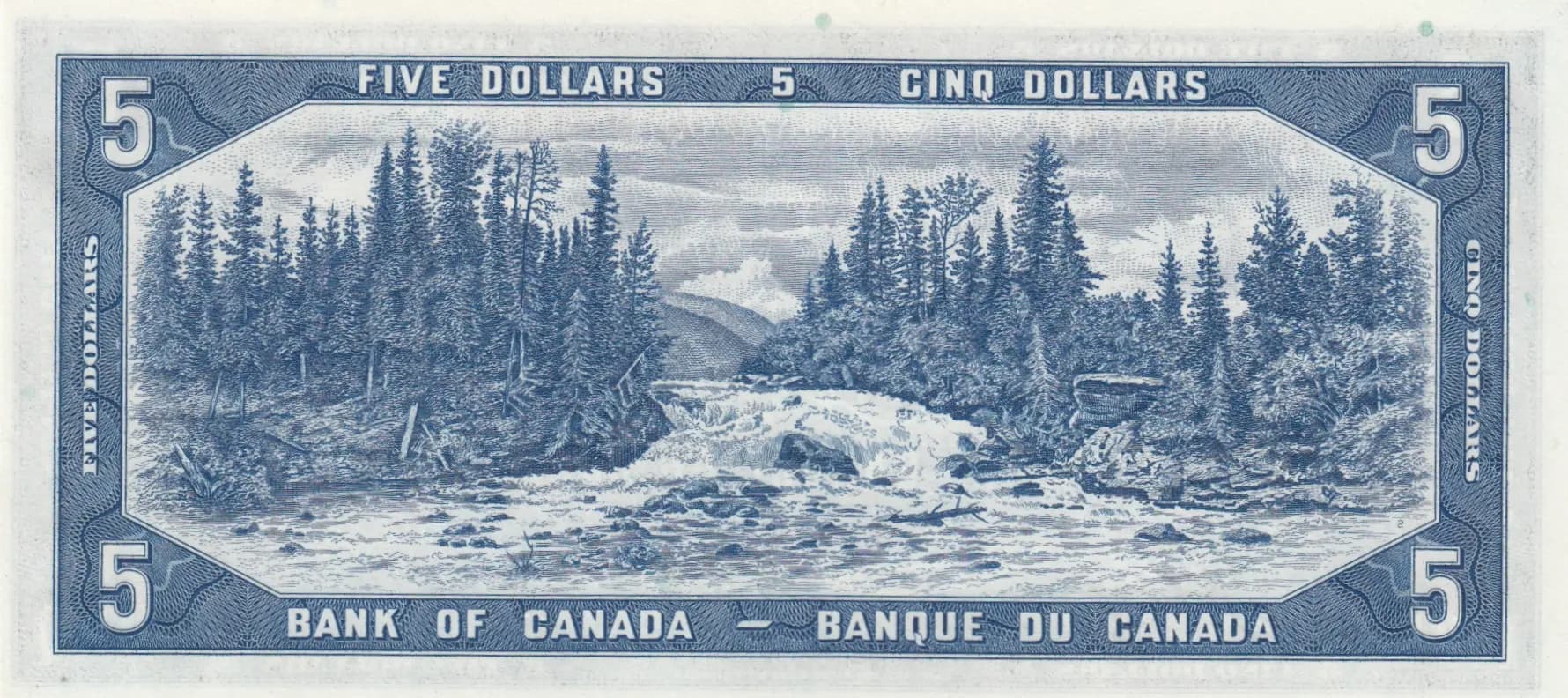
This is an uncirculated example of Canada's iconic 1954 'Devil's Face' $5 note, featuring the celebrated portrait of Queen Elizabeth II in pristine condition. The note exhibits the distinctive gray-blue color scheme and intricate security patterns characteristic of the Bank of Canada's mid-century currency design. The reverse showcases the detailed engraving of Otter Falls along the Alaska Highway, a landmark that became synonymous with Canadian wilderness imagery on currency.
Common. The 1954 'Devil's Face' $5 note (P-68a) was produced in large quantities and remains readily available to collectors. eBay market data shows recent sales ranging from $13.19 to $264.36 depending on condition, with UNC examples cataloging at approximately $400 (2016 values). Even high-grade examples regularly appear on the market, indicating substantial surviving population. This was a standard issue during a period of robust currency production by the Bank of Canada.
Issued in 1954, this note commemorates Canada's post-war prosperity and the reign of Queen Elizabeth II, whose portrait replaced King George VI on Canadian currency following her accession in 1952. The reverse features Otter Falls along the Alaska Highway, reflecting Canada's development of northern infrastructure and the nation's vast wilderness heritage during the Cold War era. The bilingual English-French inscriptions underscore Canada's bicultural identity during the mid-twentieth century.
The obverse features a formal right-facing portrait of Queen Elizabeth II, positioned on the right portion of the note, rendered in the classical engraved style typical of Commonwealth currency. The center displays the Canadian coat of arms with its distinctive shield and heraldic elements including the Crown and lions. Elaborate geometric and floral background patterns provide both aesthetic appeal and security against counterfeiting. The reverse presents a detailed wilderness landscape engraving depicting Otter Falls—a cascading waterfall surrounded by evergreen forest, rocky terrain, and mountains under a dramatic sky—rendered within an ornamental rectangular border. The bilateral symmetry and fine line work throughout exemplify the high standards of Bank of Canada currency design.
Front Side: 'FIVE DOLLARS / CINQ DOLLARS' (denomination in English and French); 'CANADA' (country name); 'BANK OF CANADA / BANQUE DU CANADA' (issuing authority); 'WILL PAY TO THE BEARER ON DEMAND / PAIERA AU PORTEUR SUR DEMANDE' (legal tender declaration); 'OTTAWA' (place of issue); '1954' (year of issue); 'A MARI USQUE AD MARE' (Latin motto meaning 'From Sea to Sea,' Canada's national motto); 'GOVERNOR GOUVERNEUR' and 'DEPUTY GOVERNOR SOUS-GOUVERNEUR' (signature titles); 'BRITISH AMERICAN BANK NOTE COMPANY LIMITED' (printer). Back Side: 'FIVE DOLLARS / CINQ DOLLARS' (denomination); 'BANK OF CANADA / BANQUE DU CANADA' (issuing authority); '5' (denomination numeral).
Intaglio engraving (line engraving) by the British American Bank Note Company Limited, the primary security printer for Bank of Canada notes during this period. The fine detail visible in both the portrait, coat of arms, and landscape engraving, combined with the intricate geometric and floral background patterns, are characteristic of intaglio's ability to create tactile, difficult-to-counterfeit imagery. The pristine impression and sharp detail visible throughout indicate production from fresh plates in early circulation.
This is Pick catalog P-68a, the 1954 'Devil's Face' variety characterized by the distinctive facial profile in Queen Elizabeth II's hairdo visible on the obverse—a feature that prompted collectors to nickname these notes 'Devil's Face' designs. Related contemporary varieties include P-77 and P-78, which feature modified hairdos on later printings. The serial number observed (AE0000043) with the 'AE' prefix is consistent with Bank of Canada's serial numbering system for this series. No overprints or special markings are visible, indicating this is a standard circulation issue from the main printing.