2 dollars 1954 "devil's face"
“O00043”
Market Prices
13 salesAbout This Note
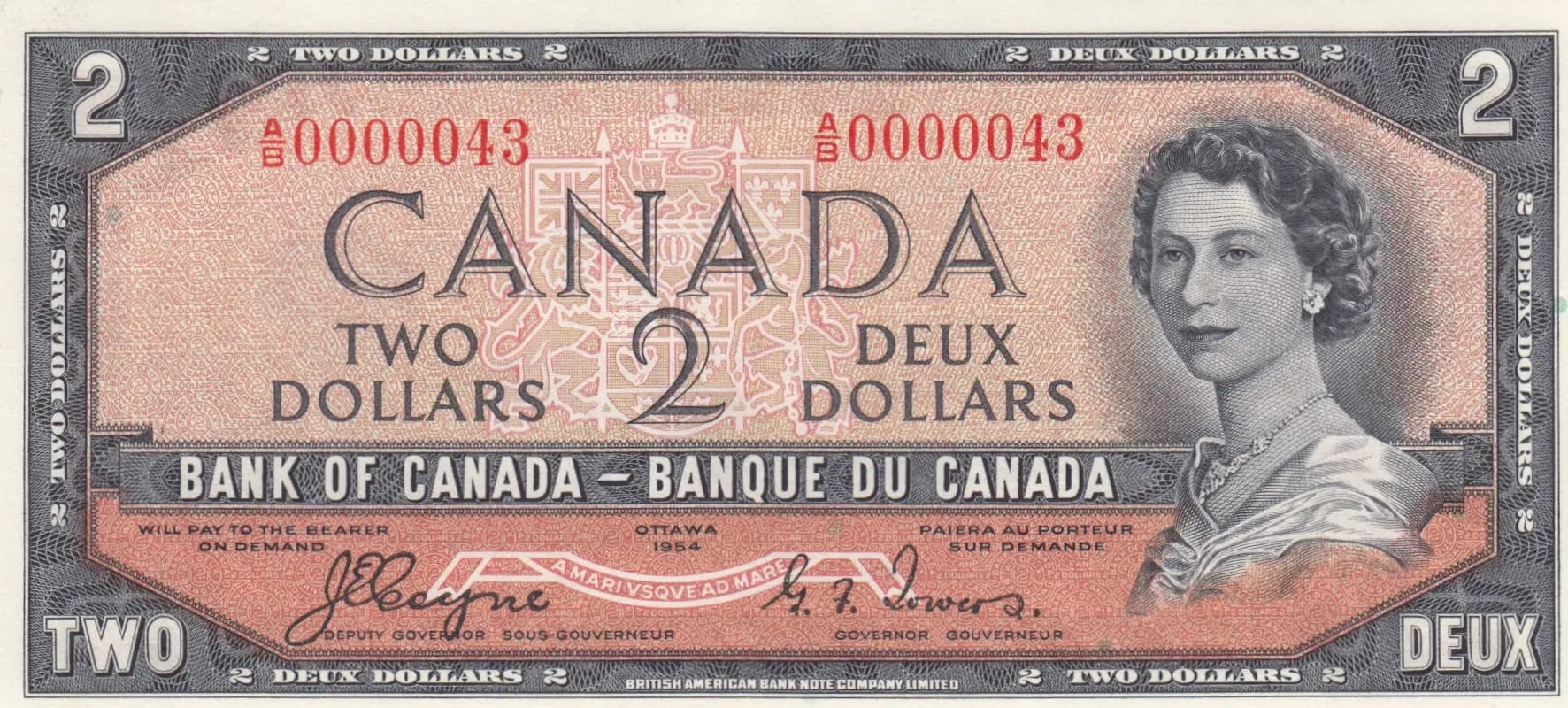
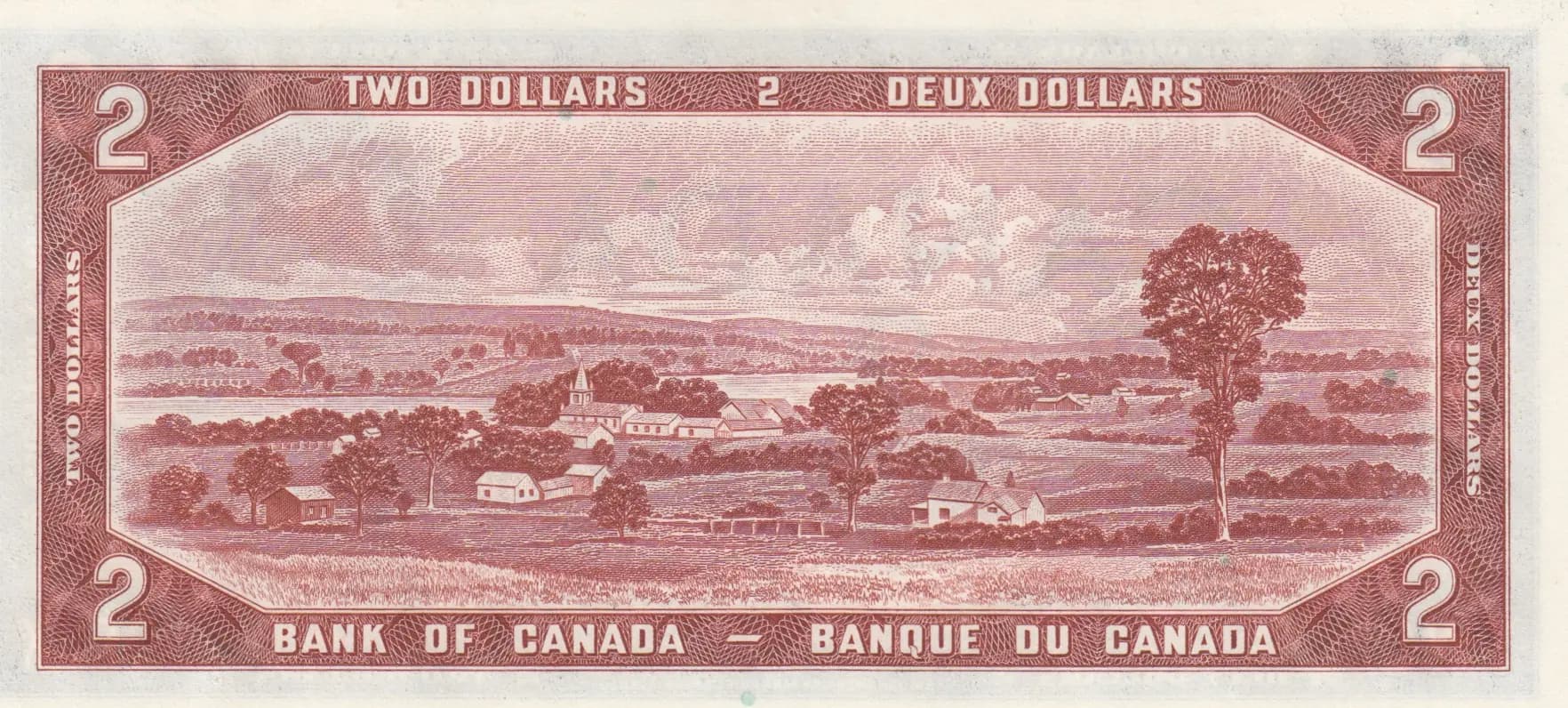
This is a Canadian $2 note from 1954 featuring the distinctive 'Devil's Face' variety, identifiable by the peculiar shading in Queen Elizabeth II's hairdo that creates an optical illusion. The note is in uncirculated condition with crisp details, vibrant red-brown coloring, and sharp printing throughout. The reverse displays a pastoral Quebec landscape with churches and farmhouses, making this a sought-after example of mid-20th century Canadian currency design.
Common. While the 'Devil's Face' variety is historically notable and culturally interesting, it was produced in substantial quantities during 1954-1955 before being replaced. Current market data shows examples in Fine to Very Fine condition consistently selling for $15-50, with uncirculated examples reaching $400 according to 2016 catalog values. The prevalence of this note in the collector market and modest pricing even for higher grades indicates it remains a common variety rather than a scarce or rare issue.
Issued in 1954 by the Bank of Canada during the reign of Elizabeth II, this note reflects Canada's post-war economic stability and the nation's bilingual identity through its English and French inscriptions. The reverse design featuring a rural Quebec valley landscape represents the agricultural heritage and regional character of Canada during the 1950s, while the formal portrait of the Queen emphasizes Canada's Commonwealth ties during this period.
The obverse features a formal right-facing portrait of Queen Elizabeth II wearing a tiara, positioned prominently on the right side of the note. The defining characteristic of this 'Devil's Face' variety is the notorious shading in the Queen's hair that creates the appearance of a demonic face in profile—a feature that became controversial and was later modified in subsequent printings. The Canadian coat of arms appears centrally in the upper portion, and the note is adorned with intricate geometric patterns and ornamental engraving work. The reverse depicts a serene rural landscape identified as Country Valley in Quebec, featuring a prominent church with steeple, scattered farmhouses, fenced pastoral fields, large trees, and a pond or water feature, rendered in fine engraved detail characteristic of Bank Note Company work.
FRONT: '2' / 'TWO DOLLARS' (English) and 'DEUX DOLLARS' (French) / 'CANADA' / 'BANK OF CANADA' / 'BANQUE DU CANADA' / 'WILL PAY TO THE BEARER ON DEMAND' / 'PAYERA AU PORTEUR SUR DEMANDE' / 'OTTAWA' / '1954' / Serial number 'A0000043' / 'GOVERNOR' / 'GOUVERNEUR' / 'DEPUTY GOVERNOR' / 'SOUS-GOUVERNEUR' / 'BRITISH AMERICAN BANK NOTE COMPANY LIMITED'. BACK: '2' (repeated in four corners) / 'TWO DOLLARS' and 'DEUX DOLLARS' / 'BANK OF CANADA' / 'BANQUE DU CANADA'. All translations maintain the bilingual nature of Canadian currency.
This note was produced using intaglio (engraved) printing by the British American Bank Note Company Limited (BABNC), as credited on the note. The fine line work, cross-hatching, and detailed engraving visible throughout both the portrait and landscape vignette are characteristic of traditional intaglio security printing. The crisp definition of both the geometric patterns and landscape details confirms the high-quality engraved plate work typical of premium banknote production during this era.
This is specifically the 'Devil's Face' variety (Pick P-67a) of the 1954 Canadian $2 note, characterized by the controversial facial features visible in Queen Elizabeth II's hairdo created by the shading pattern. The serial number observed (A0000043) with the 'A' prefix is consistent with 1954 printings. Subsequent printings replaced this design with a modified portrait (P-76) where the problematic shading was corrected. The note displays signatures for both Governor and Deputy Governor positions, typical of Bank of Canada notes from this period.