2 kak 1979
About This Note
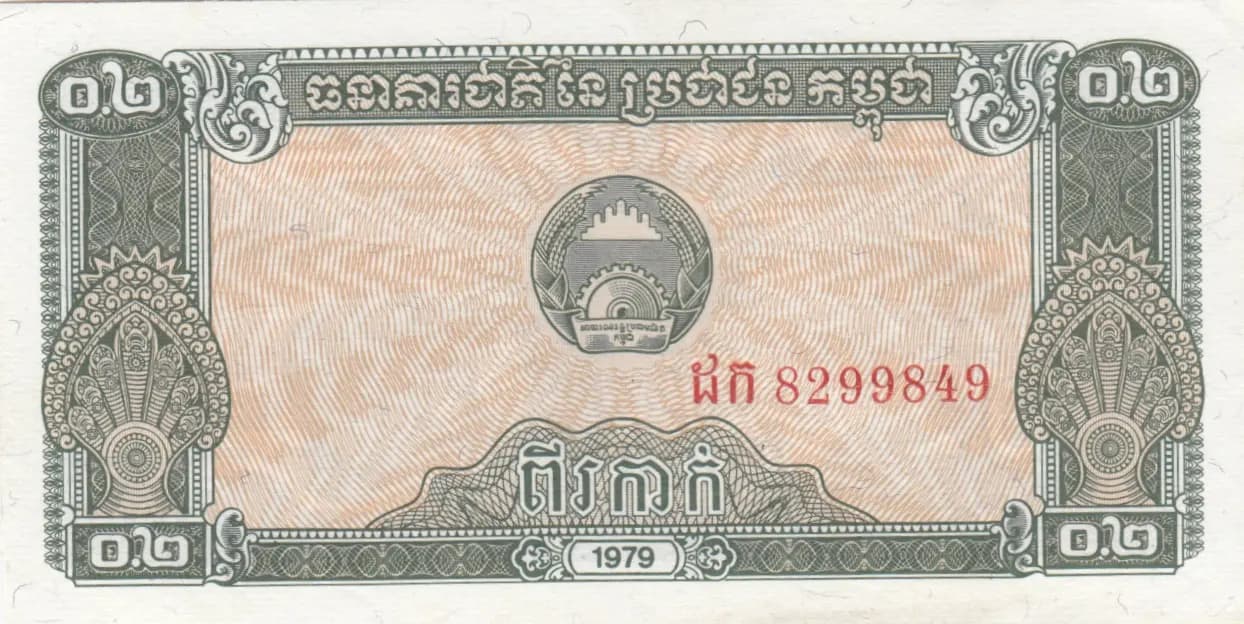
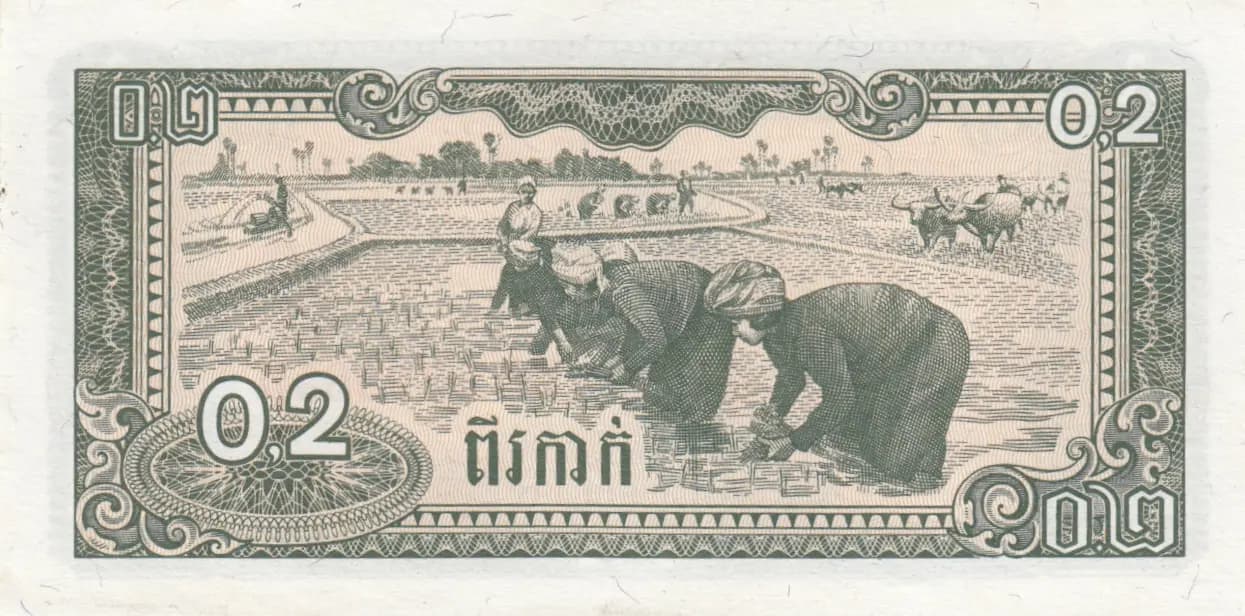
This is an uncirculated 2 kak banknote from the State Bank of Democratic Cambodja, issued in 1979 during the early Khmer Rouge period. The note exhibits exceptional preservation with crisp printing, clean margins, and no visible wear—the front features an ornate green border with a central temple emblem in red and peach tones, while the reverse depicts a detailed engraved scene of agricultural laborers working rice paddies with oxen, reflecting the regime's agrarian ideology. The intricate engraving work and fine line security patterns throughout make this an important example of Cambodian numismatic history from one of the most turbulent periods in the nation's past.
Common. The State Bank of Democratic Kampuchea issued multiple denominations in 1979 in what appear to be standard production runs for internal circulation during the final months of the regime. While the historical significance of 1979 Cambodian currency is high due to the regime's brief existence and subsequent destruction of currency stocks, individual notes from this issue remain relatively available in the numismatic market. No documented print run restrictions, significant recalls, or extreme scarcity factors apply to this particular Pick number in UNC condition.
This note was issued during the reign of Democratic Kampuchea (1975-1979) under the Khmer Rouge regime, a period marked by radical agrarian collectivization and forced labor. The reverse's depiction of idealized agricultural workers in expansive rice paddies directly reflects the regime's propaganda celebrating peasant labor as the foundation of the new society. The 1979 date indicates this was among the final currency issues before the Vietnamese invasion in January 1979 that toppled the Khmer Rouge, making it historically significant evidence of the regime's monetary policies and artistic vision.
The 2 kak note features a symmetrical design emphasizing national symbols and labor ideology. The obverse displays the State emblem of Democratic Kampuchea—a circular seal featuring a stylized temple or pagoda structure at center top, rendered in black against the peach/salmon-colored background. Elaborate decorative borders in green frame both sides with intricate scrollwork and floral patterns in fan-like corner medallions characteristic of Khmer artistic tradition. The reverse is dominated by a detailed engraved scene celebrating agricultural collectivization: multiple female workers are depicted bent over in rice paddies, engaged in transplanting or harvesting, while male figures and oxen-drawn plows appear in the background across an expansive rural landscape. This thematic focus on peasant labor and agrarian production directly embodies the Khmer Rouge's ideological vision of society. Fine line patterns and geometric security ornamentation provide anti-counterfeiting protection throughout.
Front side: Serial number ពិក ៨២៩៩៨៤៩ (Pik 8299849); គម្ពូច្ា (Kampuchea/Cambodia); ០.២ (0.2 in Khmer numerals); 1979 (Arabic numerals). Back side: ០.២ (0.2 in Khmer numerals); សម្តែក (Kampuchea/Cambodia); ០.០២ (0.2 in Khmer numerals). The denomination appears consistently across both sides in Khmer numerical notation.
Intaglio engraving (recess printing), evidenced by the crisp, deeply-defined line work visible in both the border scrollwork and the detailed agricultural scene on the reverse. The fine parallel line patterns used for background security work, the sharp edges of the decorative cartouches, and the three-dimensional quality of the portraits and landscape all indicate high-quality traditional engraving techniques typical of security printing. The precise registration of the multi-color design (green, red, black, and peach) suggests professional security printer capabilities; however, specific printer attribution for this issue is not definitively documented in readily available sources.
This specific note carries the serial number ពិក ៨២៩៩៨៤៩ (8299849). Known varieties for P-26 may include different serial number prefixes or ranges, though comprehensive variety documentation for this short-lived Democratic Kampuchea issue is limited. The consistent presence of Khmer script inscriptions and the temple emblem design appear standard across documented examples. Further variety research would require examination of multiple serial number ranges and any potential printer's marks or signature variants, which are not apparent in the visual analysis provided.