10 riels 1962
About This Note
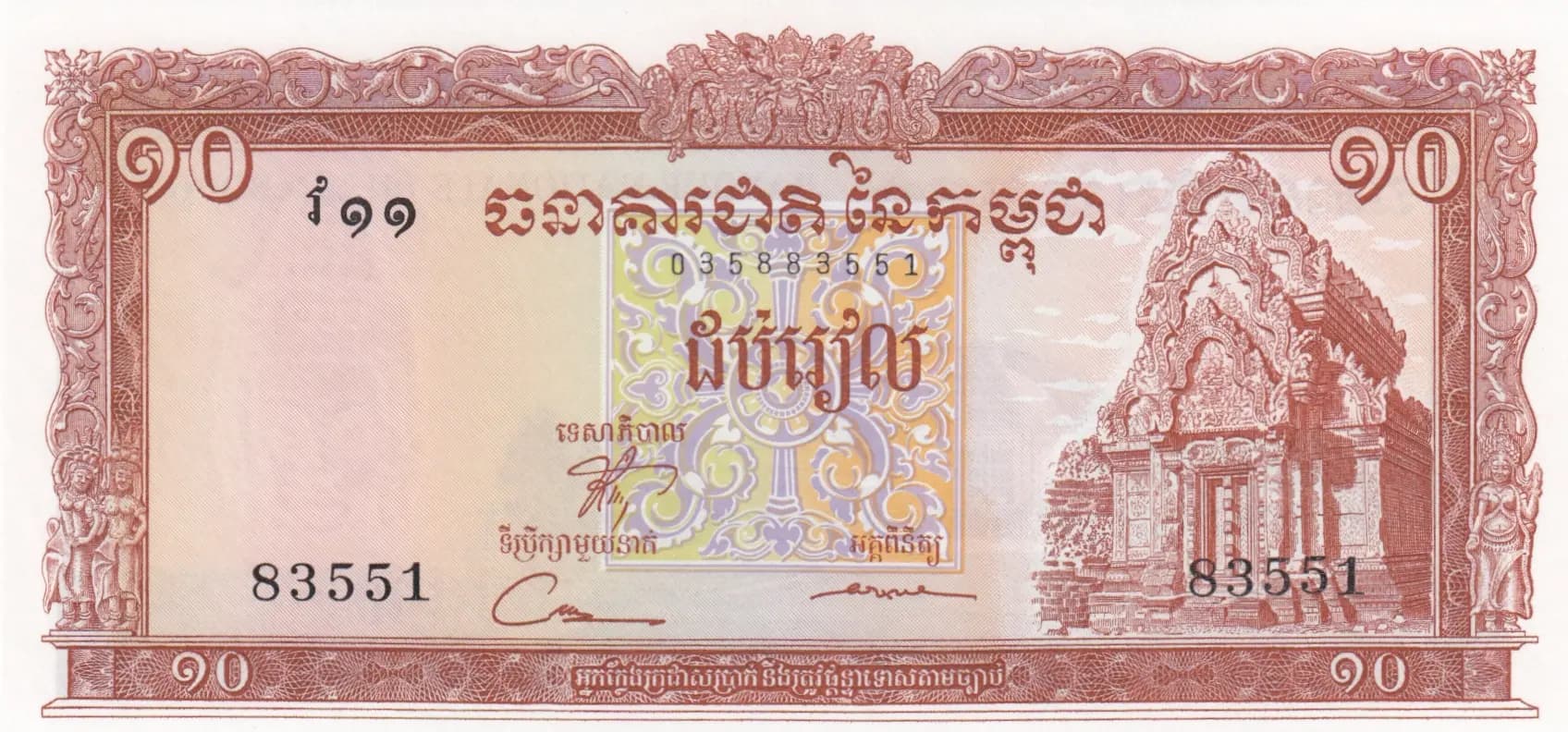
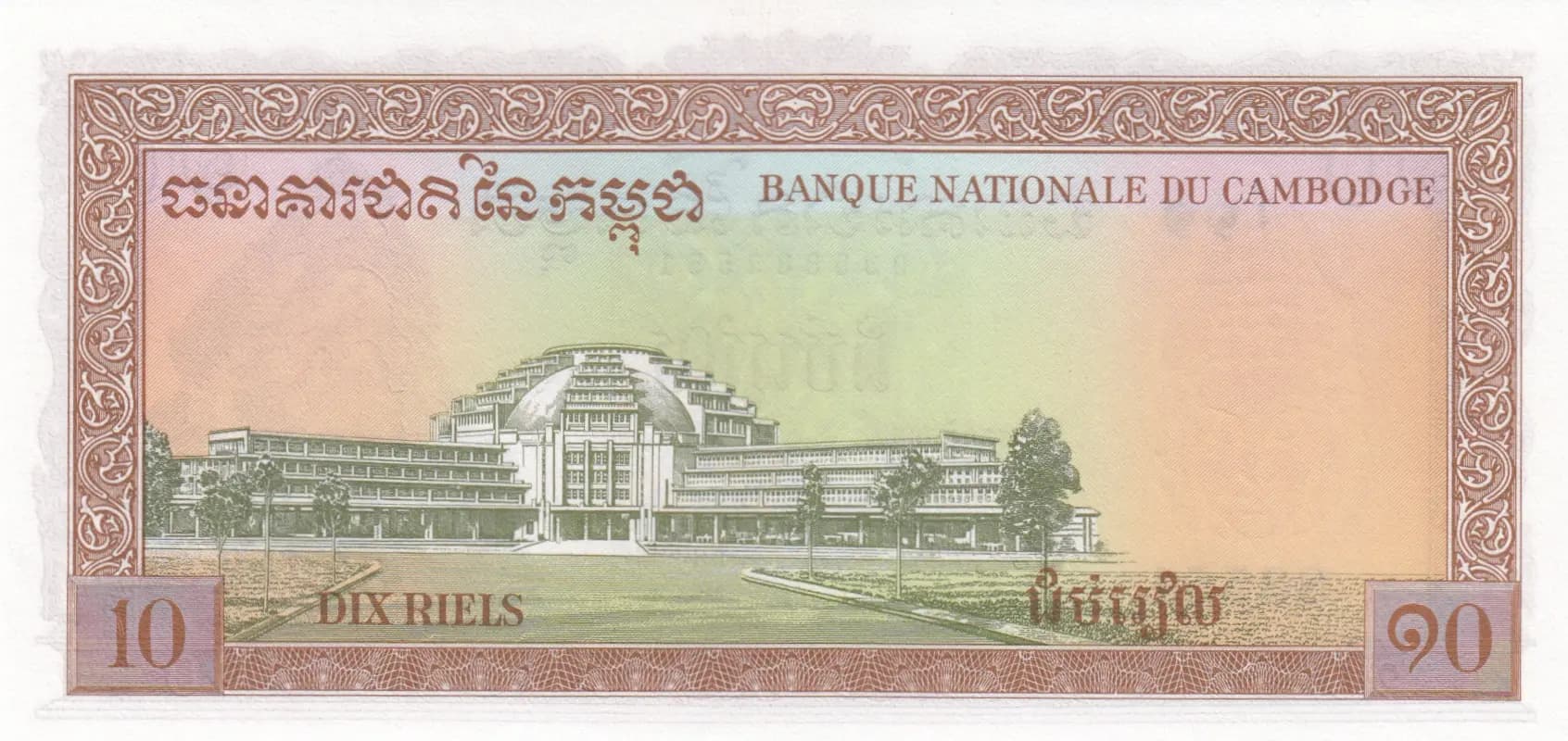
This is an exceptional example of Cambodia's 1962 10 Riels banknote (Pick P-11b3) issued by the Banque Nationale de Cambodge, presented in uncirculated condition with pristine surfaces and no visible wear. The note showcases elegant rose-mauve and cream color printing with intricate fine-line engraving throughout, featuring a tiered Khmer temple on the obverse and a grand institutional building with Art Deco styling on the reverse. This early post-independence issue represents an important piece of Cambodian numismatic history during Prince Norodom Sihanouk's reign.
common. The 1962 10 Riels (Pick P-11b3) is a standard circulation issue from Cambodia's early post-independence period with no documented evidence of limited print runs, short circulation periods, or subsequent recalls. While Cambodian currency from this era has become less common in circulation due to the country's subsequent political upheaval and currency changes, this denomination and date remain available in the numismatic market at modest price points. UNC examples command only slight premiums over circulated versions, indicating adequate surviving quantities.
The 1962 10 Riels note was issued during Cambodia's early years following independence in 1953, under the reign of Prince Norodom Sihanouk. The obverse temple imagery reflects Cambodia's deep Buddhist and Khmer cultural heritage, while the reverse depicts a modern institutional building representing the nation's mid-20th century modernization efforts. This bilingual design in French and Khmer reflects Cambodia's post-colonial transition period, when French colonial monetary systems were being replaced by nationalist currency.
The obverse features an ornate decorative border with intricate scrollwork and floral patterns framing the composition. The central design includes a large geometric medallion with decorative patterns and, prominently on the right side, a detailed engraved illustration of a multi-tiered Khmer temple with elaborate architectural ornamentation characteristic of Cambodian Buddhist religious architecture. The denomination '10' appears twice in the upper corners. The reverse displays a substantial institutional building with Art Deco or mid-20th century modernist architectural elements, including a prominent domed central section flanked by symmetrical wings, surrounded by landscaped grounds with trees and manicured lawn areas. Both sides feature repeating circular medallion patterns within ornate borders. The entire design employs bilingual French and Khmer inscriptions reflecting the post-colonial administrative period.
OBVERSE: Arabic numerals '10' and '90' appear in corners; Khmer text includes 'ធនាគារ' (Bank) and Khmer numerals; serial numbers '83551' appear on left and right sides. REVERSE: 'BANQUE NATIONALE DU CAMBODGE' (National Bank of Cambodia) and 'DIX RIELS' (Ten Riels) in French; Khmer equivalents 'ធនាគារ ជាតិ កម្ពុជា' (National Bank of Cambodia) and 'ដប់រៀល' (Ten Riels); Arabic numerals '10' and '90' appear in corners.
This note was produced using fine-line intaglio engraving, evidenced by the sharp detail and precision visible throughout both the decorative borders and architectural illustrations. The intricate scrollwork, complex geometric medallion patterns, and fine linework characteristic of high-security currency production are clearly observable. The color printing appears to be achieved through multi-pass intaglio printing, producing the distinctive rose-mauve, cream, burgundy, and gold/yellow tones. While specific printer attribution for this Pick number would require research into Cambodian central bank records, the production quality is consistent with major European security printers active in Southeast Asia during the early 1960s.
The observed serial number '83551' is specific to this individual note. Documented varieties for the 1962 10 Riels (Pick P-11b3) primarily relate to serial number prefixes and printing sequences rather than design variations. The 'P-11b3' designation itself indicates a specific variety within the Pick catalog system for this denomination and date. No overprints or significant design variants are evident in this example. Signature varieties may exist on this issue, though the specific signatories are not clearly legible in the provided images; further research into Cambodia's central bank officials during 1962 would be needed to identify signature variations.