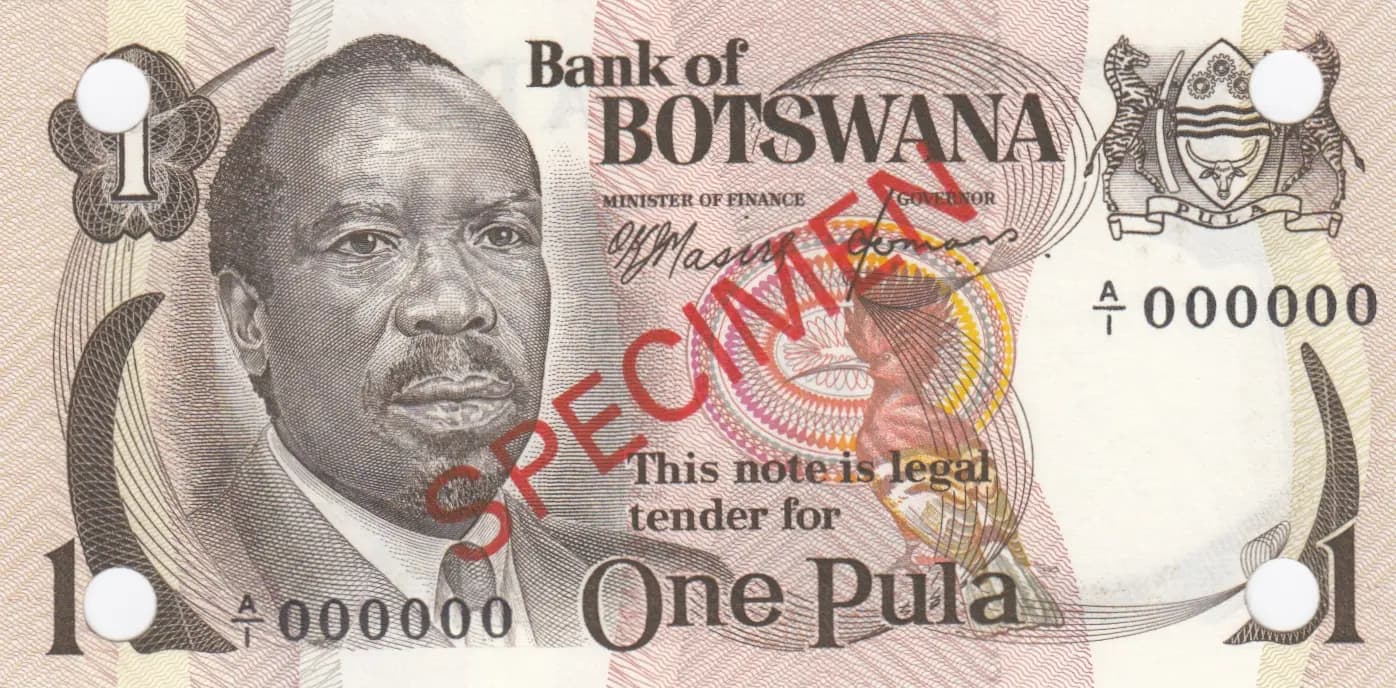
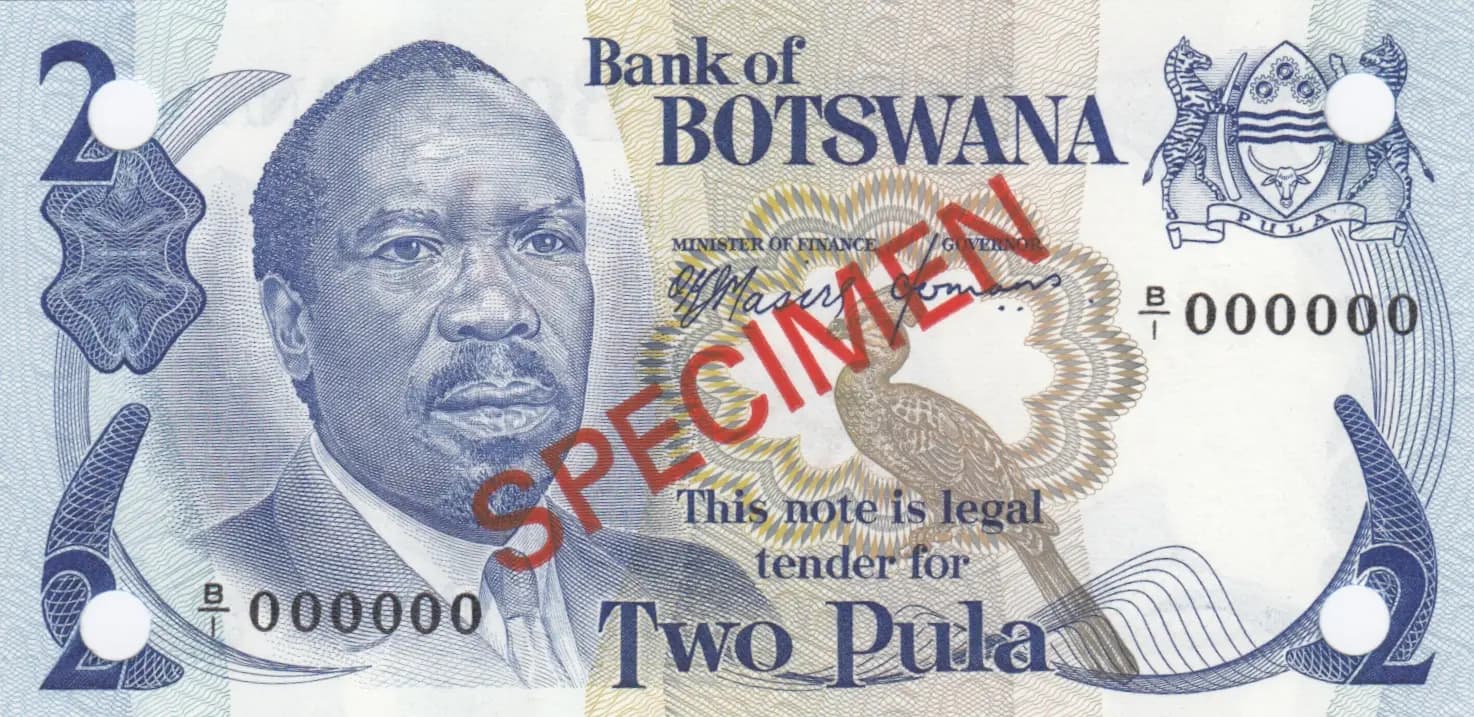
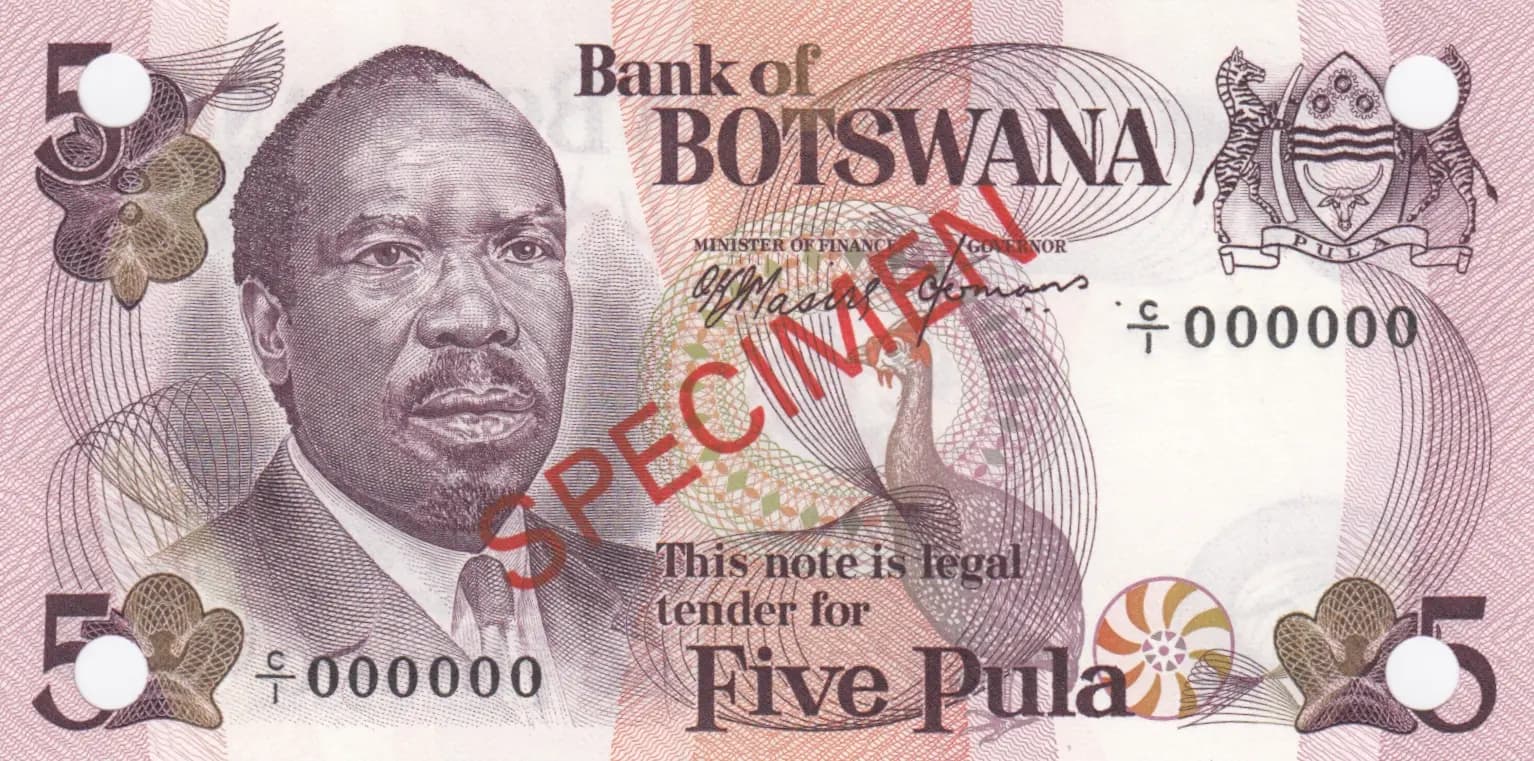
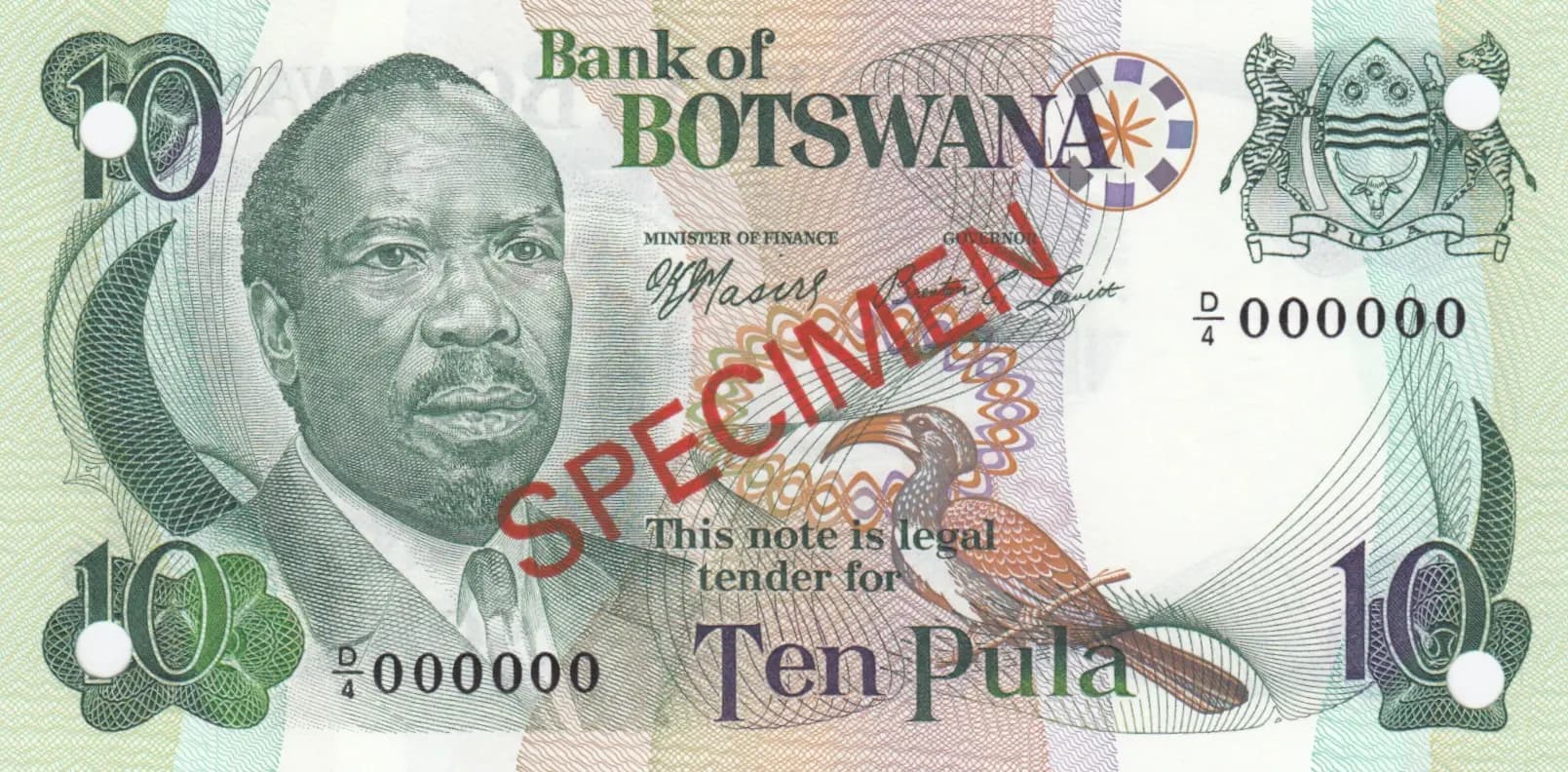
20 pula 1979 specimen
Market Prices
1 saleAbout This Note
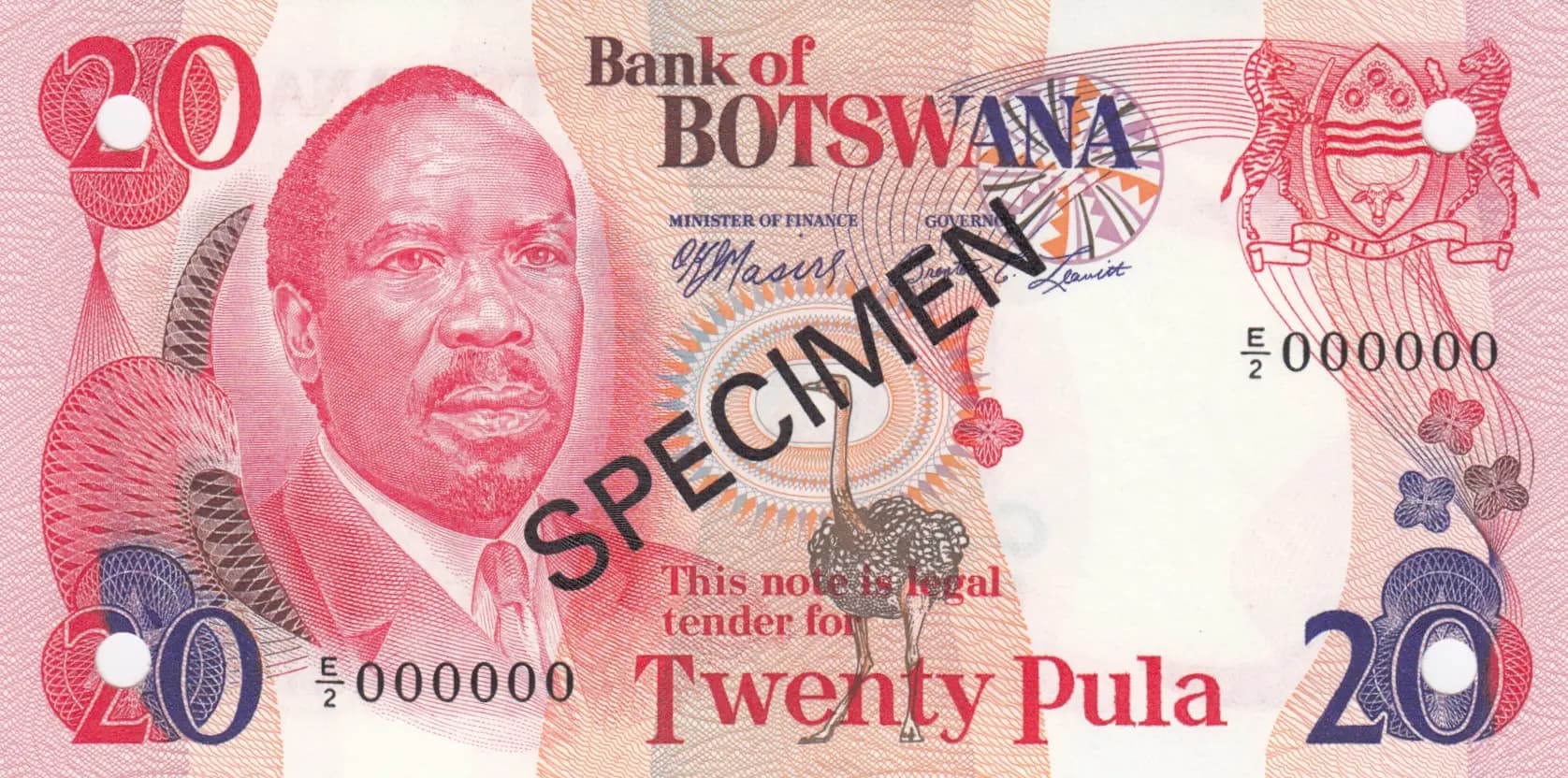
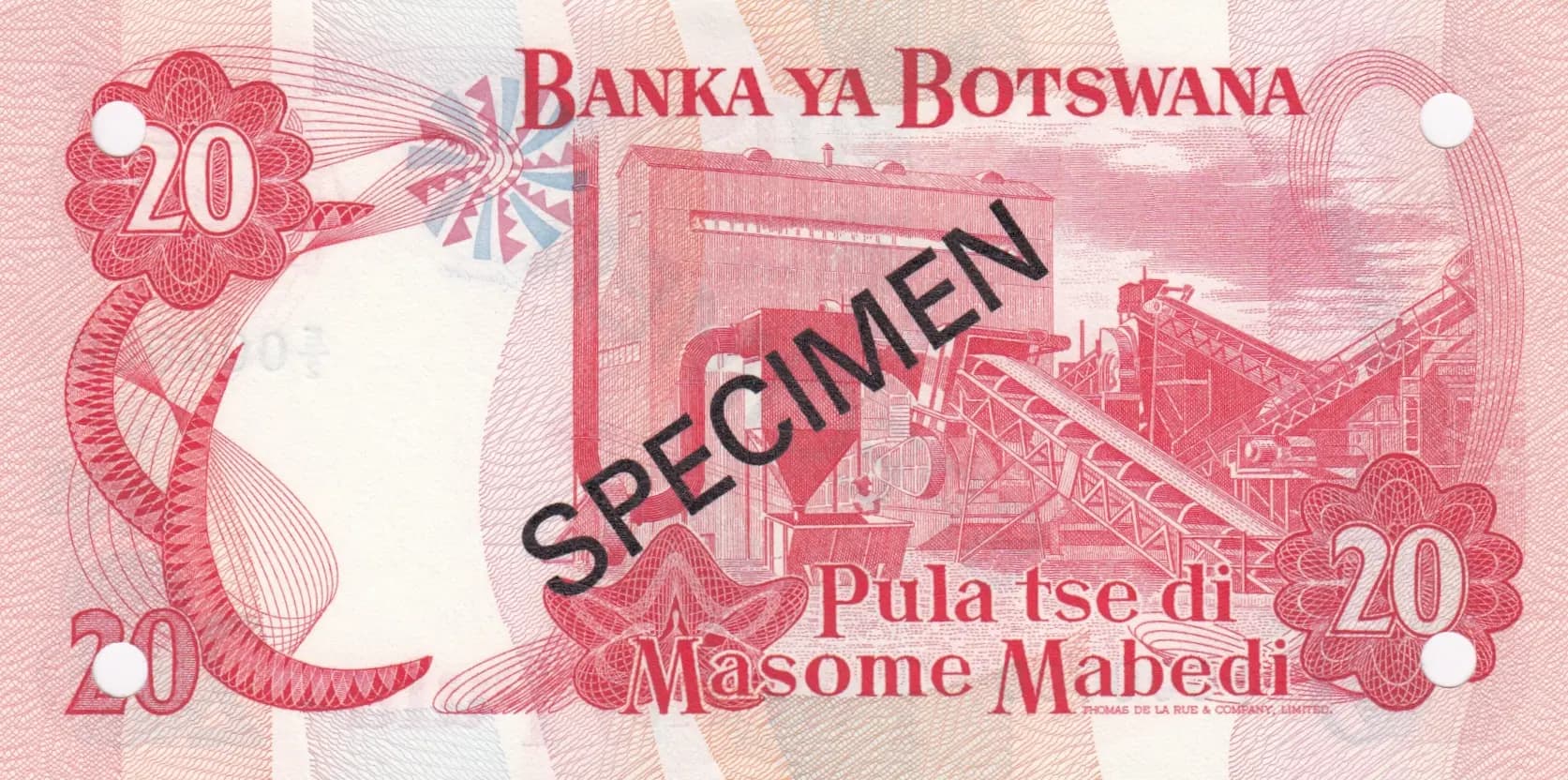
This is a Botswana 20 Pula specimen note from 1979, printed by Thomas de la Rue in London and graded UNC. The note features President Sir Seretse Khama in formal attire on the obverse and industrial/mining infrastructure on the reverse, both rendered in distinctive red/pink and cream tones with intricate security engraving. As a specimen note with the diagonal 'SPECIMEN' overprint clearly visible on both sides, this represents an early example from Botswana's first series and is highly sought by collectors of African banknotes and first-issue currency.
Uncommon. Specimen notes from the 1979 Botswana series command collector premiums significantly above circulated examples (catalog values show UNC: $300 vs. VF: $50 as of 2019). The specimen overprint designation and serial number format (E/2 000000) indicate limited production for distribution to banks and collectors rather than circulation. While not extremely rare, specimen notes from Botswana's first currency series are scarcer than regular-issue examples. The Pick-5bs designation confirms this as a documented specimen variant with established market value, though specific population data is not provided in PMG records for this particular variant.
The 1979 20 Pula note commemorates the early years of independent Botswana, with President Sir Seretse Khama's portrait honoring the nation's founding leader. The reverse design featuring mining and industrial equipment reflects Botswana's economic foundation in diamond and mineral extraction during the post-independence period. This specimen note dates to the inaugural circulation of Botswana's currency following the country's transition to independence in 1966, representing the nation's monetary sovereignty during a period of significant economic development.
The obverse features a three-quarter profile portrait of President Sir Seretse Khama, Botswana's first president, positioned on the left side wearing formal business attire (suit and tie). The coat of arms of Botswana appears in the upper right corner, depicting a zebra (rearing, as confirmed by watermark reference) flanked by decorative heraldic elements. A large circular ornamental device with radiating geometric patterns dominates the center-right area as a security feature. The reverse showcases a multi-story industrial or mining facility with conveyor systems and processing plant infrastructure, reflecting the nation's primary economic sector. Both sides employ elaborate guilloche patterns, fine-line engraving, decorative floral corner elements, and rosettes containing the denomination. The color scheme of red/pink with cream underprint provides strong visual contrast characteristic of Thomas de la Rue's 1970s security printing.
FRONT SIDE: '20' (denomination in numeric form); 'Bank of BOTSWANA' (English); 'MINISTER OF FINANCE' and 'GOVERNOR' (English titles); 'This note is legal tender for Twenty Pula' (English legal tender declaration); 'E/2 000000' (specimen serial number format); 'SPECIMEN' (overprint designation). BACK SIDE: '20' (denomination in decorative rosettes); 'BANKA YA BOTSWANA' (Bank of Botswana in Setswana); 'Pula tse di Masome Mabedi' (Twenty Pula in Setswana); 'SPECIMEN' (overprint designation); 'THOMAS DE LA RUE & COMPANY, LIMITED' (printer attribution in English).
Intaglio engraving (recess printing) by Thomas de la Rue & Company, Limited, London, as indicated by the printer's mark and visual characteristics. The note exhibits multiple security features typical of high-security banknote production: fine-line guilloche patterns throughout, complex geometric and floral engraved designs, intricate background patterns, watermark area (rearing zebra), and multi-color printing on detailed underprints. The diagonal 'SPECIMEN' overprint was applied post-printing as standard practice for specimen distribution.
This note is cataloged as Pick P-5bs, identifying it as a specimen variant of the base 20 Pula design (P-5). The 'bs' designation indicates 'banknote specimen.' The serial number format 'E/2 000000' is typical of specimen notes and confirms non-circulation status. Thomas de la Rue printing is evidenced by 'TDLR' printer identification. PMG population reports indicate multiple variants exist for this base Pick number (P-5a, P-5aCS1, P-5b, P-5s1, P-5s2), with this note representing the specimen variety. Bilingual inscriptions in English and Setswana are standard for all Botswana notes of this period.