5 francs 1929
Market Prices
8 salesAbout This Note
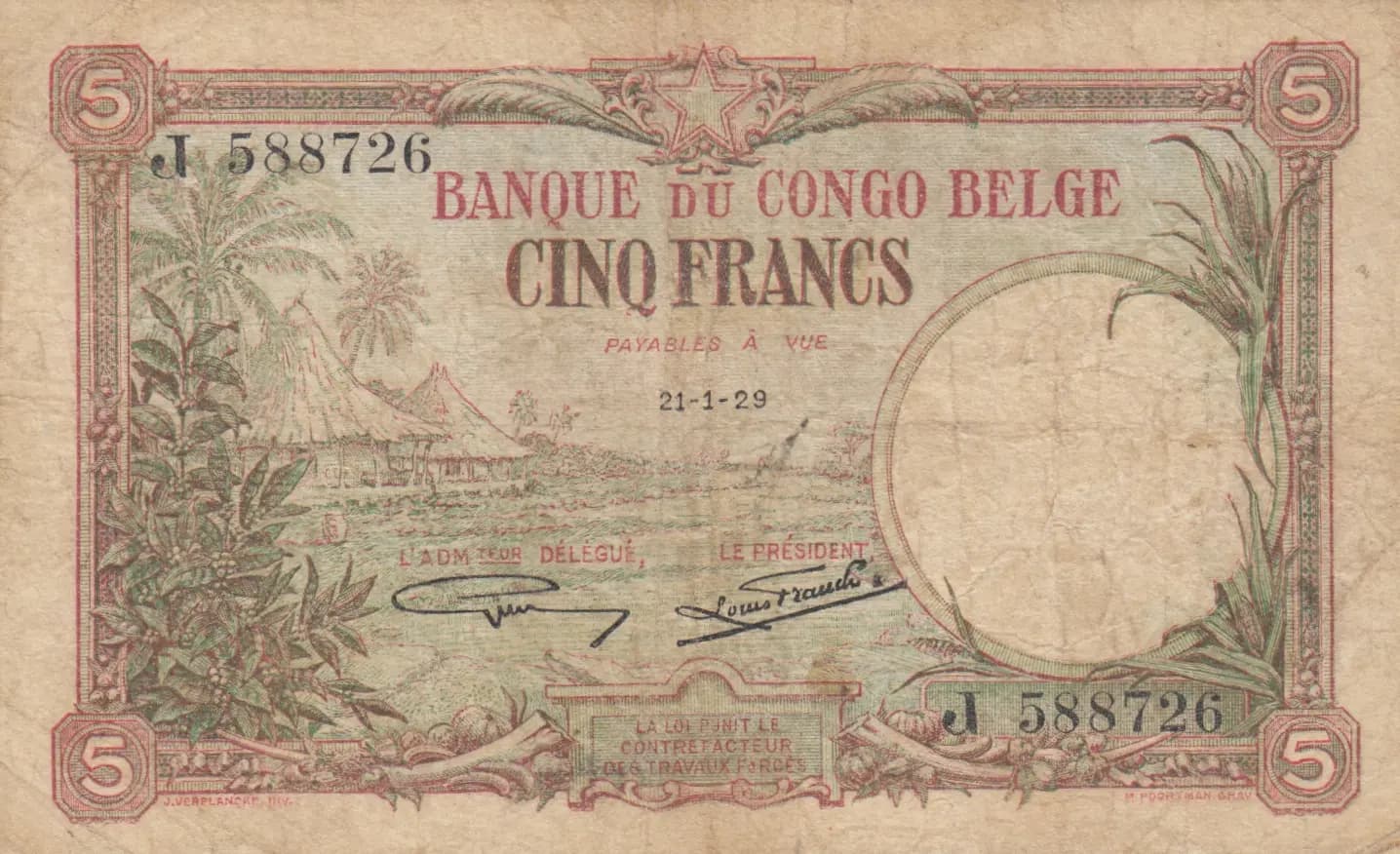
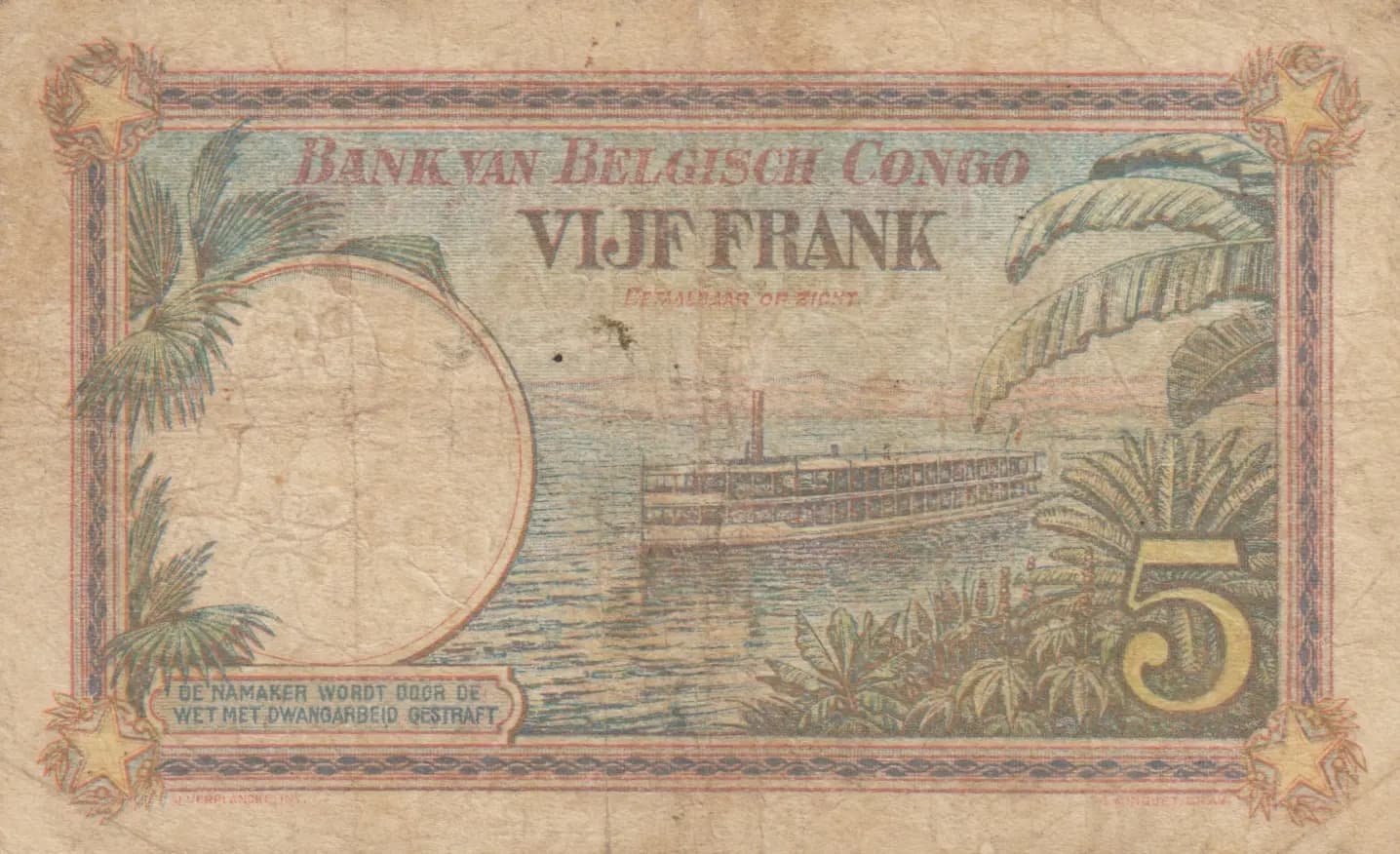
A well-circulated example of the Belgian Congo 5 Francs from 1929, issued by the Banque du Congo Belge. This P-8e variant (without office overprint) displays the characteristic tropical imagery of the colonial era—palm-flanked vignettes of a mountain landscape on the obverse and a Congo River steamship on the reverse. The note exhibits honest aging with foxing, creasing, and tan patina throughout, consistent with nearly a century of circulation, placing it squarely in Fine grade.
Common. eBay historical sales data shows regular circulation of this note type in Fine condition, with documented sales ranging from $27 to $96 depending on exact date and market. The 2016 catalog value of $150 for F grade notes reflects collector pricing, but consistent availability in the market and multiple sales records indicate this is not a scarce variety. The P-8e (without office overprint) represents the standard regular issue from the 1924-1930 series.
This note represents Belgian Congo's monetary system during the height of colonial administration, with bilingual inscriptions (French/Dutch) reflecting Belgium's linguistic divide. The depicted imagery—the volcanic mountain landscape and the paddle steamer on the Congo River—romanticize the colonial enterprise and transport infrastructure that facilitated resource extraction from central Africa. The 1929 date places this note just before the Great Depression, reflecting the relative stability of the Belgian colonial monetary system in the pre-crisis period.
The obverse features an ornamental border of repeated geometric patterns in red/pink framing a tropical landscape vignette depicting a prominent mountain or volcano in the center background, with stylized palm trees flanking both sides. Denomination numeral '5' appears in ornamental corner frames in all four corners. A large circular watermark area is positioned on the right side. The reverse displays a river transport scene with a paddle steamer (characteristic of Congo River commerce) centered within tropical vegetation framing, also with corner denomination markers and a prominent circular watermark space on the left. Both sides employ fine line engraving throughout. The paper base is cream/beige, with blue-green tones used in water and vegetation areas. Bilingual text reflects the dual administrative structure of Belgian Congo.
FRONT: 'Banque du Congo Belge' (Bank of Belgian Congo) / 'Cinq Francs' (Five Francs) / 'Payables à vue' (Payable on sight) / '21-1-29' (21 January 1929) / 'L'Administrateur Délégué' (The Delegated Administrator) / 'Le Président' (The President) / 'La loi punit le contrefacteur et les travaux forcés' (The law punishes the counterfeiter with forced labor) / Serial numbers: 'd 588726' and 'J 588726'. BACK: 'Bank van Belgisch Congo' (Bank of Belgian Congo, Dutch) / 'Vijf Frank' (Five Francs, Dutch) / 'Betaalbaar op zicht' (Payable on sight, Dutch) / 'De naamakker wordt door de wet met dwangarbeid gestraft' (The counterfeiter is punished by law with forced labor, Dutch) / Denomination '5'.
Intaglio engraving (fine line engraving evident throughout the border work, vignettes, and text). The note was produced by the Banque du Congo Belge's authorized security printer, typical of Belgian colonial currency of this period. The complexity of the dual-language bilingual design and the fine line work throughout indicate high-quality intaglio production standard for the era.
This note is identified as Pick P-8e, the 'Without Office Overprint' variant of the 5 Francs series. Known variants include P-8a (Elisabethville overprint) and P-8c (Matadi overprint). The visual analysis confirms no office overprint is present, consistent with the P-8e designation. The serial numbers visible (d 588726 and J 588726) appear to represent different control marks rather than indicating a particular sub-variety. The date of issue is confirmed as 21 January 1929 from the printed text on the obverse.