10 francs 1942
Market Prices
7 salesAbout This Note
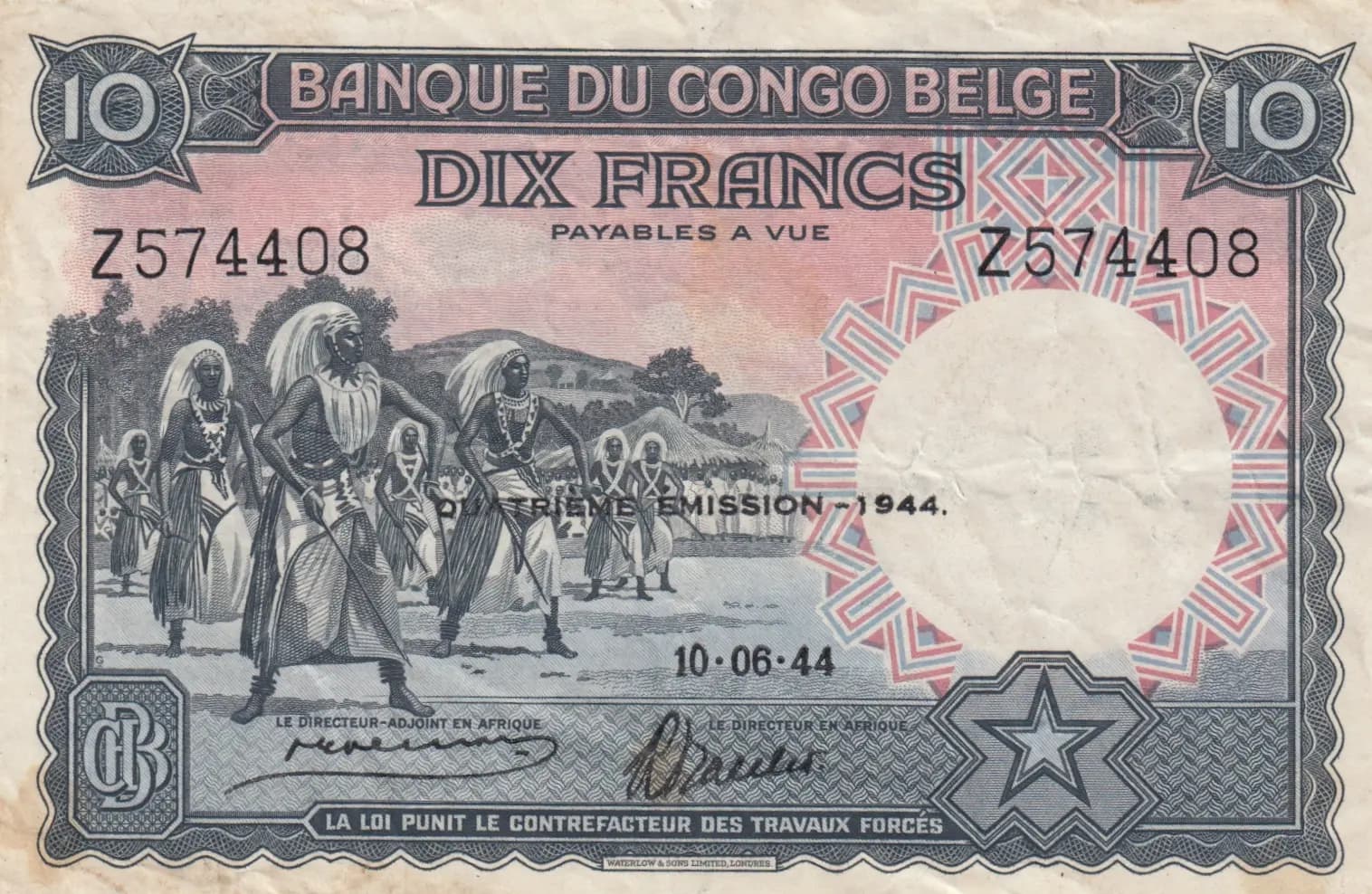
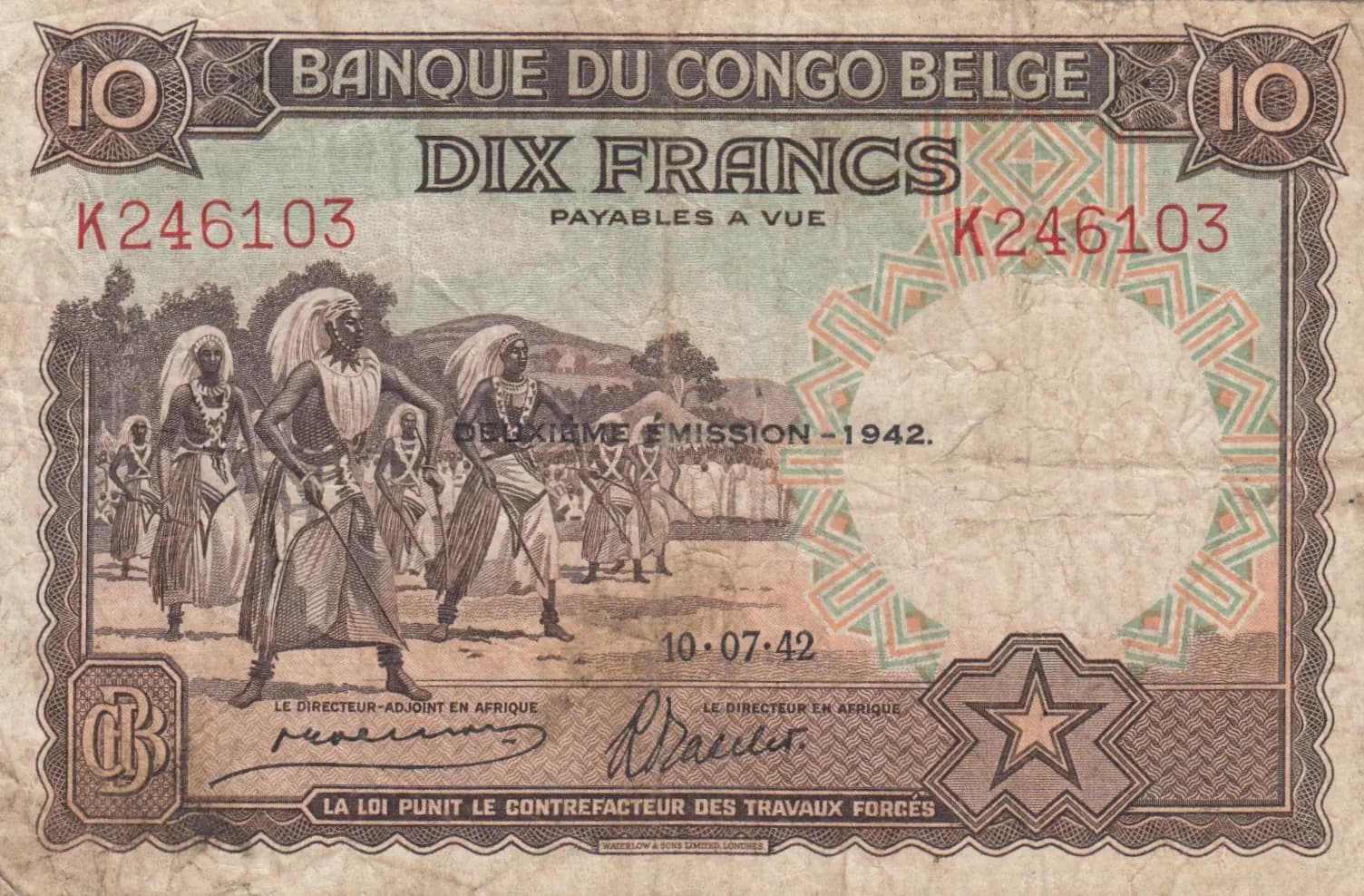
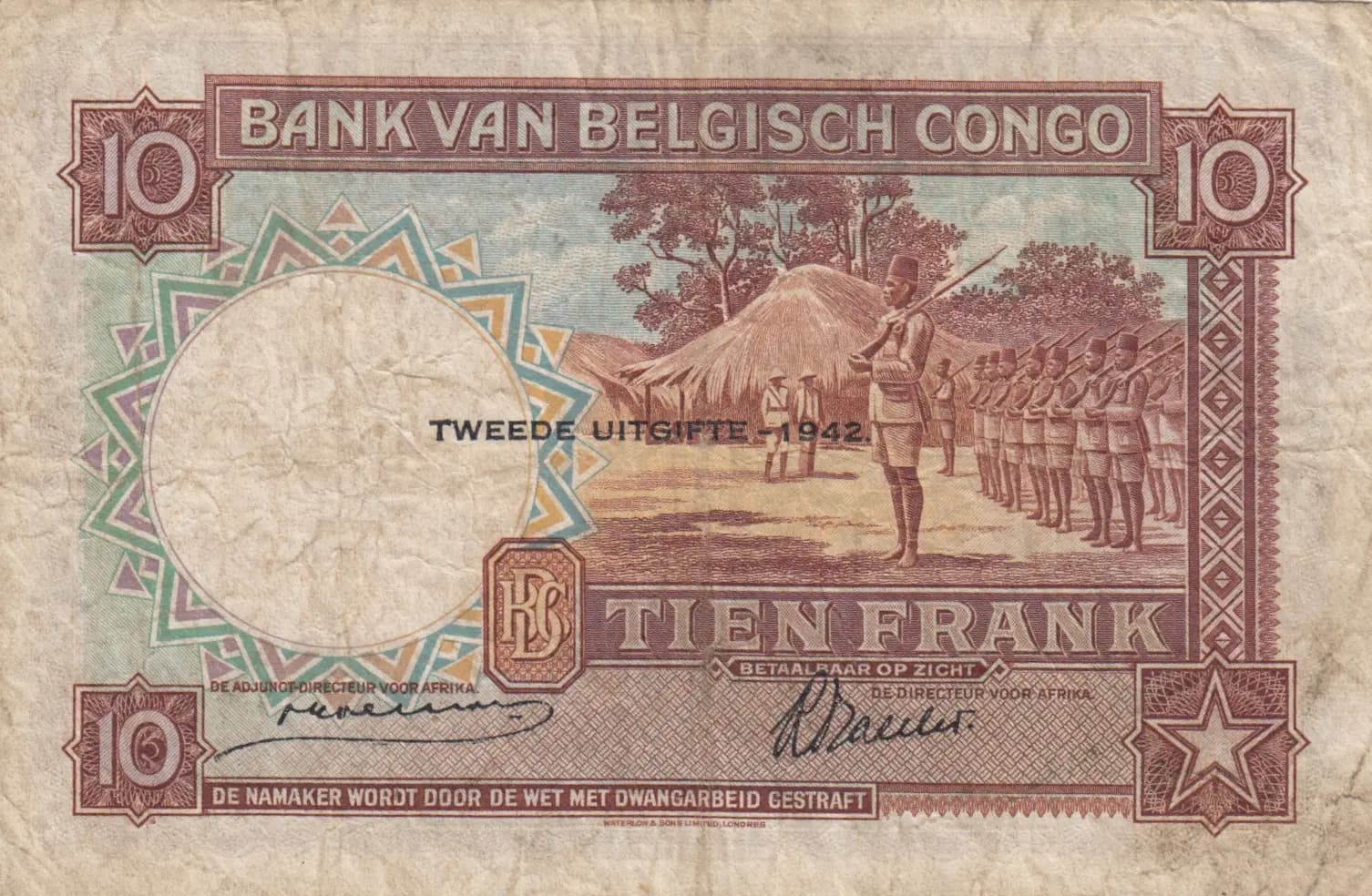
This is a Belgian Congo 10 Francs note from the second emission of 1942, issued by Banque du Congo Belge and printed by Waterlow & Sons in London. The note displays the characteristic green coloring on blue and pink underprint typical of P-14B, featuring engraved scenes of Watussi dancers on the obverse and Force Publique soldiers on the reverse. In Fair condition, the note shows expected age-related wear including creasing, foxing, and discoloration consistent with circulation during the 1940s colonial period, presenting a historically significant artifact of Belgian Congo monetary history.
Common. This note is widely available in the collector market with consistent eBay transaction history showing Fair-condition examples selling in the $30-60 range (2017-2018 data) and more recent PMG-graded examples commanding $150 for higher grades. The 2016 catalog value for F condition is $125, indicating steady collector demand but not scarcity. Multiple variants (P-14Ba, P-14Bs, P-14C, P-14Cs, P-14E, P-14Es) exist in PMG population reports, suggesting substantial print runs. The note is a standard regular issue from a major colonial bank with no documented recall or supply constraints.
Issued during World War II when Belgium was under Nazi occupation, this banknote represents the monetary authority of Belgian Congo operating under extraordinary circumstances. The depicted Watussi dancers on the front and the military inspection scene on the reverse reflect the colonial administration's imagery during this period, emphasizing both indigenous cultural elements and the presence of the Force Publique (Belgian colonial military force). This second emission of 1942 was part of the bank's wartime operations maintaining currency stability in the occupied colony.
The obverse features an engraved scene depicting Watussi dancers in traditional dress performing in a colonial African setting, with colonial-era buildings and landscape elements visible in the background. The composition showcases multiple figures (5-6 visible) arranged in a central vignette, surrounded by ornamental borders with geometric diamond and line patterns. Denomination numerals '10' appear in decorative medallions in both upper corners. The reverse displays an inspection scene of the Force Publique, showing a colonial official or officer figure prominently positioned with African soldiers or workers arranged in formation in the background, also framed by geometric border patterns and ornamental corner designs. Both sides employ fine cross-hatching and intricate line engraving characteristic of security banknote production. A large decorative circular frame occupies the left side of the reverse, likely indicating the watermark area.
FRONT (French language): 'BANQUE DU CONGO BELGE' (Bank of Belgian Congo), 'DIX FRANCS' (Ten Francs), 'PAYABLES A VUE' (Payable on Sight), 'DEUXIÈME ÉMISSION - 1942' (Second Issue - 1942), dated '10·07·42' (10 July 1942), 'LE DIRECTEUR-ADJOINT EN AFRIQUE' (The Assistant Director in Africa), 'LE DIRECTEUR EN AFRIQUE' (The Director in Africa), 'LA LOI PUNIT LE CONTREFACTEUR DES TRAVAUX FORCÉS' (The law punishes counterfeiting with forced labor). BACK (Dutch language): 'BANK VAN BELGISCH CONGO' (Bank of Belgian Congo), 'TIEN FRANK' (Ten Francs), 'BETAAL BAAR OP ZICHT' (Payable on Sight), 'TWEEDE UITGIFTE - 1942' (Second Issue - 1942), 'DE ADJUNCT-DIRECTEUR VOOR AFRICA' (The Assistant Director for Africa), 'DE DIRECTEUR VOOR AFRICA' (The Director for Africa), 'DE NAAMEKER WORDT DOOR DE WET MET DWANGARBEID GESTRAFT' (The counterfeiter is punished by law with forced labor). Both sides bear serial number K246103 in red and two official handwritten signatures.
Intaglio engraving (copperplate printing) executed by Waterlow & Sons, London, a renowned British security printer. The note exhibits characteristic fine line engravings, cross-hatching, and geometric pattern work typical of high-security banknote production of the 1940s. The design incorporates multiple color printing with green on blue and pink underprints, requiring separate printing passes for security and aesthetic purposes. Fine detail work and intricate border designs demonstrate the advanced engraving capabilities of the era.
This note is cataloged as P-14B, the green variant without overprint 'Émission/Uitgifte'. Related varieties include P-14A (blue color with overprint), P-14C, P-14E, and specialized variants (Ba, Bs, Cs, Es) noted in PMG records. The serial number K246103 appears in red on both sides. The inscription 'DEUXIÈME ÉMISSION - 1942' / 'TWEEDE UITGIFTE - 1942' confirms this as the second emission dated 10 July 1942. The bilingual French/Dutch inscriptions reflect Belgian Congo's dual-language administration. The printer attribution to Waterlow & Sons (marked as W&S) is consistent across documented variants.