5 francs 1952
Market Prices
5 salesAbout This Note
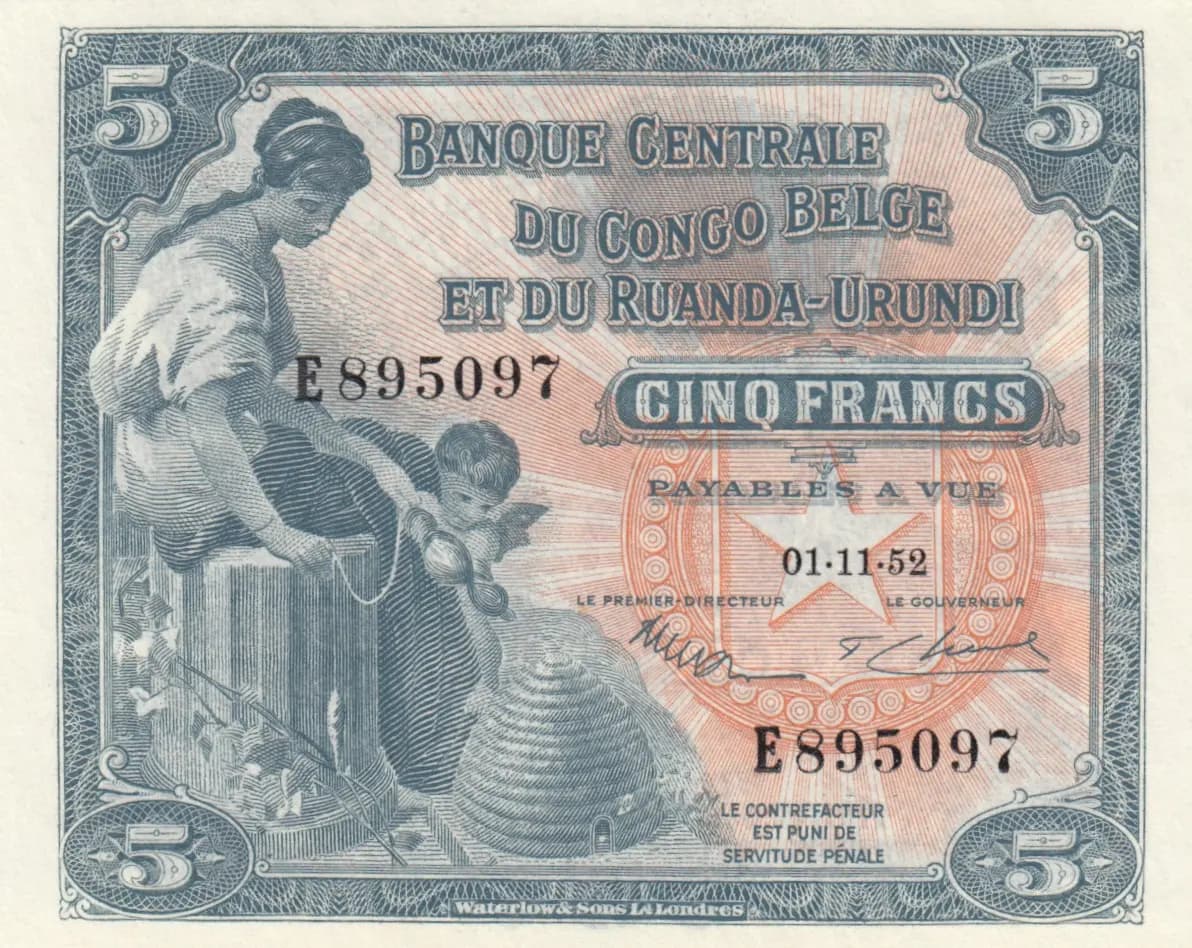
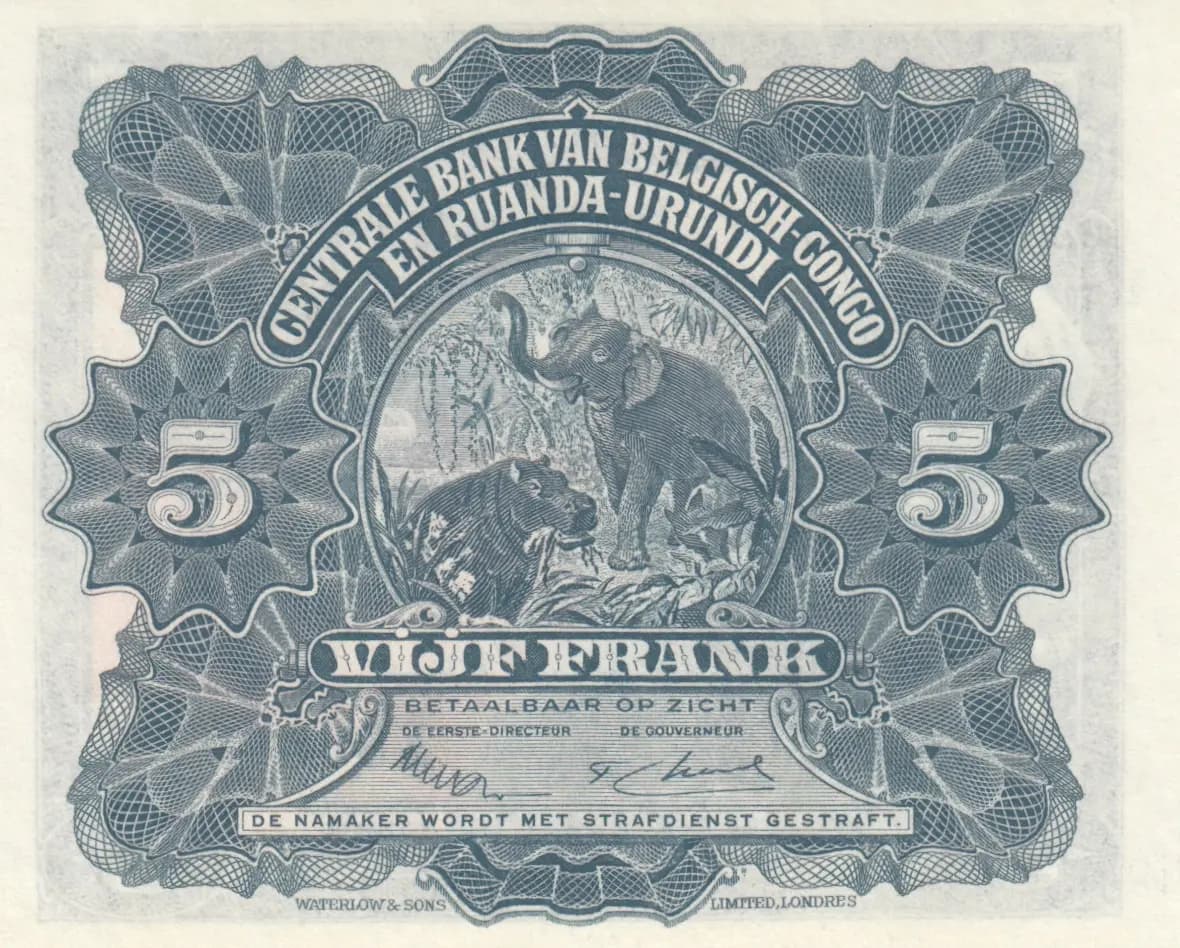
This is an exceptional example of the Belgian Congo 5 Francs dated 1 November 1952 (Pick P-13B), presented in uncirculated condition with pristine paper, sharp printing, and no visible wear. The note showcases classical engraved design work by Waterlow & Sons featuring an allegorical female figure with child on the obverse and African wildlife (elephant and hippo) on the reverse rendered in elegant blue-gray and peachy-orange tones. As a high-grade specimen from the final years of Belgian Congo's monetary independence before the 1960 independence transition, this note represents an important piece of colonial African numismatic history.
Common. While this is a legitimate and attractive colonial-era banknote, the eBay historical price data shows modest valuations ($7–$45 depending on condition) and regular sales activity, indicating reasonable availability in the collector market. The 1952 date places it near the end of Belgian Congo's monetary circulation before independence in 1960, with likely substantial print runs to meet circulation demand. UNC examples command higher prices ($45–$100 estimated value range per the 2016 catalogue data cited), but the note remains accessible to collectors and does not exhibit characteristics of scarcity such as short print runs, early withdrawal, or minimal survival rates.
Issued by the Banque du Congo Belge in 1952, this note reflects the late colonial period when Belgium still administered the Congo and Ruanda-Urundi territories. The allegorical female figure with child symbolizes the colonial 'civilizing mission' narrative, while the elephant and hippopotamus prominently featured on the reverse represent the African natural wealth and fauna that justified European colonial economic exploitation. The bilingual French-Dutch inscriptions reflect Belgium's dual-language administrative structure and the ongoing integration of Ruanda-Urundi into the Belgian Congo's monetary system.
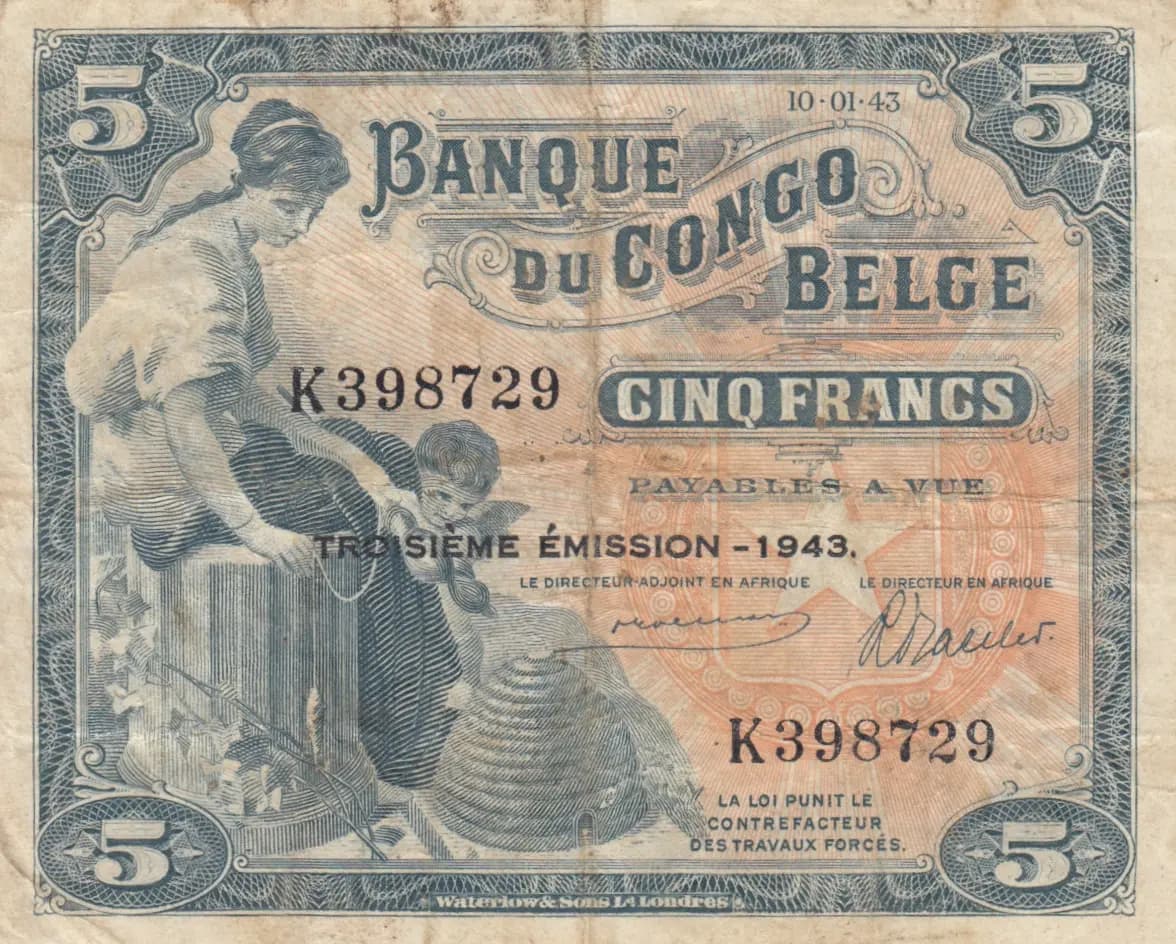
The obverse features a classical allegorical female figure in flowing robes seated at left with a cherub or child figure beside her, positioned above a beehive — symbolizing industry, productivity, and colonial development. The design is framed by ornamental borders with geometric and floral patterns, with the denomination '5' displayed in decorative corner cartouches at all four corners. The note employs a two-color printing scheme with blue-gray as the dominant tone and peachy-orange used for security elements, text areas, and the date seal. The reverse depicts a detailed natural history vignette showing an African elephant and hippopotamus in a tropical landscape with vegetation and trees, rendered in the same blue-gray palette within an elaborate oval medallion surrounded by geometric and wreath-like ornamentation. The bilateral design (French on obverse, Dutch on reverse) accommodates both Belgian linguistic communities.
FRONT (French): 'BANQUE CENTRALE DU CONGO BELGE ET DU RUANDA-URUNDI' (Central Bank of Belgian Congo and Ruanda-Urundi); 'CINQ FRANCS' (Five Francs); 'PAYABLES A VUE' (Payable on Sight); '01·11·52' (1 November 1952); 'LE PREMIER-DIRECTEUR' (The First Director); 'LE GOUVERNEUR' (The Governor); 'LE CONTREFACTEUR EST PUNI DE SERVITUDE PENALE' (The Counterfeiter is Punished with Penal Servitude); 'Waterlow & Sons Ltd Londres' (Waterlow & Sons Ltd London). BACK (Dutch): 'CENTRALE BANK VAN BELGISCH-CONGO EN RUANDA-URUNDI' (Central Bank of Belgian Congo and Ruanda-Urundi); 'VIJF FRANK' (Five Francs); 'BETAALBAAR OP ZICHT' (Payable on Sight); 'DE EERSTE-DIRECTEUR' (The First Director); 'DE GOUVERNEUR' (The Governor); 'DE NAAMAKER WORDT MET STRAFDIENST GESTRAFT' (The Counterfeiter is Punished with Penal Servitude); 'Waterlow & Sons Limited Londres' (Waterlow & Sons Limited London).
Intaglio engraving (line engraving and steel plate printing), as evidenced by the fine cross-hatching, detailed line work visible throughout both sides, and the characteristic sharp, crisp impression of security engraving. The printer was Waterlow & Sons Ltd of London, one of the world's premier security printing firms of the 20th century, known for their masterful engraved banknote work. The two-color printing was achieved through multiple passes of the engraved plates with different colored inks (blue-gray and peachy-orange), a technique characteristic of high-security banknote production of this era.
This is identified as Pick P-13B, indicating it is a variant of the base P-13 issue. The date '01·11·52' (1 November 1952) places it as one of the later-dated issues of this series, following earlier 1949 and 1951 dates noted in the reference material. The serial number E895097 is typical for notes of this period. The visual analysis confirms this note bears no 'EMISSION' overprint, which aligns with the standard circulation issue rather than overprinted variants. PMG records indicate multiple catalogued variants (P-13Aa through P-13Ad, plus P-13s) exist, suggesting signature and printer variations; this example's specific variant designation (P-13B) would be confirmed by comparing signature blocks and printer marks to the PMG population data. The note is printed by Waterlow & Sons (W&S), the standard printer for this series.