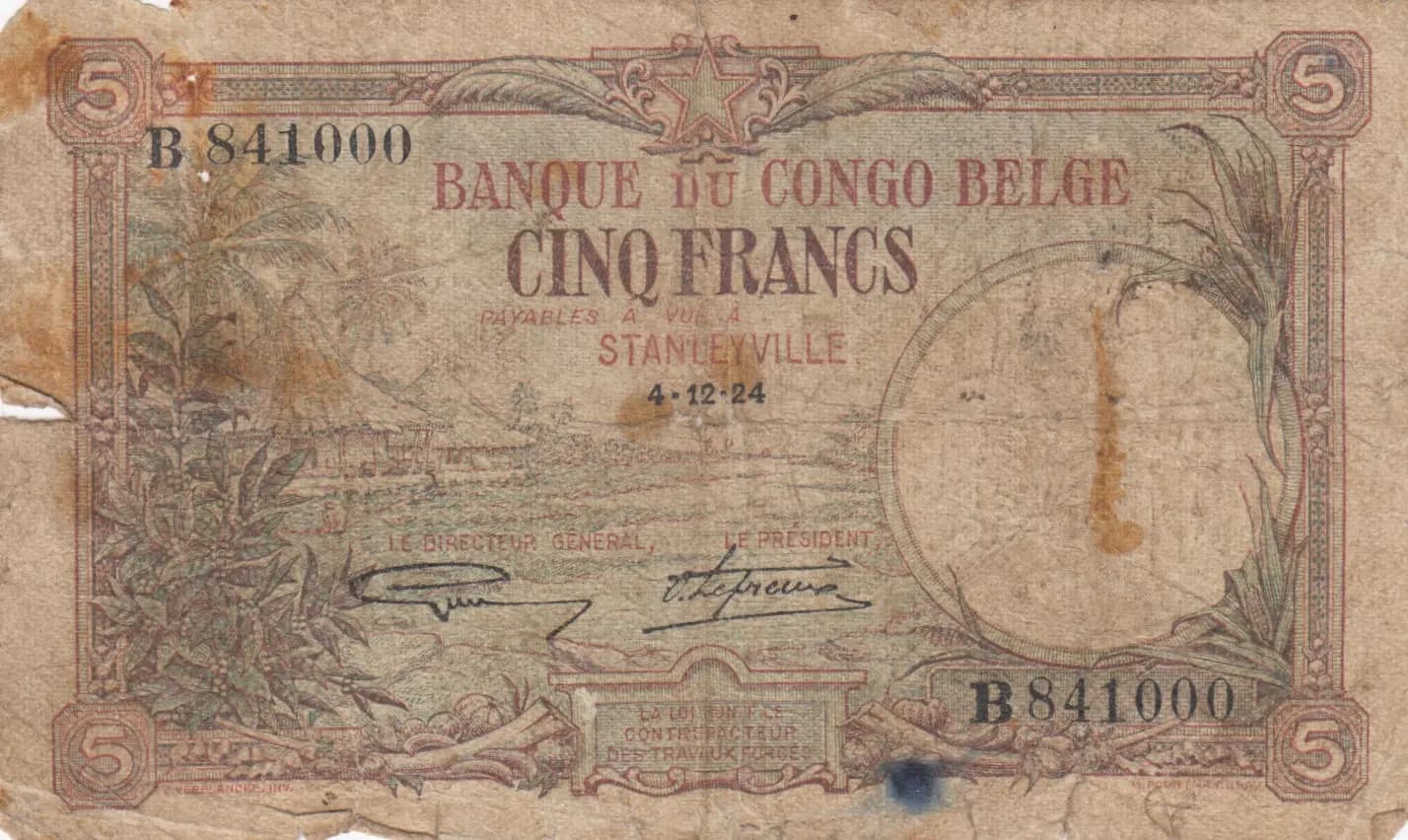
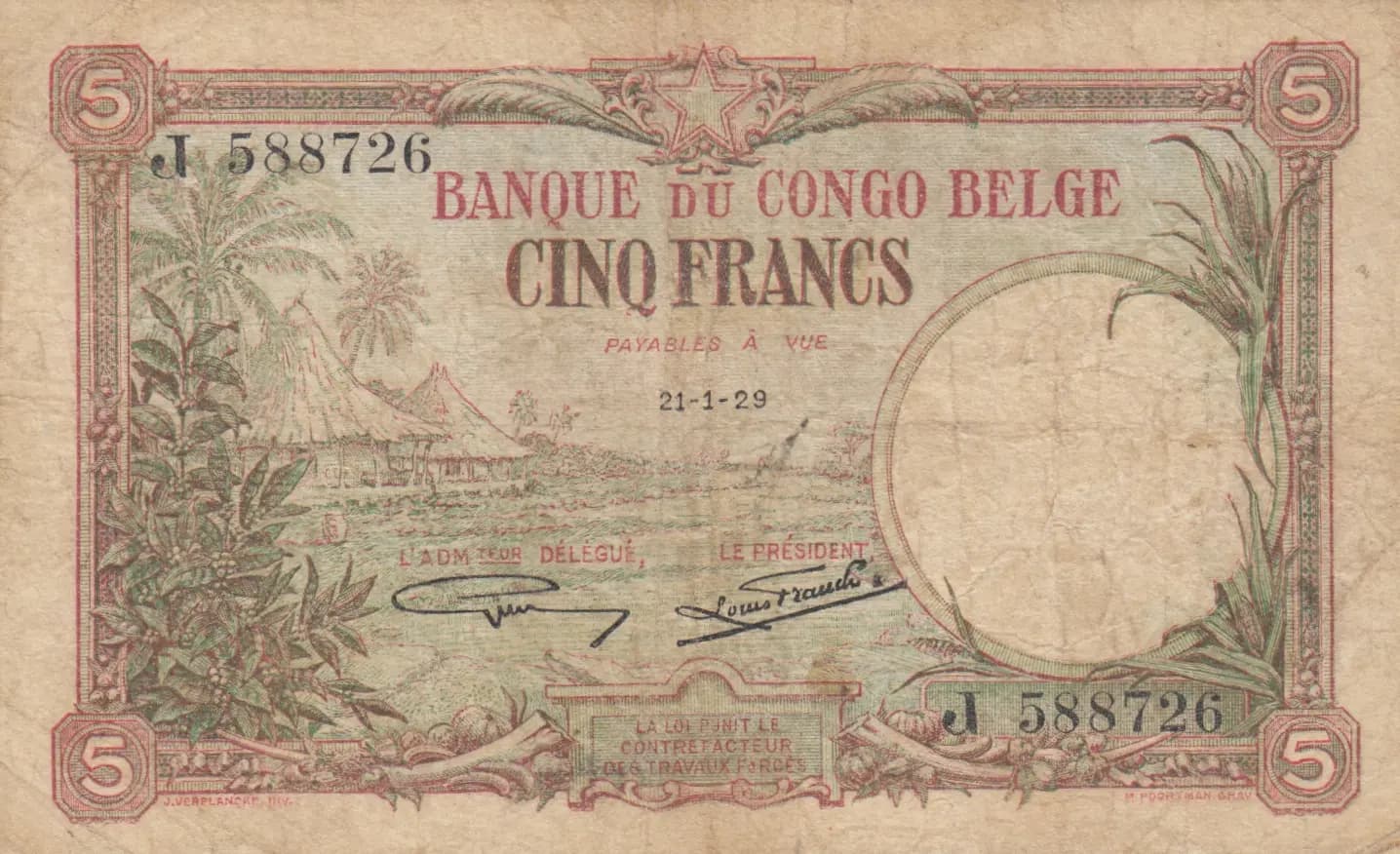
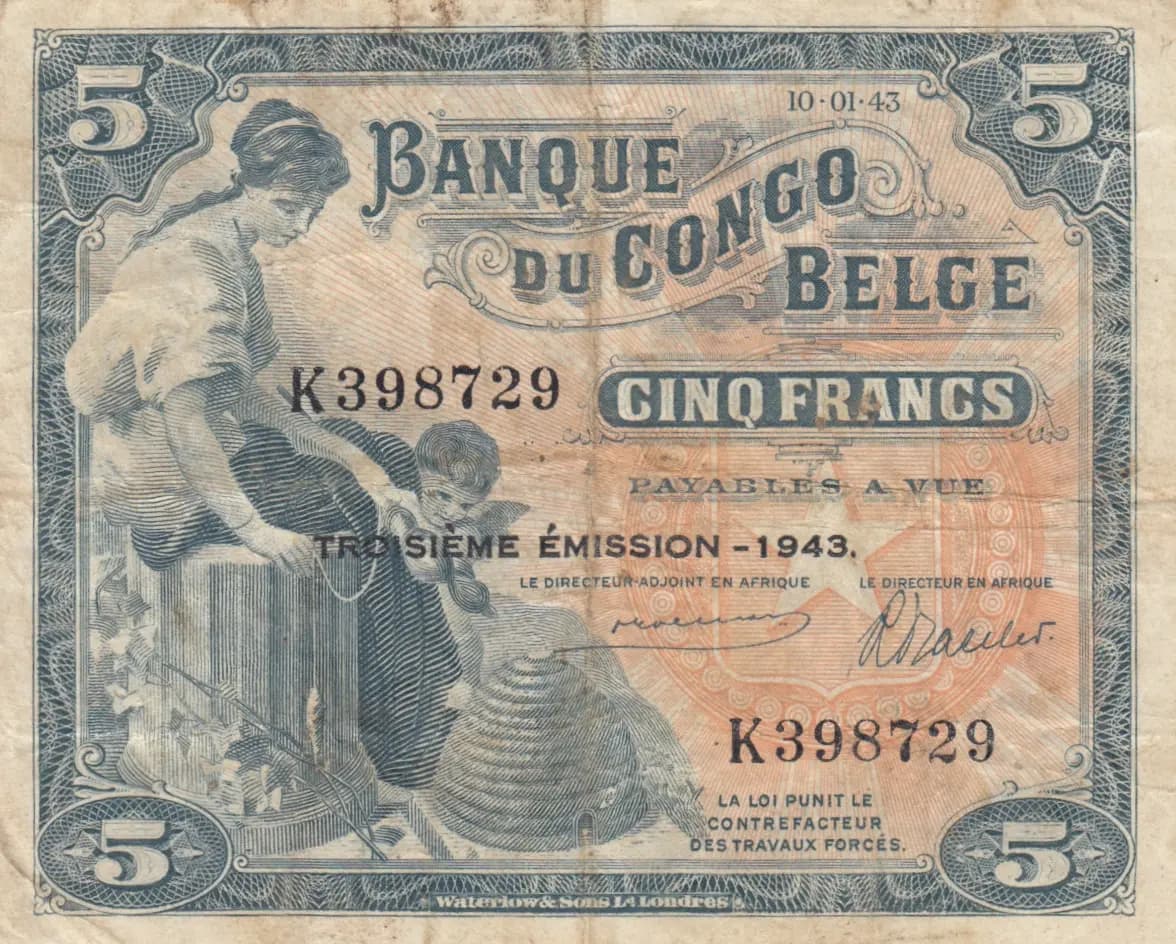
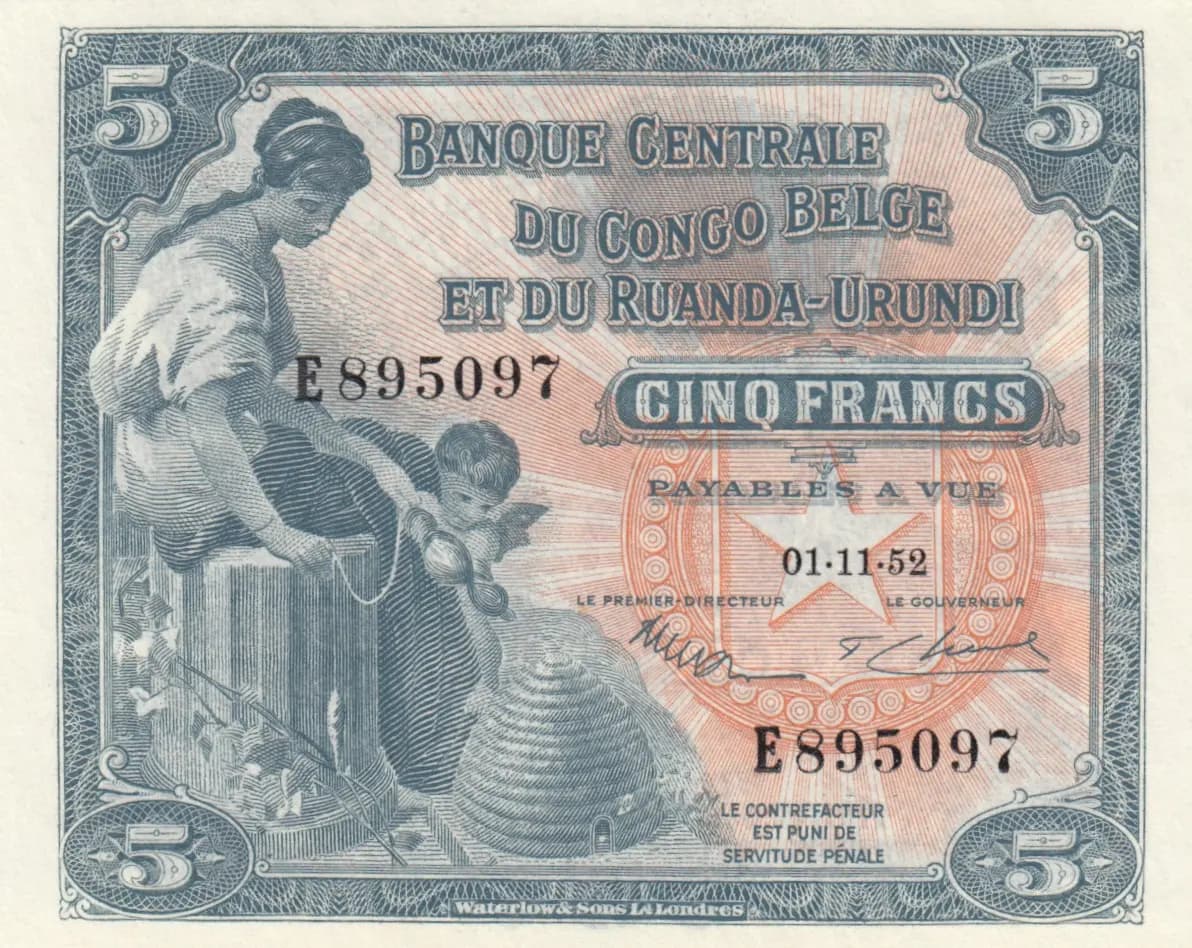
5 francs 1953
Market Prices
10 salesAbout This Note
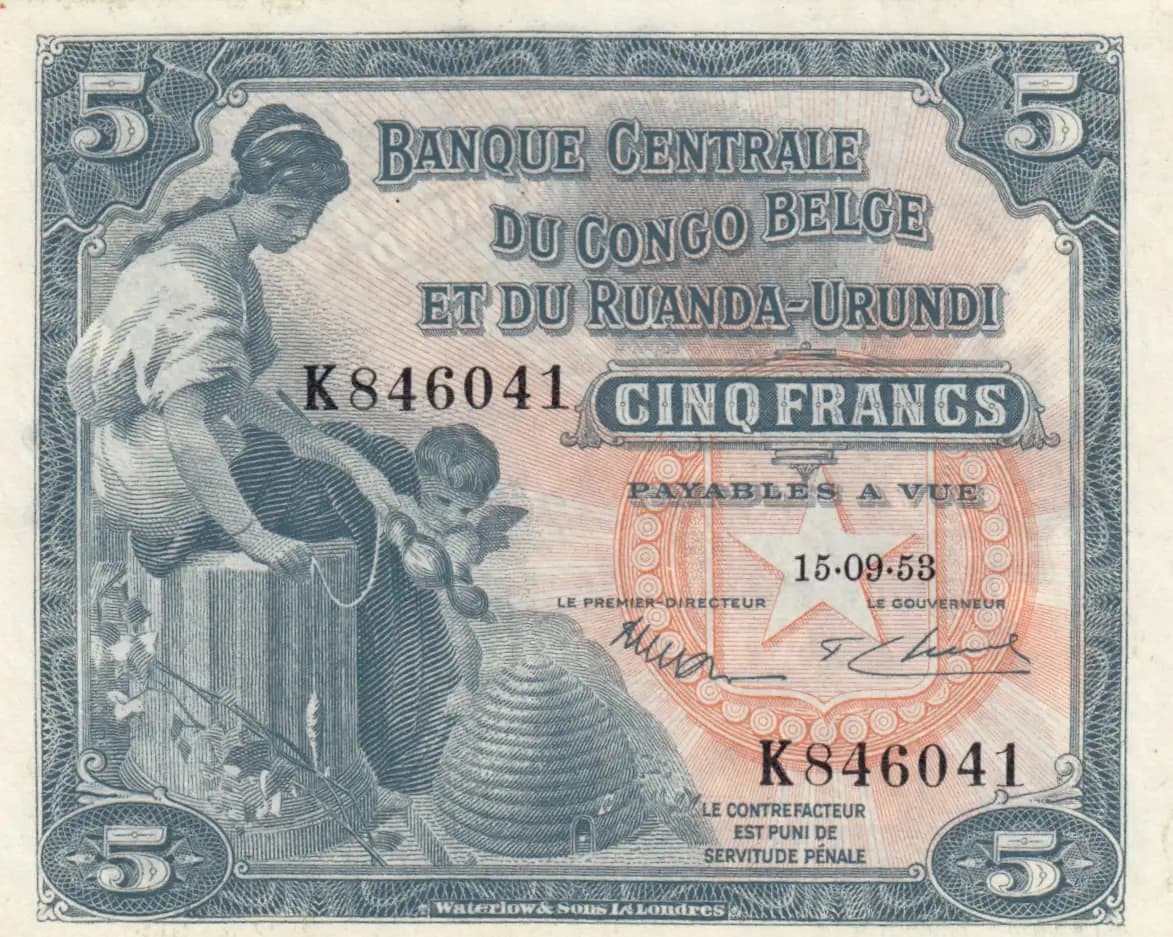
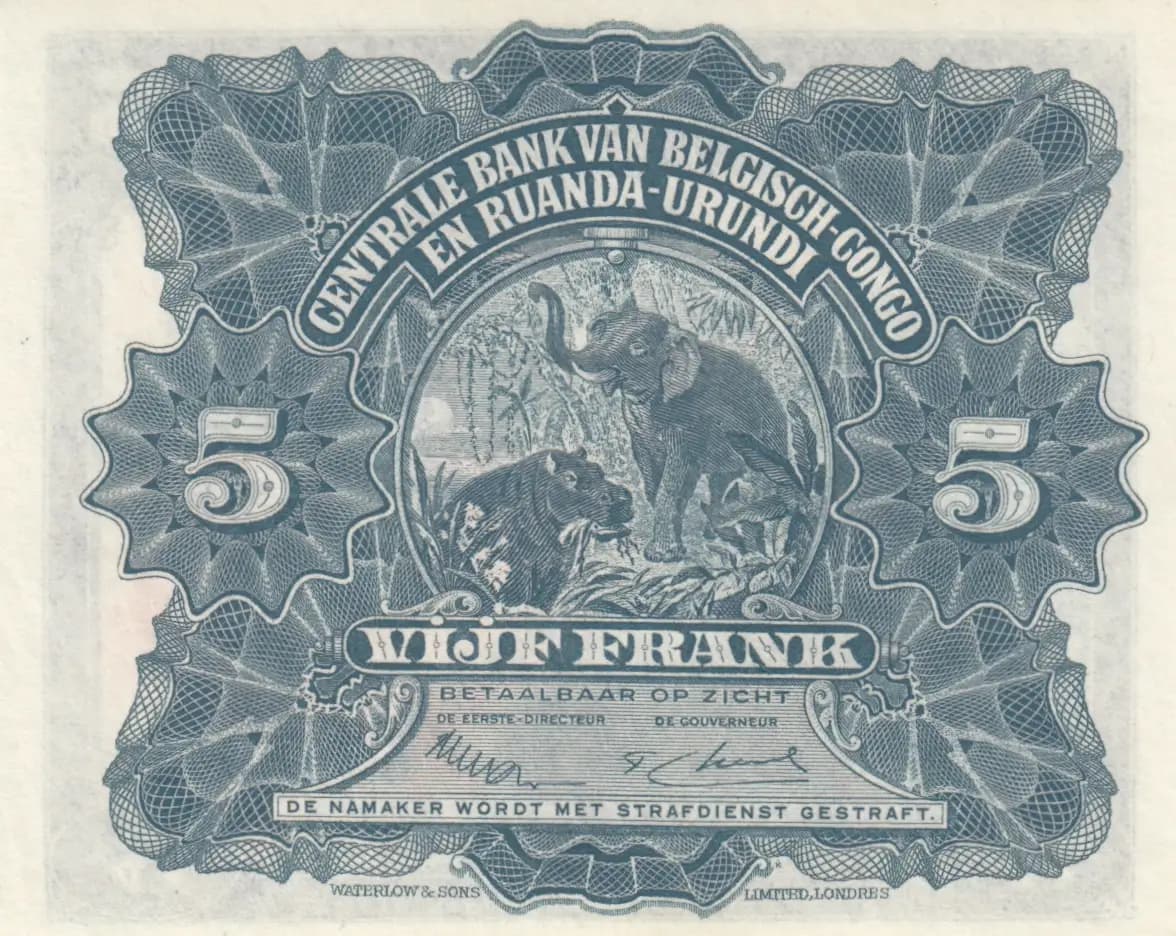
This is a Belgian Congo 5 francs banknote from 1953, issued by the Banque Centrale du Congo Belge et du Ruanda-Urundi and printed by Waterlow & Sons. The note features an allegorical female figure with child on the obverse and African wildlife (elephant and hippo) on the reverse, rendered in blue-gray and orange-red tones. The observed specimen shows light aging with minor foxing and fold marks consistent with circulation, though the engraving detail remains well-preserved, placing it in circulated condition rather than the stated UNC grade.
Common. This is a regular issue note from the Banque Centrale du Congo Belge et du Ruanda-Urundi with a documented circulation history. The eBay market data shows consistent availability at modest prices: specimens in Fine condition have sold for $9.99–$32, EF for $43–$108, and even the single PMG 30-graded example sold for $96 in 2024. The 2016 catalogue valuation lists UNC at $85, consistent with a common but modestly sought note. The date range 1952-1953 indicates a standard annual issue rather than a short-lived variety. No evidence of rarity factors such as small print runs, early withdrawal, or major recall exists for this Pick number. Despite the stated UNC grade in the provided metadata, the visual analysis indicates circulated condition with aging characteristics, which further aligns with common circulation status.
This banknote was issued during the final years of Belgian colonial rule in Central Africa, when the Banque Centrale du Congo Belge et du Ruanda-Urundi managed currency for both Belgian Congo and the UN Trust Territory of Ruanda-Urundi. The allegorical female figure with child on the obverse represents civilization and progress, while the elephant and hippo vignette on the reverse celebrate the natural wealth and exotic fauna of Central Africa—themes typical of colonial-era currency design. The bilingual (French/Dutch) inscriptions reflect Belgium's linguistic divide and administrative structure in its African territories during this transitional period before independence in 1960-1962.
The obverse features an allegorical representation of a seated female figure (representing civilization, progress, or maternal care) cradling an infant, positioned at the left side of the note with architectural elements in the background. A beehive is present in the composition, symbolizing industry and productivity—common allegorical elements in colonial-era currency. The center of the note displays a prominent red star with horizontal lines as the primary design element, surrounded by an ornamental circular frame with decorative patterns in all corners. The reverse presents a central oval vignette depicting African wildlife in a natural landscape: an elephant as the primary subject, accompanied by a hippopotamus and other fauna set against rocky terrain and vegetation typical of Central African savanna and river environments. Both sides employ elaborate decorative scalloped borders and corner ornaments framing the denomination numeral 5. The color scheme of blue-gray with red-orange accents creates visual hierarchy while maintaining the formal aesthetic of mid-20th century European banknote design.
OBVERSE (Front): 'BANQUE CENTRALE DU CONGO BELGE ET DU RUANDA-URUNDI' (Central Bank of Belgian Congo and Ruanda-Urundi); 'CINQ FRANCS' (Five francs); 'PAYABLES A VUE' (Payable on demand); '15·09·53' (September 15, 1953); 'LE PREMIER-DIRECTEUR' (The First Director); 'LE GOUVERNEUR' (The Governor); 'LE CONTREFACTEUR EST PUNI DE SERVITUDE PENALE' (The counterfeiter is punished by penal servitude); 'Waterlow & Sons Ltd Londres' (Waterlow & Sons Ltd London). Serial number: K846041. REVERSE (Back): 'CENTRALE BANK VAN BELGISCH-CONGO EN RUANDA-URUNDI' (Central Bank of Belgian Congo and Ruanda-Urundi); 'VIJF FRANK' (Five francs); 'BETAALBAAR OP ZICHT' (Payable on sight); 'DE EERSTE-DIRECTEUR' (The First Director); 'DE GOUVERNEUR' (The Governor); 'DE NAAMAKER WORDT MET STRAFDIENST GESTRAFT' (The counterfeiter is punished with penal servitude); 'Waterlow & Sons Limited, Londres' (Waterlow & Sons Limited, London).
This banknote was produced using intaglio (engraved line) printing, the standard security printing technique employed by Waterlow & Sons Ltd, a premier British security printer. The detailed engraving is evident throughout both obverse and reverse in the fine linework of the allegorical figure, facial features, wildlife details, decorative borders, and text. The printer's mark 'Waterlow & Sons Ltd Londres' (or 'Limited, Londres' on the reverse) appears at the bottom of both sides, confirming the printing house. Intaglio printing provides inherent security through the difficulty of reproduction and creates the characteristic raised texture and fine detail quality visible in the engraved elements.
The specific variety observed is dated 15·09·53 (September 15, 1953) with serial number prefix K. The catalog references note Pick P-21 is documented with a date range of 1952-1953, indicating multiple date varieties exist within this Pick number. The note is described as 'Without watermark' in the realbanknotes.com reference, distinguishing it from potentially watermarked variants. The serial number K846041 appears on both obverse and reverse. The note is bilingual with French on the obverse and Dutch/Flemish on the reverse, reflecting the standard bilingual issuance policy of the Central Bank. PMG population data indicates only 1 variant has been catalogued for Pick P-21, though this likely represents a single primary variant classification rather than exhaustive variety documentation. No overprints or significant printing varieties are evident in the visual analysis.