20 francs 1953
Market Prices
13 salesAbout This Note
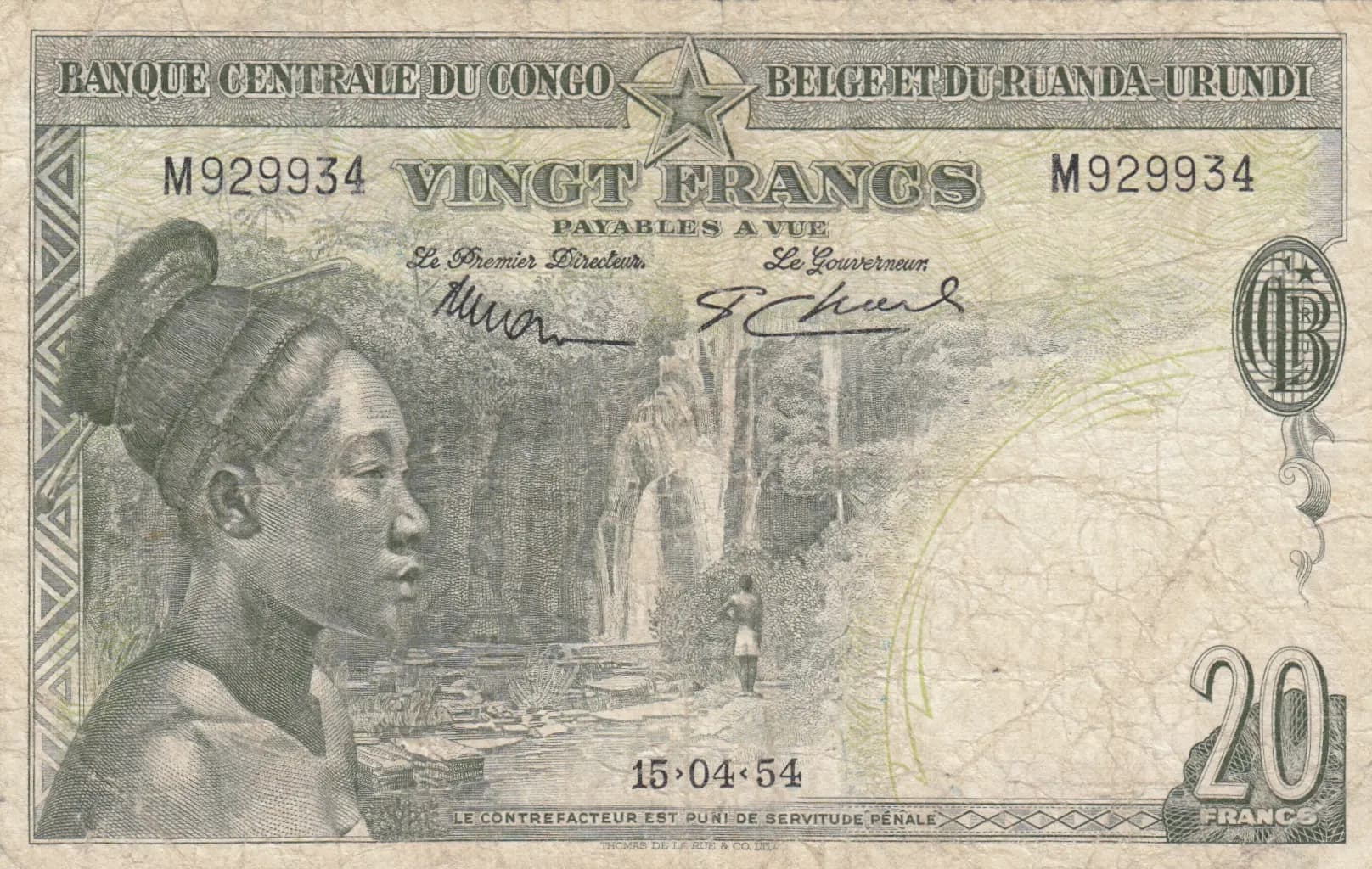
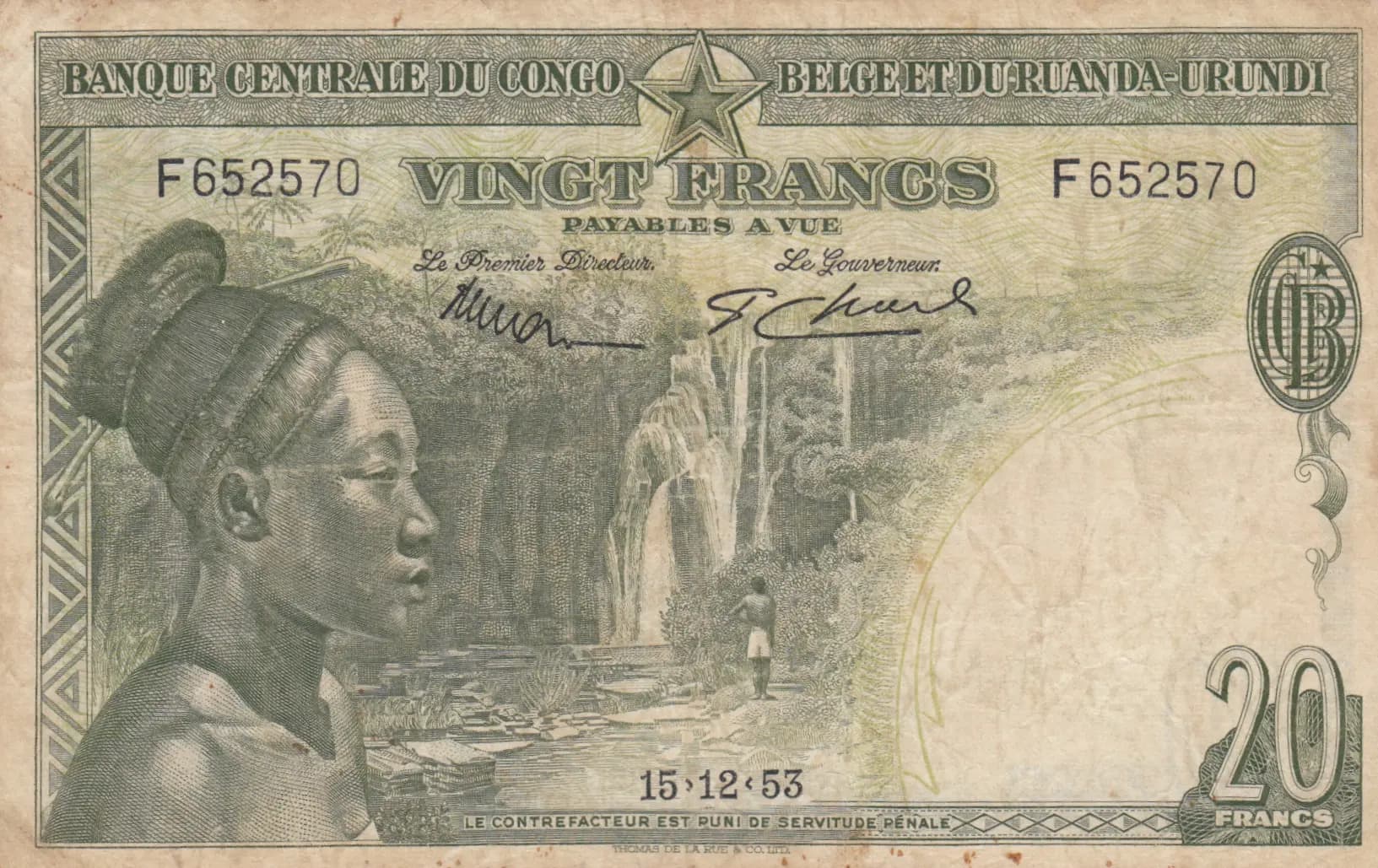
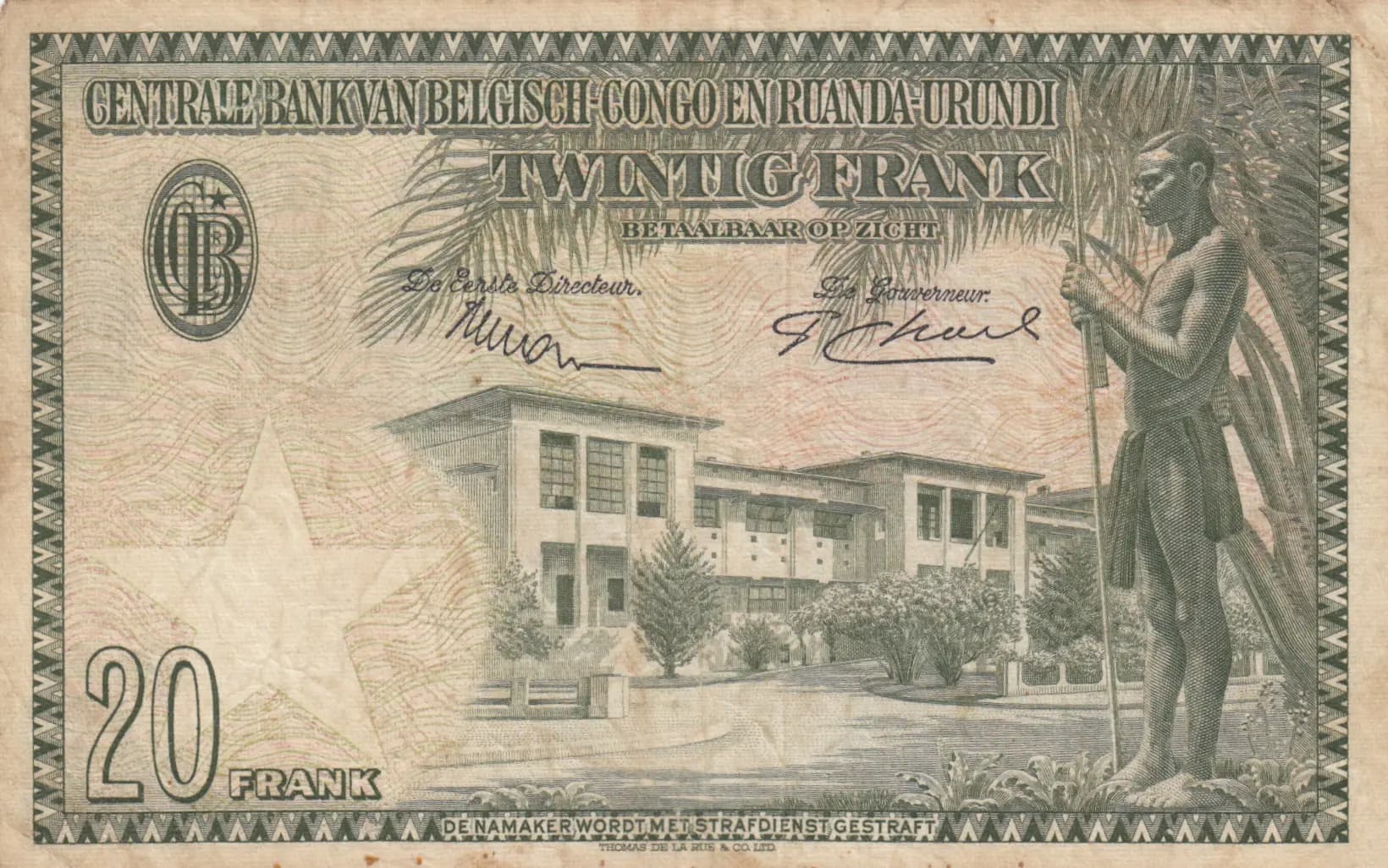
This is a Belgian Congo 20 Francs note from 1953, issued by the Banque Centrale du Congo Belge et du Ruanda-Urundi. The note displays the characteristic olive-green coloring on a yellow underprint, featuring a female portrait on the obverse and an institutional building (Queen Astrid Laboratory in Leopoldville) on the reverse, with visible aging characteristics including foxing, discoloration, and fold marks consistent with its Fair grade. The bilingual design (French/Dutch) and Thomas De La Rue printing reflect the colonial administration's dual-language requirements.
Common. The eBay market data shows consistent sales across multiple condition grades, with Fair condition examples selling for approximately $22-$40 in recent years (2021-2025). The 2016 catalog value for VG is only $10, and F examples regularly appear in the market at modest prices. This was a standard issue for a major African colonial bank, likely produced in substantial quantities. The lack of any premium pricing and the frequency of sales indicates this is a common date and denomination in the Belgian Congo series.
This banknote was issued during the final decade of Belgian colonial rule in Congo, representing the modernization efforts of the colonial administration through its depiction of the Queen Astrid Laboratory in Leopoldville—a symbol of scientific and institutional development in the Belgian Congo. The inclusion of both French and Dutch inscriptions reflects Belgium's linguistic duality and its administrative jurisdiction over both the Congo and the Ruanda-Urundi territories following World War II. The 1953 issue date places this note during a period of relative stability before the rapid decolonization movement of the late 1950s.
The obverse features an elegantly rendered profile portrait of a woman in traditional dress with an elaborate upswept hairstyle, positioned on the left side. The central design depicts a tropical waterfall landscape with palm trees and indigenous figures, representing the natural resources and indigenous populations of the Congo. A five-pointed star appears at top center, with a decorative oval emblem on the right side and geometric border patterns on the left margin. The reverse showcases the Queen Astrid Laboratory in Leopoldville as the dominant central feature—a modernist institutional building with multiple large rectangular windows, reflecting the colonial administration's investment in scientific and medical infrastructure. A classical male figure in relief appears on the right side, while a flagpole with landscaping elements frames the building. Geometric zigzag and triangular border patterns frame both sides of the note. The color scheme of olive-green on yellow underprint is consistent throughout both sides.
OBVERSE (French): Banque Centrale du Congo Belge et du Ruanda-Urundi (Central Bank of Belgian Congo and Ruanda-Urundi) | Vingt Francs (Twenty Francs) | Payables à Vue (Payable on Sight) | Le Premier Directeur (The First Director) | Le Gouverneur (The Governor) | Le Contrefacteur est Puni de Servitude Penale (The Counterfeiter is Punished with Penal Servitude) | Serial: F652570 | Date: 15·12·53 (15 December 1953). REVERSE (Dutch): Centrale Bank van Belgisch-Congo en Ruanda-Urundi (Central Bank of Belgian Congo and Ruanda-Urundi) | Twintig Frank (Twenty Francs) | Betaalbaar op Zicht (Payable on Sight) | Eerste Directeur (First Director) | De Gouverneur (The Governor) | De Namaker wordt met Strafdienst Gestraft (The Counterfeiter is Punished with Penal Servitude) | Thomas De La Rue & Co Ltd (Printer).
This note was produced using intaglio printing by Thomas De La Rue & Co Ltd (TDLR), the renowned security printer whose imprint appears on the reverse. The intaglio method is evidenced by the fine line work, detailed portraiture, and dimensional quality visible in the design elements. The multi-color printing technique successfully layered the olive-green primary color over a yellow underprint to create the distinctive color scheme. An elephant's head watermark was incorporated during the paper manufacturing process as a security feature.
This note is identified as Pick P-26, with serial number F652570 and an issue date of 15 December 1953. The PMG population report indicates two cataloged variants for this base Pick number (P-26 and P-26s), likely distinguished by specimen markings or printer variations. The F-prefix serial number and specific signature combinations may indicate a particular printing run or batch, though without access to comprehensive census data, the exact variety cannot be definitively determined from the visual analysis alone. The note exhibits the standard TDLR printer identification consistent with the primary P-26 listing.