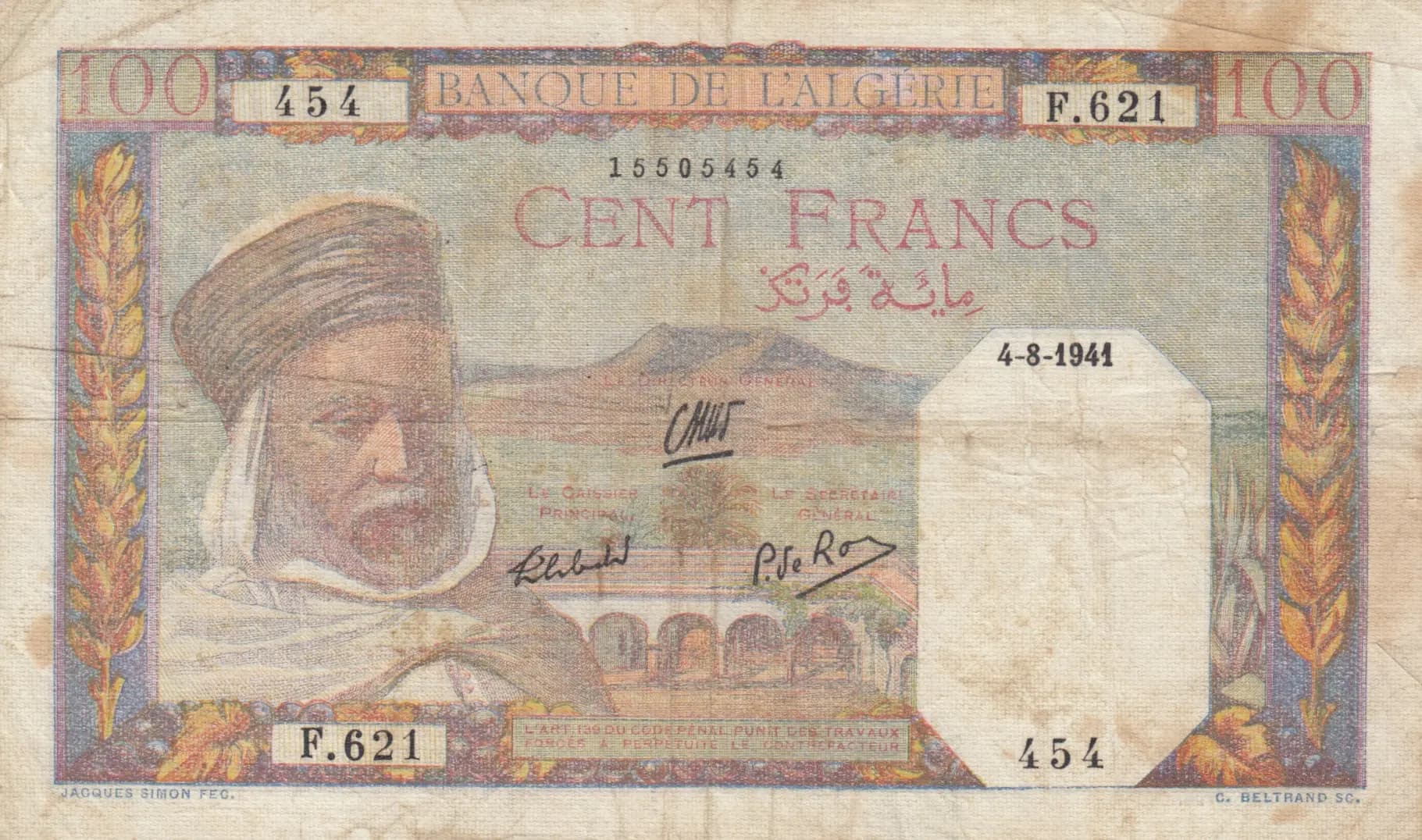
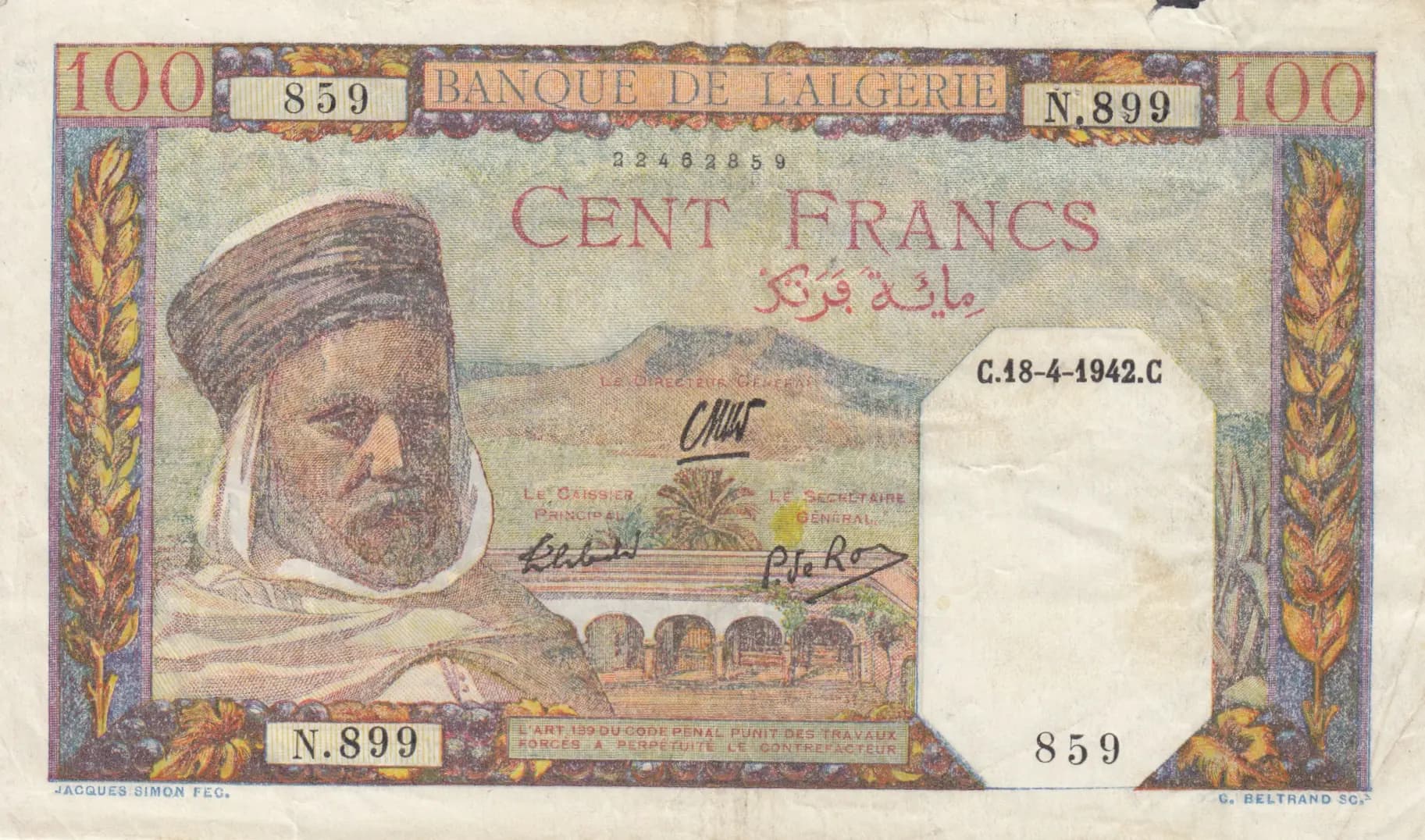
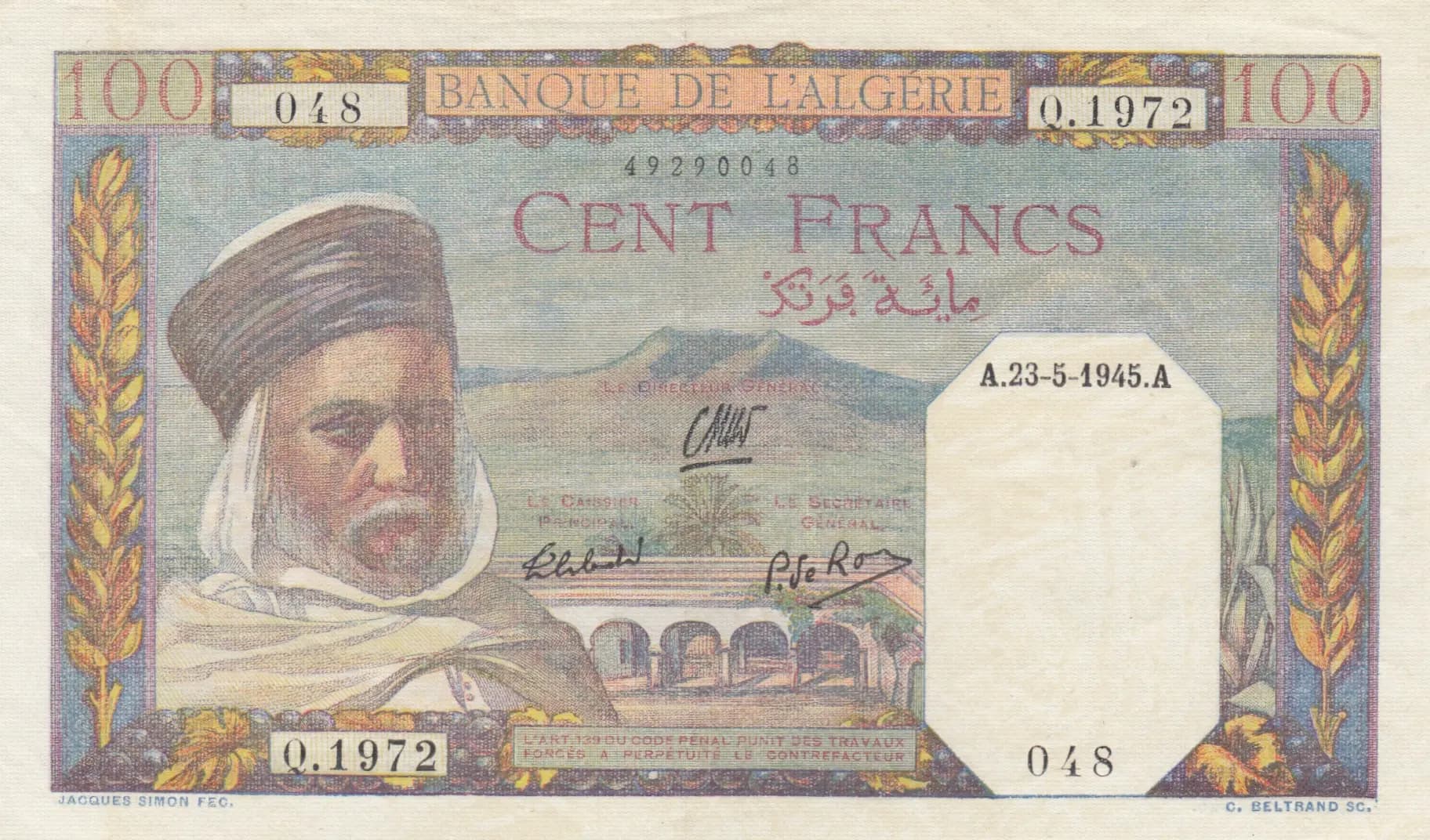
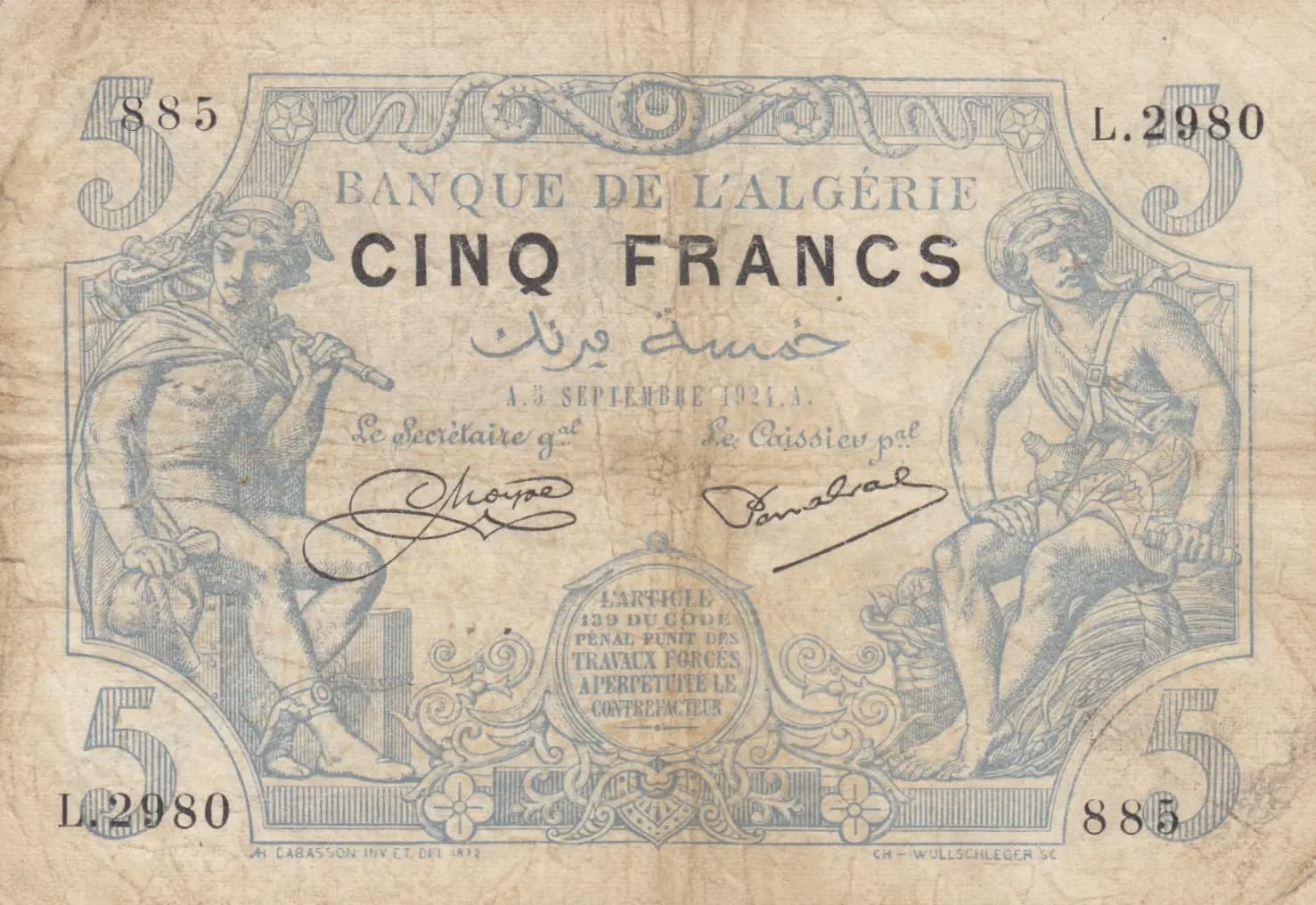
100 francs 1942
“2.11.42”
Market Prices
43 salesAbout This Note
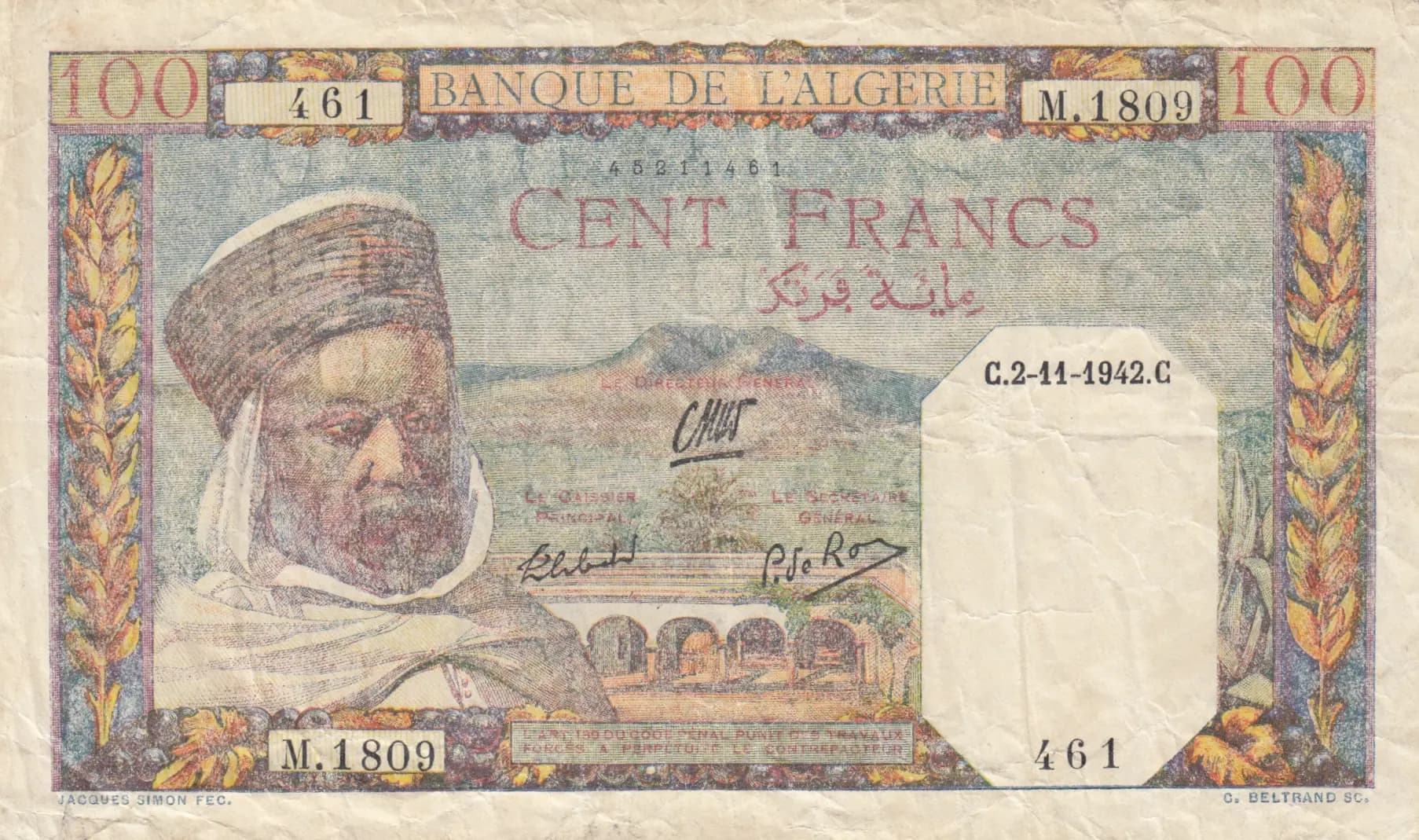
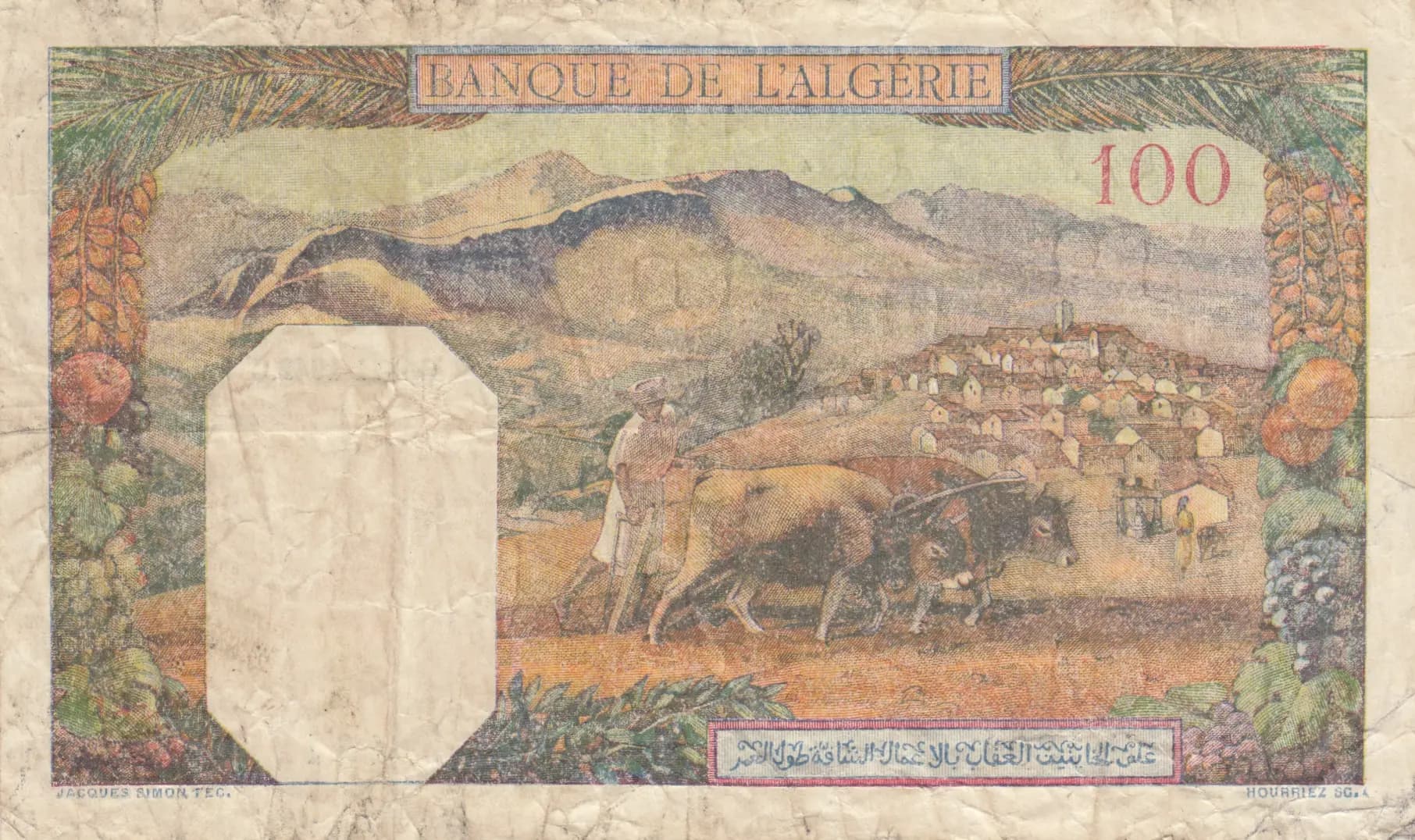
This 100 francs banknote from Banque de l'Algérie dated November 2, 1942, presents an ethnographically rich design typical of French colonial-era currency for North Africa. The note features a distinguished portrait of a turbaned man in traditional North African dress on the obverse, paired with an evocative reverse depicting agricultural labor with oxen in a pastoral Algerian landscape. In Fair condition, the note displays moderate circulation wear with creasing, foxing, and age-related discoloration, though the fine engraving work remains largely legible—characteristic of notes from this transitional wartime period under French administration.
Common. The Banque de l'Algérie 100 francs note of 1942 (Pick P-85) was issued during a period of sustained demand for colonial currency and represents standard circulation issue denominations. No evidence suggests limited print runs, early recall, or scarcity in the collector market. Notes from this series appear with reasonable regularity in numismatic commerce and auction results, with typical Fair condition examples trading at modest valuations consistent with common wartime colonial banknotes. The denomination, issuing period, and administrative stability of the note indicate substantial production runs typical of standard circulation issues.
Issued during World War II under French administration, this banknote reflects Algeria's colonial economic status and cultural identity within the French monetary system. The imagery—featuring indigenous portraiture alongside idealized pastoral agriculture—exemplifies the colonial iconography of the era, presenting Algeria through the lens of French economic interests and cultural representation. The November 1942 date places this note amid the significant political upheaval following the Allied invasion of North Africa (Operation Torch), a pivotal moment in Algeria's path toward independence that would culminate less than two decades later.
The obverse depicts a dignified bearded gentleman in traditional Maghrebi attire, specifically a white turban and ornate robes typical of North African dress conventions. The portrait is set against a mountainous landscape with a fortified kasbah or administrative building, evoking Algeria's architectural and geographic character. Elaborate decorative borders featuring laurel and wheat leaf motifs frame both sides, with gold-colored ornamental corner designs emphasizing the note's official status. The reverse presents an idealized scene of Algerian rural life, depicting agricultural workers with oxen engaged in field labor, with a hillside settlement featuring traditional architecture visible in the distance against mountain ranges. Palm fronds and botanical ornamental elements create an elaborate frame, reinforcing the colonial aesthetic that romanticized North African indigenous life for European audiences. The color palette—cream, tan, soft greens, browns, and gold highlights—creates a sophisticated, historically authentic appearance consistent with high-quality engraved currency of the 1940s.
FRONT SIDE: 'Banque de l'Algérie' (Bank of Algeria); 'Cent Francs' (One Hundred Francs); '100' (denomination); 'M.1809' (internal identifier); '461' (series designation); 'C.2-11-1942.C' (issue date: November 2, 1942, with series marker); '48211461' (serial number); 'Jacques Simon Fec.' (Jacques Simon engraved); 'O. Beltrand Sc.' (O. Beltrand sculpted); 'Le Trésorier Principal' (The Principal Treasurer); 'Le Gouverneur Général' (The Governor General); Arabic text relating to general accounting/treasury functions. BACK SIDE: 'Banque de l'Algérie' (Bank of Algeria); '100' (denomination); 'Jacques Simon Fec.' (Jacques Simon engraved); 'Hourriez Sc.' (Hourriez sculpted); Arabic text relating to port authority and labor administration.
This banknote employs intaglio (engraving) printing throughout, evidenced by the fine line work, intricate detail preservation, and characteristic impressed quality visible in both obverse and reverse designs. The detailed signatures of engravers Jacques Simon and sculptors O. Beltrand and Hourriez indicate traditional hand-engraved dies were used in production. The multiple layers of fine line work, decorative borders, and tonal gradations in the portrait and landscape scenes are hallmarks of steel engraving, the dominant security printing method for French colonial currency. The note was produced by Banque de l'Algérie's official printing facilities, likely coordinated with French central bank printing standards.
The observed serial number configuration (48211461 with series designation 461 and identifier M.1809) suggests this note belongs to a standard production run. The dated series marking 'C.2-11-1942.C' indicates November 2, 1942, as the official issue date. Collector notation '2.11.42' corresponds to this printed date, confirming consistent record-keeping. Minor varieties may exist within production runs related to signature variations of treasury officials and governors, but this represents a standard issue without known major varieties affecting collector value. The engraver attributions (Simon, Beltrand, Hourriez) appear consistent across documented examples of this type.