100 francs 1942
“18.04.42”
Market Prices
43 salesAbout This Note
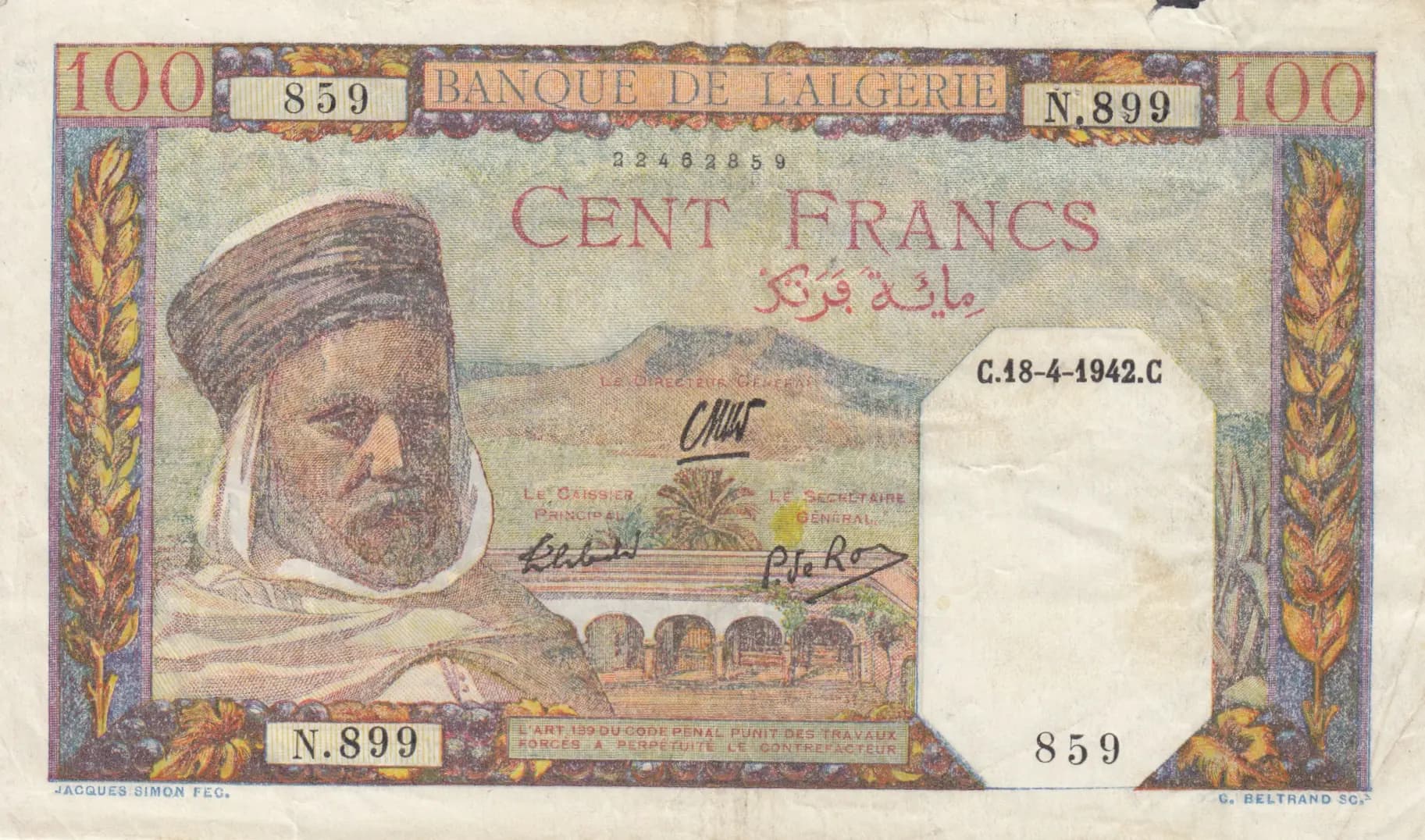
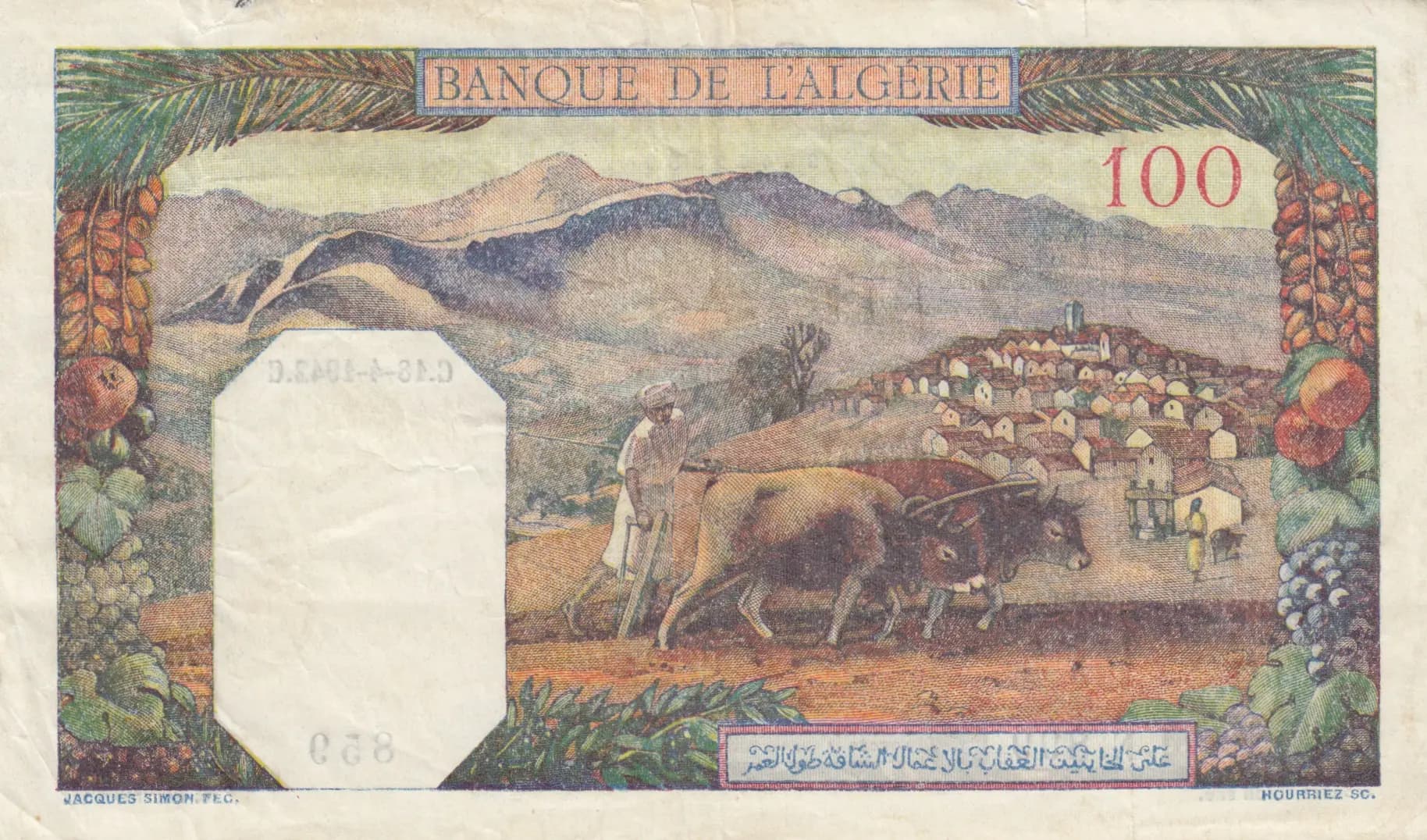
This is a Banque de l'Algérie 100 Francs note from April 18, 1942, issued during the transitional period of World War II when Algeria's political status was in flux. The note displays the classic colonial-era design with a portrait of a North African man in traditional dress on the obverse and an agricultural scene with oxen and plowing on the reverse, reflecting Algeria's economy at the time. In Fair (F) condition, the note exhibits significant aging with foxing, yellowing, and creasing consistent with 80+ years of circulation, making it a tangible artifact of a pivotal historical moment.
Common. The eBay sales data shows consistent market availability with numerous examples in circulation condition selling for $6.50–$32 USD across Fair to Very Fine grades. The abundance of sales records spanning from 2009 to 2025 indicates this is a regularly traded note with steady collector demand but no scarcity premium. Fair-condition examples have sold for $6.50–$23.50, demonstrating that this grade carries minimal collector value. The note was part of a regular issue with substantial print run and no documented recall or shortage.
This 100 Francs note was issued during the period following the French liberation of North Africa from Vichy French control (November 1942), when Algeria's relationship with France was being redefined. The imagery—featuring a Maghrebi man in traditional attire and agricultural labor with oxen—reflects the colonial portrayal of Algeria as an agrarian territory, while the bilingual French-Arabic inscriptions acknowledge Algeria's dual cultural character. This note represents the currency of Algeria during the crucial transitional years leading toward independence in 1962.
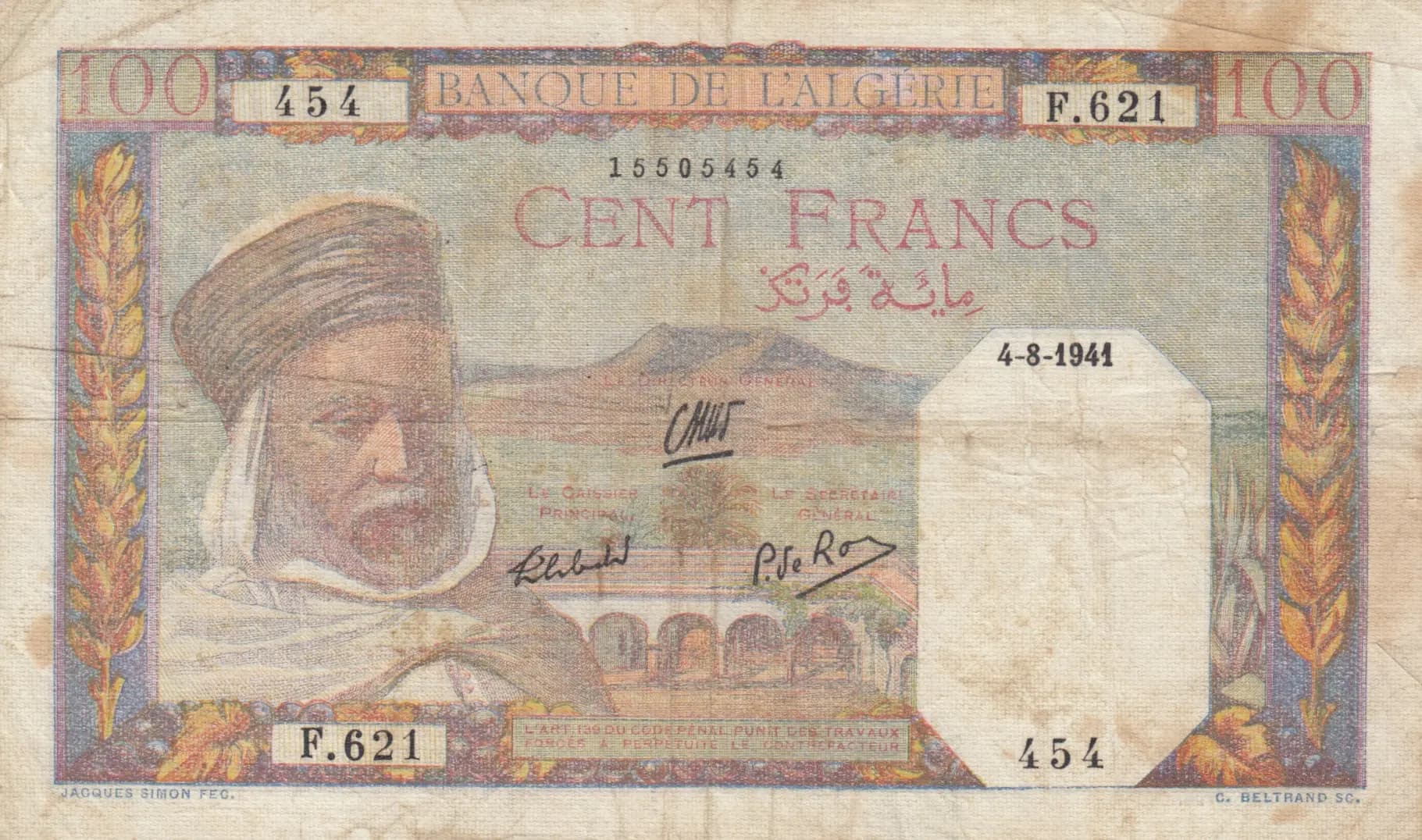
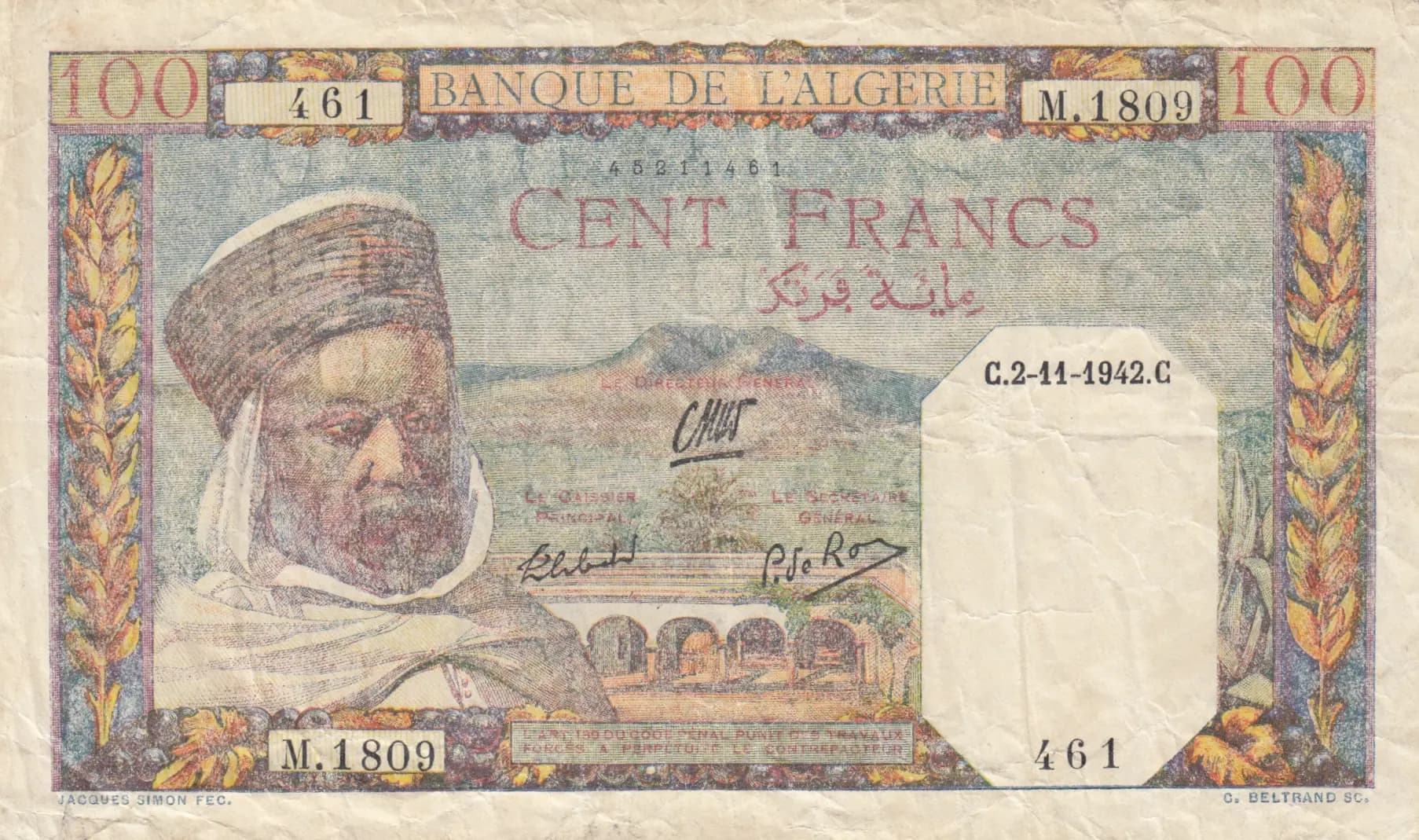
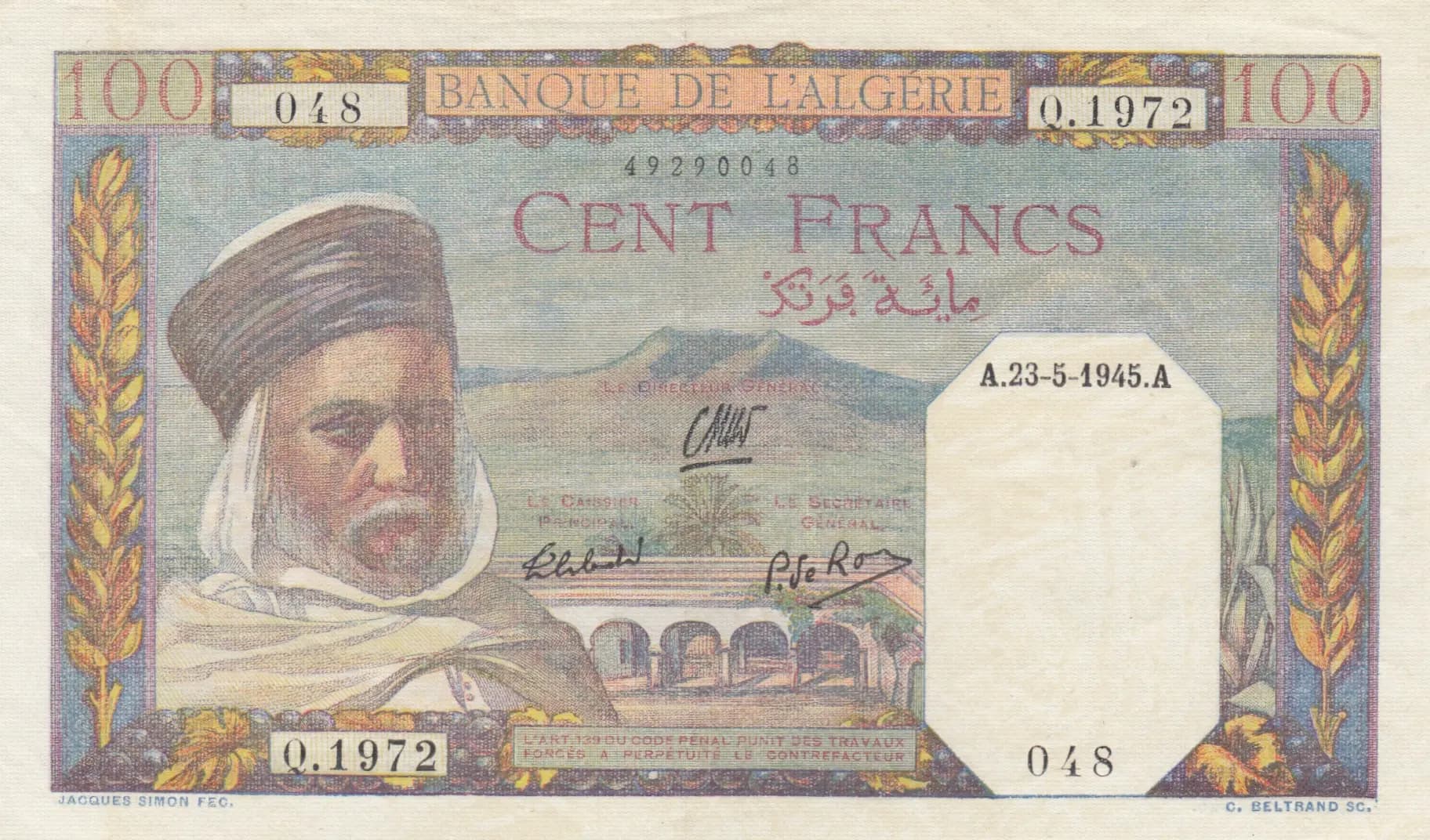
The obverse features a three-quarter portrait of a bearded Maghrebi man wearing traditional North African dress: a white turban and flowing burnous (draped robe), positioned on the left side of the note. The background depicts a North African landscape with palm trees and what appears to be a kasbah or fort structure, evoking colonial Algeria's architectural heritage. Ornate decorative borders on both sides feature wheat and grain sheaves in gold and earth tones, symbolizing agricultural wealth. The reverse depicts the agricultural foundation of Algeria's economy: a farmer or rural laborer in traditional clothing stands with a pair of oxen engaged in plowing work in the foreground, with North African hills, mountains, and a distant settlement visible in the landscape. Decorative borders feature pomegranates, grape bunches, palm fronds, and other botanical elements representing the region's agricultural products. The overall design employs a multicolor palette of cream, red, blue, green, brown, and gold, typical of 1940s banknote production.
FRONT: 'Banque de l'Algérie' (Bank of Algeria) | 'Cent Francs' (One Hundred Francs) / 'مائة فرنك' (One Hundred Francs in Arabic) | Serial numbers: N.899, a2482859, 859 | Date: C.18-4-1942.C (April 18, 1942) | 'L'Art 139 du Code Pénal punit des travaux forcés la contrefaçon' (Article 139 of the Penal Code punishes counterfeiting with hard labor) | Authority signatures: 'Le Caissier Primeau' (Cashier Primeau) / 'Le Secrétaire Général' (General Secretary) | Engraver credits: 'Jacques Simon fec.' (Drawn by Jacques Simon) / 'G. Beltrand sc.' (Engraved by G. Beltrand). BACK: 'Banque de l'Algérie' / 'Cent Francs' | Engraver credits: 'Jacques Simon fec.' / 'Hourriez sc.' (Engraved by Hourriez) | Arabic inscription relating to Islamic governance
Steel engraving combined with color lithography, characteristic of high-security banknote production of the 1940s. The detailed engraving work on portraits and landscape vignettes was executed by Jacques Simon (designer) and engravers G. Beltrand (obverse) and Hourriez (reverse). The multiple colors, fine line work in the decorative borders, and intricate details visible in the foxed paper all confirm classical intaglio printing methods combined with chromatic lithographic enhancement. Security features included the watermark area (visible as blank rectangular spaces on both sides) and complex serialization.
This specific example is identified as Pick P-85, the standard variety. The note bears the date '18.4.1942' (April 18, 1942) in the format 'C.18-4-1942.C', with serial number N.899 and sequential number a2482859. The Pick catalog notes a variant P-85s exists, though this specimen appears to be the standard P-85. No overprints, security overprints (like SPECIMEN markings), or unusual serial characteristics are evident in the visual analysis, indicating this is a regular circulation issue from the identified date. The signatures of Primeau (Cashier) and the General Secretary are standard for this issue period.