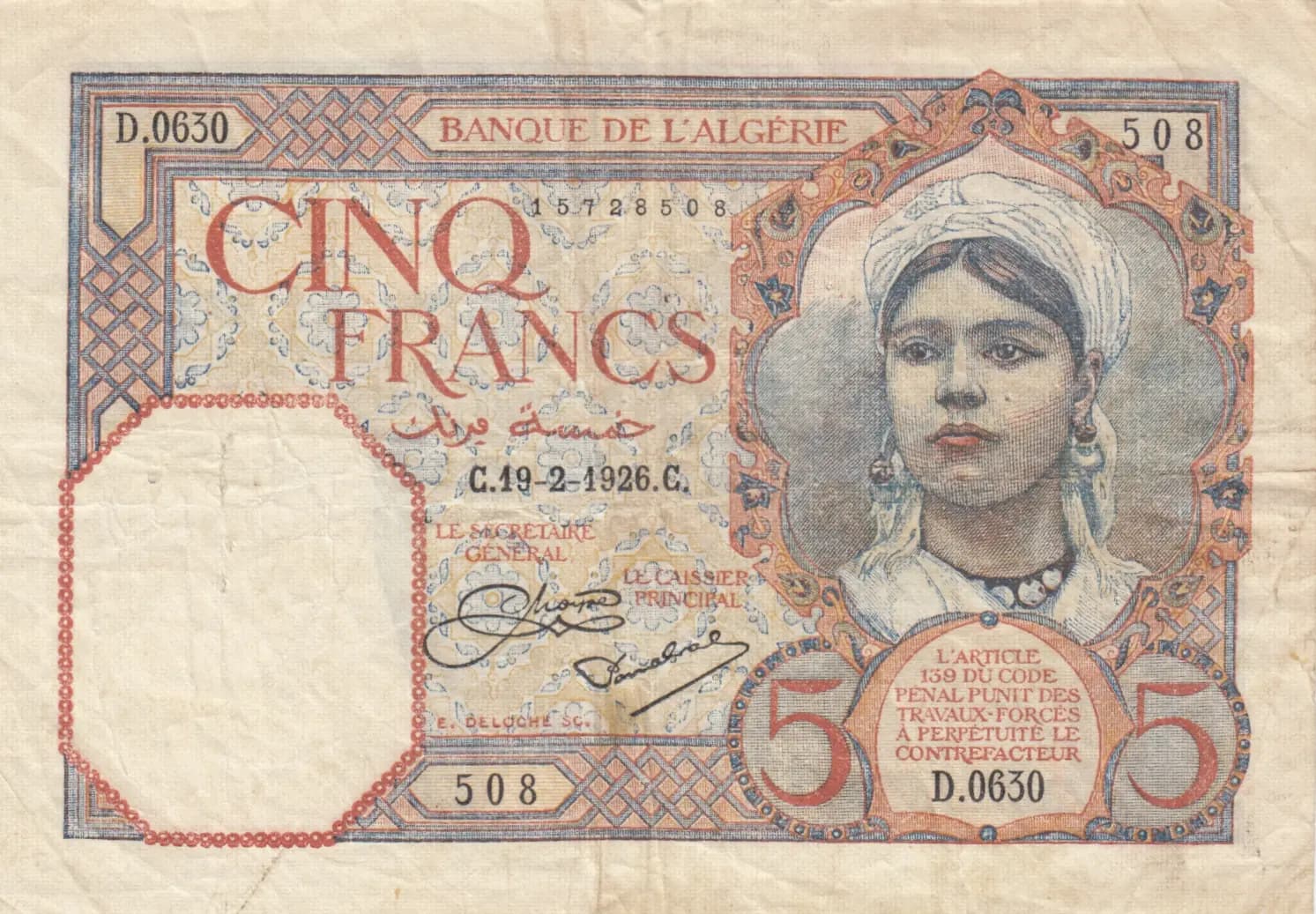
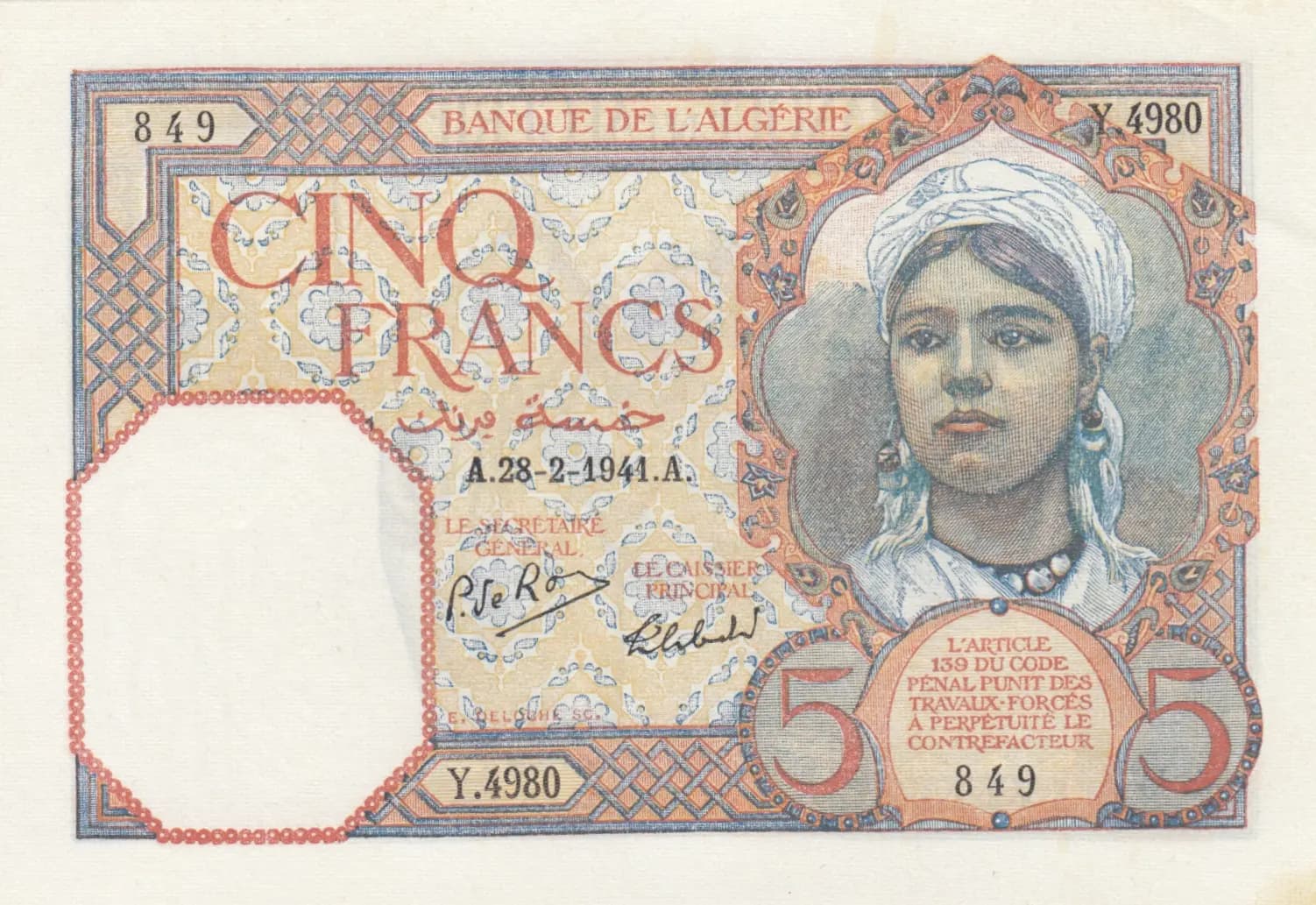
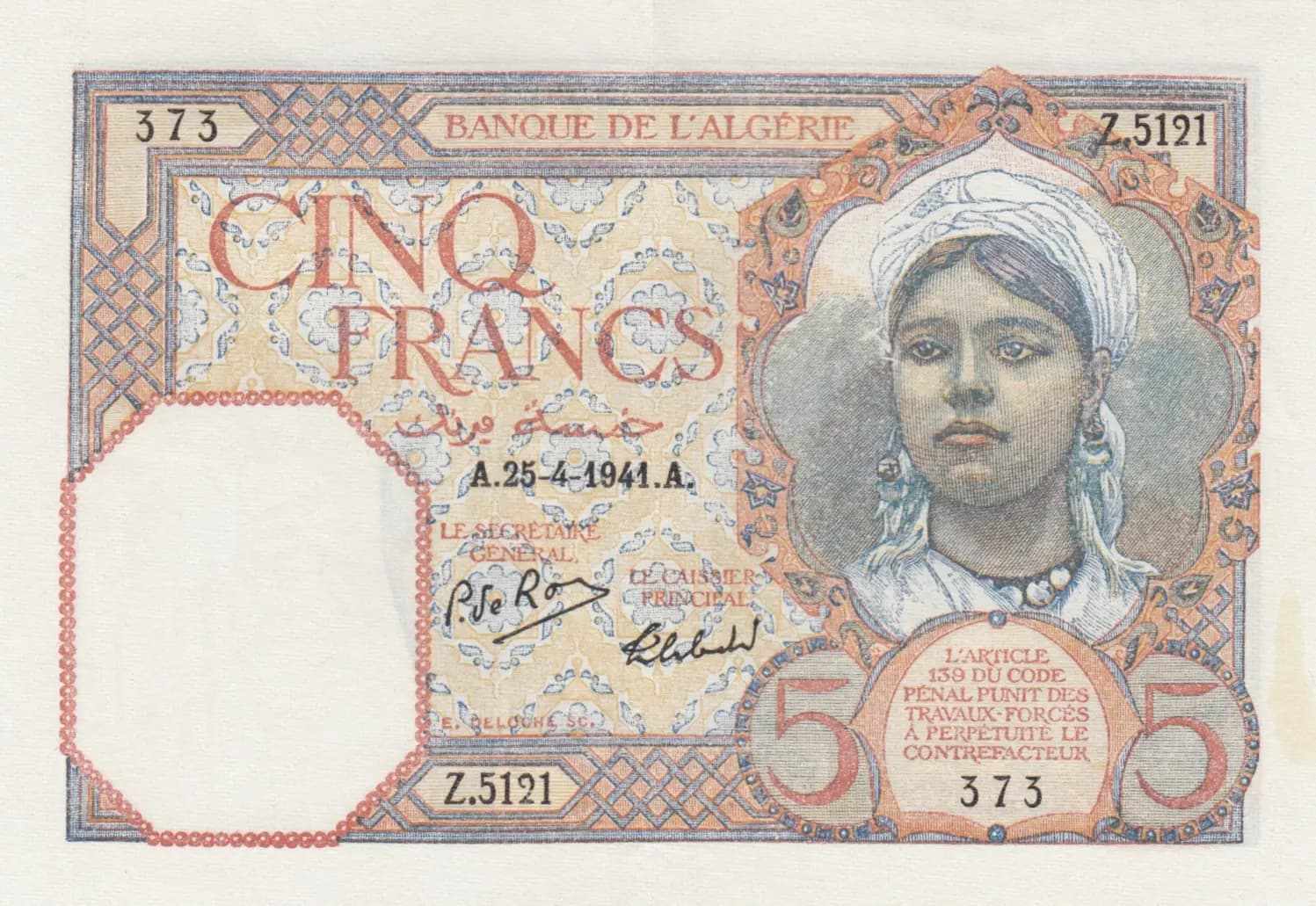
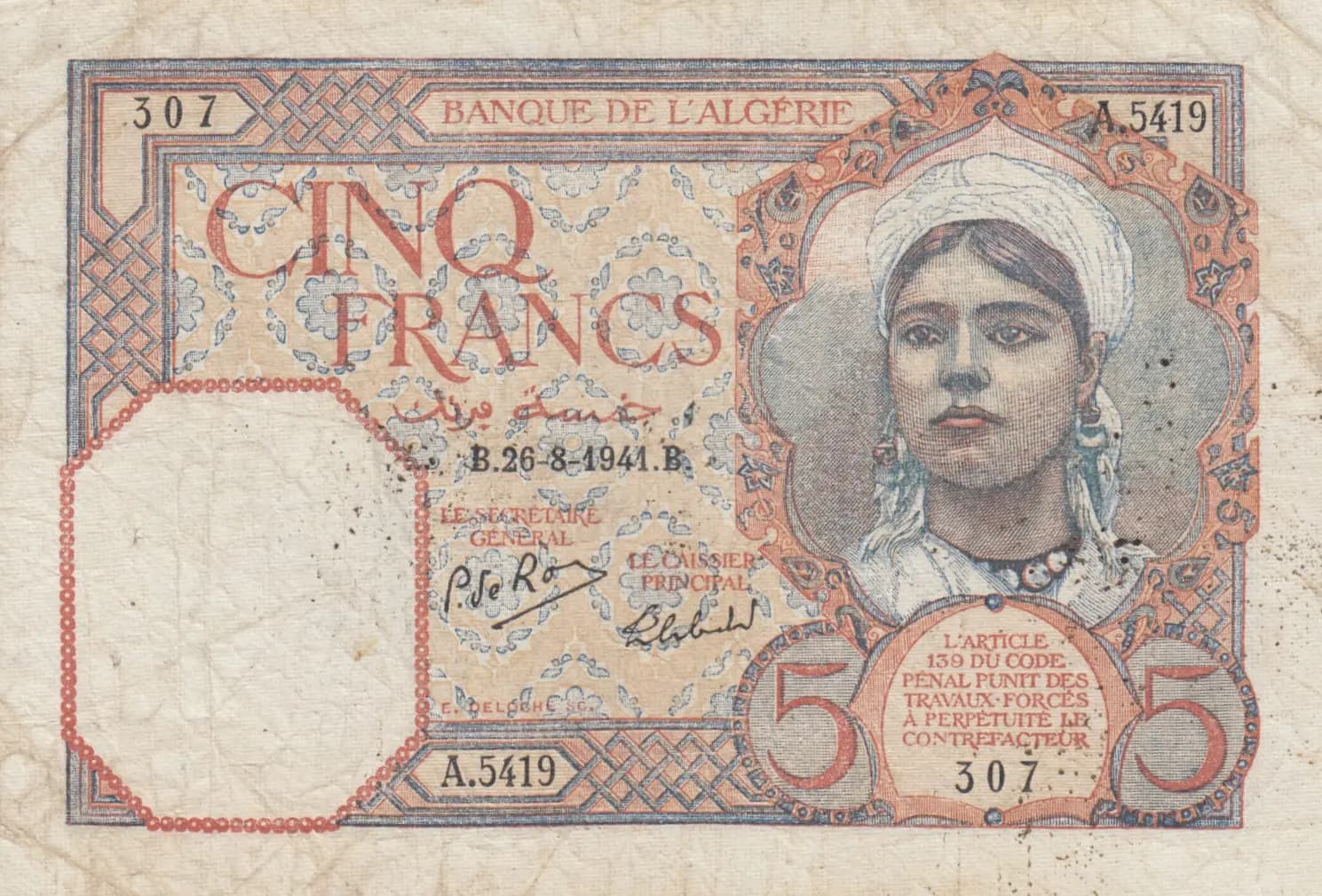
5 francs 1924
Market Prices
5 salesAbout This Note
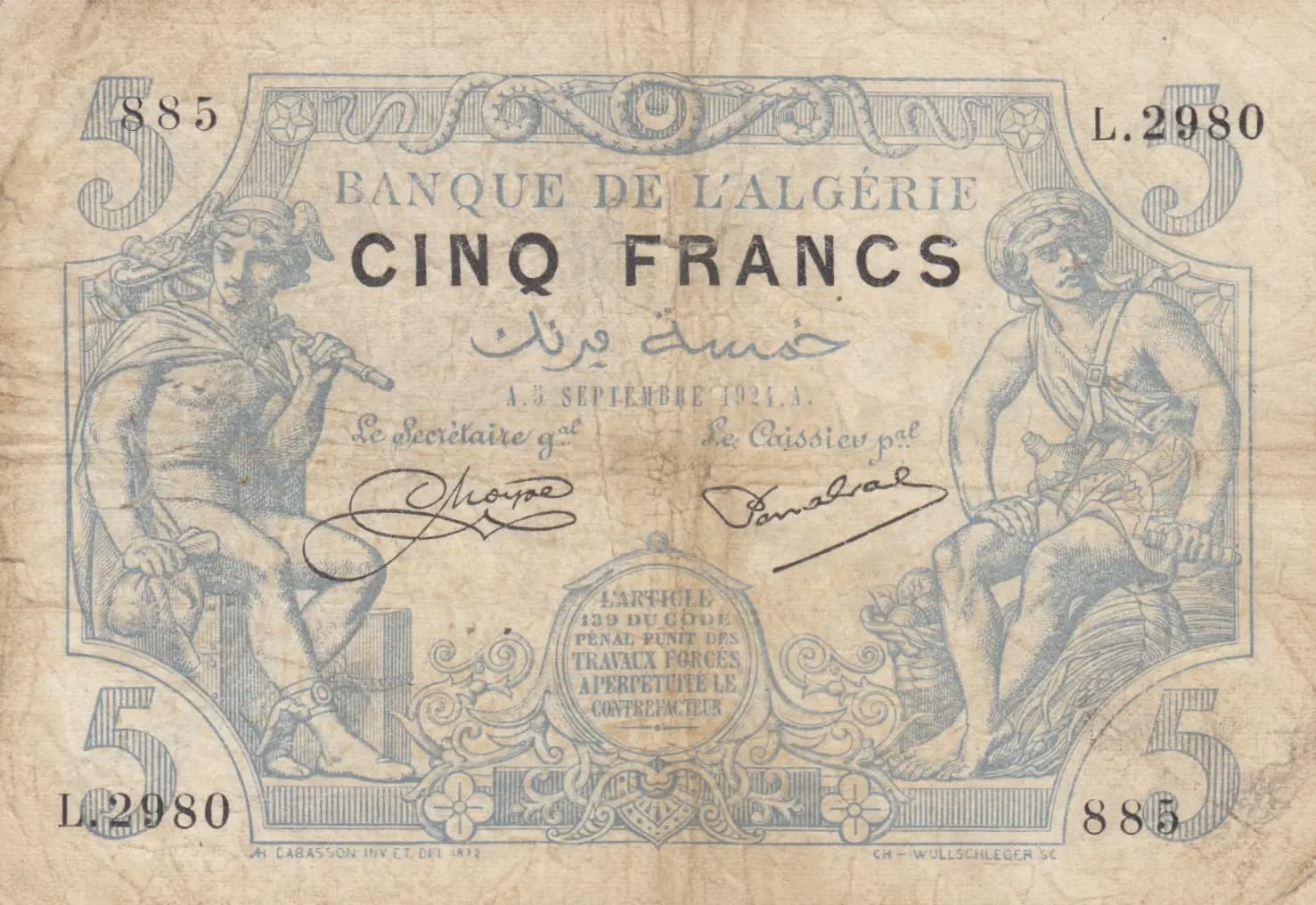
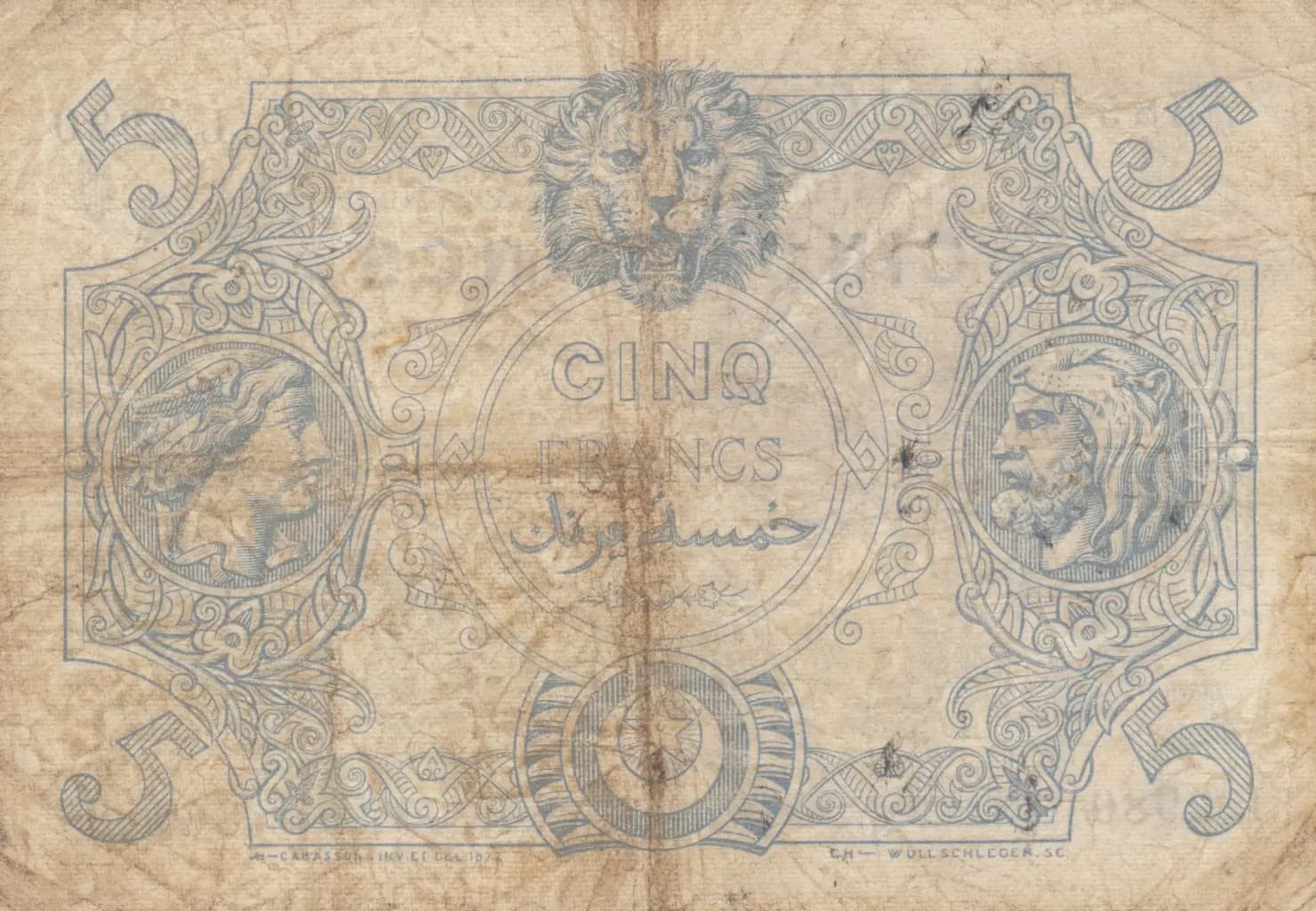
A 5 Francs banknote from Banque de l'Algérie dated 15 September 1921, presented in Fine (F) condition with characteristic circulation wear of a century-old note. The banknote features elegant allegorical female figures on the obverse and classical portrait medallions on the reverse, all executed in fine line engraving with ornate decorative borders in blue-gray and tan tones. Significant creasing, foxing, and staining throughout reflect authentic age and handling, making this an attractive example of early 20th-century Algerian currency with appealing classical artistic design.
Common. Secondary market data shows F-graded examples selling consistently in the $52-$73 range (2015-2018 eBay auctions), with catalog 2016 values listing F at $65. PMG population data indicates this is a standard catalogued variety (P-71b) without significant scarcity indicators. The note was part of a regular series issued 1916-1925 with substantial circulation, and multiple examples appear in the collector market regularly.
Issued during the period of French colonial administration in Algeria, this 1921 banknote represents the interwar monetary system of French North Africa. The classical allegorical imagery—featuring Mercury (god of commerce) and other classical figures—reflects the Banque de l'Algérie's effort to establish cultural legitimacy and monetary confidence during a period of post-World War I economic stabilization in the colony.
The obverse features two allegorical female figures in classical drapery flanking the central text area containing the bank name and denomination in French and Arabic. Two handwritten signatures (Choyse and Farabé) occupy the center, representing the Secretary General and Cashier. A circular seal bearing the counterfeiting warning from the French Penal Code appears in the lower center. The reverse displays four classical portrait medallions in ornate circular frames positioned at each corner—representing historical and allegorical figures from classical antiquity, consistent with the note's Mercury-themed iconography mentioned in catalog references. A heraldic eagle or classical bird symbol crowns the top center. Fine line engraving creates ornate decorative borders with floral and scroll designs at all corners. The bilingual presentation (French and Arabic) reflects colonial administrative practice.
FRONT SIDE: 'BANQUE DE L'ALGÉRIE' (Bank of Algeria); 'CINQ FRANCS' (Five Francs); 'خمسة فرنك' (Arabic: Five francs); '15 SEPTEMBRE 1921' (15 September 1921); 'Le Secrétaire g±' (The Secretary General); 'Le Caissier p±' (The Cashier); Signatures: 'Choyse' and 'Farabé'; 'A. LABASSON INV ET DEL 1922' (A. Labasson invented and designed 1922); 'CH - WULLSCHLEGER SC' (Ch. Wullschleger engraved); 'L'ARTICLE 139 DU CODE PENAL PUNIT DES TRAVAUX FORCES A PERPETUITE LE CONTREFACTEUR' (Article 139 of the Penal Code punishes counterfeiting with perpetual forced labor); Serial numbers 'L.2980' and '885'. BACK SIDE: 'CINQ FRANCS' (Five Francs); 'خمسة فرنك' (Arabic: Five francs); '5' (denomination markers); 'A LABASSON INV ET DEL 1922' (A. Labasson invented and designed 1922); 'CH - WULLSCHLEGER SC' (Ch. Wullschleger engraved).
Intaglio engraving (line engraving and possibly steel plate engraving), as evidenced by the crisp, detailed fine-line work visible throughout the ornate borders, portrait medallions, and decorative elements. Designer A. Labasson and engraver Ch. Wullschleger are credited on both sides. The Banque de l'Algérie likely employed a major European security printer for production, consistent with French colonial banking practices of the 1920s.
This note is catalogued as Pick P-71b (variant b of the 5 Francs type). The specific date of 15 September 1921 and signatures of Choyse and Farabé identify this as part of the 1916-1925 issue series. Serial number L.2980 places it within standard numbering sequence. No overprints or exceptional printing varieties are evident from the visual analysis. The 1921 date falls within the recognized issue period, distinguishing it from earlier 1909-1916 variants if those exist as separate Pick numbers.