5 dong 1946
About This Note
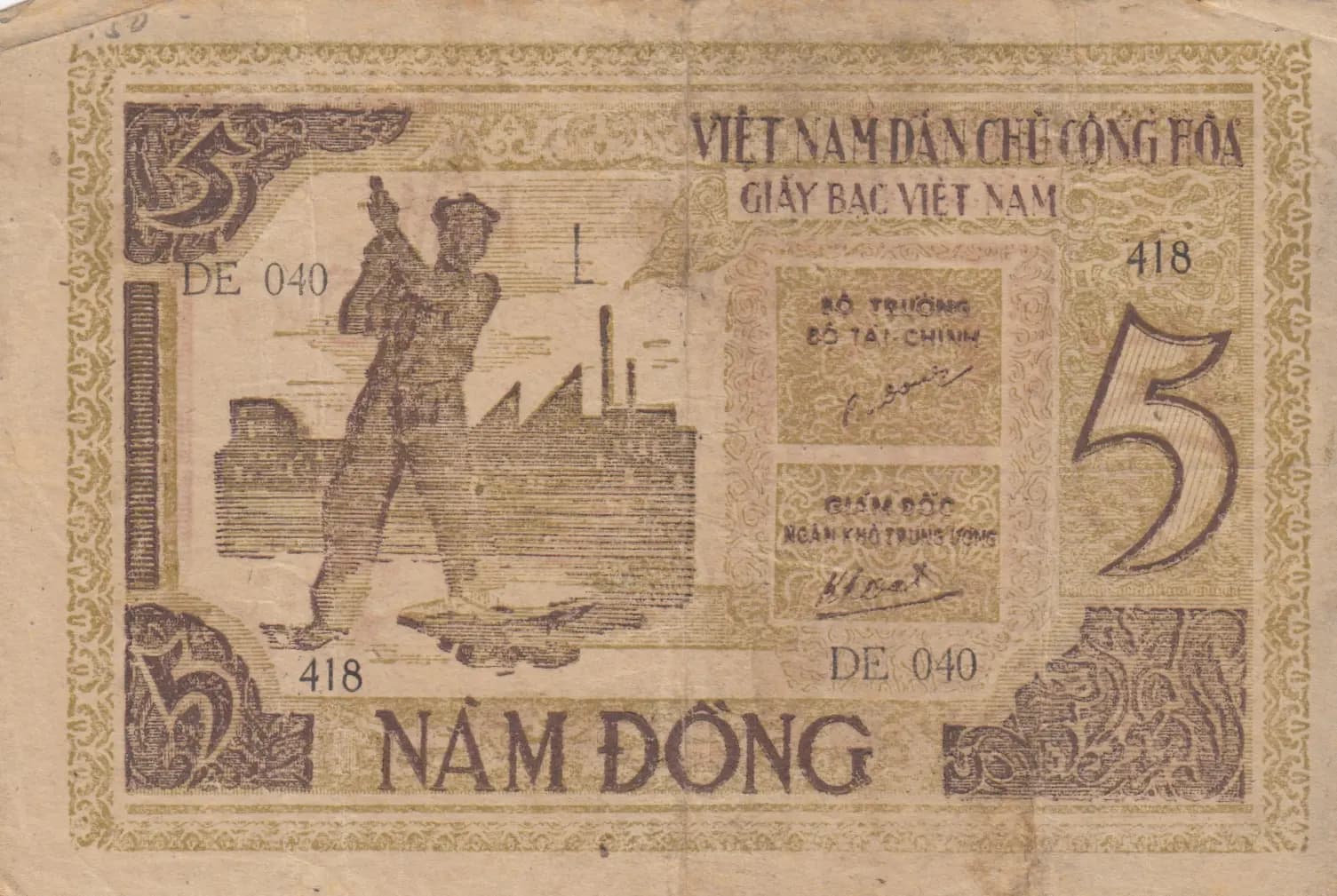
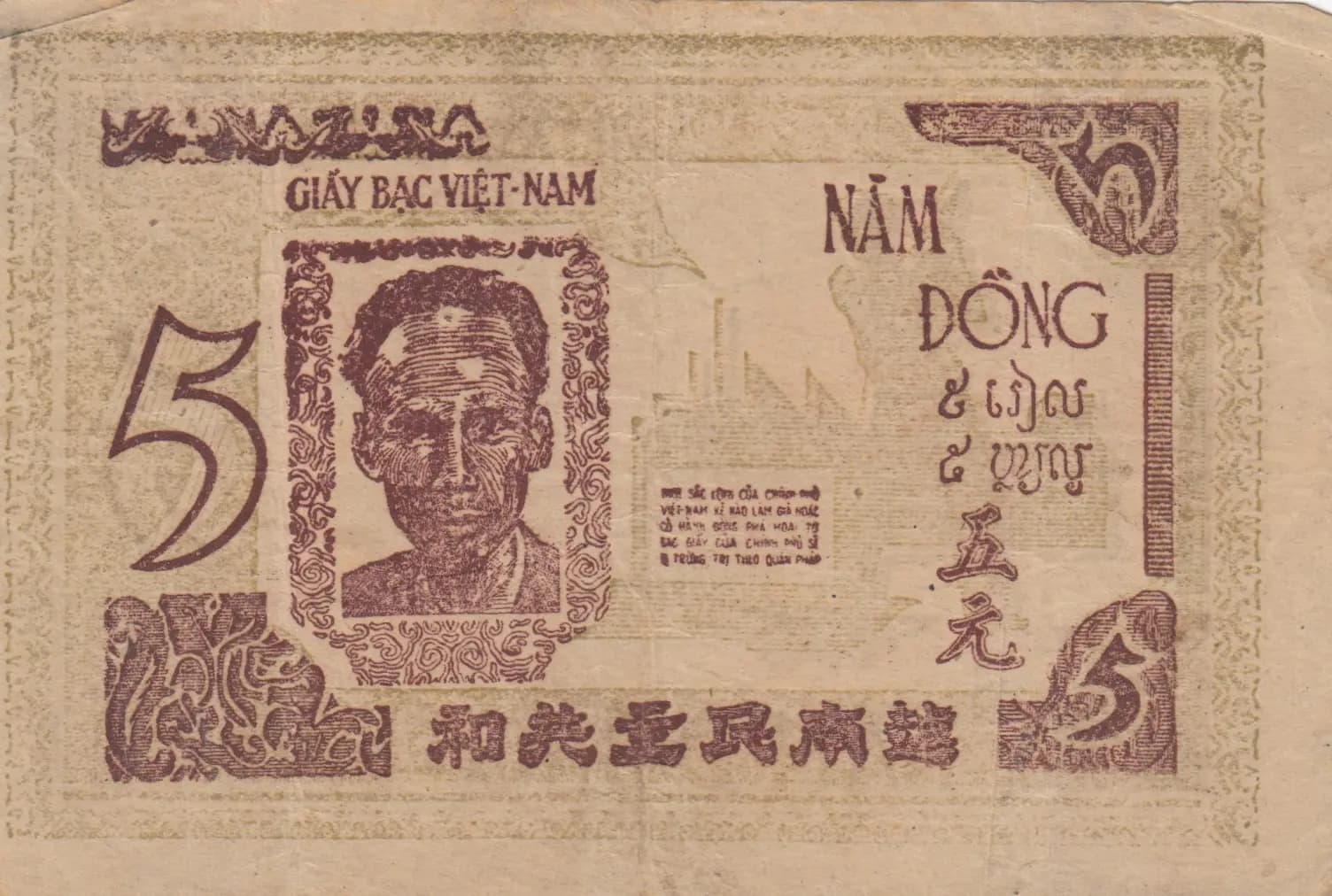
This is a VF-grade example of the 1946 Vietnamese 5 Đồng (Pick P-3b), featuring the characteristic fine-line engraving and ornamental borders typical of early Democratic Republic of Vietnam currency. The note displays aged tan/beige paper coloration with visible foxing and creasing consistent with its age and circulation history, while the engraved details remain clearly visible. This watermarked variety represents an important early issuance from Vietnam's newly independent government during a pivotal moment in the nation's history.
Common. While this is an early issue from a newly formed government with limited infrastructure, the 1946 Vietnamese 5 Đồng appears regularly in the international numismatic market. Multiple varieties and print runs were produced, and the denomination's modest value meant substantial circulation. VF-grade examples are readily available to collectors at modest prices, typically in the $5-15 USD range, consistent with common-grade early Vietnamese currency. The watermarked P-3b variety is more desirable than the unwatermarked P-4, but neither is scarce.
Issued in 1946 by the Central Treasury of the newly established Democratic Republic of Vietnam, this banknote commemorates the nation's independence following decades of French colonial rule. The front design features a classical figure holding a torch—symbolizing enlightenment and revolutionary progress—standing before industrial and architectural elements representing the nation's modernization aspirations. The back portrait, likely depicting Ho Chi Minh or another founding leader, underscores the revolutionary credentials of the fledgling state during this transitional period.
The obverse features a classical male figure in heroic pose, holding aloft a torch or staff, positioned on or near an industrial platform—iconography representing revolutionary progress, enlightenment, and national construction. He is framed by ornamental scrollwork and geometric border patterns in tan and brown tones. The denomination '5' appears prominently in the upper right and lower left corners in stylized numerals. The reverse presents a formal portrait of a male figure in classical engraving style, centered within an ornamental rectangular frame and flanked by decorative corner scrollwork. The large numeral '5' and text 'NĂM ĐÔNG' (Five Dong) occupy the left and right margins respectively. Both sides employ fine-line engraving throughout, with the overall aesthetic reflecting classical European banknote design traditions adapted for Vietnam's revolutionary government.
FRONT: 'VIỆT NAM DÂN CHỦ CỘNG HÒA' (Democratic Republic of Vietnam); 'GIẤY BẠC VIỆT NAM' (Vietnamese Currency Note); 'NAM ĐÔNG' (Nam Dong); 'HỆ TRƯỞNG, CỤC TÀI CHÍNH' (Finance Department); 'GIÁM ĐỐC NGÂN PHÓ TRƯƠNG CÔNG' (Director of State Bank); Serial: 'DE 040' and '418'. BACK: 'GIẤY BẠC VIỆT-NAM' (Vietnamese Currency Note); 'NĂM ĐÔNG' (Five Dong); Chinese characters '和平王冠民國' (Peace Crown Republic) and '越南民國銀行' (Vietnam Republic Bank), suggesting this design may have origins in earlier Republican currency designs.
Intaglio/fine-line engraving on paper, characteristic of professional currency production from this era. The visual analysis confirms detailed engraving work with clear line definition and ornamental border security printing. This note represents the watermarked variety (P-3b) as opposed to the unwatermarked P-4 variant. The printer and specific security printer for this issue are not definitively recorded in standard catalogs, but the technical quality suggests production by an established currency printer, possibly from a government treasury facility or contracted European security printer.
This specimen represents the watermarked variety (Pick P-3b) as distinguished from the unwatermarked P-4. The observed serial number 'DE 040' with block number '418' indicates this is from an early production run. Signature varieties may exist within the Finance Department and State Bank Director signatures visible on the front, though standard catalogs do not typically distinguish multiple signature variants for this issue. The presence of Chinese characters on the reverse ('和平王冠民國' and '越南民國銀行') may indicate this design was adapted from earlier Vietnamese Republic banknotes or represents transitional design elements during the regime change from French colonial to independent governance.