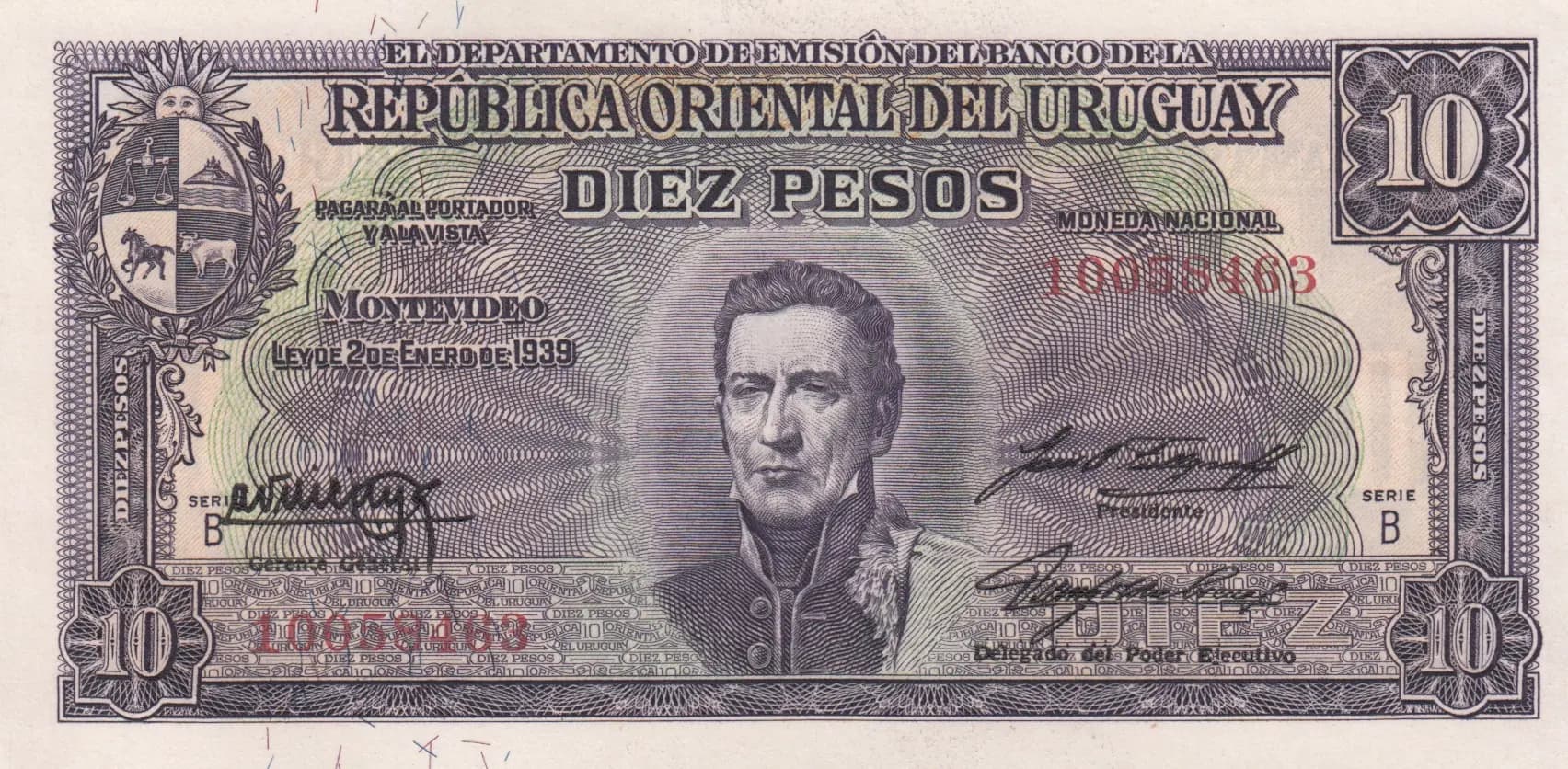
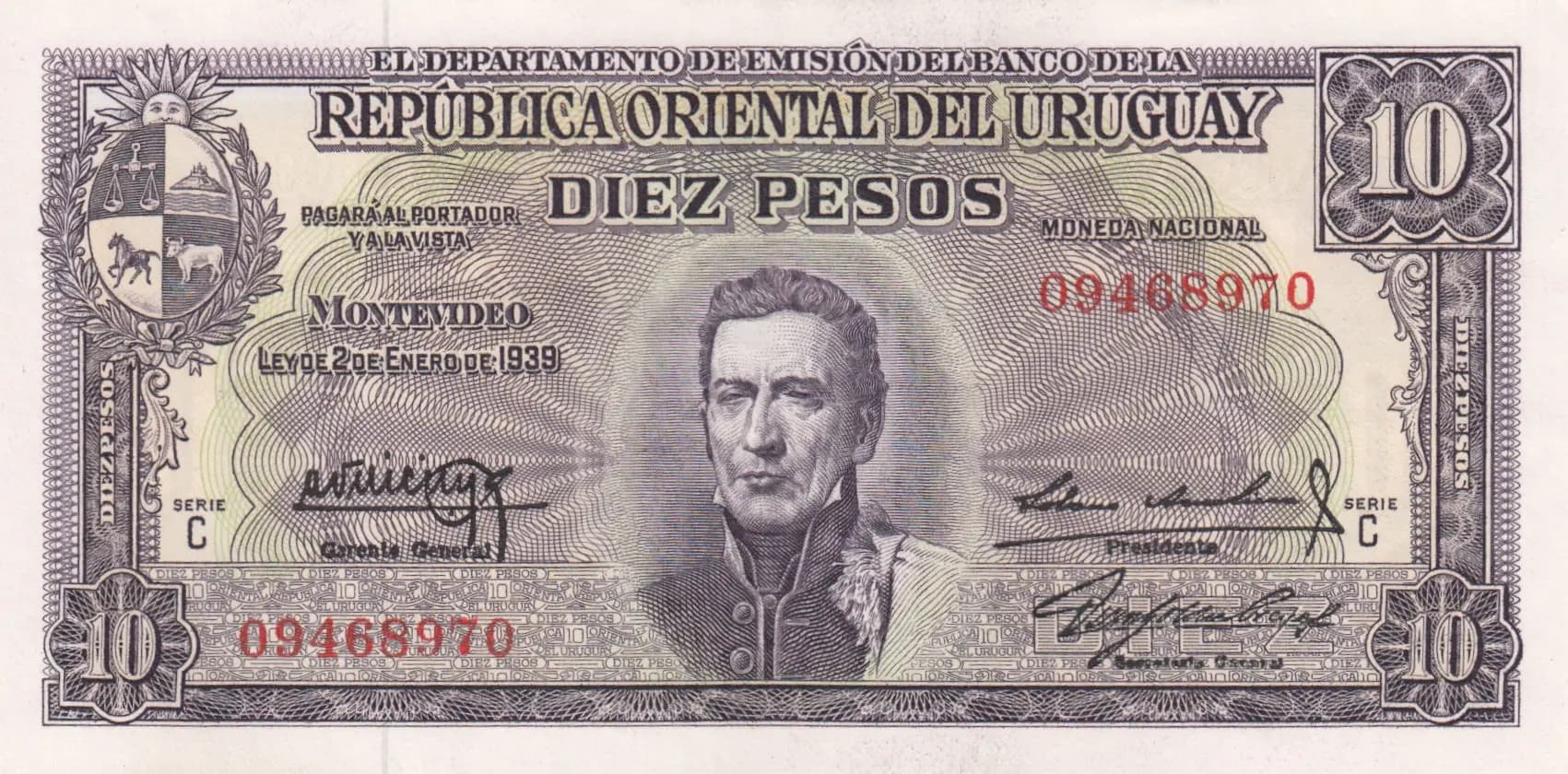
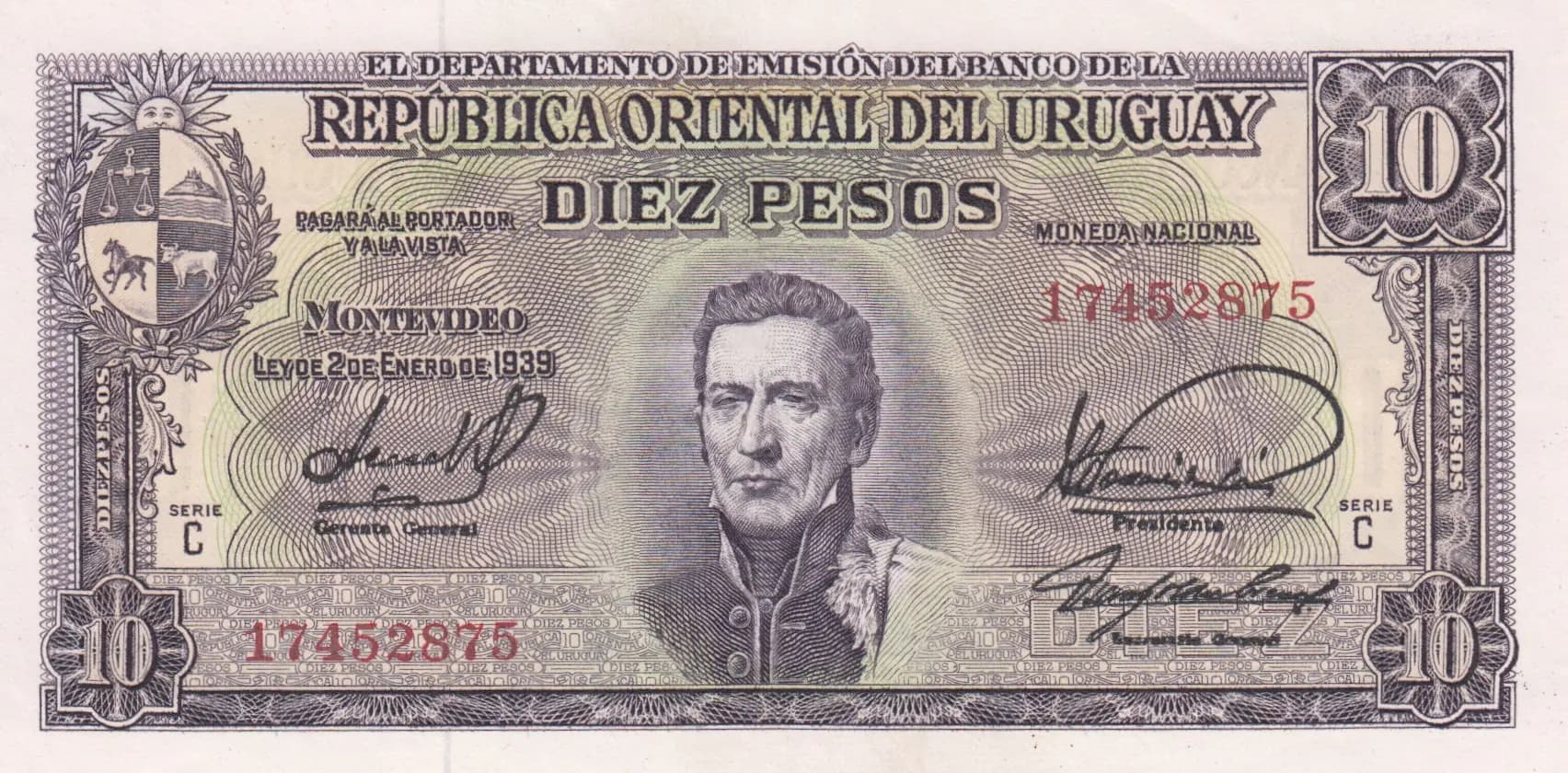
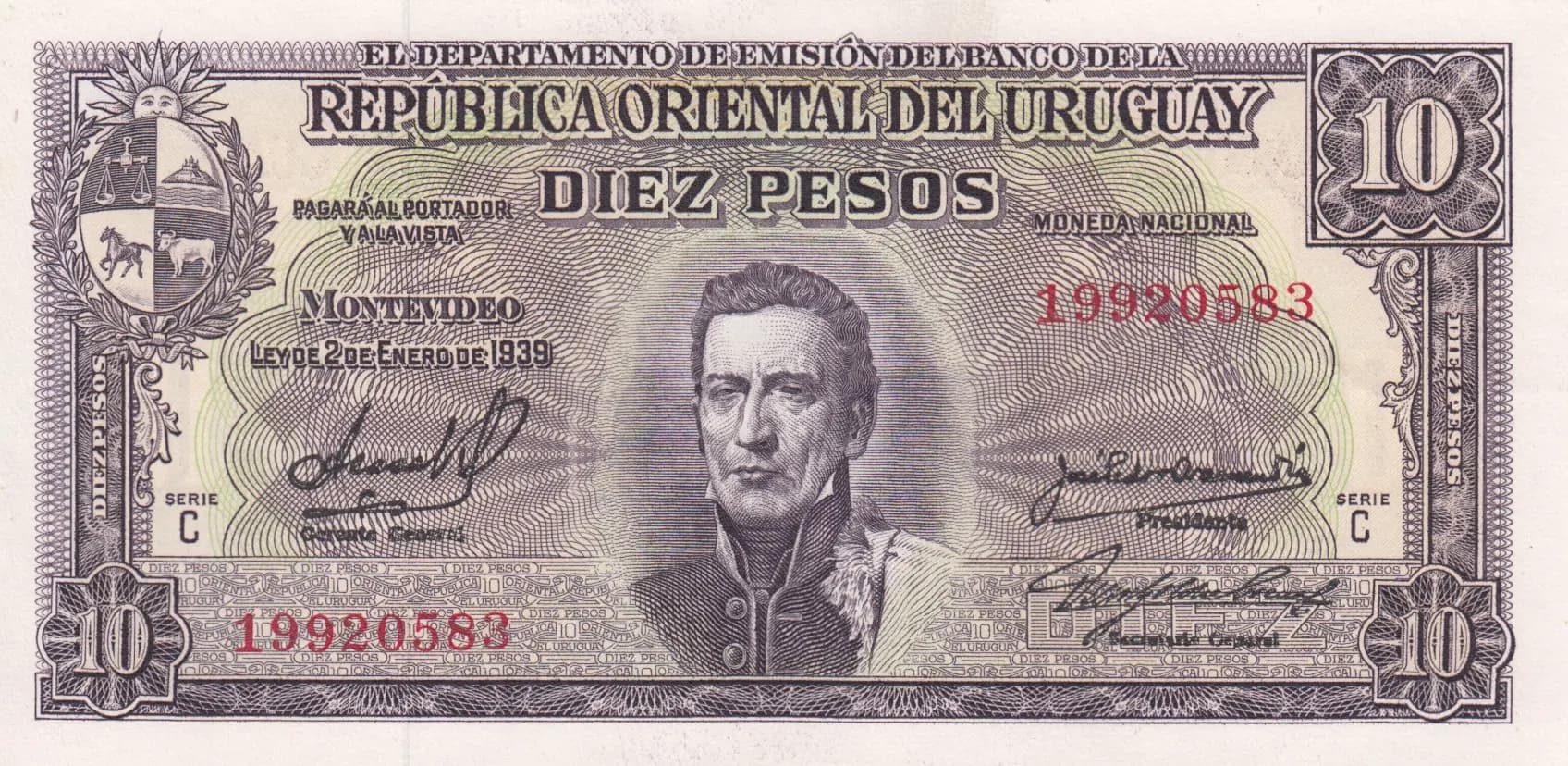
10 pesos 1939
Market Prices
13 salesAbout This Note
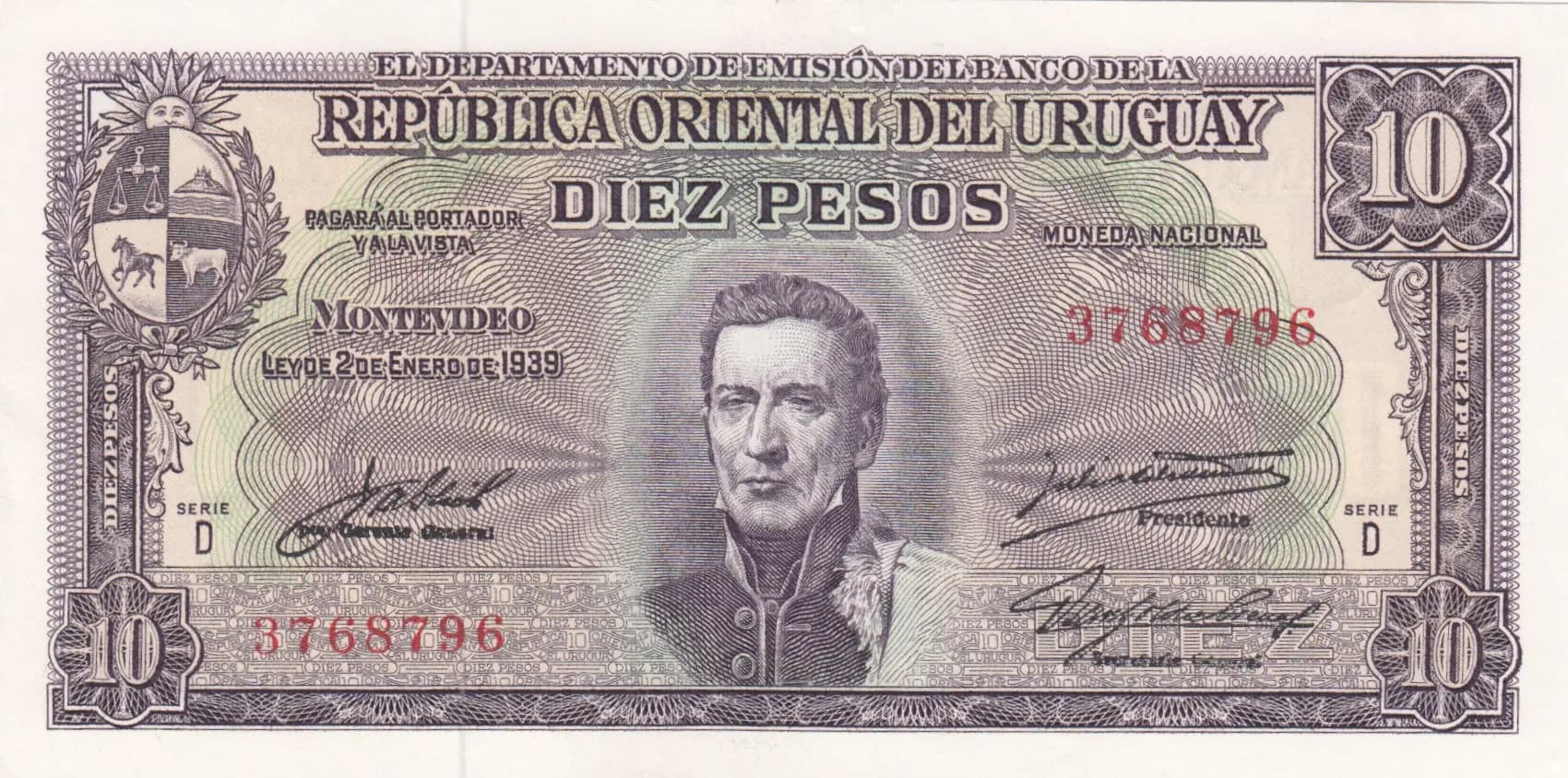
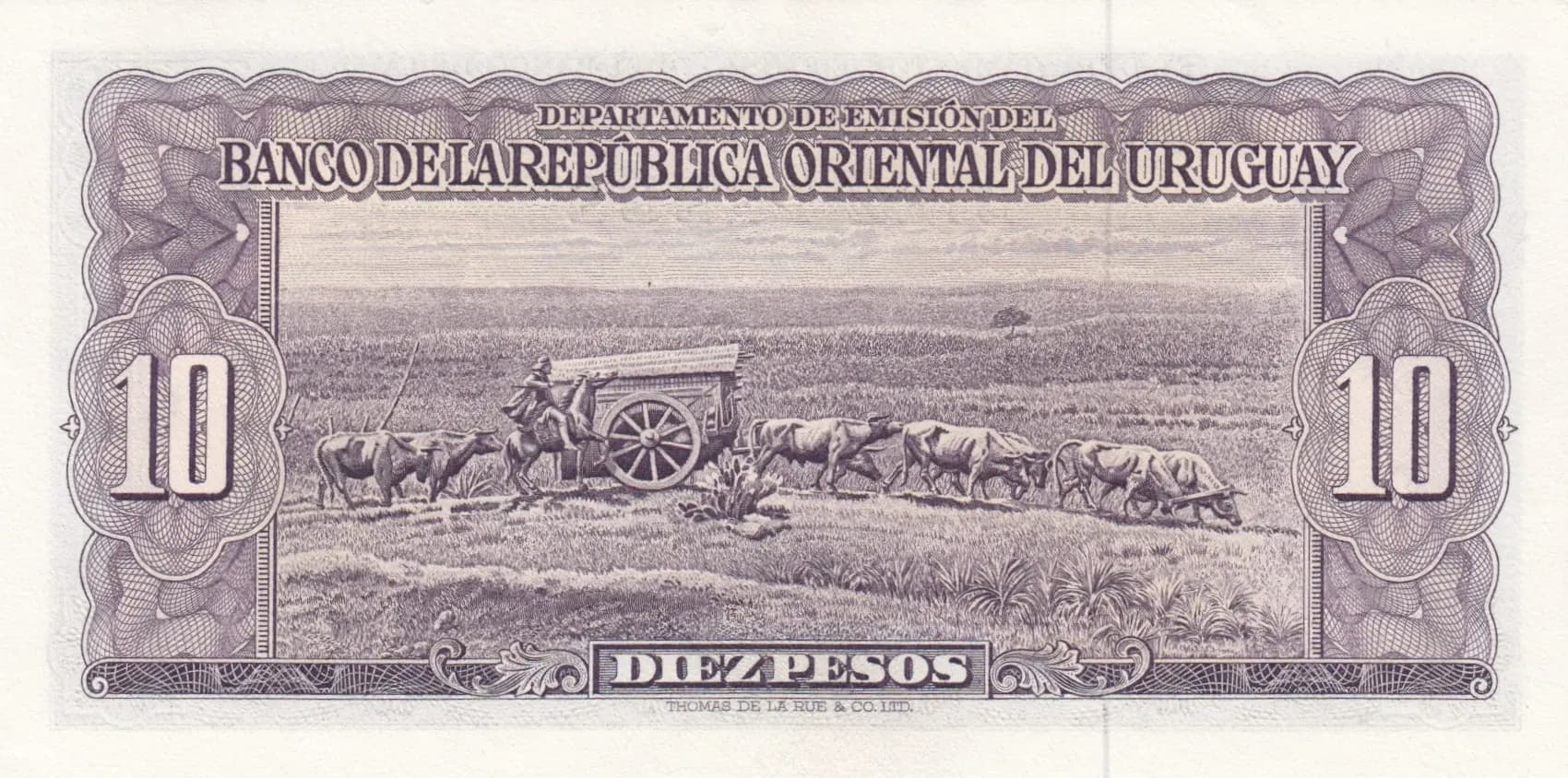
This is a 1939 Uruguay 10 pesos banknote (Pick P-37d, Series D) issued by the Departamento de Emisión del Banco de la República Oriental del Uruguay. The note features an engraved portrait of General José Gervasio Artigas in military uniform on the obverse, with the national coat of arms containing scales of justice and a horse and rider motif. The reverse depicts a pastoral agricultural scene with oxen and a traditional carreta (ox-cart), reflecting Uruguay's rural heritage. The note shows visible creases and general age-related discoloration consistent with moderate circulation, though the fine engraved details and ornate borders remain well-preserved.
Common. This note appears frequently in the secondary market with consistent availability. eBay transaction data shows numerous sales across multiple condition grades (VG, VF, EF, AUNC, and PMG-graded examples), with prices ranging from under $2 to approximately $56 for higher grades (PMG 66). The 2016 catalog valuation of $3 UNC supports common status. The substantial print run from the prestigious Departamento de Emisión and lack of any historical recall or short-lived issuer status confirms this is a readily available note for collectors.
This note was issued during a transitional period in Uruguayan monetary history, predating the establishment of the Banco Central del Uruguay. The imagery emphasizes national identity through the portrayal of General Artigas, the founding father of Uruguay, and the celebration of agricultural labor via the iconic carreta scene, symbolizing the nation's rural foundation. The classical ornate design and composition reflect early 20th-century European banknote aesthetics, with production by the prestigious London printer Thomas de la Rue, demonstrating Uruguay's economic standing and access to world-class currency printing technology.
The obverse features a center portrait of General José Gervasio Artigas (1764-1850), Uruguay's founding father and national hero, rendered in formal military dress with a high collar uniform characteristic of early 19th-century military attire. The upper left displays the coat of arms of the Oriental Republic of Uruguay, featuring scales of justice (symbolizing law and order) and a horse and rider (representing liberty and national sovereignty), enclosed within an oval frame decorated with laurel wreaths. The reverse depicts the Monumento a la Carreta (Monument to the Cart), illustrating a traditional oxen-drawn carreta—an iconic symbol of rural Uruguayan identity and agricultural heritage. The composition shows three yoked oxen pulling the wooden cart across open pastoral landscape, emphasizing the nation's agrarian foundation. Both sides are framed by ornate classical borders featuring floral scrollwork and guilloche patterns typical of high-security banknote design. Denomination numerals appear prominently in corners, and the entire note employs fine-line engraving with intricate background patterns to prevent counterfeiting.
{"front":{"issuer":"El Departamento de Emisión del Banco de la República Oriental del Uruguay (The Emission Department of the Bank of the Oriental Republic of Uruguay)","denomination":"Diez Pesos / 10 (Ten Pesos)","currencyType":"Moneda Nacional (National Currency)","location":"Montevideo","issueDate":"Levoe 2 de Enero de 1939 (Issued 2nd of January 1939)","paymentClause":"Pagará al Portador Vista (Payable to Bearer on Sight)","series":"Serie D (Series D)","serialNumber":"3786796"},"back":{"issuer":"Departamento de Emisión del Banco de la República Oriental del Uruguay (Emission Department of the Bank of the Oriental Republic of Uruguay)","denomination":"Diez Pesos / 10 (Ten Pesos)","printer":"Thomas De La Rue & Co. Ltd."}}
Intaglio engraving (line engraving) produced by Thomas de la Rue & Co. Ltd., London, the world's leading security printer of the period. The note exhibits characteristic features of quality intaglio work: intricate parallel-line patterns forming textured backgrounds, complex guilloche patterns in border decorations, fine-line portraiture, and multi-layered engraved imagery. The security features include elaborate border designs, ornate corner flourishes, and the combination of multiple engraved elements that would be extremely difficult to reproduce with contemporary counterfeiting technology.
This specimen is identified as Series D based on the visible 'SERIE D' marking. The Pick catalog notes signature and signature title varieties exist for this issue. This particular example displays serial number 3786796. The Series D designation indicates this is a later printing variant within the P-37 designation (which encompasses multiple series: P-37a through P-37d and beyond). The printer credit 'Thomas de la Rue & Co. Ltd.' is visible on the reverse, confirming London production. Collectors should note that similar notes were subsequently issued by Banco Central del Uruguay (referenced as Pick P-42), representing the transition to the new central banking authority.