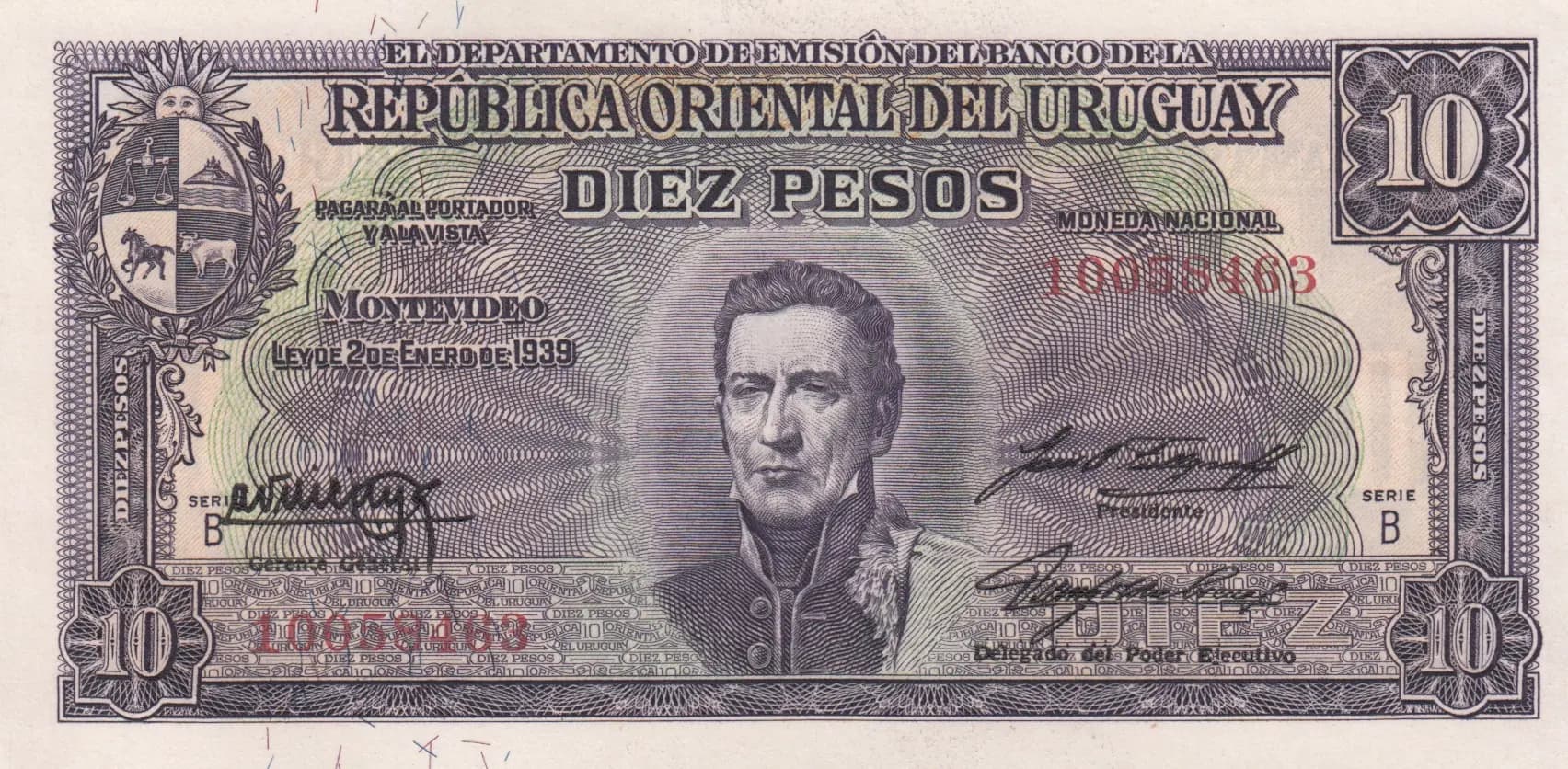
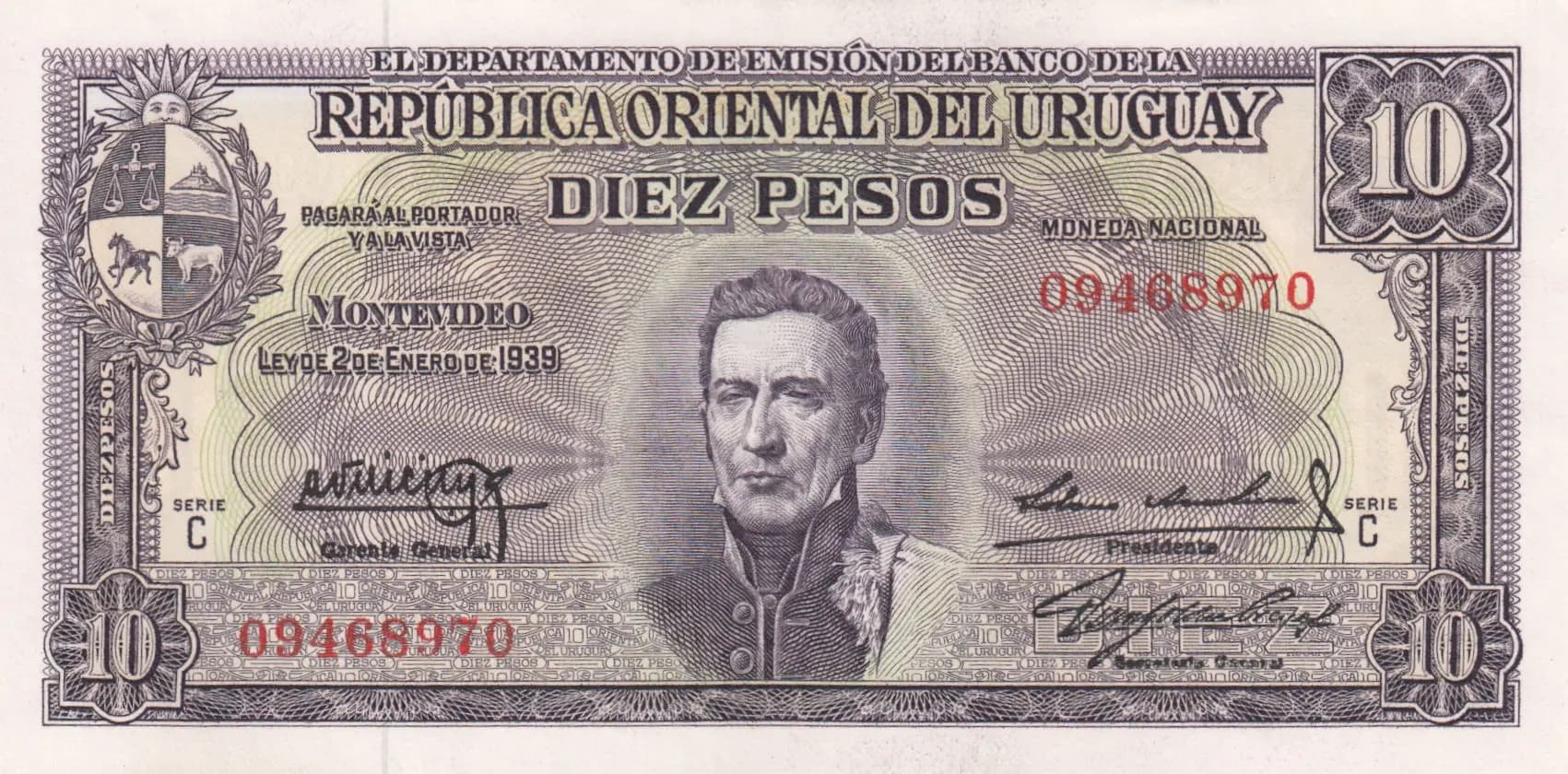
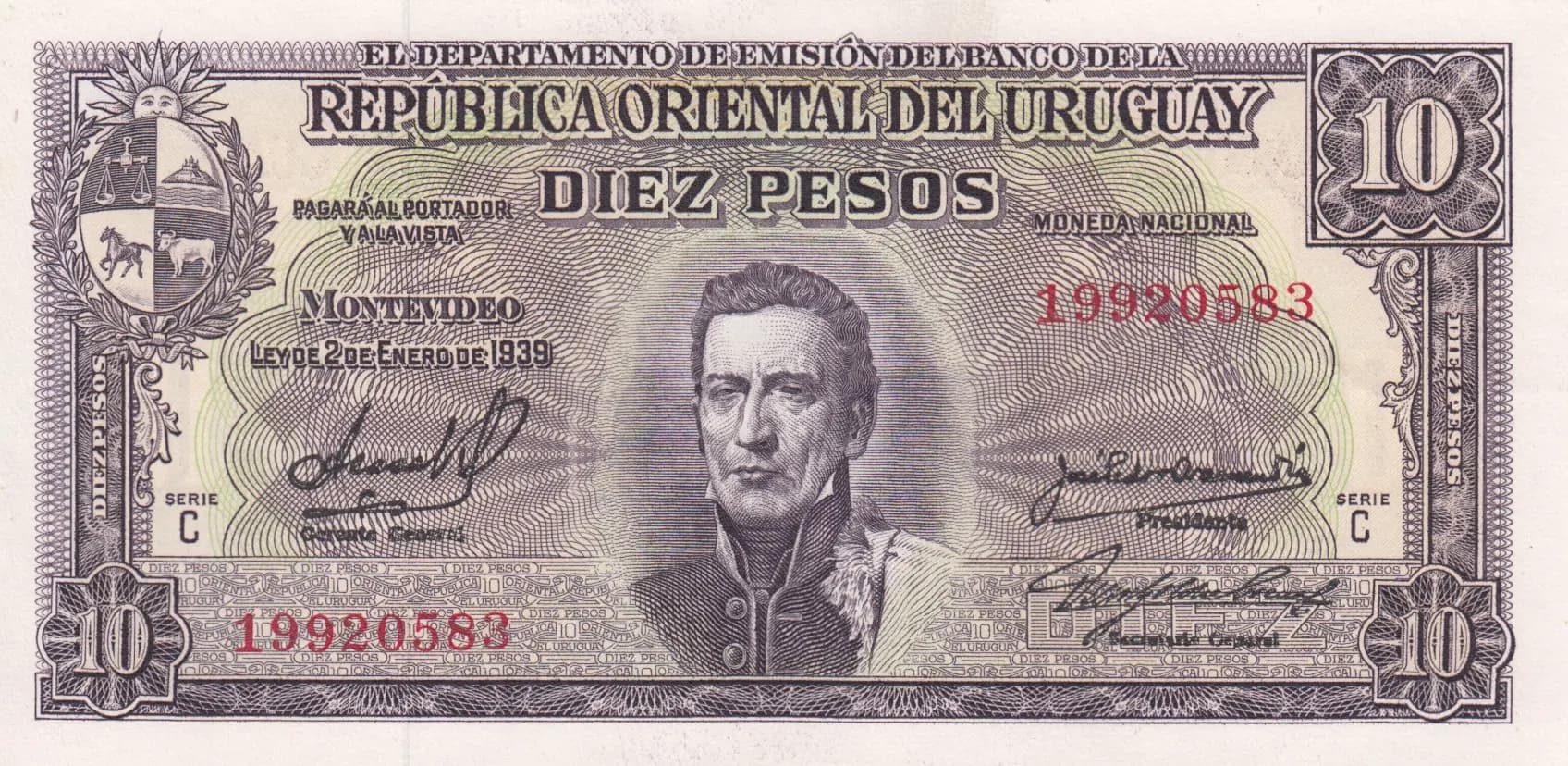
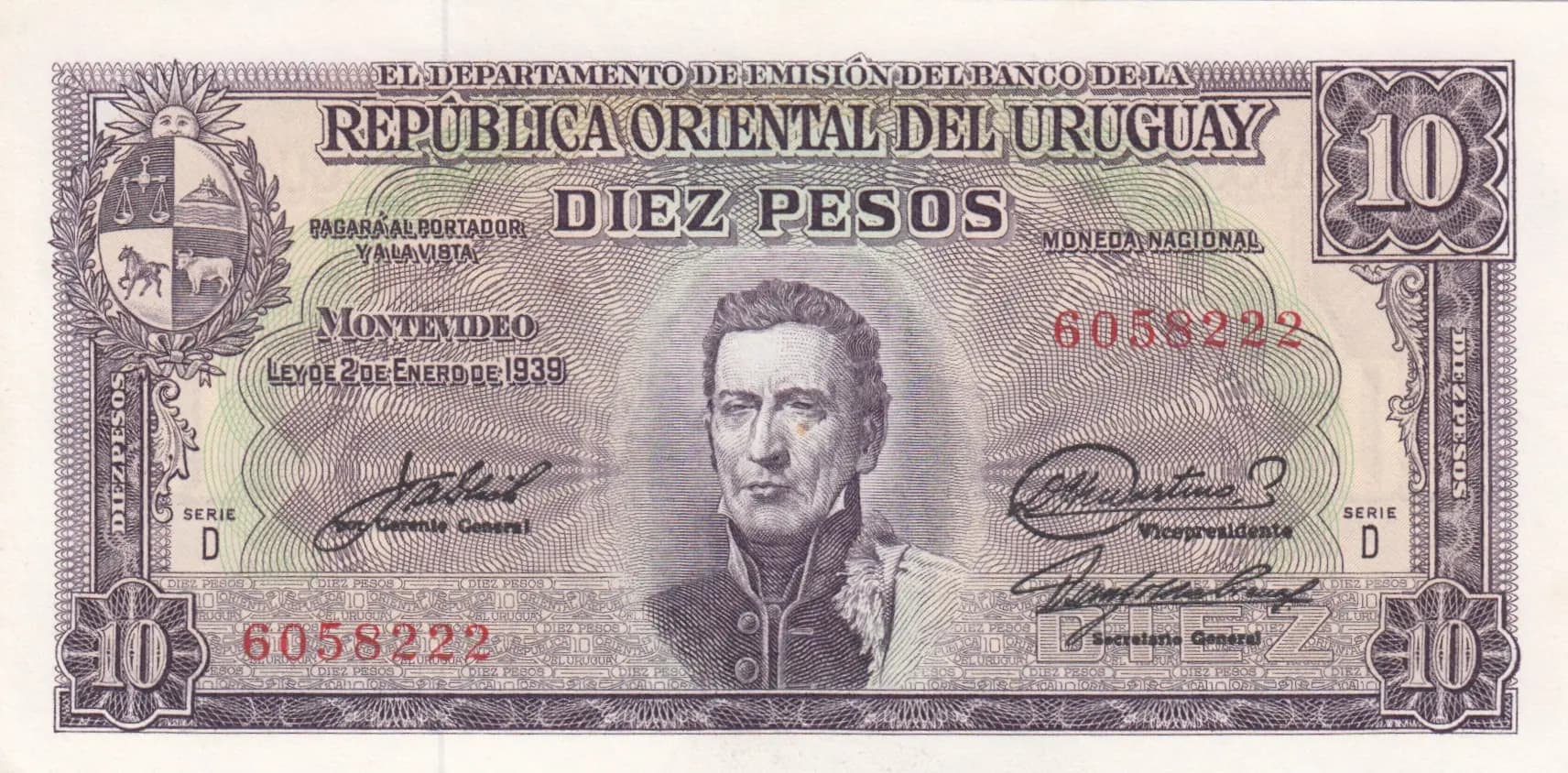
10 pesos 1939
Market Prices
25 salesAbout This Note
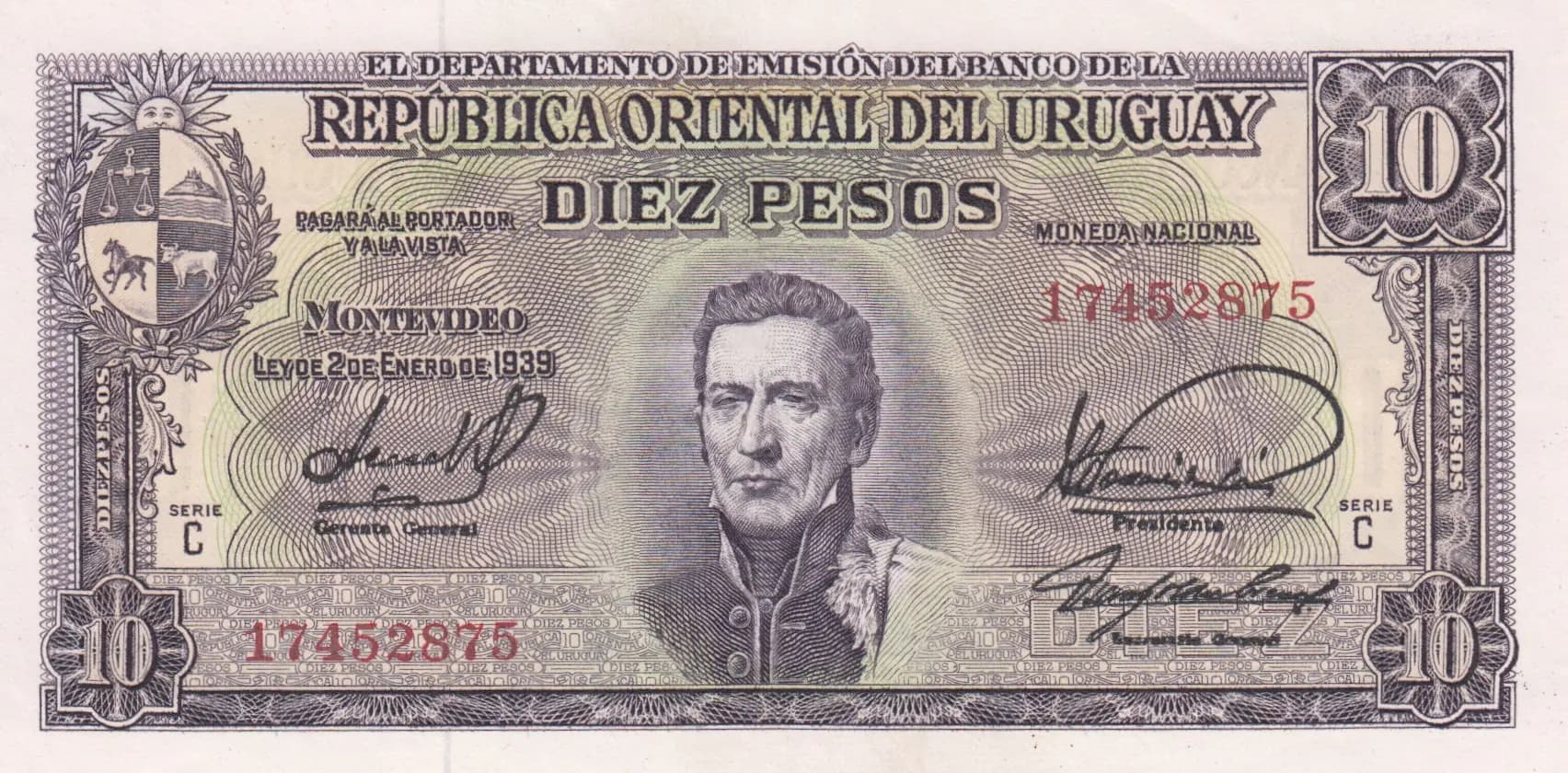
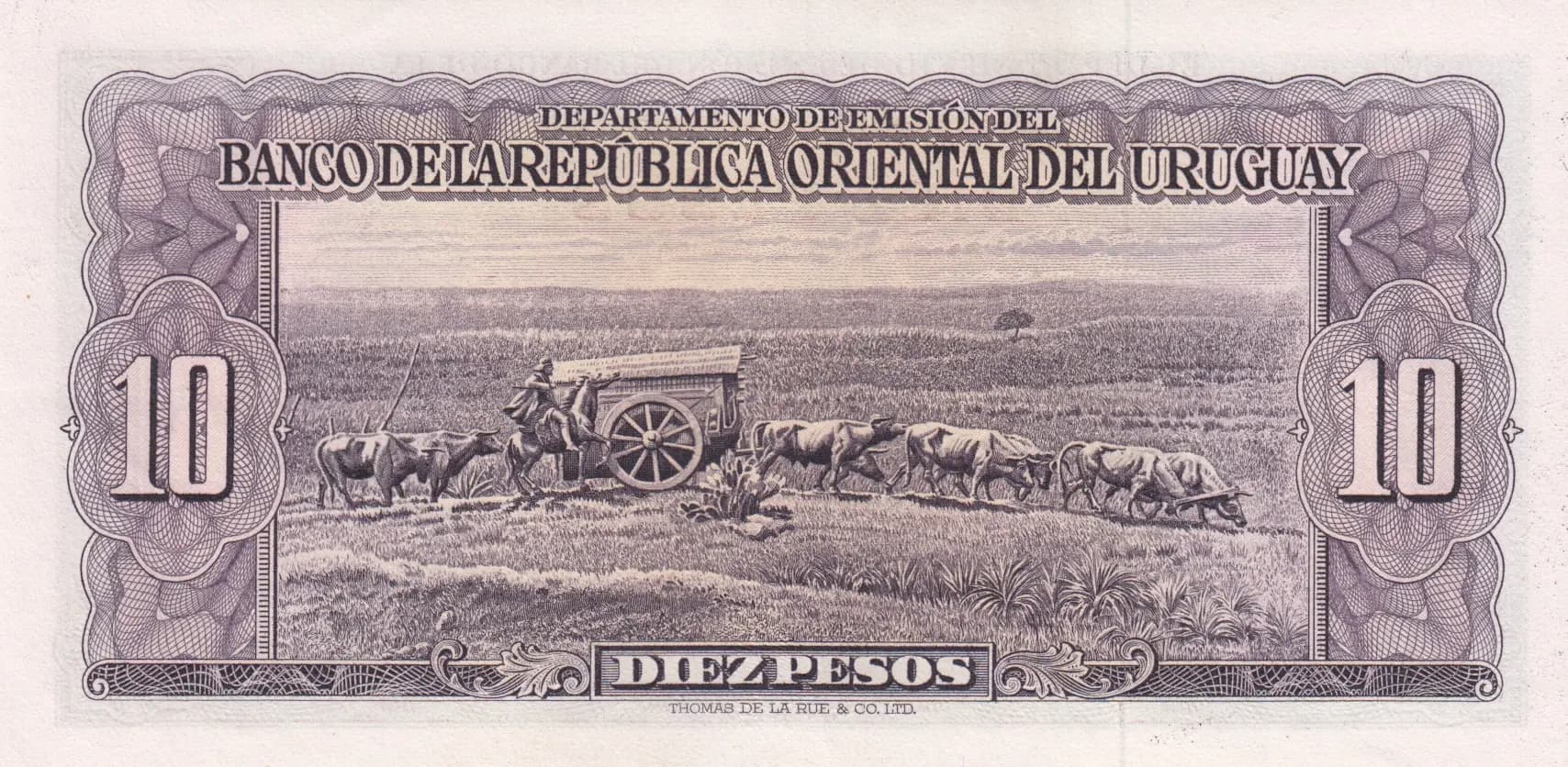
This is a well-preserved example of Uruguay's 1939 10 Pesos note (Pick P-37c) in AU condition, issued by the Departamento de Emisión del Banco de la República Oriental del Uruguay. The note displays excellent detail in its fine engraved work by Thomas de la Rue, with crisp impressions visible in both the ornate decorative borders and the central portrait, though some age-related discoloration is naturally present. The note is particularly notable for its culturally significant reverse design depicting an ox-cart team, which became an iconic symbol of Uruguayan agricultural heritage and rural identity.
Common. This note circulates frequently in the secondary market with consistent sales records documented on eBay spanning from 2009 to 2025, with examples in various grades (VG through EF/AUNC) regularly selling for between $0.85 and $11.60. Market prices for AU condition specimens typically fall in the $3-6 range based on recent comparable sales, indicating steady collector demand but abundant supply. The large print run characteristic of regular-issue banknotes from a national banking authority, combined with the 80+ year circulation period allowing survival of numerous examples, confirms this as a common date and denomination in the Uruguayan numismatic market.
Issued on January 2, 1939, during a period of economic stabilization in Uruguay, this banknote reflects the nation's strong agricultural economy through its reverse design featuring the traditional carreta (ox-cart) with a farmer driver—a symbol deeply embedded in Uruguayan national identity and rural tradition. The portrait on the obverse depicts General José Gervasio Artigas, the founding father of the nation and hero of Uruguayan independence, reinforcing national pride during the pre-war period. This note represents the Departamento de Emisión del Banco de la República's currency issue, part of Uruguay's managed monetary system prior to the later establishment of the Banco Central del Uruguay.
The obverse features a left-facing portrait of General José Gervasio Artigas, Uruguay's founding father and national hero, rendered in formal 19th-century attire with styled dark hair. To the left of the portrait is the Uruguayan coat of arms within a shield, adorned with a laurel wreath, containing symbolic elements representing the nation's values: scales of justice (representing law and order), a horse (representing strength and freedom), and cattle (representing the pastoral and agricultural wealth). The note is dominated by warm brown/sepia and cream tones with intricate cross-hatching and line-work patterns providing security and aesthetic refinement. Decorative numeral frames containing '10' appear in the upper right and lower left corners. The reverse depicts a striking agricultural scene showing a team of oxen (cattle) harnessed to a traditional wooden carreta (cart) with a farmer seated atop, traversing through rural grassland or crop fields. This imagery celebrates Uruguay's agricultural heritage and the iconic 'Monumento a la Carreta' concept. The landscape extends to a distant horizon, emphasizing the pastoral character of the nation. Both sides feature ornamental border designs with the characteristic fine engraving work typical of Thomas de la Rue's high-quality production.
{"front":{"primary_issuer":{"original":"EL DEPARTAMENTO DE EMISIÓN DEL BANCO DE LA REPÚBLICA ORIENTAL DEL URUGUAY","translation":"The Emission Department of the Bank of the Eastern Republic of Uruguay"},"denomination":{"original":"DIEZ PESOS","translation":"Ten Pesos"},"promise_to_pay":{"original":"PAGARÁ AL PORTADOR Y A LA VISTA","translation":"Will pay to the bearer on sight"},"currency_type":{"original":"MONEDA NACIONAL","translation":"National Currency"},"location":{"original":"MONTEVIDEO","translation":"Montevideo"},"legislative_basis":{"original":"LEY DE 2 DE ENERO DE 1939","translation":"Law of January 2, 1939"},"series":{"original":"SERIE C","translation":"Series C"},"serial_number":{"original":"1992053","translation":"Serial number (printed in red)"}},"back":{"issuer":{"original":"DEPARTAMENTO DE EMISIÓN DEL BANCO DE LA REPÚBLICA ORIENTAL DEL URUGUAY","translation":"Emission Department of the Bank of the Eastern Republic of Uruguay"},"denomination":{"original":"DIEZ PESOS","translation":"Ten Pesos"},"printer":{"original":"THOMAS DE LA RUE & CO. LTD.","translation":"Thomas De La Rue & Company Limited (British security printer)"}}}
Intaglio (engraved line) printing by Thomas de la Rue & Co. Ltd., London, a world-renowned British security printer. The visual evidence of fine cross-hatching, intricate line patterns throughout, and the crisp detail visible in both the portrait and landscape scene are characteristic of high-quality intaglio production. The note incorporates a security thread in the paper and uses red-colored serial numbers. The complexity of the background patterns and the precision of the engraved details demonstrate the sophisticated security and design standards maintained by Thomas de la Rue during this period.
This specimen is identified as Pick P-37c, representing Series C of the 1939 10 Pesos issue. The visual analysis confirms this is Series C as indicated by the 'SERIE C' inscription on the obverse. Known varieties for this issue include signature and signature title variations mentioned in reference catalogs. The serial number 1992053 visible on this specimen is in red, which is consistent with the standard printing for this issue. The Pick reference P-37c distinguishes this from earlier series (P-37a, P-37b) and from the later Banco Central del Uruguay issue (P-42), though the catalog notes these are similar designs issued by different authorities.