5 dollars 1969
“series 651”
About This Note
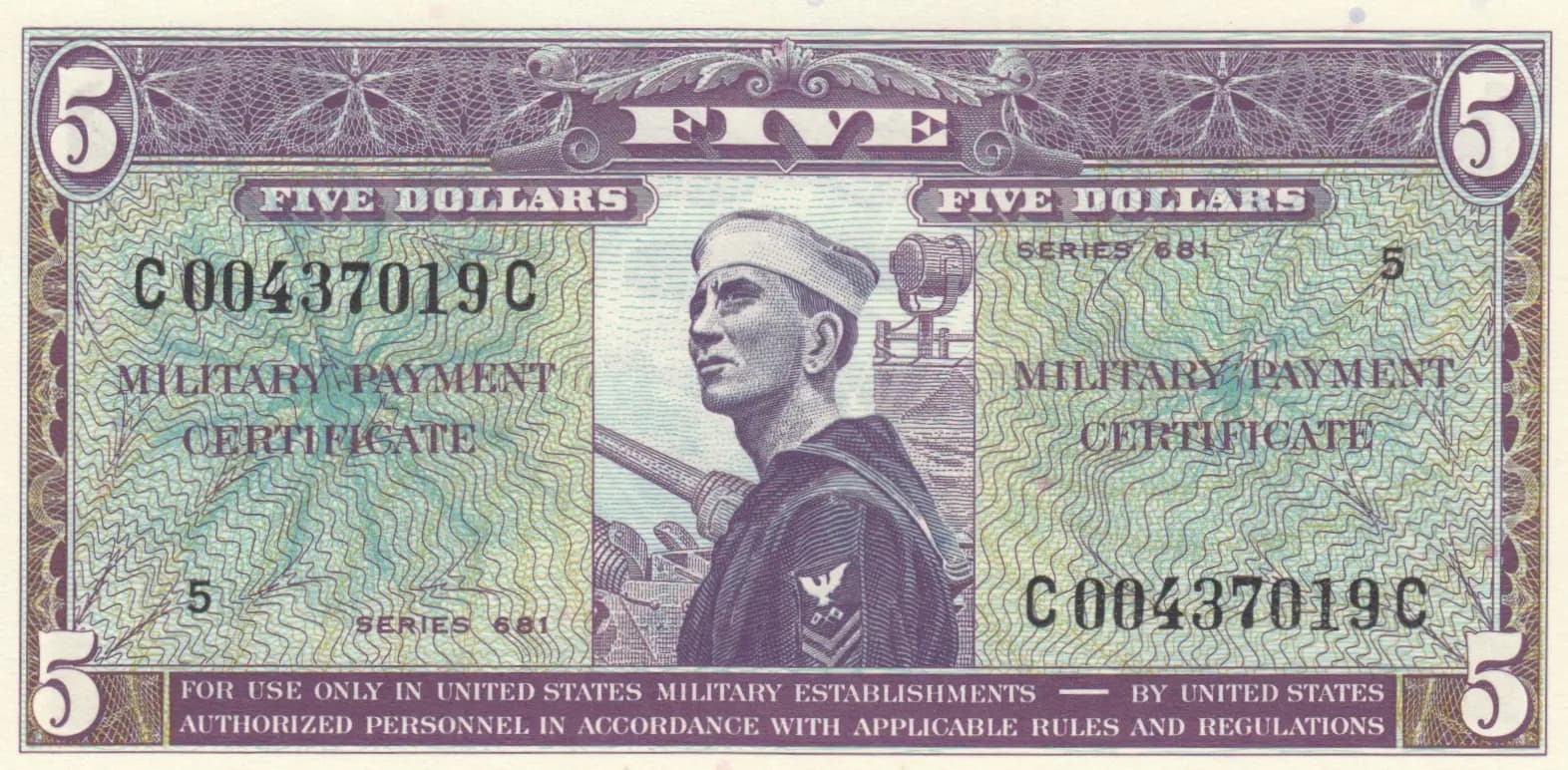
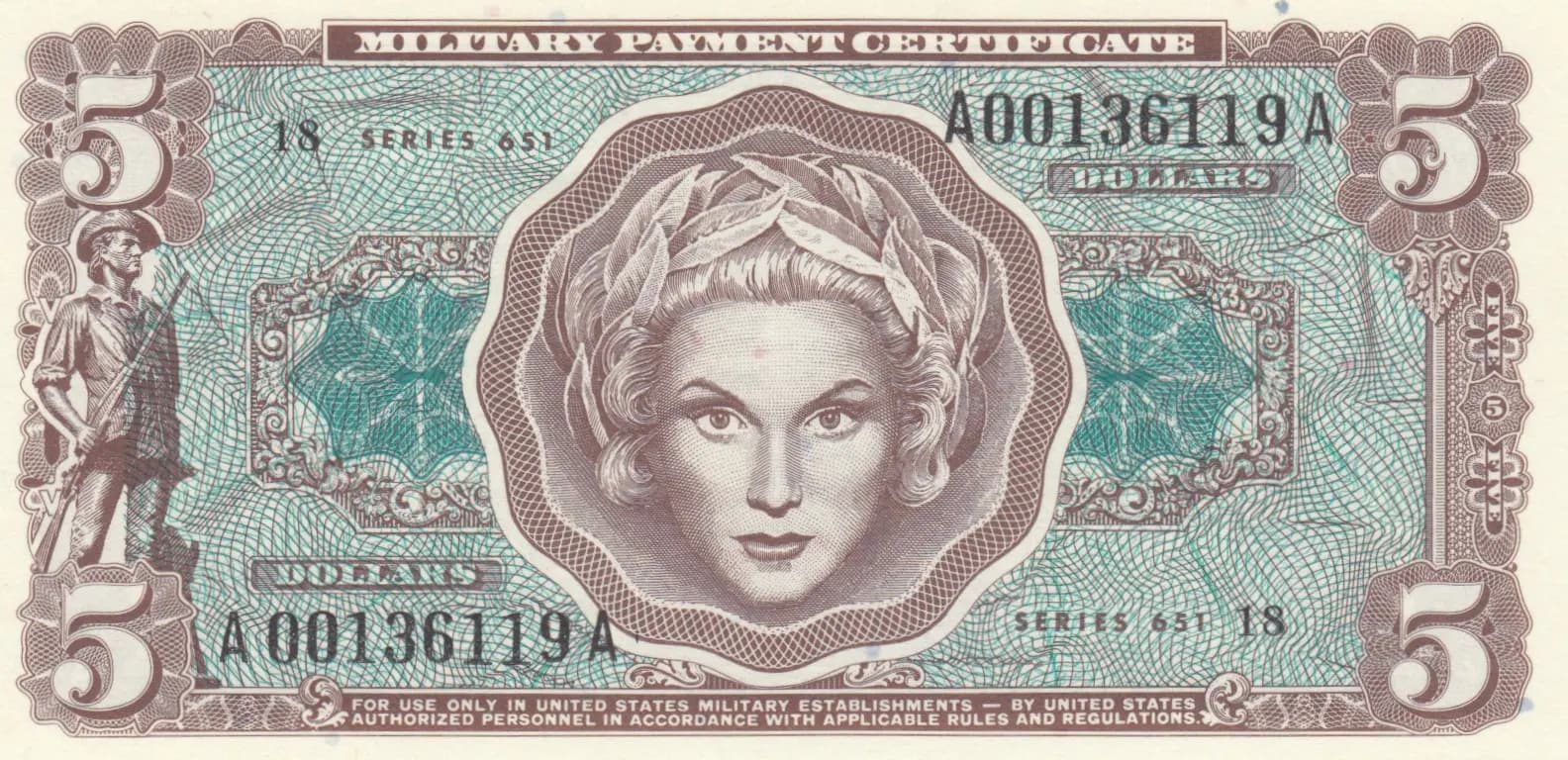
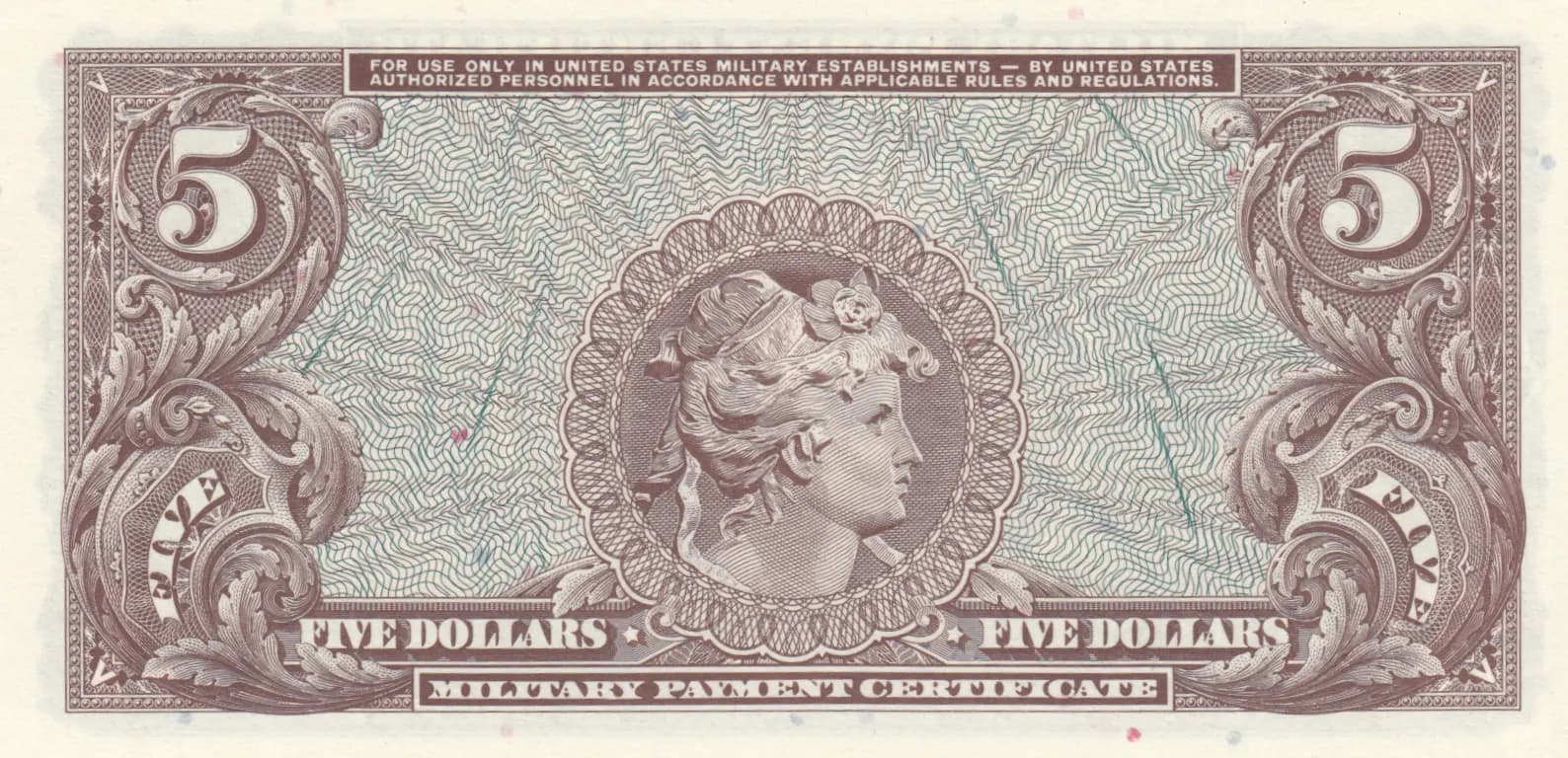
This is a Series 69-1 Military Payment Certificate in the $5 denomination, issued by the U.S. Army in 1969 and graded UNC. The note features an elegant classical design with a central portrait of a woman wearing a laurel wreath on the obverse and a profile portrait on the reverse, both surrounded by ornate scalloped frames. The uncirculated condition is evident from the crisp appearance, clean margins, and absence of wear, though minor foxing is noted in the upper right of the reverse, making this an exceptional example of Cold War-era military currency.
Common. Series 69-1 $5 Military Payment Certificates were produced in substantial quantities as part of the routine currency supply for U.S. military personnel worldwide during 1969. While MPCs as a category are collectible, this specific denomination and series in uncirculated condition, though desirable, remains common in the collector market. The absence of reported scarcity for this Pick number and the large print runs typical of late-series MPCs support this assessment.
Military Payment Certificates were issued by the U.S. Armed Forces as a form of exchange currency for use in overseas military establishments during the Cold War era. The 1969 Series represents the later years of MPC production, which was eventually phased out in 1973 due to counterfeiting concerns and logistical complexities. The classical imagery—including the laurel wreath symbolizing victory and the military figure in classical attire—reflects the aesthetic tradition of American military currency design, connecting Cold War military service to broader Western classical heritage.
The obverse features a central portrait of a classical female figure (likely representing Liberty or a symbolic allegorical figure) with styled blonde hair adorned with a laurel wreath, enclosed within an ornate scalloped decorative frame. To the left stands a male figure in classical military attire, holding a spear or staff, reinforcing the military theme. The background employs sophisticated fine line work with a combination of grid and wave patterns in teal/green and brown tones. Large numeral 5s are positioned in the corners. The reverse displays the same female figure in right-facing profile, similarly framed by scalloped ornamental borders, with fine wavy line patterns and cross-hatching forming the background. Ornamental scrollwork and floral designs accent both sides. This classical design approach was typical of American military payment certificates, drawing on numismatic traditions established in earlier 20th-century U.S. currency.
Front: 'MILITARY PAYMENT CERTIFICATE' (header); 'DOLLARS' (denomination text); Serial number 'A00136119A'; 'SERIES 69-1' (series designation); 'FOR USE ONLY IN UNITED STATES MILITARY ESTABLISHMENTS — BY UNITED STATES AUTHORIZED PERSONNEL IN ACCORDANCE WITH APPLICABLE RULES AND REGULATIONS.' (legal restriction text). Reverse: 'MILITARY PAYMENT CERTIFICATE' (header); 'FIVE DOLLARS' (appears twice, denomination text); 'FOR USE ONLY IN UNITED STATES MILITARY ESTABLISHMENTS — BY UNITED STATES AUTHORIZED PERSONNEL IN ACCORDANCE WITH APPLICABLE RULES AND REGULATIONS.' (legal restriction text). All text is in English.
This note was produced using intaglio/engraved printing, evidenced by the fine, precise line work, intricate cross-hatching patterns, and the depth of the scalloped frames visible in both images. The sophisticated background patterns—the grid and wave designs on the obverse and wavy line patterns on the reverse—are characteristic of security printing techniques employed by the U.S. Bureau of Engraving and Printing for Military Payment Certificates. The multi-layer ornamental elements and fine detail work are consistent with the high-security intaglio process used for all MPCs.
This note is identified as Series 69-1 with serial number A00136119A. The 'A' prefix on the serial number is standard for this series. The Series 69-1 designation indicates this is from the first issue of 1969 production. No significant varieties (such as color variations, signature changes, or major overprints) are apparent from the visual analysis. The minor foxing noted on the reverse is a condition characteristic rather than a variety marker.