20 dollars 1914
About This Note
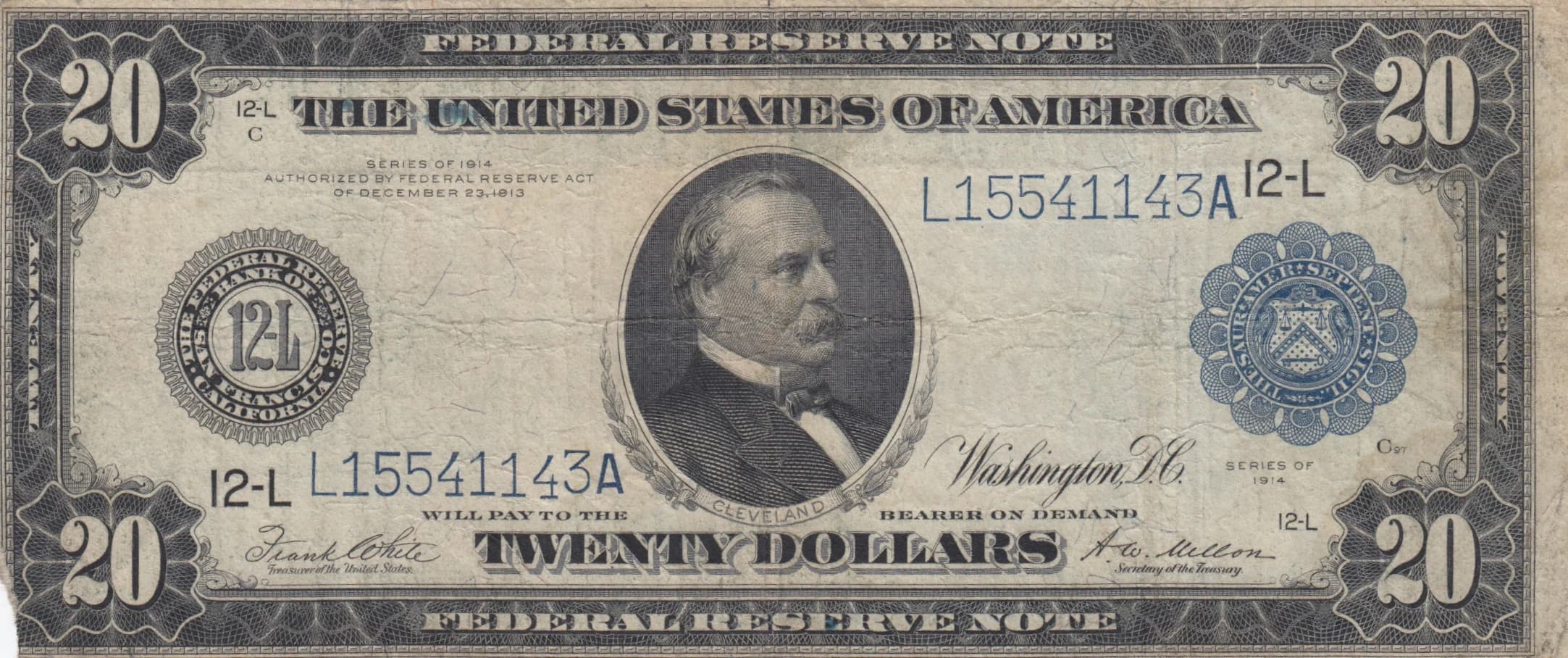
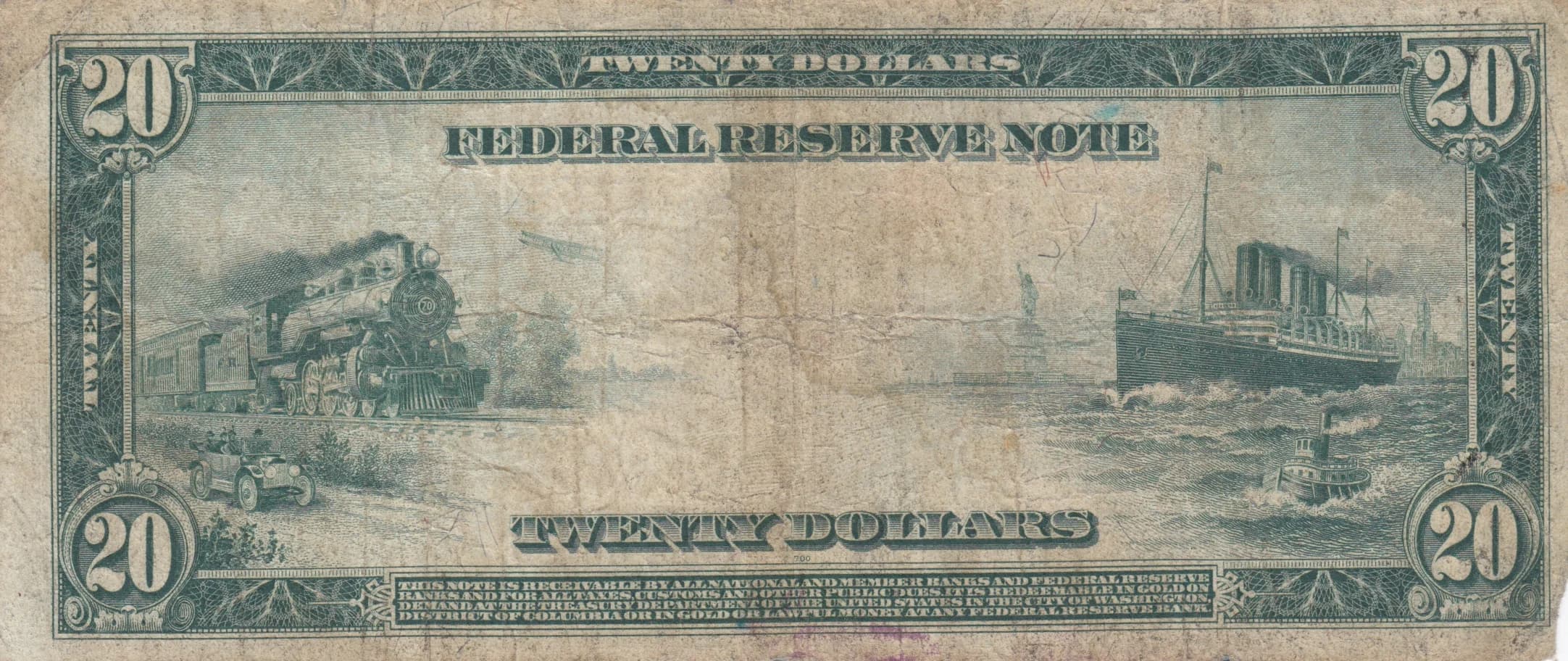
This $20 Federal Reserve Note from the Series of 1914 presents a well-circulated example of the first year of Federal Reserve currency issuance. The note displays the characteristic gray and black obverse featuring a left-facing portrait in ornate oval frame with Federal Reserve and Treasury seals, paired with the iconic transportation-themed reverse in green featuring a steam locomotive and steamship. The Fair condition grade reflects expected wear from approximately a century of circulation, including visible creasing, fold marks, yellowing, and foxing, making it a representative example of early 20th century circulating currency.
Common. The 1914 Series $20 Federal Reserve Note is a widely produced issue from the first year of Federal Reserve operations, with millions printed across all twelve Federal Reserve Banks. Despite its age and historical significance, examples in all grades remain readily available to collectors at modest prices. The Fair condition grade is typical for survivors of this era, and notes in this condition trade at reasonable market values reflecting their common availability rather than rarity.
Issued following the Federal Reserve Act of December 23, 1913, this 1914 $20 note represents the inaugural year of Federal Reserve currency and the modernization of American monetary systems. The reverse imagery celebrating steam locomotive and steamship transportation reflects the economic priorities of the progressive era, emphasizing industrial development and commerce as cornerstones of American prosperity during the pre-World War I period.
The obverse features a portrait of James Garfield, twentieth President of the United States, depicted in left profile wearing formal 19th century attire with bow tie, surrounded by an ornate oval decorative frame with geometric flourishes. The portrait is flanked by the Federal Reserve seal (marked '12-L' for the San Francisco Federal Reserve Bank) on the left and the Treasury Department seal on the right, both featuring intricate rosette patterns. Ornate denomination numerals '20' occupy all four corners with elaborate surrounding geometric designs. The reverse presents two powerful symbols of American industrial progress: a steam locomotive with billowing smoke traveling on railroad tracks on the left side, and a large ocean-going steamship with multiple smokestacks and masts on the right, set against a light green/teal background. The color scheme of the obverse is predominantly gray, black, and cream, while the reverse employs green and dark green on a cream background, creating visual distinction between the two sides.
FRONT SIDE: 'Federal Reserve Note' and 'The United States of America' appear at top; 'Series of 1914' and 'Authorized by Federal Reserve Act of December 23, 1913' provide legal foundation; 'Will Pay to the Bearer On Demand' and 'Twenty Dollars' state the note's value and redemption promise; signatures of A. O. McAdoo (Secretary of the Treasury) and Frank White (Treasurer of the United States) appear with 'Washington D.C.' location; Federal Reserve Bank designation '12-L' (Federal Reserve Bank of San Francisco) and serial number 'L15541143A' identify the specific note. BACK SIDE: 'Twenty Dollars' and 'Federal Reserve Note' appear prominently; extended legal tender clause reads 'This Note is Legal Tender for All Debts Public and Private and is Receivable by All National and Member Banks and Federal Reserve Banks and for All Taxes Customs and Other Public Dues and when so Received may be Re-Issued. It is Convertible on Demand into Gold Coin of the United States at the Treasury Department or at any Federal Reserve Bank. Redeemable in Gold on Demand at the Treasury of the United States in the City of Washington D.C. or at any Federal Reserve Bank.'
This note was produced using intaglio engraving and printing, the standard security printing method for U.S. currency during this period. The fine line work visible in the portrait's cross-hatching, the intricate geometric border patterns, the detailed locomotive and steamship engravings, and the elaborate ornamental designs throughout all reflect the precision of steel plate engraving. The Bureau of Engraving and Printing (BEP) produced these notes using multiple-color intaglio printing, with the obverse in black and gray on the front and green on the reverse, typical of early Federal Reserve Note production standards.
This note is designated as Pick 361b, indicating it is a 1914 Series $20 Federal Reserve Note. The '12-L' designation indicates issuance by the Federal Reserve Bank of San Francisco (the twelfth district). The serial number L15541143A and signatures of A. O. McAdoo and Frank White are consistent with 1914 production. Varieties of this issue exist across different Federal Reserve Banks (marked 1-L through 12-L) and with signature variations, though the basic design remained consistent throughout the 1914 series printing.