20 dollars 1950A
About This Note
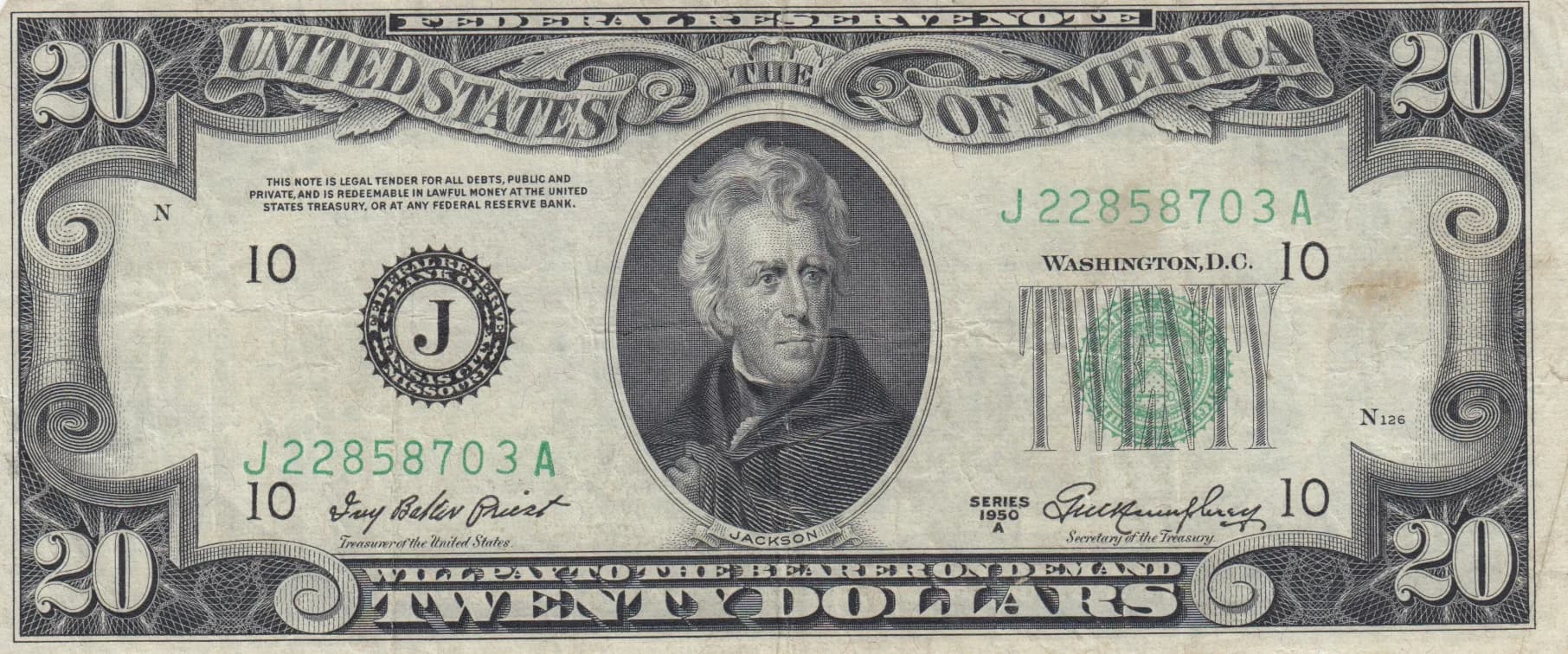
This Series 1950A $20 Federal Reserve Note features Andrew Jackson's portrait on the obverse and the White House on the reverse, printed in classic green and black ink. The note displays moderate circulation wear including visible creases, foxing, and age-related discoloration consistent with VF (Very Fine) grade, making it a pleasant mid-grade example suitable for collectors seeking affordable vintage currency from the early post-war era.
Common. The 1950A $20 series was produced in substantial quantities for circulation throughout the 1950s and beyond. Series 1950A notes remain readily available in the numismatic market and do not command premiums based on rarity. VF-graded examples are typical for mid-grade circulated notes of this series.
The 1950A series represents the early Cold War period of American currency production, issued during President Truman's administration. The White House reverse design emphasizes American civic institutions and governance, while Jackson's portrait continues the long tradition of honoring early American political figures on the $20 denomination, a tradition maintained since 1862.
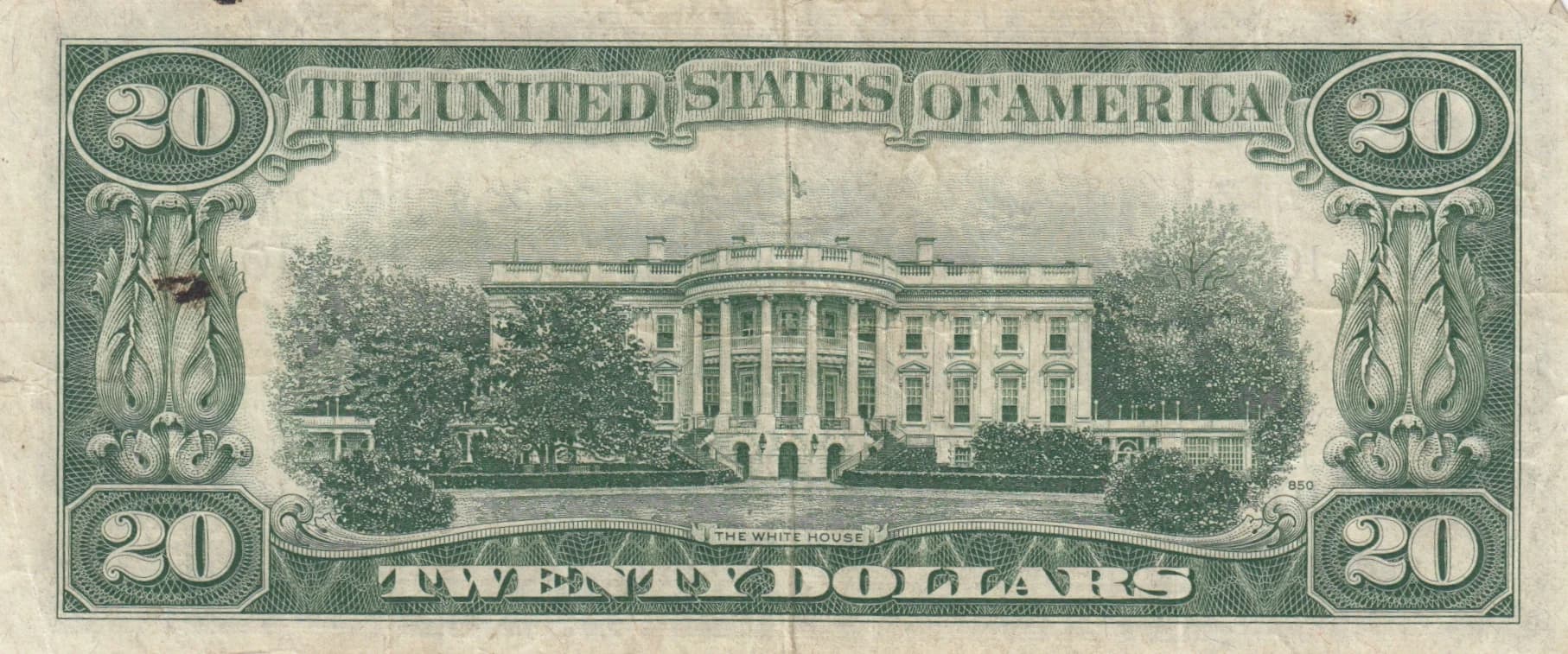
This $20 note presents the standardized design established for the 1950 series. The obverse features a formal oval portrait of Andrew Jackson in three-quarter profile, rendered in black ink against an ornate frame of elaborate scrollwork and spiral designs in the corners. Green and black inks create denomination numerals '20' in the upper corners. The Federal Reserve Bank seal with the letter 'J' (indicating the Federal Reserve Bank of Kansas City) appears prominently. The reverse depicts an engraved architectural representation of the White House's north facade with its characteristic portico and colonnade, surrounded by landscaping elements and flanked by ornamental acanthus leaf designs. Denomination markers appear in all four corners within oval cartouches.
FRONT: 'THE UNITED STATES OF AMERICA' (national designation); 'TWENTY DOLLARS' (denomination spelled out); 'JACKSON' (portrait identification); 'SERIES 1950' (issue series); 'THIS NOTE IS LEGAL TENDER FOR ALL DEBTS, PUBLIC AND PRIVATE, AND IS REDEEMABLE IN LAWFUL MONEY AT THE UNITED STATES TREASURY OR AT ANY FEDERAL RESERVE BANK' (legal tender declaration); 'WASHINGTON, D.C.' (location); signatures of Treasurer and Secretary of Treasury; 'Say Peller Print' (printer attribution); Serial number 'J22858703A'; 'N126' (note identifier). BACK: 'THE UNITED STATES OF AMERICA' (national designation); 'THE WHITE HOUSE' (landmark identification); 'IN GOD WE TRUST' (national motto); '20' (denomination in corner ovals); '850' (plate position identifier).
Intaglio (recess) engraving on a flat-bed press, the standard method employed by the Bureau of Engraving and Printing for all U.S. currency of this era. The fine line engraving visible throughout the borders, intricate scrollwork patterns, and detailed architectural rendering of the White House are characteristic of this security printing technique. Multiple plates were used for the design, as indicated by the plate position identifier '850'.
The note is identified as Series 1950A (the first revision of the 1950 design). The Federal Reserve Bank letter 'J' indicates issue by the Kansas City Federal Reserve Bank. The serial number prefix and specific signatures on this note would identify the exact year of production within the 1950A series (which ran from 1950 through the mid-1960s). The 'A' suffix on the series designation distinguishes this from the original 1950 series and represents a standard variety change within the long production run of this design type.