1 dollar 1935F replacement
About This Note
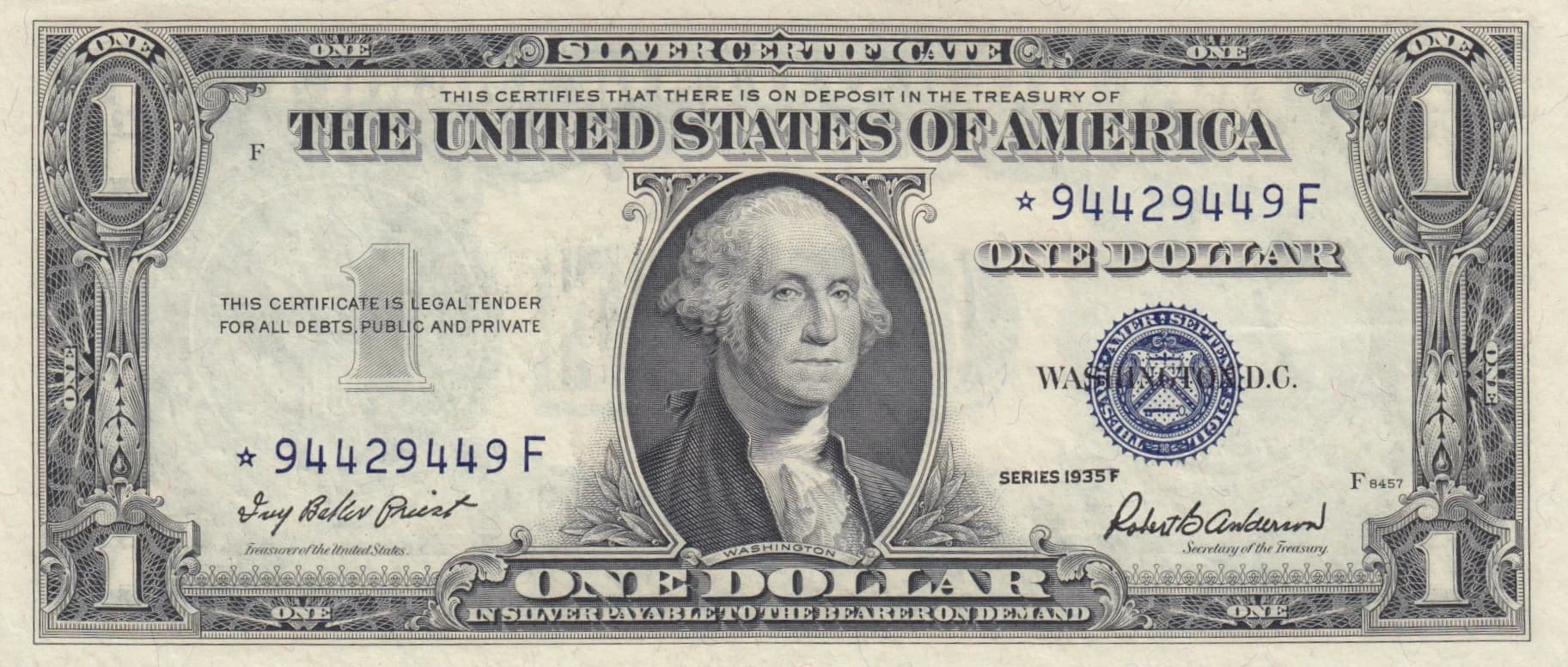
This is a Series 1935F United States one dollar Silver Certificate in uncirculated condition, featuring the distinctive portrait of George Washington on the obverse and the dual Great Seal imagery on the reverse. The note exhibits crisp, clean printing with no visible wear, creases, or foxing, representing an excellent example of 1930s currency production. The replacement note designation (indicated by the asterisk in the Pick number) and the signatures of Ivy Baker Priest and Robert Okeland add numismatic interest to this well-preserved specimen.
Common. The 1935F series was produced in substantial quantities, with millions of notes issued. Silver Certificates of this series remain readily available in the collector market across most grades. While replacement notes (indicated by the asterisk designation) may have had somewhat smaller print runs than standard notes, they do not command significant premiums and are not considered scarce. Uncirculated examples are desirable but not exceptionally rare.
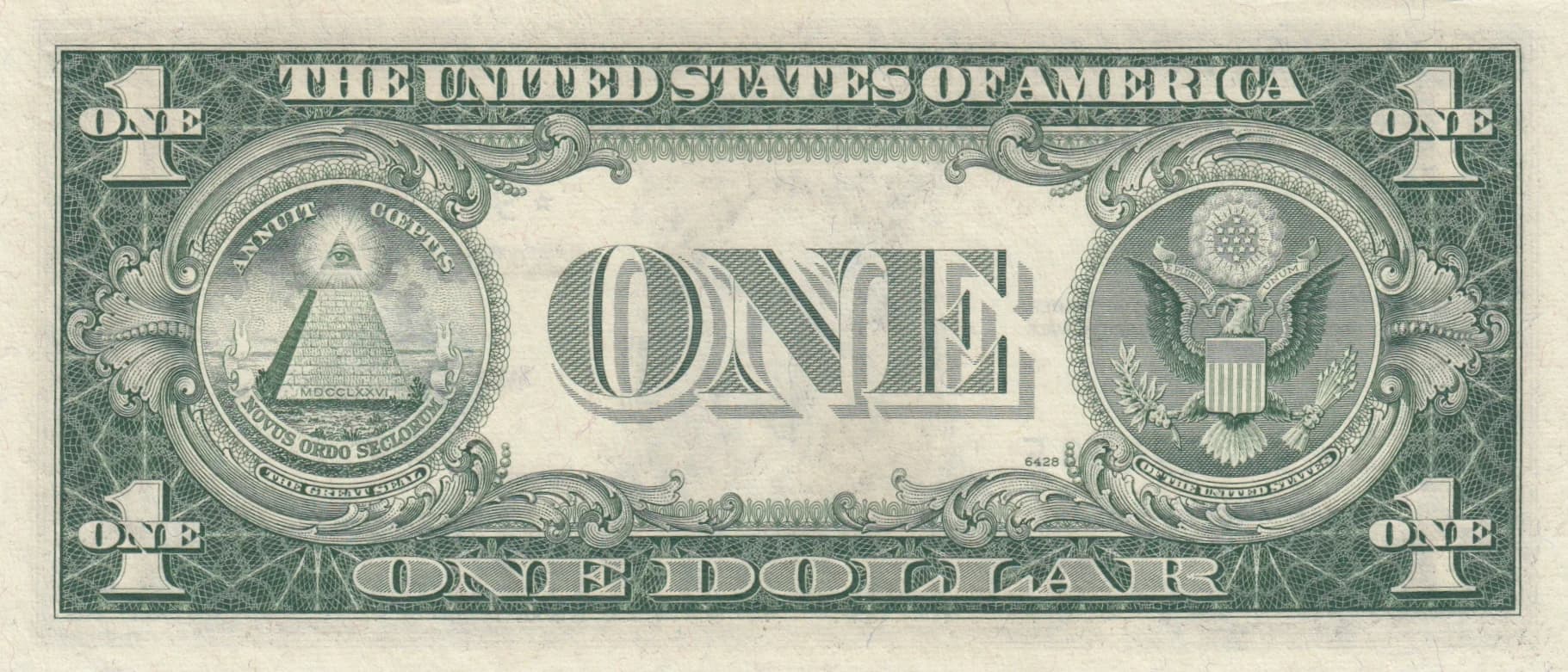
The 1935F series represents the later years of Silver Certificate production, when the U.S. Treasury was obligated to maintain gold and silver reserves backing the currency. The dual Great Seal imagery on the reverse—featuring both the pyramid with the all-seeing eye and the eagle with shield—reinforced the government's authority and national symbolism during the New Deal era. The formal certificate text ('THIS CERTIFIES THAT THERE IS ON DEPOSIT IN THE TREASURY') reflects the specific backing promise that defined Silver Certificates until their discontinuation in 1968.
The obverse features a formal profile portrait of George Washington facing left, rendered in fine detail within an ornate oval cartouche surrounded by intricate decorative borders and geometric patterns. Large ornamental numeral '1' denominations occupy the left and right margins. The Treasury Department seal appears on the right side. The reverse showcases the Great Seal of the United States in two circular medallions: the reverse seal on the left displaying a pyramid with an all-seeing eye and radiating light, and the obverse seal on the right depicting an eagle with spread wings holding a shield with vertical stripes, an olive branch in its left talon, and arrows in its right talon. The word 'ONE' dominates the center field in large letters. All elements are rendered with fine-line engraving characteristic of high-security currency production.
FRONT SIDE: 'This certifies that there is on deposit in the Treasury of the United States of America one dollar. This certificate is legal tender for all debts public and private.' Series 1935F, with Treasury Seal, Federal Reserve identification (F 8457), serial number 94429449F, signatures of Ivy Baker Priest (Treasurer of the United States) and Robert Okeland (Secretary of the Treasury), and location Washington D.C. BACK SIDE: 'The United States of America' and 'One Dollar' with Latin mottos: 'E Pluribus Unum' (Out of many, one), 'Annuit Coeptis' (He has favored our undertakings), and 'Novus Ordo Seclorum' (New order of the ages). Print identification number 6428.
Intaglio (engraved plate) printing, the standard method for U.S. currency production. The front is printed in black ink, while the reverse utilizes green ink, both on a light cream/beige currency paper stock. The fine-line intricate engraving patterns throughout both sides, complex geometric and floral border designs, and detailed portrait and seal engravings are hallmarks of the Bureau of Engraving and Printing's security protocols of the era.
This is a replacement note variant, as indicated by the asterisk (*) in the Pick number (P-416D2f*). Replacement notes were printed to replace damaged currency and typically bear a star or asterisk in their serial number sequence. The specific signatures of Ivy Baker Priest and Robert Okeland identify this note within the 1935F series issuing period (1950-1953 for Priest, 1949-1953 for Okeland). The Federal Reserve Letter F and corresponding print number (F 8457) further specify the production details.