5 griven 1920
Market Prices
6 salesAbout This Note
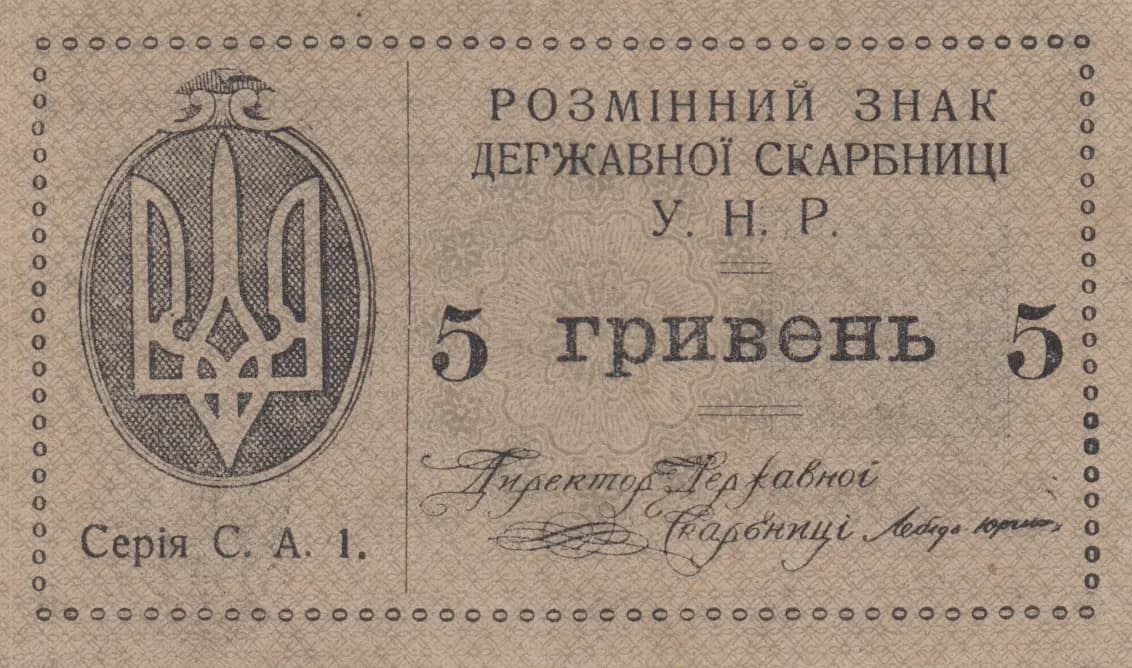
This Ukrainian 5 Hryvnia note from 1920 represents a significant piece of interwar Eastern European currency history, issued by the Ukrainian People's Republic during a period of political upheaval. The note displays excellent condition (AU grade) with well-preserved tan and beige coloring, clear Cyrillic inscriptions, and minimal aging signs beyond light foxing consistent with a century-old paper note. The central trident emblem—Ukraine's national heraldic symbol—is prominently featured within an ornate oval frame, making this an aesthetically appealing example of early Ukrainian state currency.
Common. The eBay price tracking data shows consistent market prices ranging from $13-$58 depending on condition grade, with multiple sales recorded across different years and condition levels (VG, F, VF grades). The 2016 catalog valuation of $30 for VF and $60 for UNC indicates this note is readily available in the collector market. The AU-graded example observed here falls within the mid-range of documented sales prices ($27-$30 range for VF examples from 2014-2022), suggesting reasonable availability even in higher grades. While historically significant as a Ukrainian independence-era issue, the note's regular circulation during 1920-1921 and subsequent preservation by collectors means it is not scarce.
This banknote was issued during the tumultuous 1920-1921 period when the Ukrainian People's Republic (U.N.R.) existed as a short-lived independent state, contested between multiple factions including the Bolsheviks, White Russians, and Ukrainian nationalists. The trident emblem on the obverse served as a powerful symbol of Ukrainian sovereignty and national identity during this brief window of independence. The note's formal designation as a 'Change sign of the State Treasury' reflects the monetary chaos of the era, when multiple competing currencies and denominations circulated simultaneously across the fractured post-Imperial landscape.
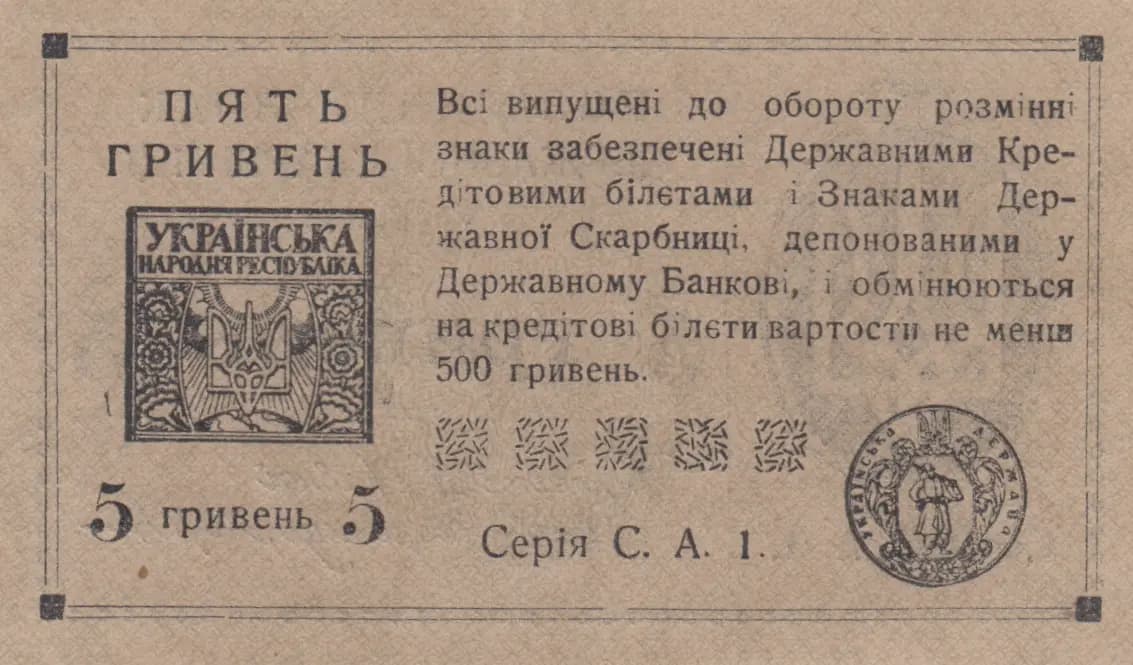
The obverse features the Ukrainian national trident (Trizub) emblem as the dominant central element, positioned within an elaborate ornate oval frame enhanced with small decorative flags at the top corners. This heraldic symbol, representing Ukraine's sovereignty and historical continuity, occupies the left-center portion of the note's tan and beige background. The reverse presents a rectangular official government stamp bearing the full name 'УКРАЇНСЬКА НАРОДНА РЕСПУБЛІКА' with ornamental borders, positioned on the left side, while the right side contains the backing guarantee text in smaller print. A circular seal or official emblem appears in the lower right corner. Both sides are framed with perforated dotted borders and feature ornamental corner designs. The color scheme throughout—predominantly tan, beige, brown, and gray with black print—reflects the austere aesthetic of early 20th-century Eastern European state finance.
FRONT: 'РОЗМІННИЙ ЗНАК ДЕРЖАВНОЇ СКАРБНИЦІ У.Н.Р.' translates to 'Change sign of the State Treasury of U.N.R.'; '5 ГРИВЕНЬ' means '5 Hryvnia'; 'Серія С.А. 1.' indicates 'Series S.A. 1'; 'Директор Державної Скарбниці Чеботар' credits 'Director of the State Treasury Chebotar.' BACK: 'П'ЯТЬ ГРИВЕНЬ' reads 'Five Hryvnia'; 'УКРАЇНСЬКА НАРОДНА РЕСПУБЛІКА' states 'Ukrainian People's Republic'; the lengthy legal text beginning with 'Всі випущені до обороту...' provides backing guarantee language: 'All circulating change signs are guaranteed by State Credit tickets and State Treasury notes, deposited in the State Bank, and can be exchanged for credit bills of value not less than 500 hryvnia'; '5 гривень 5' repeats the denomination.
This note was produced using letterpress printing technology, characteristic of early 1920s Ukrainian currency production. The crisp definition of the Cyrillic text, clear outline of the trident emblem, and uniform ornamental patterns visible in the analysis indicate high-quality letterpress work. The intricate decorative background patterns and perforated borders required skilled engraving and precise registration. The specific printer for U.N.R. notes of this series has not been definitively documented in accessible numismatic literature, though production likely occurred in Kyiv or under Ukrainian State Treasury supervision during the brief independence period.
This example is cataloged as Pick P-41a, with PMG records indicating a variant P-41x exists for the same 5 Hryven denomination. The observed specimen carries Series designation 'С.А. 1.' and signature of Director Chebotar. The specific series letter and director signature combination may distinguish varieties within the P-41 base catalog number. The absence of overprints and the clear Series S.A. 1. designation suggest this is a standard issue of the primary variety (P-41a) rather than the variant form (P-41x), though full variety distinction would require direct comparison with PMG-graded examples or specialist Ukrainian numismatic references.