200 karbovantsev 1942
Market Prices
19 salesAbout This Note
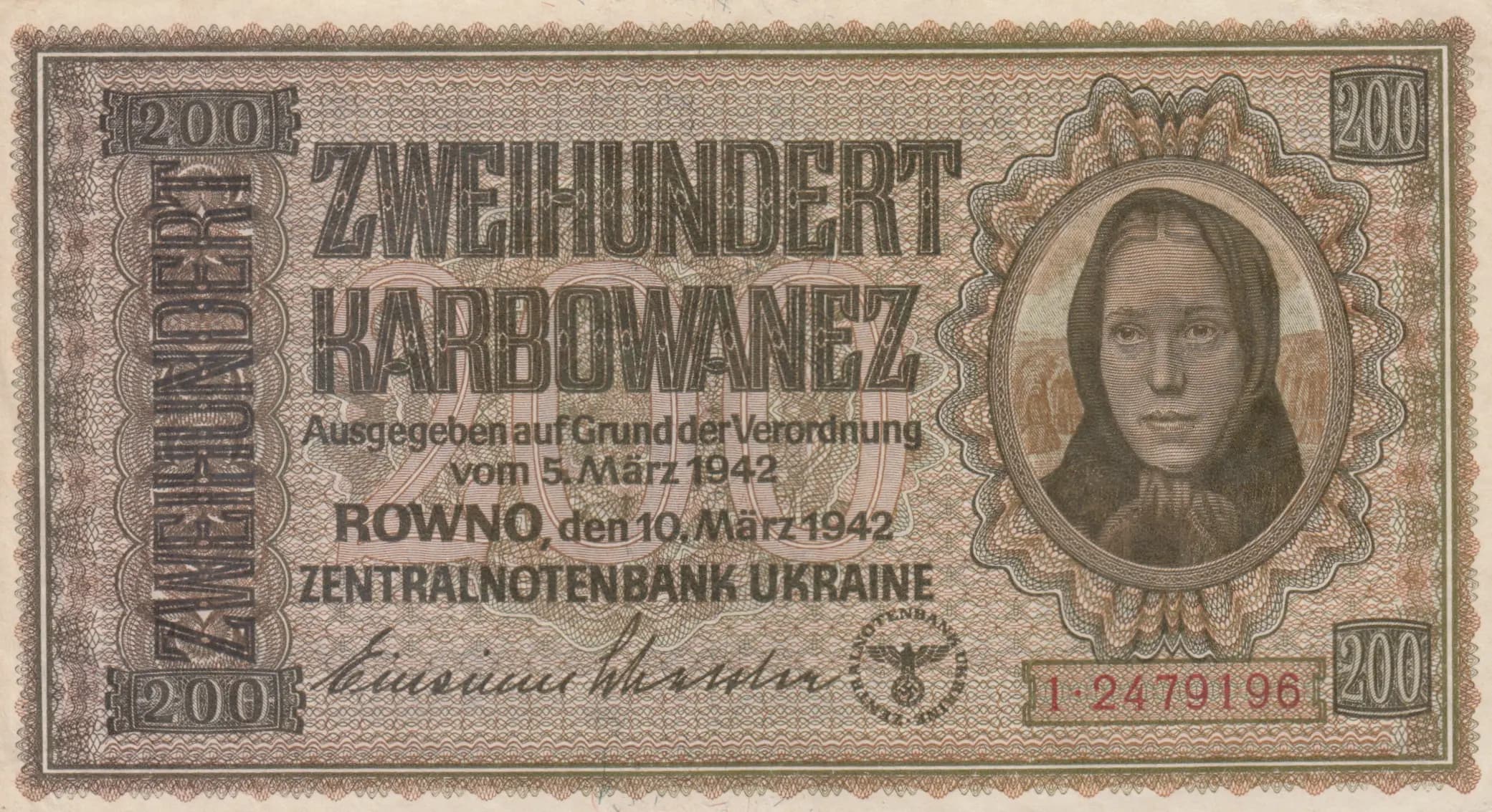
This is a well-preserved example of the Ukraine 200 Karbowanetz from 1942, issued by the Zentralnotenbank Ukraine during the German occupation. The note displays excellent condition consistent with AU grading, featuring crisp printing, sharp detail in the engraved portrait of a peasant woman, and no visible wear or damage. The bilingual German-Ukrainian design and historical context as wartime occupation currency make this a notable piece of WWII-era numismatics.
Common. The eBay market data provided shows consistent sales across multiple condition grades over more than a decade, with prices ranging from $11.50 to $565.99 depending on condition and grading service. Multiple examples in various grades (VG, VF, F) appear regularly on the market, indicating adequate supply. The 2016 catalog value of $120 for VF condition aligns with typical market prices for common wartime occupation notes. While historically significant, these notes were produced in sufficient quantities that they remain readily available to collectors at reasonable prices.
This banknote was issued on March 10, 1942, during Nazi Germany's occupation of Ukraine, as evidenced by the German issuing authority name (Zentralnotenbank Ukraine) and German-language inscriptions throughout the design. The portrait of a peasant woman on the obverse reflects the occupying authority's attempt to present the occupation as economically beneficial, while the dual-language format acknowledges the local Ukrainian population. The date and place of issue (Rovno, March 10, 1942) document the administrative machinery of wartime occupation currency management.
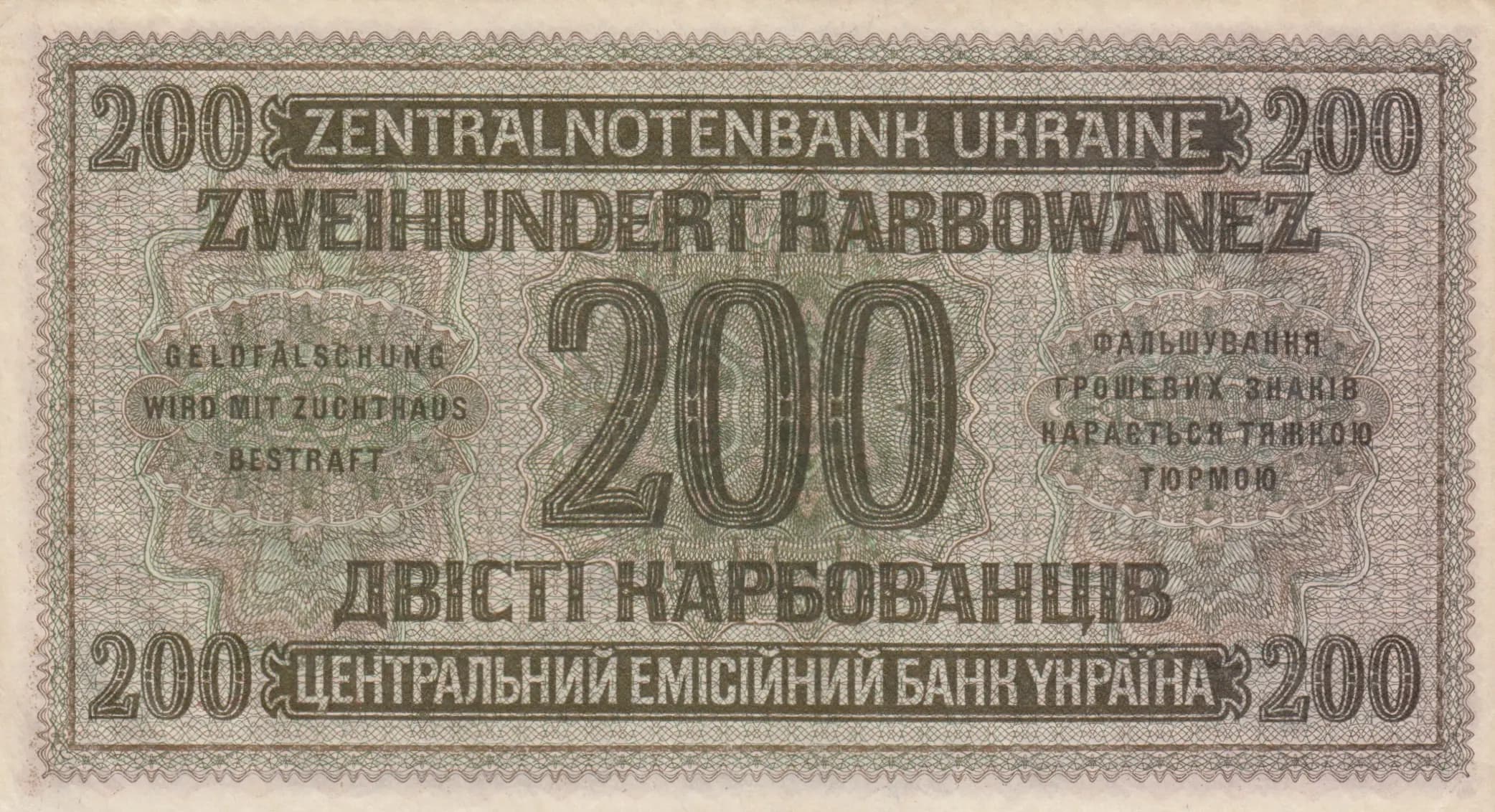
The obverse features a portrait of a peasant woman with long dark hair rendered in three-quarter frontal view, positioned within an ornate circular decorative frame on the right side of the note. The portrait demonstrates fine engraving technique characteristic of German security printing of the period. The reverse is dominated by the large numeral '200' in the center, with ornate geometric border patterns framing both sides. The color scheme is predominantly brown, tan, and sepia tones with subtle green-gray accents, typical of occupation-era currency. The design employs symmetrical ornamental elements and fine-line geometric patterns throughout, reflecting 1940s Central European banknote aesthetic standards. Bilingual German-Ukrainian text appears throughout both sides, reflecting the administrative structure of the occupation regime.
FRONT: '200' (denomination), 'ZWEIHUNDERT KARBOWANEZ' (Two Hundred Karbovanets in German), 'Ausgegebenenauf Grund der Verordnung vom 5. März 1942' (Issued under the regulation of March 5, 1942), 'ROVNO, den 10. März 1942' (Rovno, March 10, 1942), 'ZENTRALNOTENBANK UKRAINE' (Central Bank of Ukraine), '11.2470196' (serial number), 'Unterschrift des Notenbankführers' (Signature of the Bank Director). BACK: '200' (denomination), 'ZWEIHUNDERT KARBOWANEZ' (Two Hundred Karbovanets), 'ZENTRALNOTENBANK UKRAINE' (Central Bank of Ukraine), 'GELDFÄLSCHUNG WIRD MIT ZUCHTHAUS BESTRAFT' (Counterfeiting currency is punishable by imprisonment), 'ДАЛЬШУВАННЯ ГРОШЕЙ КАРАЄТЬСЯ ТЮРМОЮ' (Ukrainian: Counterfeiting money is punishable by imprisonment), 'ЦЕНТРАЛЬНИЙ ЕМІСІЙНИЙ БАНК УКРАЇ'НА' (Ukrainian: Central Emission Bank of Ukraine).
Intaglio engraving (copperplate/steel plate printing). The fine-line engraving visible throughout the note—particularly in the portrait detail, geometric border patterns, and security background—is characteristic of intaglio printing. The sharp, crisp appearance of all printed elements and the depth visible in the design elements confirm high-quality security printing methods typical of German state printing houses (likely Reichsdruckerei or affiliated security printers) during the WWII occupation period. No evidence of lithography or offset printing is present.
This specific note (P-56) is identified by the Pick catalog designation for the 200 Karbowanetz 1942 issue. Based on the visual analysis, this appears to be a standard issue from the March 10, 1942 date, issued from Rovno. The serial number visible as '11.2470196' indicates standard numbering without notable prefixes or overprints. The PMG population report indicates a single cataloged variant for this Pick number, suggesting minimal variety documentation exists for this denomination. No evidence of rare signature varieties, overprints, or unusual printing characteristics distinguishing this as a notable variety within the Pick-56 designation.