20 karbovantsev 1942
Market Prices
42 salesAbout This Note
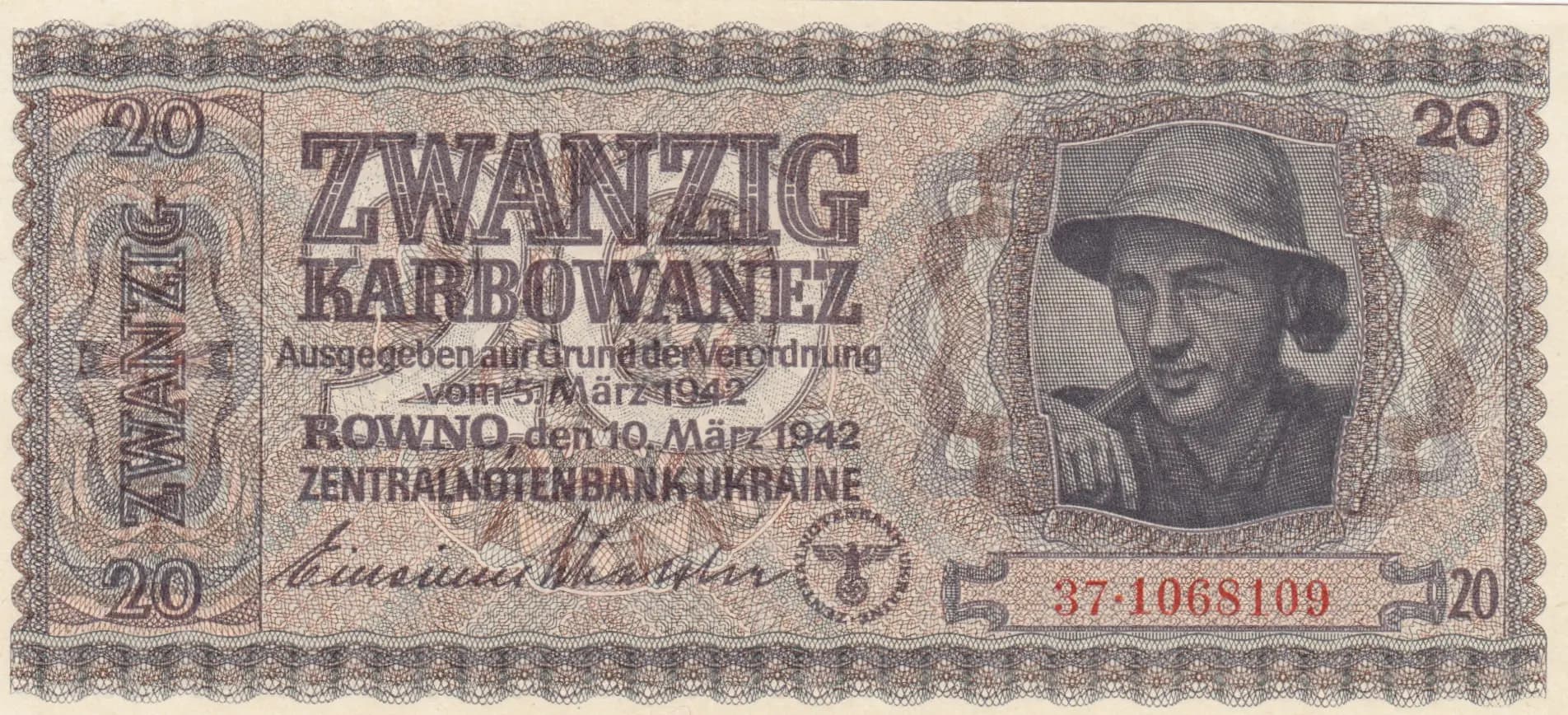
This is a striking example of the 20 Karbowantsev issued by the Zentralnotenbank Ukraine on March 10, 1942, presented in UNC condition with crisp printing and vibrant cream and beige coloring. The note features a military-uniformed portrait on the obverse and bilingual German-Ukrainian text reflecting the German occupation of Ukraine during World War II. The exceptional condition and historical significance of this wartime occupation currency make it a notable piece for collectors of WWII-era European currency.
Common. eBay market data demonstrates consistent availability with regular sales across multiple condition grades spanning from 2011 to 2026. UNC examples have sold repeatedly in the $40-93 range in recent years, with no notable premiums suggesting scarcity. The note was issued as a regular issue during the occupation period with substantial print runs typical of occupation currency. The consistent pricing and regular appearance in the secondary market confirm this is not a scarce or rare variety.
This banknote represents the German occupation administration of Ukraine during World War II, issued under Decree dated March 5, 1942, from the occupation capital of Bowno (Białystok). The Zentralnotenbank Ukraine was established as a German-controlled issuing authority to manage currency during the occupation period. The bilingual German-Ukrainian format and military portrait reflect the occupation's attempt to establish administrative legitimacy while maintaining German control over economic functions.
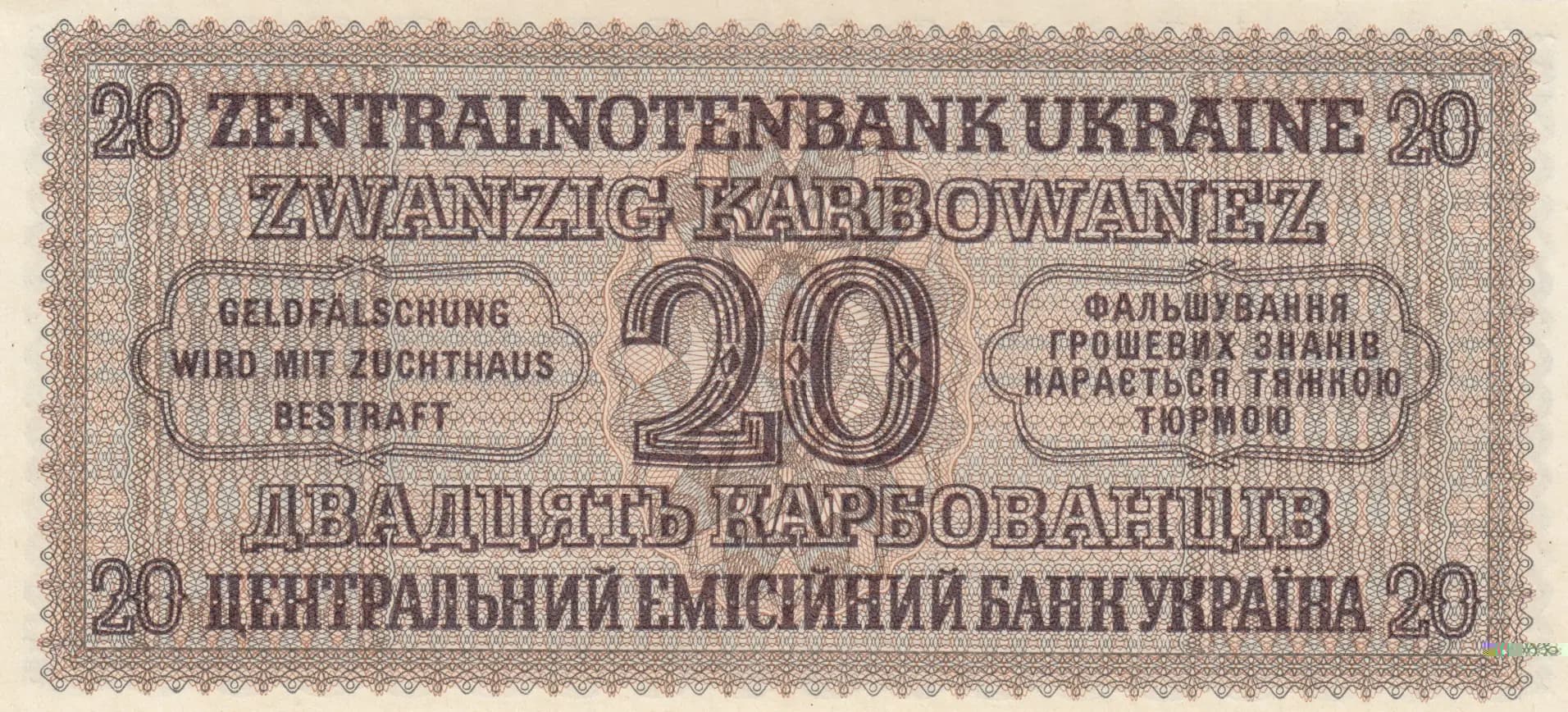
The obverse features a right-facing profile portrait of a military officer wearing a uniform and military cap, positioned on the right side of the note. The portrait is rendered in fine detail typical of central bank currency production. The reverse displays the large denomination numeral '20' prominently in the center with a symmetrical layout. Both sides are framed by elaborate ornamental borders with repeating geometric patterns and fine-line work throughout the design. The bilingual text arrangement (German in larger, authoritative fonts with Ukrainian text as a secondary layer) reflects the occupation administration structure. The overall design employs a cream and beige color scheme with brown and gray accents, creating a conservative, official appearance. The fine-line geometric security patterns are consistent with German occupation-period currency design practices.
FRONT SIDE: Denomination: '20' (numerical); 'ZWANZIG KARBOWANEZ' (German: Twenty Karbowantsev); 'Ausgesehen auf Grund der Verordnung vom 5.März 1942' (German: Issued pursuant to the Decree of March 5, 1942); 'BOWNO, den 10. März 1942' (German: BOWNO, March 10, 1942); 'ZENTRALNOTENBANK UKRAINE' (German: Central Bank of Ukraine); Serial number: '37.1068109'. BACK SIDE: Denomination: '20' (numerical); 'ZENTRALNOTENBANK UKRAINE' (German: Central Bank of Ukraine); 'ZWANZIG KARBOWANEZ' (German: Twenty Karbowantsev); 'GELDFÄLSCHUNG WIRD MIT ZUCHTHAUS BESTRAFT' (German: Counterfeiting is punished with imprisonment); 'ДАЛЫШУВАННЯ ГРОШЕВИХ ЗНАКІВ КАРАЄТЬСЯЯ ТАНКОМ ГОРМОМ' (Ukrainian: Counterfeiting of currency is punishable by hard labor); 'ДВАДЦЯТЬ КАРБОВАНЦІВ' (Ukrainian: Twenty Karbovantsev); 'ЦЕНТРАЛЬНИЙ ЕМІСІЙНИЙ БАНК УКРАЇНА' (Ukrainian: Central Emission Bank of Ukraine).
Intaglio (offset lithography and letterpress combination) printing, typical of German occupation currency production during WWII. The fine-line geometric patterns, ornamental borders, and the quality of the portrait rendering indicate high-security intaglio production methods. The crisp, uniform color application and sharp detail preservation suggest professional central bank printing facilities, likely operated under German Reichsbank or contracted German security printer oversight during the occupation period.
Single known variant catalogued by PMG under Pick number P-53. The observed serial number format '37.1068109' appears consistent with standard sequential numbering for this issue. The note displays the standard March 10, 1942 date; no date varieties are known for this denomination. No significant signature varieties, overprints, or design modifications are documented for this Pick number. The UNC condition grade with red serial number printing represents the typical production standard for this series.