5 dinars 1980
Market Prices
38 salesAbout This Note
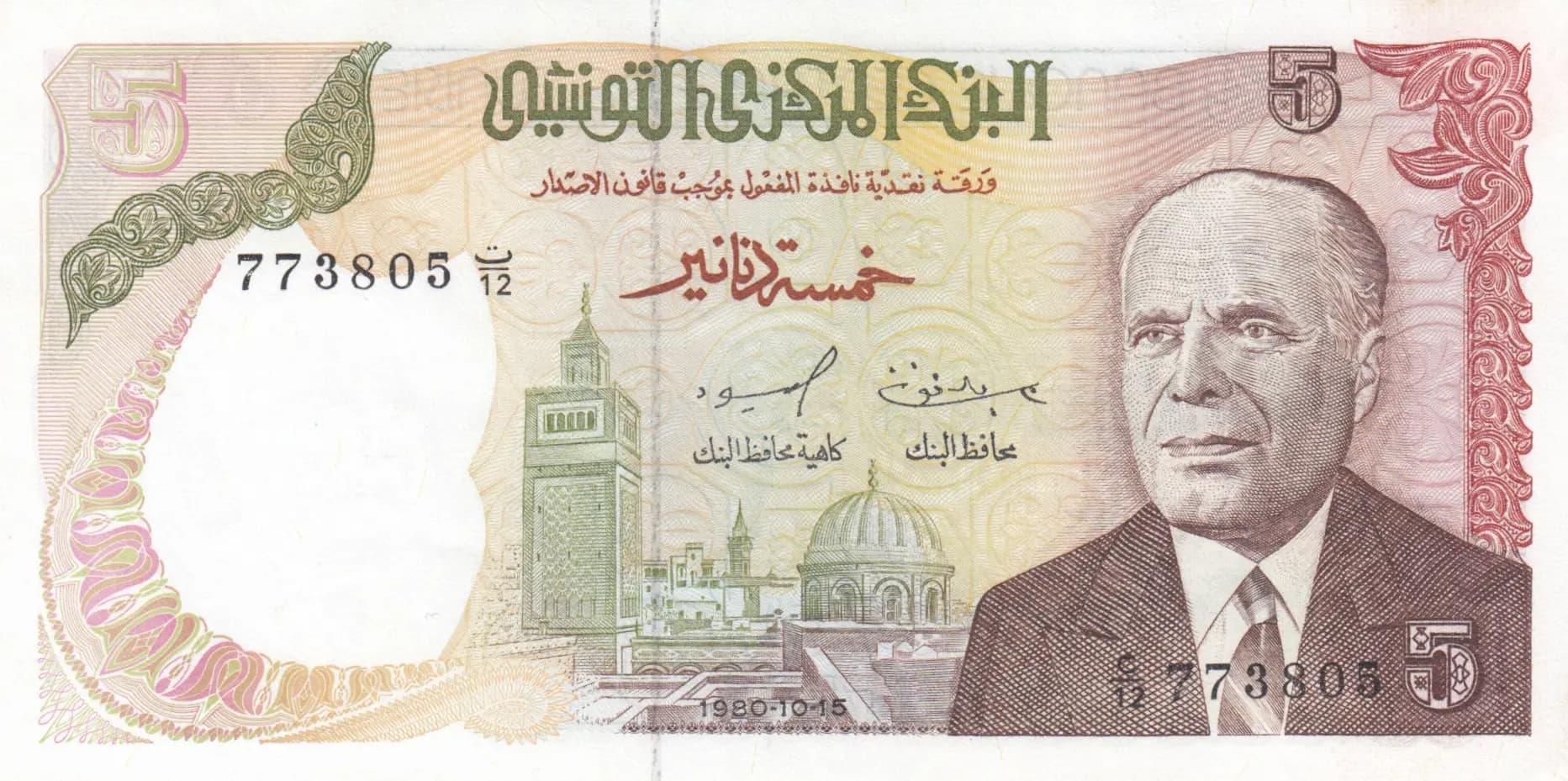
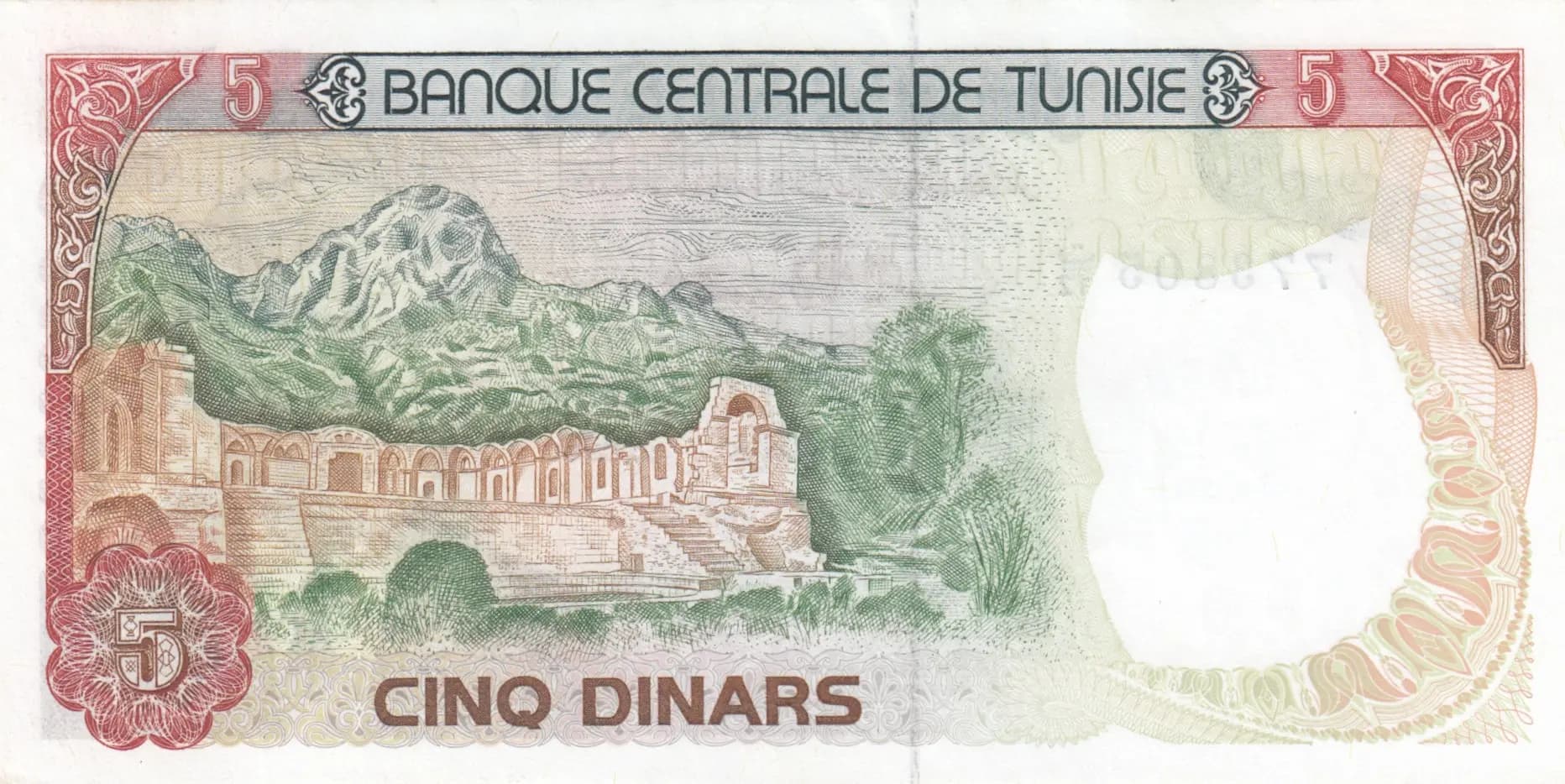
This is an uncirculated example of the 1980 Tunisian 5 Dinars (Pick P-75), issued by the Banque Centrale de Tunisie. The note displays the characteristic design elements of this period with a formal portrait of President Habib Bourguiba in profile on the obverse, accompanied by the iconic Ez-Zitouna Mosque minaret and domed structure, rendered in warm brown, red-brown, and olive-green tones on a multicolor underprint. The reverse presents a beautifully engraved landscape featuring a fortified kasbah with arched architecture set against mountainous terrain, exemplifying the artistic merit of Tunisian banknote design from this era. In pristine UNC condition, this note shows no wear, creases, or stains, making it a desirable example for collectors of North African currency.
Common. The 1980 5 Dinars note is a regular issue from an extended print run, as evidenced by the high frequency of sales in the eBay market data spanning from 2013 to 2024. Uncirculated examples sell for $12–$18 on the secondary market (based on historical eBay prices of $12.99 and $13.49 for UNC specimens), well below the threshold that would indicate scarcity. The note remains readily available to collectors at modest prices, and PMG has recorded no special varieties or variants that would elevate rarity. Condition-graded examples (PMG 65-67) command moderately higher prices ($14.50–$53), but this reflects the premium for professional certification rather than inherent scarcity.
The 1980 issue of this 5 Dinars note was released during the presidency of Habib Bourguiba, whose portrait anchors the obverse design, representing the political continuity and national identity of Tunisia during this period. The Ez-Zitouna Mosque (the Olive Tree Mosque) depicted on the front is one of Tunisia's most historically significant Islamic monuments, located in the medina of Tunis and serving as a symbol of the nation's cultural and religious heritage. The fortified kasbah illustrated on the reverse represents Tunisia's architectural patrimony and the defensive structures that characterize its historic landscape, reflecting the country's rich layered history.
The obverse features President Habib Bourguiba in formal business attire, depicted in right-facing profile, positioned prominently on the right side of the note. To his left stands a detailed engraving of the Ez-Zitouna (Olive Tree) Mosque minaret—a distinctive tower with Islamic architectural proportions—accompanied by the mosque's characteristic domed structure, rendered with careful architectural detail. The design incorporates ornate decorative borders in pink/red and beige tones with arabesque patterns and fine engraving flourishes. A large oval watermark area occupies the left side, featuring the portrait of Bourguiba as the security watermark. The reverse depicts a scenic landscape of a fortified kasbah (North African fortress) with multiple arches and crenellated defensive walls set against a backdrop of green mountains and natural vegetation including trees and shrubs, all rendered in green, brown, and tan tones. Both sides feature the denomination '5' in multiple locations and comprehensive text in both Arabic and French, reflecting Tunisia's bilingual official standards.
Front side: 'البنك الوطنى التونسى' (National Bank of Tunisia in Arabic); 'خمسة دنانير' (Five Dinars in Arabic); Denomination: '5'; Serial number visible as '778805'. Back side: 'BANQUE CENTRALE DE TUNISIE' (Central Bank of Tunisia in French); 'CINQ DINARS' (Five Dinars in French); Denomination: '5'. Date notation on obverse: '1920-10-15' (October 15, 1920 — likely a commemorative or reference date rather than issue date, as the actual issue date per external catalogs is October 15, 1980).
The note exhibits characteristics of intaglio (engraved) printing, evidenced by the fine line work, intricate shading patterns, and the depth of detail visible in both the portrait and landscape scenes. The security printing demonstrates sophisticated engraving techniques typical of central bank currency production in 1980. The multicolor underprint and the precise registration of the pink/red, beige, olive-green, and brown color scheme indicate either multi-pass intaglio printing or advanced offset lithography combined with intaglio elements, which was standard practice for the Banque Centrale de Tunisie during this period. The printer for this specific issue is not explicitly documented in the provided catalogs, but production was under the authority of Tunisia's central bank.
The visual analysis indicates a serial number fragment '778805' visible on the obverse. The PMG population report identifies only one base variant (P-75*) for this Pick number, suggesting no major varieties in signature, overprint, or date configurations are cataloged. The date visible in the visual analysis ('1920-10-15') appears anomalous given the 1980 issue date documented in external catalogs and may represent a decorative or commemorative element within the design rather than a separate variety marker. Without additional detailed information on signature combinations, plate numbers, or security thread variations, the standard P-75 designation encompasses the typical circulation issues from this release.