20 francs 1948
Market Prices
3 salesAbout This Note
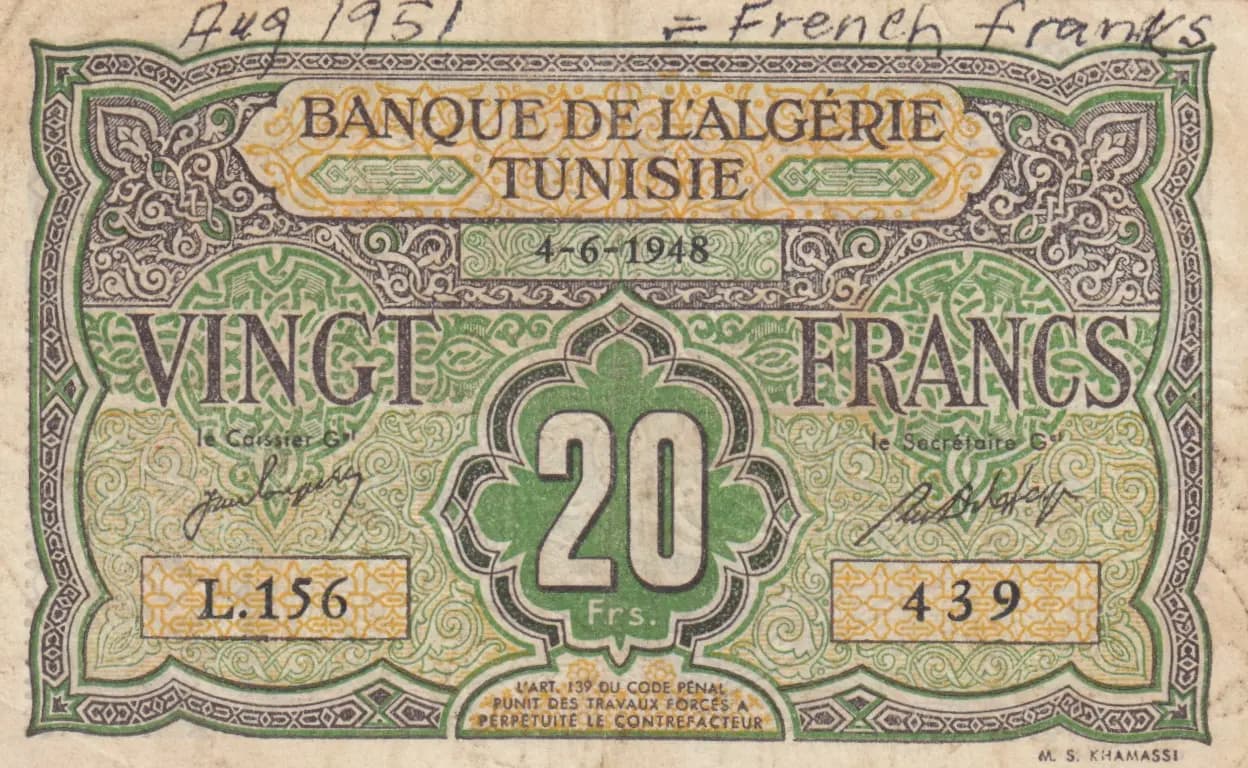
A 1948 Banque de l'Algérie et de la Tunisie 20 Francs note (Pick P-22) in Fair condition, featuring distinctive bilingual French-Arabic design with ornate Islamic geometric and floral patterns in green, beige, and gold tones. The note displays significant aging with foxing and discoloration throughout, visible creasing, and handwritten annotations, consistent with historical circulation. Despite moderate wear, this note represents an interesting example of post-WWII North African colonial currency with dual-language design reflecting the cultural context of 1948 Tunisia.
Common. This note represents a regular issue from the final years of colonial Tunisian banking under French administration. eBay market data confirms commonality: a comparable F-graded example sold for $17.50 in January 2024, and catalog values for F-grade specimens are listed at $15 USD (2016 pricing). The 1948 date represents an early post-war issue with substantial print runs, and specimens survive in moderate supply. No evidence of short print runs, recall, or scarcity factors applies to this Pick number.
Issued in 1948 by the Banque de l'Algérie et de la Tunisie during the final phase of French colonial administration in North Africa, this note reflects the bilingual colonial monetary system serving both French and Arab populations. The prominent bilingual inscriptions (French on front, Arabic on back) and Islamic geometric design elements demonstrate the bank's deliberate cultural accommodation during a transitional period before Tunisian independence in 1956. The security warning in French referencing the Penal Code underscores the colonial legal framework governing counterfeiting enforcement.
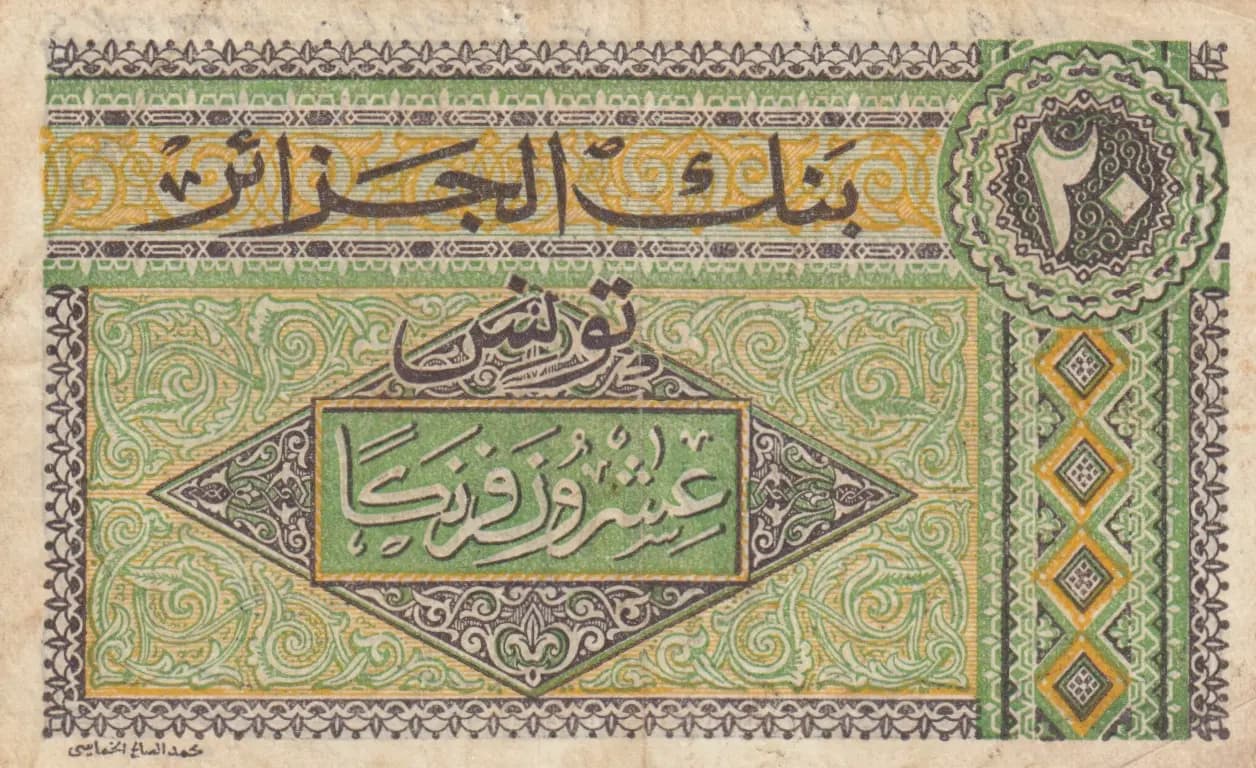
This note exemplifies the decorative style of mid-20th century colonial North African currency. The front features a prominent central shield-shaped cartouche containing the denomination '20 FRANCS' in large numerals, surrounded by an ornate border of Islamic geometric patterns and floral medallion designs rendered in green, beige, and tan. The back mirrors this aesthetic with a larger diamond-shaped central cartouche containing Arabic calligraphy, flanked by a circular decorative rosette in the upper right corner and a vertical decorative stripe with diamond motifs along the right edge. Both sides employ fine linework and interlocking geometric lattice patterns characteristic of Islamic design traditions, with no portraits or allegorical figures—instead relying entirely on ornamental and calligraphic elements to convey authority and cultural identity. The color palette of greens, golds, and earth tones was typical of French colonial currency printing of this era.
FRONT: 'BANQUE DE L'ALGÉRIE TUNISIE' = Bank of Algeria Tunisia; 'VINGT FRANCS' = Twenty Francs; '20 Frs.' = 20 Francs; 'L.156' = Serial/reference marking; '439' = Serial number component; '1948' = Issue year; 'L'ART. 139 DU CODE PÉNAL PUNIT DES TRAVAUX FORCÉS À PERPÉTUITÉ LE CONTREFACTEUR' = Article 139 of the Penal Code punishes counterfeiting with perpetual hard labor; 'M. S. KHAMASSI' = Printer/engraver attribution. BACK: 'بنك الجزائر التونسية' (Benk al-Jazair al-Tunisiyyah) = Bank of Algeria Tunisia; 'عشرون فرنك' (Ashrun Frank) = Twenty Francs; Additional Arabic calligraphic text in central cartouche (partially visible/stylized in design).
Intaglio (engraved) printing, evidenced by the fine detailed line work, complex geometric pattern repetition, and the intricate calligraphic designs visible in both the borders and central cartouches. The security printing shows characteristic intaglio depth and precision in the border ornaments and denomination shields. Printed by M. S. Khamassi in Tunis, as attributed on the note—a local printer rather than a major European security printer, which was common for colonial-era North African banknotes of this period.
Pick P-22 represents the standard 1948 issue; the PMG population report indicates two catalogued variants exist (P-22 and P-22s, likely indicating signed and specimen varieties). This example shows serial number components 'L.156' and '439', with handwritten notation suggesting 1951 documentation. No overprints or major variety features are evident beyond standard production variation. The presence of the printer attribution 'M. S. KHAMASSI' is consistent with the standard printing for this issue.