100 francs 1947
Market Prices
1 saleAbout This Note
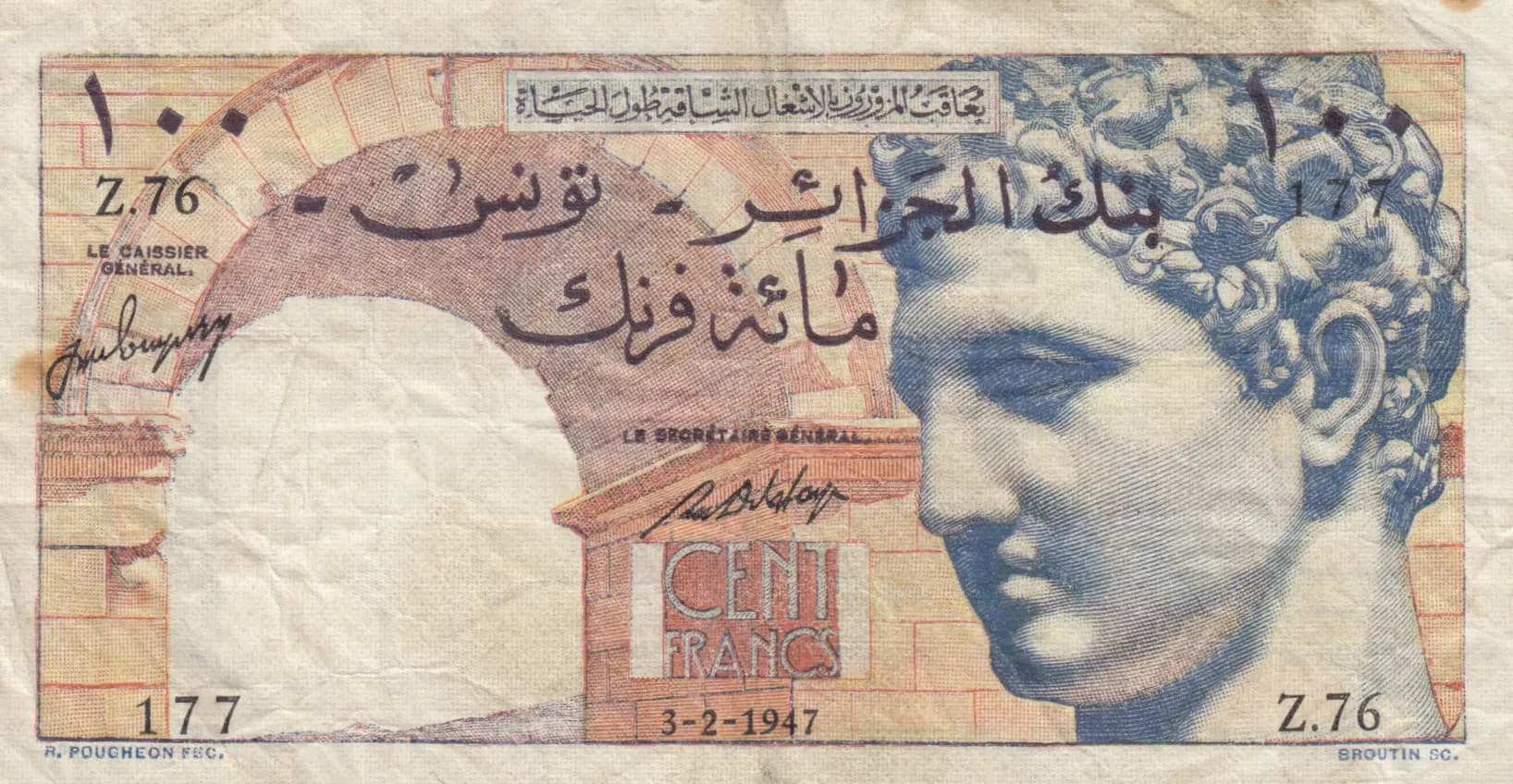
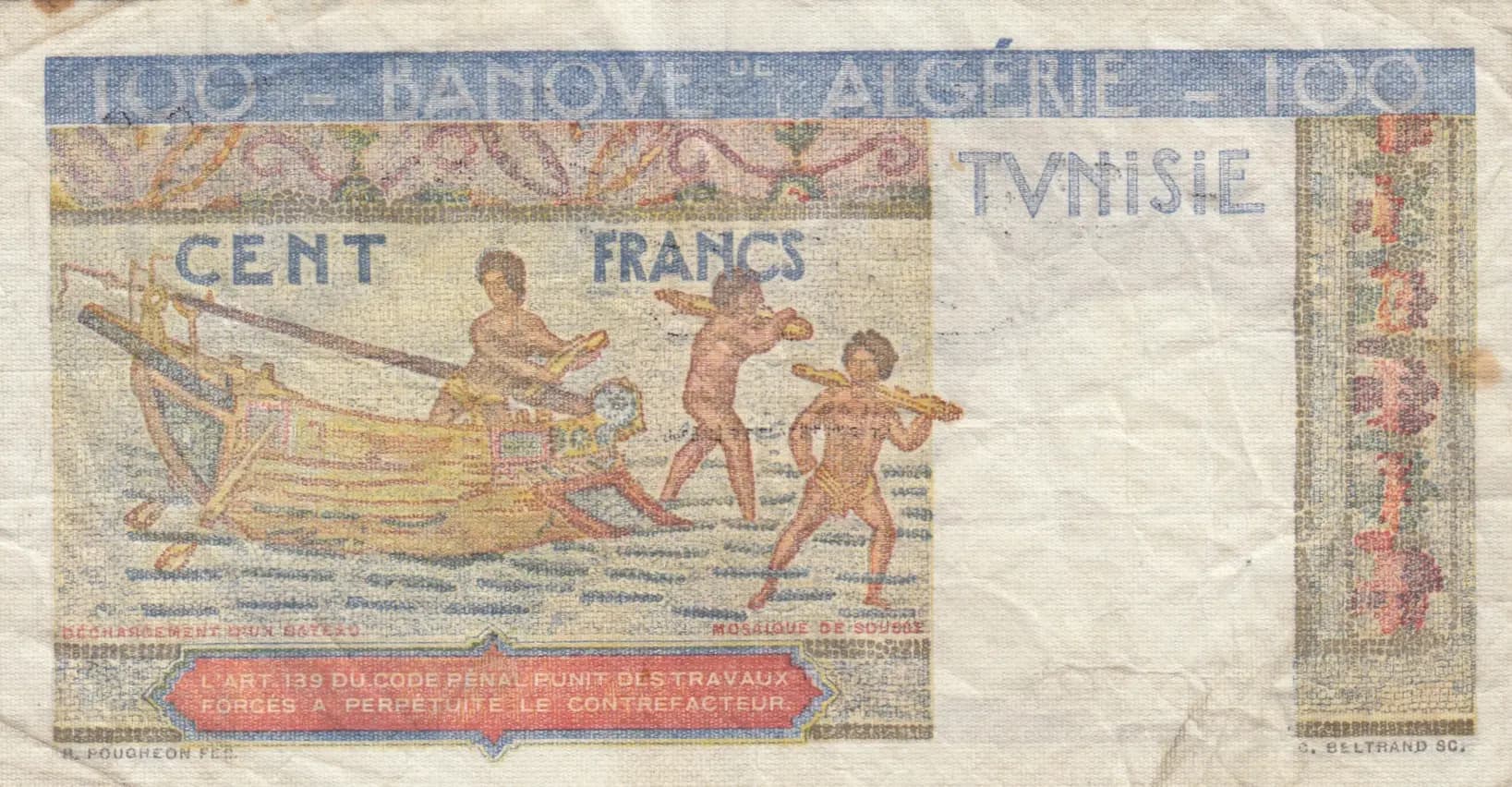
This is a Tunisia 100 Francs note from 1947, issued by the Banque de l'Algérie et de Tunisie during the post-WWII colonial period. The note features a classical portrait of Mercury (Hermes) in blue engraving on the obverse, with a reverse depicting the famous Mosaic of Sousse showing cherubs and a classical boat. The specimen grades F (Fine) with visible foxing, age-related discoloration, and creasing consistent with decades of circulation, yet retains clear legibility of all design elements and inscriptions.
Common. The eBay pricing history provided (VG sold for $51.55 in 2014, with 2016 catalog values: G=$12, F=$60, EF=$200) indicates this is a readily available note in the collector market. The 1946–1948 issue period was a regular series with substantial print runs for the colonial banking system. The Fine condition grade specimen observed is typical of surviving examples and commands modest premiums only in higher grades (EF and above). No evidence of scarcity in standard collections or specialized catalogs.
This note was issued during 1946–1948 as Tunisia was transitioning from French colonial administration toward independence (achieved in 1956). The classical imagery—Mercury and the Sousse mosaic—reflects Tunisia's dual Mediterranean and Roman heritage, emphasizing cultural sophistication. The bilingual French-Arabic inscriptions mirror the administrative transition of the period, while the Bank of Algeria and Tunisia issuer reflects the unified Franco-Algerian-Tunisian banking structure of the late colonial era.
The obverse features a classical right-facing profile portrait of Mercury (Hermes), rendered in fine blue engraving with exceptional detail, occupying the right portion of the note. Below the portrait is a Roman architectural gateway, referencing Tunisia's classical heritage. The background employs cream/beige stock with red-brown and blue guilloché patterns and fine-line engraving throughout, creating visual security and aesthetic sophistication. The reverse displays the celebrated 'Mosaic of Sousse,' a genuine Roman mosaic motif from Tunisia's archaeological heritage, depicting three cherub figures (putti) in classical pose near a decorated boat and water, rendered in sepia and multicolored tones. Ornamental borders frame both sides with decorative scrollwork. The bilingual French-Arabic text appears on both sides, with denomination prominently marked. Fine-line engraving and guilloché patterns serve as both security features and artistic embellishment.
FRONT: 'Banque de l'Algérie et Tunisie' (Bank of Algeria and Tunisia); 'Cent Francs' (One Hundred Francs); 'Le Caissier Général' (The General Cashier); 'Le Secrétaire Général' (The General Secretary); Date: '3-2-1947' (February 3, 1947); Serial number reference 'Z.76' and '177'; Engraver credit 'R. Poucheon Fec.'; Sculptor credit 'Broutin Sc.'; Arabic inscriptions referencing the Democratic Popular Republic of Tunisia and the Bank of Algeria/Tunisia. BACK: 'Banque Algérie Tunisie' (Bank of Algeria Tunisia); 'Cent Francs' (One Hundred Francs); 'Mosaïque de Sousse' (Mosaic of Sousse); Legal warning 'L'Art. 139 du Code Pénal punit de travaux forcés à perpétuité le contrefacteur' (Article 139 of the Penal Code punishes counterfeiters with life imprisonment at hard labor); Engraver credit 'R. Poucheon Fec.'; Sculptor credit 'S. Beltrand Sc.'
Intaglio (copperplate engraving) process, evidenced by the fine-line detail, guilloché background patterns, and depth of impression visible in the image. The engravers R. Poucheon and sculptors Broutin and S. Beltrand are credited, typical of high-security banknote production. The multilayered color application (blue, red-brown, cream, sepia tones) suggests multi-pass printing typical of interwar and immediate post-WWII European banknote security printing standards.
The specimen displays the standard P-24 variety with date 3-2-1947, serial number Z.76/177. PMG has catalogued P-24 and P-24s variants for this Pick number; the 's' designation typically indicates a specimen note with special markings or perforations. This circulated example is the standard P-24 type. Signatures appear to be the authorized officer signatures for the 1947 issue period. No overprint variations or secondary date markings are observed beyond the issue date.