10 dinars 1969 specimen
Market Prices
About This Note
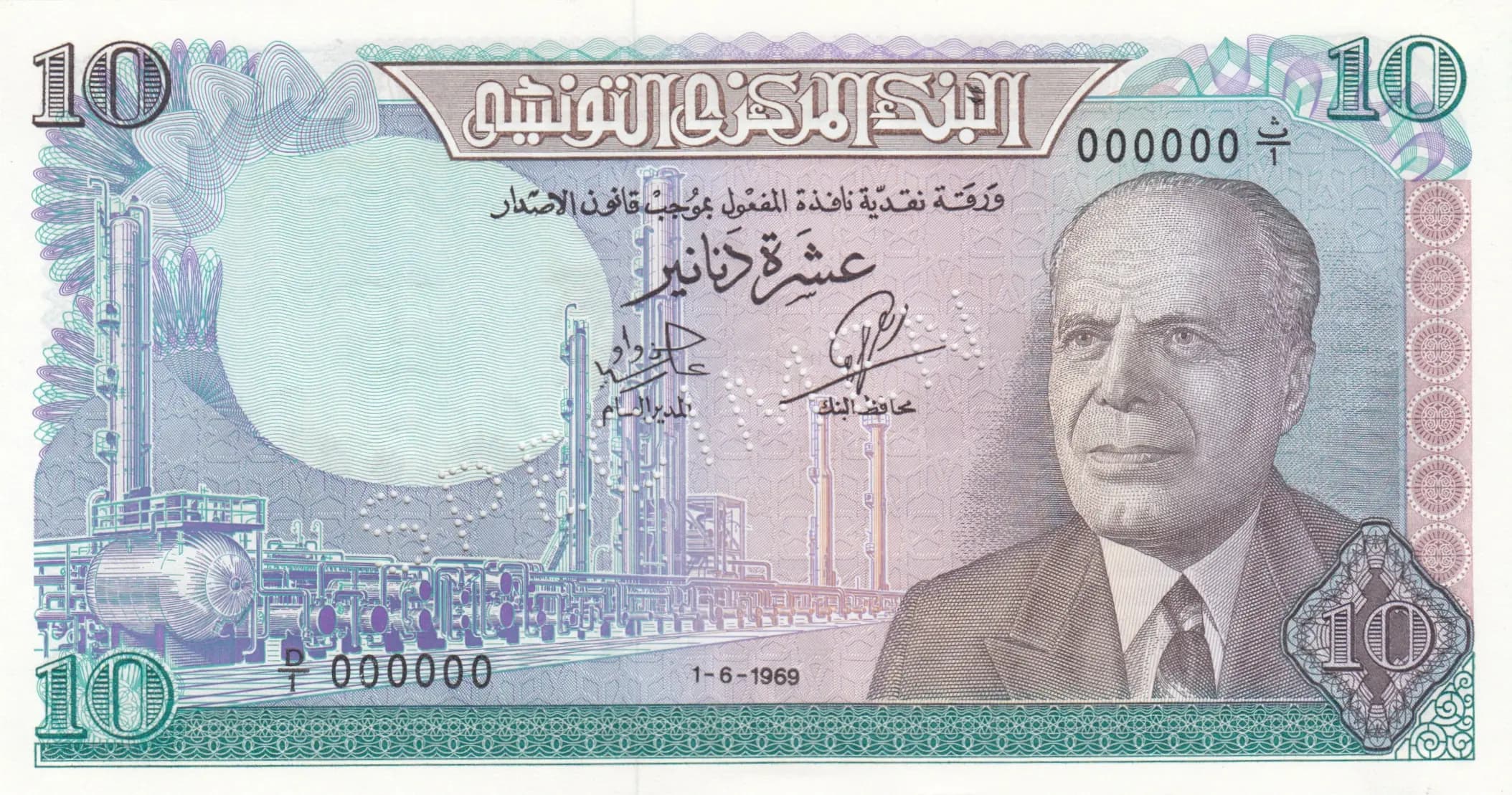
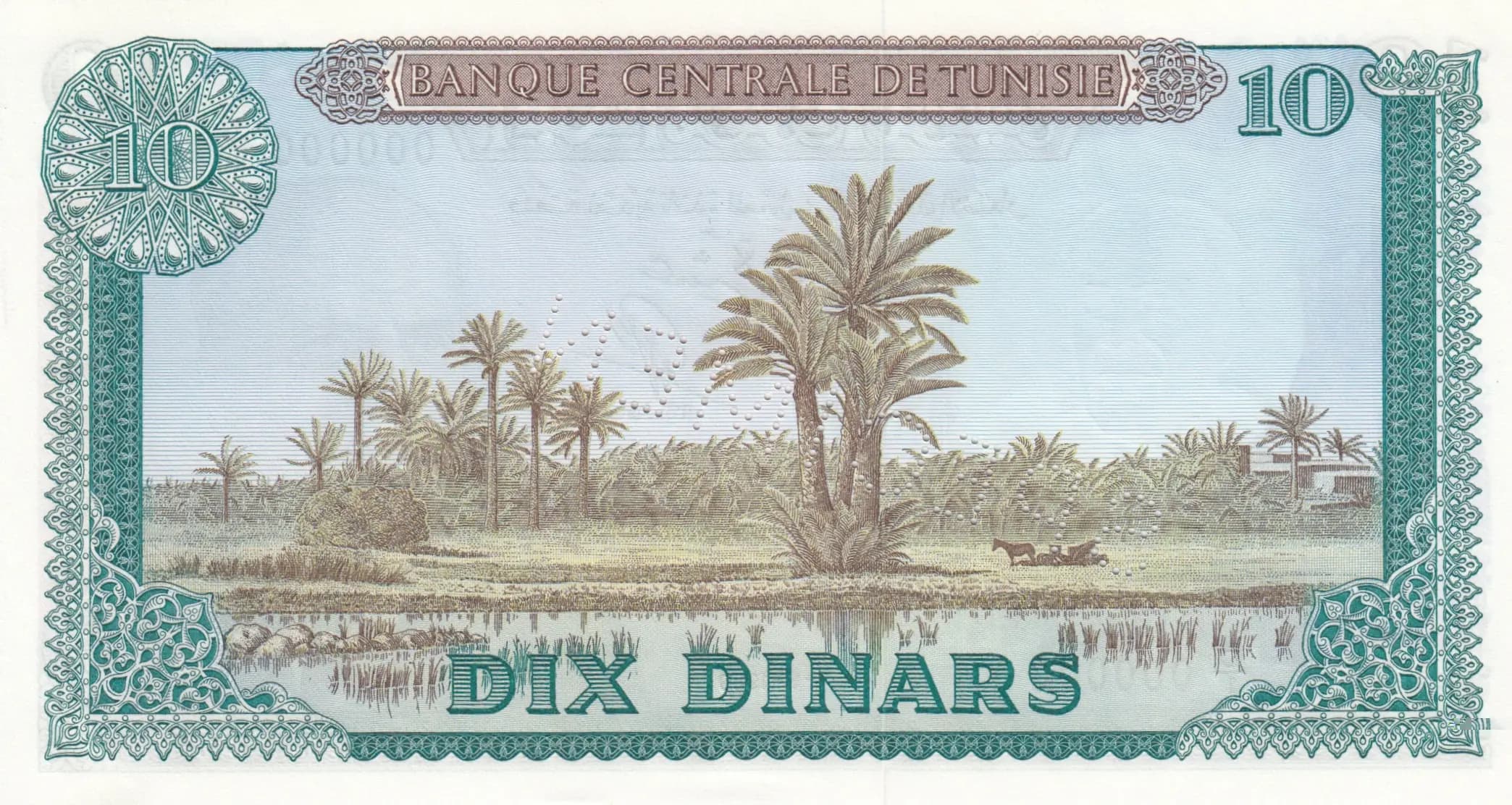
This is a 1969 Tunisian 10 dinars specimen note in uncirculated condition, featuring President Habib Bourguiba's portrait on the obverse alongside an industrial refinery complex symbolizing Tunisia's modernization. The reverse displays a pastoral landscape with palm trees and agricultural fields, reflecting the nation's rural heritage. As a specimen note with serial number 000000, this is a special printing issued for official banking and archival purposes, making it a desirable item for collectors of African currency and mid-century banknote design.
Common. The eBay price tracking data shows wide distribution of UNC examples ranging from $9.99 to $312.43, with an average around $75-100 for uncirculated specimens. The 2019 catalogue value of $100 USD and the multiple UNC sales listings at modest prices indicate this specimen note, while not mass-circulated, was produced in sufficient quantities for regular collector availability. Specimen notes of this era from African central banks were typically preserved in quantity for official and institutional purposes, making them accessible to modern collectors. The broad price range reflects typical market variation rather than extreme scarcity.
Issued on June 1, 1969, this banknote reflects Tunisia's post-independence economic development under President Habib Bourguiba's leadership. The prominent depiction of an industrial refinery on the obverse symbolizes the nation's pivot toward modernization and petroleum-based industry, while the reverse's pastoral landscape with palm trees anchors the design in Tunisia's agricultural traditions and North African identity. This period marked Tunisia's efforts to balance rapid industrialization with preservation of its cultural and economic roots.
The obverse features a formal portrait of President Habib Bourguiba positioned on the right side in a business suit and tie, representing political authority and modernization. The left side displays a detailed industrial petrochemical refinery complex with multiple towers, pipes, and processing equipment, symbolizing Tunisia's industrial development and economic aspirations of the 1960s. The reverse depicts a tranquil rural landscape with prominent palm trees, agricultural fields, an irrigation waterway or canal, and scattered settlements in the background, emphasizing Tunisia's agricultural heritage and natural wealth. Both sides employ ornate decorative geometric medallions in corners and intricate lace-like border patterns, with the note executed in complementary color schemes: purple-pink and teal on the obverse, teal-green and tan-beige on the reverse.
FRONT SIDE: 'البنك المركزي التونسي' (Central Bank of Tunisia), '10' (denomination), '000000' (specimen serial number), 'عشرة دنانير' (Ten dinars), '1-6-1969' (Issue date: June 1, 1969), 'ورقة نقدية بإصدار بنك التنمية والادخار' (Banknote issued by the Development and Savings Bank). BACK SIDE: 'BANQUE CENTRALE DE TUNISIE' (Central Bank of Tunisia in French), '10' (denomination), 'DIX DINARS' (Ten dinars in French).
Intaglio engraving (recess printing) combined with multicolor offset lithography. The banknote exhibits characteristics typical of high-security currency production of the era: complex guilloche patterns, fine line work, multiple color layers, and intricate geometric security patterns. The sharp definition of the portrait, refinery details, and landscape elements indicates professional banknote engraving. This note was produced by Banque Centrale de Tunisie; specific security printer attribution would require archival research, though major European security printers were commonly engaged for African currency production during this period.
This note is catalogued as Pick P-65s, indicating it is a specimen issue (denoted by the 's' suffix). The visual analysis confirms the specimen designation through the 000000 serial number, which is standard for specimen notes. The PMG population report indicates P-65a as a variant, suggesting there may be additional varieties within this Pick number based on signature combinations, signature dates, or subtle printing differences. Without additional signature or serial number data visible in the current images, specific variety identification beyond the specimen designation cannot be determined. Collectors should verify signature combinations and any security features for precise variety classification.