1/2 dinar 1972 specimen
Market Prices
1 saleAbout This Note
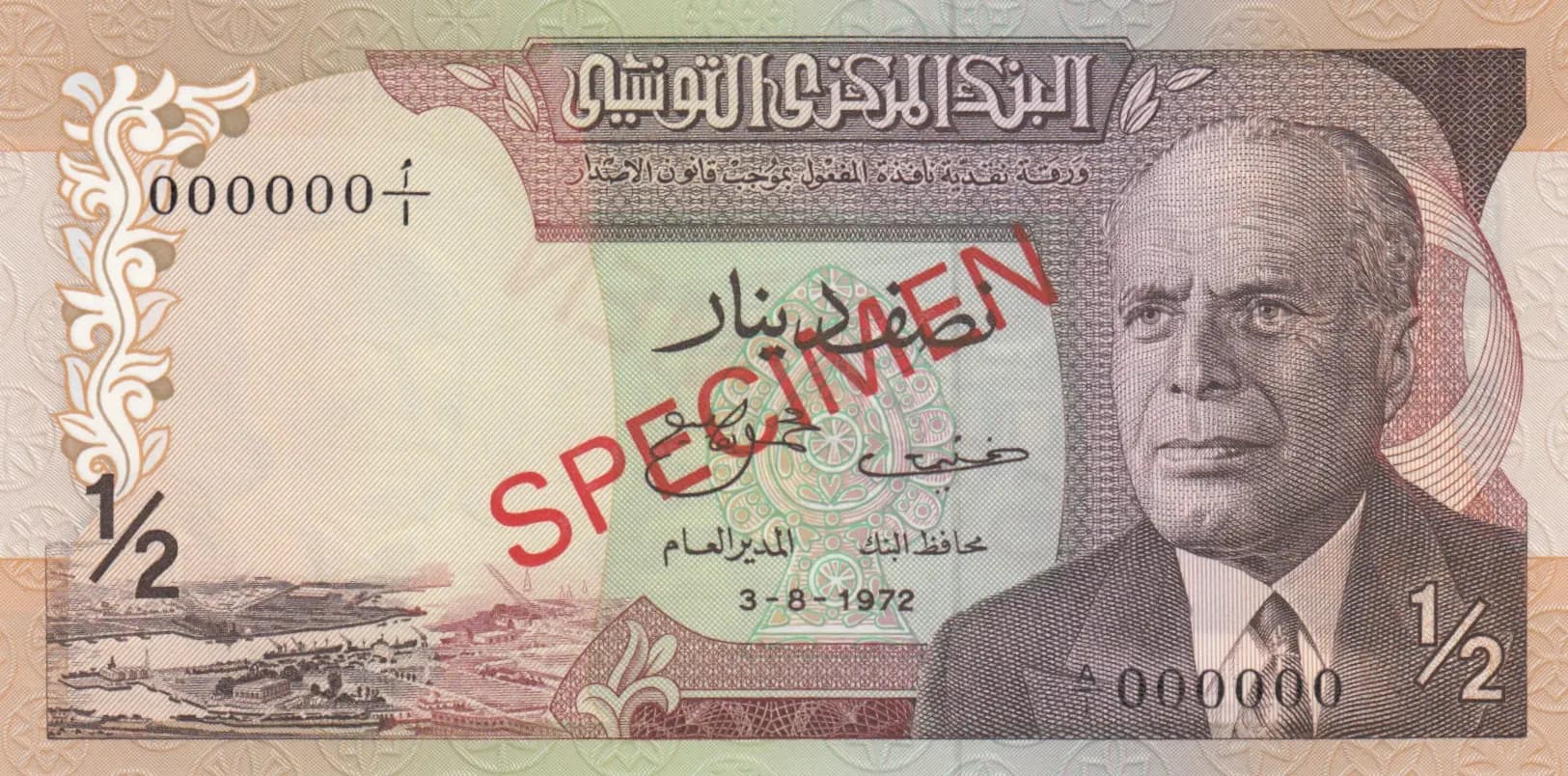
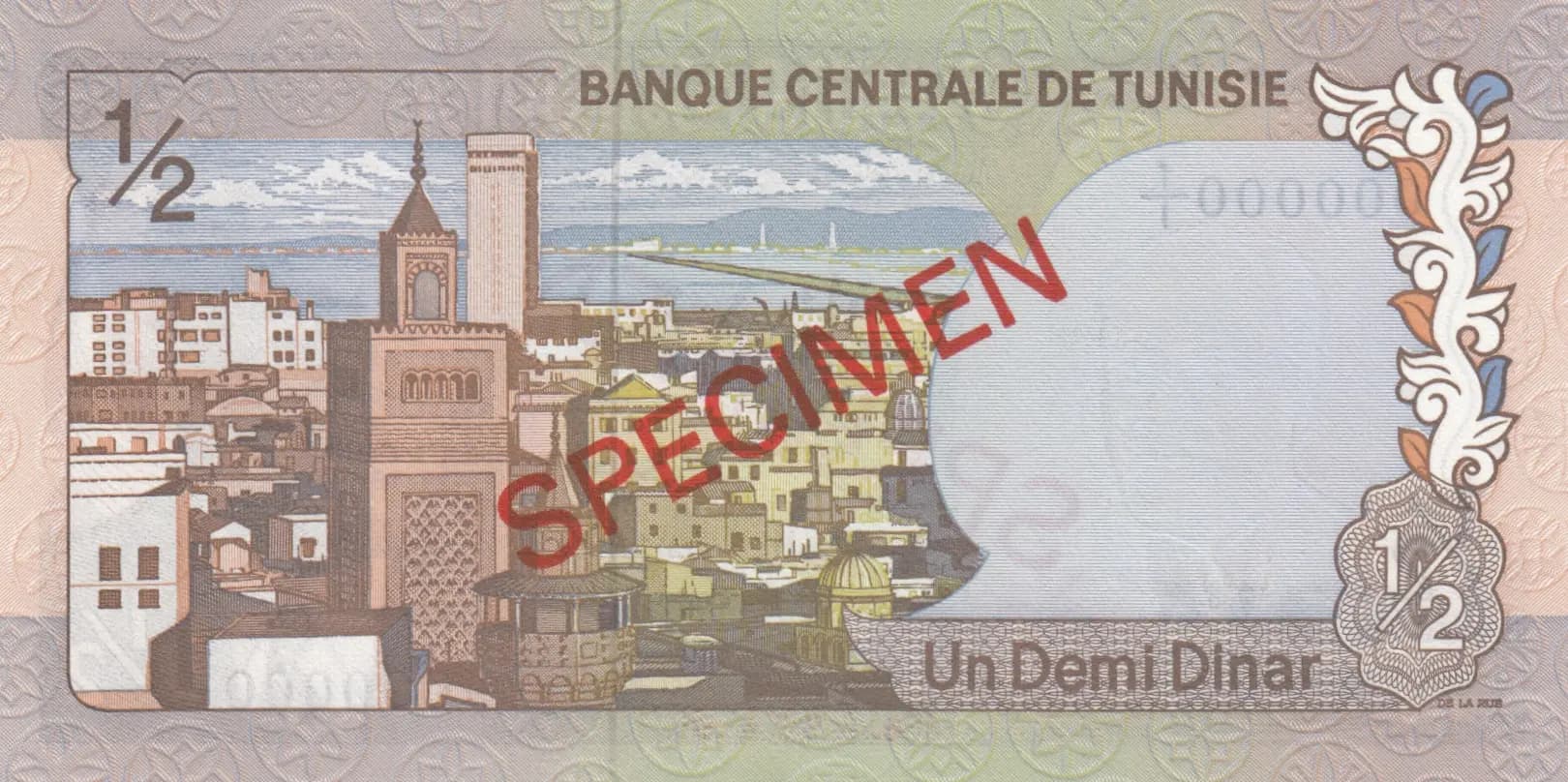
This is a pristine 1972 specimen note from the Banque Centrale de Tunisie, notable for its exceptional UNC condition and complete specimen markings. The obverse features President Habib Bourguiba in formal profile against a cream and burgundy palette, with a harbor scene visible in the lower left, while the reverse depicts the iconic minaret and cityscape of Tunis with Islamic architectural elements. As a specimen issue with the characteristic diagonal SPECIMEN overprint and zero serial numbers, this note represents an important issue from Tunisia's early post-independence banking period and is highly sought by collectors of North African currency.
Common. While specimen notes are less frequently encountered in circulation than regular issues, this 1972 Tunisian half dinar appears in multiple PMG census variants (P-66a* and P-66s), indicating meaningful production for both regular and specimen releases. Catalog values from 2019 place UNC examples at approximately $40, and recent eBay market data shows PMG 63 examples selling in the $350-$385 range, suggesting solid collector demand but not scarcity. The note represents standard production from a major note printer during a stable period of the Banque Centrale de Tunisie's operations, with no evidence of limited print runs or recall.
Issued on August 3, 1972, during Habib Bourguiba's presidency when he served as both president and prime minister of Tunisia, this note reflects the nation's consolidation of economic sovereignty following independence in 1956. The depiction of Bourguiba on the obverse celebrates his role as the architect of modern Tunisia, while the reverse's detailed rendering of Tunis—featuring the minaret and Mediterranean cityscape—emphasizes the capital as the cultural and administrative heart of the nation. The dual French and Arabic inscriptions reflect Tunisia's bilingual character during this transitional period in North African postcolonial development.
The obverse presents Habib Bourguiba, Tunisia's first president and principal architect of the modern nation-state, depicted in right-facing profile wearing a formal business suit and tie against an ornate cream and burgundy background. A coastal harbor view of Tunis appears in the lower left, rendered in green tones with detailed architectural elements representing the Mediterranean character of the capital. The reverse features a prominent Islamic minaret tower alongside modern residential and administrative buildings of Tunis, set against a cream background with brown, blue, and gold-toned architectural details. Both sides display extensive ornamental borders with floral and geometric patterns characteristic of De la Rue's sophisticated security printing. The specimen marking appears diagonally across both sides, and zero serial numbers indicate this is an official specimen not intended for circulation.
FRONT: 'البنك الركزالتونسي' (Banque Centrale de Tunisie / Central Bank of Tunisia) - Arabic; 'حافظ بورقيبة' (Habib Bourguiba) - Arabic; '3-8-1972' (Date: August 3, 1972); '1/2' (Half dinar denomination); 'SPECIMEN' (English specimen designation); '000000' (specimen serial number placeholder). BACK: 'BANQUE CENTRALE DE TUNISIE' (Central Bank of Tunisia - French); 'Un Demi Dinar' (One Half Dinar - French); '1/2' (Half denomination); 'SPECIMEN' (English specimen designation).
Intaglio engraving and multicolor offset lithography, executed by De la Rue, London (indicated by printer mark TDLR). The note demonstrates the hallmarks of De la Rue's mid-20th century banknote production: intricate microprint patterns in background areas, fine line engraving throughout the design, ornamental security borders, and sophisticated multicolor underprinting creating visual depth and security against counterfeiting. The sharp rendering of both portraiture and architectural detail reflects the high standards of security printing employed for central bank currency.
This note is catalogued as Pick P-66s, the specimen variety of the 1/2 dinar 1972 issue. The 's' designation indicates specimen overprinting, zero serial numbers, and official specimen marking. PMG records show a known variant P-66a* exists (likely representing regular circulation notes with actual serial numbers). The printer identification 'TDLR' (De la Rue, London) is visible in the lower right, confirming the London production site. The specimen designation and complete specimen formatting (diagonal SPECIMEN overprint, zero serial numbers) distinguish this from the regular circulation variety P-66a.